Diabetes Insipidus
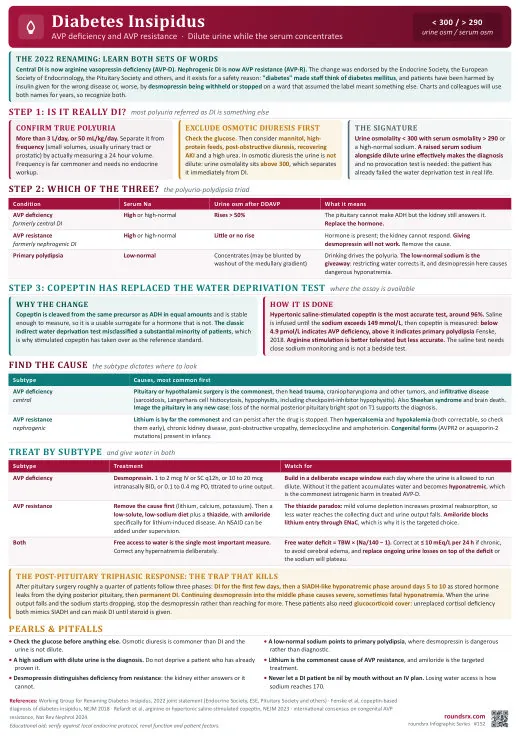
Diabetes insipidus (DI) is the inability to concentrate urine, causing massive free water loss. Two types: Central DI -deficient ADH production from posterior pituitary (post-pituitary surgery #1, head trauma, tumors, idiopathic, Sheehan syndrome). Nephrogenic DI -kidneys resistant to ADH (lithium #1 cause, hypercalcemia, hypokalemia, tubulointerstitial disease, medications). Key features: polyuria > 3L/day (can exceed 15-20L), dilute urine (osm < 300), hypernatremia if free water access is restricted. Triphasic response post-pituitary surgery: DI (days 1-5) → SIADH (days 5-10, transient ADH release from dying neurons) → permanent DI (if > 80% of ADH neurons destroyed). This is a dangerous pattern -the SIADH phase can cause fatal hyponatremia if you're giving DDAVP for the initial DI phase.
- Serum Na⁺ + serum osmolality -Na usually > 145, osm > 295. If patient has free water access, Na may be normal (compensated by polydipsia).
- Urine osmolality + urine specific gravity -Uosm < 300 mOsm/kg (often < 100) in the presence of elevated serum osm = inappropriately dilute = DI. Sp. gravity < 1.005.
- 24-hour urine volume -> 3L/day (often 5-15L). UOP > 250 mL/hr should prompt immediate evaluation.
- Water deprivation test -gold standard for diagnosis (rarely needed in obvious cases). [Miller et al., 1970 Withhold fluids, monitor urine osm and body weight. In DI, urine remains dilute despite rising serum osm. Then give DDAVP 2 mcg IV: if Uosm rises > 50% → central DI (responds to exogenous ADH). If no response → nephrogenic DI.
- Copeptin level -newer test, co-secreted with ADH. Low copeptin + hyperosmolality = central DI. Fenske et al., 2018
- MRI pituitary -if central DI suspected. Look for absent posterior pituitary bright spot (normal T1 hyperintensity from ADH-containing vesicles).
- Calcium + potassium -hypercalcemia and hypokalemia cause nephrogenic DI
- Lithium level -most common drug cause of nephrogenic DI (40% of chronic lithium users develop some concentrating defect)
- Medication review -lithium, amphotericin B, foscarnet, demeclocycline, cidofovir
- Central DI:
- Desmopressin (DDAVP) -10-40 mcg daily intranasal, 0.1-0.4 mg BID PO, or 1-4 mcg q12h IV. Selective V2 agonist, so unlike vasopressin it has no vasopressor effect and will not raise blood pressure or cause splanchnic ischemia.
- Titrate to the lowest dose that controls thirst and nocturia, and allow a period of breakthrough polyuria before each dose. Continuous full antidiuresis in a patient who keeps drinking is what causes iatrogenic hyponatremia.
- Let the patient drink to thirst -an intact thirst mechanism protects the sodium far better than any dosing schedule. The dangerous patient is the one who cannot drink (intubated, obtunded, adipsic), who needs measured free water replacement instead.
- Find the cause -pituitary MRI, and check the other pituitary axes. Isolated central DI is uncommon, and a missed cortisol deficiency can mask DI until steroids are replaced and the polyuria suddenly appears.
- Monitor Na⁺ at least daily while titrating (q4-6h in the acute post-operative setting) -both under- and over-treatment show up in the sodium before the patient reports symptoms.
- Nephrogenic DI:
- Remove cause -stop lithium (if possible), correct hypercalcemia, correct hypokalemia
- Thiazide diuretics (paradoxical effect) -hydrochlorothiazide 25 mg daily. Causes mild volume depletion → increased proximal Na⁺/H₂O reabsorption → less water delivered to collecting duct → reduced urine volume. Counterintuitive but effective.
- Amiloride 5-10 mg daily -specifically for lithium-induced NDI. Blocks lithium entry through ENaC in collecting duct.
- Low-sodium, low-protein diet -reduces solute load → reduces obligatory urine volume
- NSAIDs (indomethacin) -reduce prostaglandin-mediated antagonism of ADH. Adjunct, not first-line.
- ICU management of acute DI: D5W or free water via NG tube. Match UOP with replacement (mL for mL replacement initially). DDAVP 1-2 mcg IV q12h. BMP q4-6h.
| Drug | Dose | Route | Notes |
|---|---|---|---|
| DDAVP (desmopressin) | 10-40 mcg daily (nasal); 0.1-0.4 mg BID (PO); 1-4 mcg q12h (IV) | IN/PO/IV | Central DI treatment. V2 receptor agonist. No vasopressor effect (unlike native ADH). Risk: hyponatremia from overcorrection. |
| Hydrochlorothiazide (Microzide) | 25 mg daily | PO | Nephrogenic DI. Paradoxical antidiuresis via proximal volume depletion. Monitor K⁺. |
| Amiloride | 5-10 mg daily | PO | Lithium-induced NDI specifically. Blocks ENaC → blocks lithium entry into principal cells. |
| Indomethacin | 25-50 mg TID | PO | Adjunct for NDI. Reduces prostaglandin antagonism of ADH. GI/renal side effects. |
| D5W | Per free water deficit | IV | Free water replacement. Replace 50% of deficit in first 24h. Limit Na correction ≤ 10-12 mEq/24h. |
Mr. Ahmed is a 45-year-old man, post-op day 2 from transsphenoidal resection of pituitary macroadenoma. Overnight UOP 4.2L in 8 hours (525 mL/hr). Clear, dilute urine. Na 152 (was 139 pre-op), serum osm 312, urine osm 89, urine SG 1.002. Patient reports extreme thirst.
- Urine output hourly -in ICU/acute DI. UOP > 250 mL/hr = uncontrolled DI → needs DDAVP or more free water.
- Serum Na⁺ q4-6h -target decline ≤ 10-12 mEq/24h in chronic hypernatremia. Faster correction → cerebral edema.
- Urine osmolality -rising Uosm on DDAVP confirms central DI and response to therapy.
- Daily weights + strict I&Os -fluid balance critical
- Post-pituitary surgery: UOP + Na q4-6h × 72h minimum. Watch for triphasic response -DI phase (days 1-5) may transition to SIADH (days 5-10). Stop DDAVP if UOP drops and Na falls.
- Lithium level -if continuing lithium with amiloride, monitor both