Diabetic Foot Infection
- 15–25% of diabetics develop a foot ulcer in their lifetime; ~50% of those ulcers become infected
- Diabetic foot infections (DFI) are the leading cause of non-traumatic lower-extremity amputation
- Annual incidence: ~6% in patients with neuropathy; 5-year mortality after major amputation approaches 50%
- Most infections are polymicrobial -gram-positives (Staph, Strep) dominate mild cases; gram-negatives and anaerobes join in moderate-severe
| IDSA Grade | Severity | Clinical Features | Setting |
|---|---|---|---|
| 1 | Uninfected | Wound without purulence or signs of inflammation | Wound care only, offloading |
| 2 | Mild | Erythema < 2 cm from wound edge, superficial (skin/subcutaneous only), no systemic signs | Outpatient oral antibiotics |
| 3 | Moderate | Erythema > 2 cm, deep tissue involvement (abscess, fascia, muscle, bone, joint), no SIRS | Inpatient IV antibiotics ± surgery |
| 4 | Severe | Any foot infection with SIRS/sepsis, limb-threatening ischemia, or necrotizing features | ICU, emergent surgery, broad-spectrum IV |
IDSA DFI Guidelines, 2012 -classification drives antibiotic selection, setting of care, and need for surgical intervention.
| Grade | Description |
|---|---|
| 0 | Intact skin, bony deformity (at-risk foot) |
| 1 | Superficial ulcer |
| 2 | Deep ulcer to tendon, capsule, or bone (no abscess/osteo) |
| 3 | Deep ulcer with abscess, osteomyelitis, or joint sepsis |
| 4 | Localized gangrene (forefoot or heel) |
| 5 | Extensive gangrene (entire foot) |
- Non-limb-threatening: Superficial infection, erythema < 2 cm, no deep tissue involvement, intact vasculature, no systemic signs → outpatient management with close follow-up
- Probe-to-bone test positive -sterile blunt probe contacts bone through ulcer → positive LR ~6 for osteomyelitis (PPV ~89% in high-prevalence population)
- Ulcer > 2 cm in diameter or > 3 mm deep
- ESR > 70 mm/hr (specificity ~90% for osteomyelitis in DFI setting)
- Visible bone or palpable bone at wound base
- "Sausage toe" (diffuse swelling of a single digit)
- Non-healing ulcer despite 6 weeks of appropriate wound care and offloading
- Mild / acute: Gram-positive cocci dominate -S. aureus (including MRSA), Streptococcus spp.
- Moderate-severe / chronic: Polymicrobial -add gram-negatives (E. coli, Proteus, Klebsiella) and anaerobes (Bacteroides, Peptostreptococcus)
- MRSA risk factors: Prior MRSA, recent hospitalization, hemodialysis, prior antibiotics, nasal colonization
- Pseudomonas risk: Water exposure, failed prior therapy, warm/tropical climate
- Probe-to-bone test -do on EVERY diabetic foot wound. Insert sterile blunt metal probe into wound. If you touch hard, gritty surface → positive (PPV ~89%). Simple, bedside, takes 10 seconds.
- Measure erythema -mark borders with skin marker, measure from wound edge. < 2 cm = mild, > 2 cm = moderate.
- Assess depth -superficial (skin/subcut only) vs deep (fascia, muscle, tendon, bone, joint)
- Pedal pulses -dorsalis pedis and posterior tibial. Absent/diminished → order ABI
- Monofilament test -10g monofilament to assess neuropathy at plantar sites
- CBC -leukocytosis (may be absent in immunocompromised diabetics)
- BMP -renal function (impacts antibiotic dosing), glucose
- CRP -sensitive but nonspecific; useful for trending treatment response
- ESR -> 70 mm/hr has ~90% specificity for osteomyelitis in DFI
- HbA1c -chronic glycemic control (target < 7% for wound healing)
- Wound culture -deep tissue biopsy or curettage >>> surface swab. Surface swabs grow colonizers, not pathogens. Obtain AFTER debridement of necrotic tissue.
- Blood cultures × 2 -draw before starting antibiotics. Positive in ~15% of moderate-severe DFI.
- Procalcitonin -helps distinguish systemic infection from localized; useful for monitoring treatment response
- Lactate -if concern for sepsis
- Coags -if surgical intervention planned
| Modality | When to Order | Key Findings | Limitations |
|---|---|---|---|
| X-ray (plain film) | First-line, all patients | Soft tissue gas, foreign body, cortical erosion, periosteal reaction | Osteomyelitis changes take 10-14 days to appear; sensitivity only ~55% |
| MRI | Gold standard for osteomyelitis | Bone marrow edema, rim enhancement, soft tissue extent | Sensitivity ~90%, specificity ~80%. Charcot arthropathy can mimic osteo. |
| WBC-labeled scan | When MRI contraindicated | Focal uptake in bone = osteomyelitis | Lower resolution; paired with sulfur colloid scan for specificity |
- ABI (ankle-brachial index) -first-line. ABI < 0.9 = PAD. ABI < 0.5 = critical limb ischemia. Caution: ABI may be falsely elevated (> 1.3) in diabetics due to medial artery calcification.
- TBI (toe-brachial index) -more reliable in diabetics (toe arteries less prone to calcification). TBI < 0.7 = PAD, TBI < 0.4 = unlikely to heal without revascularization.
- Arterial duplex ultrasound -anatomic localization of stenosis/occlusion if revascularization considered
- CTA/MRA -pre-surgical planning for revascularization
- Podiatry -wound care, debridement, offloading strategies, custom orthotics
- Vascular surgery -if ABI/TBI abnormal or absent pedal pulses → revascularization evaluation
- Orthopedics/Plastics -if deep tissue debridement needed, bone resection for osteomyelitis, or soft tissue reconstruction
- Infectious disease -moderate-severe infections, osteomyelitis, MRSA/MDR organisms, treatment failures
- Endocrinology -if HbA1c > 9% or uncontrolled glycemia
- Oral antibiotics targeting gram-positives (Staph, Strep)
- Amoxicillin-Clavulanate (Augmentin) 875/125 mg PO BID -covers MSSA, Strep, anaerobes
- If MRSA risk: TMP-SMX (Bactrim) DS BID + Cephalexin (Keflex) 500 mg QID (TMP-SMX alone has gaps in Strep coverage)
- Wound care: sharp debridement of necrotic tissue, moist wound environment
- Offloading: non-weight-bearing or therapeutic footwear
- Follow-up in 48-72 hours to assess response. If worsening or no improvement → escalate to inpatient.
- Duration: 1-2 weeks
- Hospitalize for IV antibiotics, surgical evaluation, vascular assessment
- Ampicillin-Sulbactam (Unasyn) 3g IV q6h -covers gram-positives, gram-negatives, anaerobes
- OR Piperacillin-Tazobactam (Zosyn) 3.375g IV q6h if Pseudomonas risk (water exposure, failed prior therapy)
- Add Vancomycin (Vancocin) if MRSA risk factors present
- Surgical evaluation: debridement, I&D of abscesses, bone biopsy if osteomyelitis suspected
- Vascular assessment: ABI/TBI → vascular surgery consult if abnormal
- IV-to-oral step-down when clinically improving, adequate source control, and susceptibilities known OVIVA, 2019
- Duration: 2-3 weeks (soft tissue only); 6 weeks if osteomyelitis
- Urgent surgical debridement -do not delay for imaging
- Broad-spectrum IV: Vancomycin (Vancocin) + Piperacillin-Tazobactam (Zosyn) 4.5g IV q6h
- OR Vancomycin (Vancocin) + Meropenem (Merrem) 1g IV q8h if MDR risk
- ICU admission if septic (hemodynamic instability, organ dysfunction)
- Blood cultures, lactate, aggressive fluid resuscitation
- Amputation may be limb- or life-saving in extensive gangrene or necrotizing infection
- Duration: 2-4 weeks (adjust based on surgical margins and response)
- Medical (antibiotics alone): 6 weeks total duration. Consider if no surgical indication (stable bone, no abscess, no dead bone).
- Surgical resection + antibiotics: If bone is resected with clean margins, duration can be shortened to 2-4 weeks post-resection IDSA DFI Guidelines, 2012
- Bone biopsy -gold standard for diagnosis AND culture-guided therapy. Surface swab does NOT correlate with bone pathogens.
- IV-to-oral switch -acceptable once clinically stable with identified organism and susceptibility-guided oral agent with good bone penetration (fluoroquinolones, TMP-SMX, linezolid, doxycycline) OVIVA, 2019
- Debridement -sharp debridement of all necrotic, callous, and nonviable tissue. Repeat as needed.
- Offloading -total contact cast (TCC) is gold standard for plantar ulcers. Alternatives: removable cast walkers, therapeutic shoes. Non-weight-bearing if possible.
- Moist wound healing -appropriate dressings (foam, alginate, hydrogel) to maintain moisture without maceration
- Glycemic control -target glucose < 180 mg/dL during acute infection. Long-term HbA1c < 7% for optimal healing.
- Nutrition -correct protein-calorie malnutrition. Consider wound healing supplements (zinc, vitamin C). Note: albumin/prealbumin reflect inflammation, not nutritional status (ASPEN, 2021).
- Revascularization if ABI < 0.5 or TBI < 0.4 -wound will not heal without adequate perfusion
- Options: angioplasty/stenting (endovascular) or bypass grafting (surgical)
- Timing: revascularize early -do not wait for antibiotic course to fail before addressing ischemia
- Multidisciplinary approach: vascular surgery + ID + podiatry = best outcomes
| Severity | Empiric Regimen | Organisms Covered | Duration | Key Notes |
|---|---|---|---|---|
| Mild | Amoxicillin-Clavulanate (Augmentin) 875/125 PO BID | MSSA, Strep, anaerobes | 1–2 weeks | First-line for most mild DFI without MRSA risk |
| Mild + MRSA risk | TMP-SMX (Bactrim) DS BID + Cephalexin (Keflex) 500 mg QID | MRSA, MSSA, Strep | 1–2 weeks | TMP-SMX alone has Strep gap -add cephalexin |
| Moderate | Ampicillin-Sulbactam (Unasyn) 3g IV q6h | Gram-pos, gram-neg, anaerobes | 2–3 weeks | Workhorse for moderate DFI. Add vanco if MRSA risk. |
| Moderate (Pseudomonas risk) | Piperacillin-Tazobactam (Zosyn) 3.375g IV q6h ± Vancomycin (Vancocin) | Broad including Pseudomonas, MRSA | 2–3 weeks | Water exposure, failed prior therapy, tropical climate |
| Severe | Vancomycin (Vancocin) + Piperacillin-Tazobactam (Zosyn) 4.5g IV q6h | MRSA, Pseudomonas, GNR, anaerobes | 2–4 weeks | Escalate to meropenem if MDR risk |
| Severe (MDR risk) | Vancomycin (Vancocin) + Meropenem (Merrem) 1g IV q8h | MRSA, ESBL, Pseudomonas, anaerobes | 2–4 weeks | Reserve for MDR, prior broad abx exposure, nosocomial |
| Osteomyelitis | Guided by bone culture | Culture-directed | 6 weeks (or 2–4 wks post-resection) | IV-to-oral switch acceptable OVIVA, 2019 |
| Drug | Dose | Route | Key Notes |
|---|---|---|---|
| Vancomycin (Vancocin) | 15–20 mg/kg IV q8–12h (target AUC/MIC 400-600) | IV | First-line IV MRSA agent. Monitor troughs or AUC. Nephrotoxic. |
| Daptomycin (Cubicin) | 6–8 mg/kg IV daily | IV | Alternative to vancomycin. Check weekly CPK. Inactivated by surfactant -do not use for pneumonia. |
| Linezolid (Zyvox) | 600 mg PO/IV q12h | PO/IV | 100% oral bioavailability. Good bone penetration. Limit to 2 weeks if possible (serotonin syndrome, myelosuppression, lactic acidosis with prolonged use). |
| TMP-SMX (Bactrim) | DS 1-2 tabs PO BID | PO | Good MRSA coverage. Add cephalexin for Strep gap. Good bone penetration. |
| Doxycycline | 100 mg PO BID | PO | Alternative oral MRSA option. Good soft tissue penetration. |
- Ertapenem (Invanz) 1g IV daily -once-daily, covers gram-pos + gram-neg + anaerobes. NO Pseudomonas coverage. Excellent for moderate DFI OPAT. SIDESTEP, 2005
- Daptomycin (Cubicin) 6 mg/kg IV daily -once-daily MRSA option for OPAT
- Ceftriaxone (Rocephin) 2g IV daily + Metronidazole (Flagyl) 500 mg PO TID -alternative once-daily IV backbone
| Infection Type | Duration | Notes |
|---|---|---|
| Mild soft tissue | 1–2 weeks | Outpatient oral. Reassess at 48–72h. |
| Moderate soft tissue | 2–3 weeks | IV → oral step-down when improving |
| Severe soft tissue | 2–4 weeks | Based on response, source control adequacy |
| Osteomyelitis (no surgery) | 6 weeks | Culture-guided. IV-to-oral switch acceptable. |
| Osteomyelitis (post-resection, clean margins) | 2–4 weeks | Shortened if bone resected with no residual infected bone |
| Post-amputation (clean margins) | 2–5 days | Prophylactic only if margins clear. Longer if margins positive. |
Patient: 62M with T2DM (A1c 9.8%), presents with left foot ulcer between 4th and 5th toes, purulent drainage, erythema extending 3 cm from wound edge, no fever, WBC 11.2.
Bedside assessment:
- Probe-to-bone test: sterile probe contacts hard, gritty surface → POSITIVE (PPV ~89%).
- Erythema 3 cm → moderate infection (IDSA grade 3).
- Pedal pulses: dorsalis pedis faint, posterior tibial absent → order ABI.
Workup: ESR 82 (> 70 → high specificity for osteo). X-ray: cortical erosion 5th metatarsal head. MRI: bone marrow edema with rim enhancement → confirms osteomyelitis. ABI 0.6 → significant PAD.
Management:
- Admit. Ampicillin-Sulbactam (Unasyn) 3g IV q6h + Vancomycin (Vancocin) (MRSA risk)
- Surgical consult: debridement + deep bone biopsy for culture (NOT surface swab)
- Vascular surgery consult: ABI 0.6 → may need revascularization for wound healing
- 6 weeks antibiotics for osteomyelitis, guided by bone culture. IV-to-oral switch acceptable OVIVA, 2019
- Glucose control: target < 180 during acute infection
Teaching point: The triad for DFI success = antibiotics + surgical debridement + vascular assessment. Missing any one → treatment failure.
Patient: 71F with T2DM, CKD3, presents with foul-smelling left foot wound, crepitus on palpation, T 39.4°C, HR 118, BP 88/52, WBC 24k, lactate 4.1.
Key findings: Wet gangrene of 1st and 2nd toes with gas on palpation. Absent pedal pulses bilaterally. SIRS/sepsis criteria met → IDSA grade 4 (severe).
Management:
- Fluid resuscitation: 30 mL/kg LR. Blood cultures × 2.
- Vancomycin (Vancocin) + Meropenem (Merrem) 1g IV q8h (broad coverage including MRSA, Pseudomonas, anaerobes)
- Emergent surgical consult: debridement vs partial amputation. Do NOT delay surgery for imaging.
- X-ray confirms gas in soft tissue → surgical emergency.
- Vascular assessment post-stabilization: CTA to evaluate for revascularization potential.
Teaching point: Gas gangrene / necrotizing infection in a diabetic foot is a surgical emergency. Antibiotics are adjunctive -the scalpel is the definitive treatment. Amputation may be life-saving.
Patient: 55M with well-controlled T2DM (A1c 6.9%), presents with plantar ulcer under 2nd metatarsal head, mild surrounding erythema (1.5 cm from wound edge), no purulence, no systemic signs. Pedal pulses 2+ bilaterally.
Assessment: IDSA grade 2 (mild). Probe-to-bone negative. ABI 1.0 (normal vasculature). X-ray: no bony changes.
Management:
- Amoxicillin-Clavulanate (Augmentin) 875/125 PO BID × 2 weeks
- Sharp debridement of wound edges, moist dressing changes daily
- Offloading: removable cast walker, strictly non-weight-bearing to affected foot
- Follow-up in 48-72 hours: mark erythema borders to track progression
- Diabetes education: daily foot checks, proper footwear, glucose control
Teaching point: Not every DFI needs hospitalization. Mild infections with intact vasculature, no deep tissue involvement, and no systemic signs can be safely managed outpatient with close follow-up. The key is reliable follow-up at 48-72h to confirm response.
- Wound assessment → Erythema improving or expanding? Mark borders daily. Any new drainage, crepitus, or necrosis?
- Cultures finalized? → Narrow antibiotics when sensitivities return. What day of antibiotics are we on?
- Osteomyelitis addressed? → Bone biopsy done? MRI obtained? Surgical plan for resection vs medical management?
- Vascular status → ABI/TBI ordered? Vascular surgery consult? Revascularization plan?
- Glucose control → Target < 180 mg/dL. On insulin drip vs basal-bolus? HbA1c obtained?
- Offloading in place? → Non-weight-bearing? TCC or removable cast walker ordered?
- Inflammatory markers → ESR/CRP trending down? If plateauing, reassess source control and antibiotic adequacy.
- Nutrition → Adequate protein intake for wound healing? Note: albumin/prealbumin reflect inflammation, NOT nutritional status (ASPEN, 2021). Assess nutrition by intake history, weight trend, and physical exam.
- IV-to-oral switch? → Clinically improving + adequate source control + oral agent with good bone penetration available? OVIVA, 2019
- Discharge planning → OPAT if continued IV needed? Podiatry follow-up? Wound care plan? Diabetes education?
| Parameter | Frequency | Target / Action |
|---|---|---|
| Wound assessment | Daily | Mark erythema borders, measure wound size, assess drainage |
| Temperature | q4–8h | Defervescence expected within 48–72h of appropriate therapy |
| WBC / CRP | q48–72h | Trending down = responding. Plateau = reassess source control. |
| ESR | Weekly (osteo) | Slow decline expected. Useful for monitoring 6-week course. |
| Blood glucose | AC/HS or q6h | < 180 mg/dL. Hyperglycemia impairs wound healing + neutrophil function. |
| Vancomycin level | Before 4th dose or per protocol | AUC/MIC 400–600. Troughs 15–20 mcg/mL (traditional). Monitor renal function. |
| Renal function (BMP) | q48–72h on nephrotoxic abx | Vancomycin, aminoglycosides, contrast dye → monitor Cr closely. |
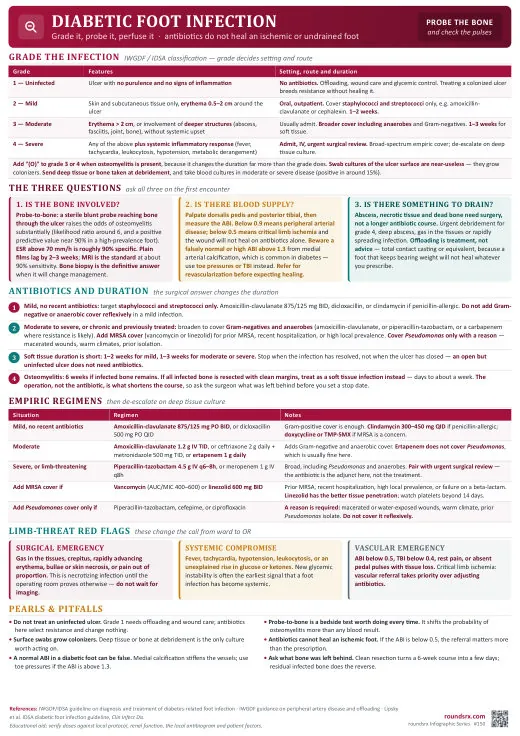
Text version
- Probe-to-bone on every wound (PPV ~89%)
- Deep tissue culture (NOT surface swab)
- X-ray first, MRI for osteo (sens ~90%)
- ESR > 70 = high specificity for osteo
- ABI/TBI for vascular assessment
- CBC, BMP, CRP, HbA1c
- Mild (2): Erythema < 2 cm, superficial
- Moderate (3): Erythema > 2 cm, deep, no SIRS
- Severe (4): SIRS/sepsis, limb-threatening
- Limb-threatening: gas, crepitus, wet gangrene
- Osteomyelitis: probe-to-bone +, ESR > 70
- Mild: 1-2 weeks
- Moderate: 2-3 weeks
- Severe: 2-4 weeks
- Osteo (medical): 6 weeks
- Osteo (post-resection): 2-4 wks
- Surface swab cultures (colonizers!)
- Ignoring vascular assessment
- Falsely elevated ABI (calcification)
- Delaying surgery for imaging
- No offloading plan
- Podiatry: wound care, offloading
- Vascular surgery: if PAD / ischemia
- Ortho/Plastics: debridement, resection
- ID: moderate-severe, osteo, MDR
- OVIVA 2019: Oral non-inferior to IV for bone/joint infections
- SIDESTEP 2005: Ertapenem non-inferior to pip-tazo for DFI
- IDSA 2012: DFI classification and management guidelines