Diabetic Ketoacidosis (DKA)
- Type 1 DM (can be the presenting illness in ~25%)
- Type 2 DM under physiologic stress
- SGLT2-inhibitor users (euglycemic DKA -BG may be < 200!)
- Precipitants: infection (30–40% -most common), insulin omission/non-compliance (20–25%), new diagnosis T1DM, MI/ACS, pancreatitis, cocaine, alcohol
Infection (30–40%, #1 cause -UTI, pneumonia, skin) · Insulin (missed or inadequate doses) · Infarction (MI, stroke, mesenteric ischemia) · Intoxication (cocaine, alcohol, drugs) · Inflammation (pancreatitis, surgery, trauma)
- Polyuria, polydipsia, nausea, vomiting, abdominal pain
- Weakness, fatigue, altered mental status (in severe cases)
- Timeline: hours to days (faster than HHS)
- Kussmaul respirations (deep, rapid -compensating for acidosis)
- Fruity/acetone breath
- Signs of dehydration: dry mucosa, tachycardia, hypotension, poor skin turgor
- Altered mental status → think cerebral edema, severe osmolarity
- Potassium < 3.5 → do NOT start insulin until repleted
- Euglycemic DKA (SGLT2i) -don't miss it
- pH < 7.0 or bicarb < 10 → severe DKA, ICU threshold
- HHS -BG often > 600, severe hypertonicity, no/minimal ketones, pH usually > 7.3
- Alcoholic ketoacidosis -low or normal glucose, ketones present, history of binge drinking + poor PO
- Starvation ketosis -mild, pH > 7.3, bicarb usually > 18
- Other high AG acidosis -lactic acidosis, toxic ingestions (methanol, ethylene glycol, salicylates)
- BMP -BG, creatinine, K⁺, bicarbonate
- VBG or ABG -pH, pCO₂, calculated bicarb
- Anion gap = Na – (Cl + HCO₃) → normal 8–12; in DKA typically > 20
- Beta-hydroxybutyrate (BHB), serum -≥ 3.0 mmol/L is diagnostic for DKA per ADA/EASD 2024. Preferred over urine ketones for both diagnosis AND monitoring resolution.
- Urine ketones (only if serum BHB unavailable; moderate-to-large dipstick ketones is the fallback diagnostic threshold)
- Phosphate, magnesium -often depleted
- CBC, blood cultures -rule out infectious precipitant
- Lipase -DKA can elevate lipase without true pancreatitis
- HbA1c -assess chronic control
- Urinalysis + urine culture
- Pregnancy test (women of childbearing age)
- ECG -assess for hyperkalemia changes (peaked T waves, wide QRS) or ischemia as precipitant
- CXR -rule out pneumonia as precipitant
- CT head only if focal neuro deficits or concern for cerebral edema
- Hyperglycemia: glucose ≥ 200 mg/dL (or known diabetes; not required in euglycemic DKA on SGLT2i)
- Ketosis: BHB ≥ 3.0 mmol/L (preferred) OR moderate-to-large urine ketones
- Acidosis: venous pH < 7.3 OR serum bicarbonate < 18 mEq/L
| Parameter | Mild | Moderate | Severe | vs prior guideline |
|---|---|---|---|---|
| Venous pH | 7.25–7.30 | 7.00–7.24 | < 7.00 | UNCHANGED |
| Bicarb (mEq/L) | 15–18 | 10–<15 | < 10 | CHANGED mild now 15–18 (was 15–18, but resolution threshold raised) |
| Anion gap and mental status were removed from severity grading in 2024. AG is still elevated in DKA but is confounded by hyperchloremic acidosis after NS resuscitation. Altered mental status remains an independent ICU-triage criterion. | ||||
ABCs. IV access × 2. Foley if altered or unable to void. Cardiac monitor. POC glucose. Draw all STAT labs. Call senior if severe (pH < 7.1, AMS, K⁺ < 3.5).
• Unstable / severely volume-depleted: 1-1.5 L isotonic crystalloid bolus over 1 hour (NS OR balanced).
• Stable: skip the bolus -start 250-500 mL/hr maintenance from the outset.
The reflex "2 L for everyone" is out; over-resuscitation is the more common modern error ADA DKA Consensus, 2024
After the first hour, choose by corrected Na⁺ (calculator):
• Corrected Na ≤ 135 → continue 0.9% NS at 250-500 mL/hr
• Corrected Na > 135 → switch to 0.45% NaCl at 250-500 mL/hr
• If using LR: just continue LR throughout and skip the half-NS switch (LR's Na 130 already provides some free water; only switch to 0.45% NaCl if corrected Na > 150).
Goal: replace 3-6 L deficit over 24-48 h (gentler is fine; over-aggressive correction risks cerebral edema, especially in pediatrics -PECARN, 2018).
K⁺ < 3.5 → replace aggressively (20–40 mEq/hr IV), do NOT start insulin yet
K⁺ 3.5–5.0 → add 20–30 mEq K⁺ per liter of IVF, start insulin
K⁺ > 5.0 → start insulin, hold K⁺ replacement, recheck in 2 hours
Insulin Infusion
Regular insulin drip at 0.1 units/kg/hr fixed rate, no bolus required (per ADA/EASD Consensus, 2024). A 0.1 units/kg IV bolus is reserved for a delay in setting up the infusion. Target: BG drop of 50–75 mg/dL/hr.
Add D5 to IV fluids (D5-0.45%NS) -reduce insulin drip to 0.05 units/kg/hr. Continue until the ketosis resolves (BHB < 0.6 mmol/L), NOT just until BG normalizes. This is the most common resident mistake.
- Beta-hydroxybutyrate (BHB) < 0.6 mmol/L
- AND patient tolerating PO / clinically improved
- Venous pH ≥ 7.3 OR serum bicarbonate ≥ 18 mEq/L (either one, not both)
- Where BHB cannot be measured at all, normalization of the anion gap is a reasonable surrogate, but the consensus publishes no numeric gap cutoff -and the gap closes on saline before the ketones are gone, which is why it was demoted.
- pH < 7.0 or bicarb < 10
- Altered mental status / decreased GCS
- Hemodynamic instability not responding to fluids
- K⁺ < 3.0 or > 6.0 with ECG changes
- Concurrent MI, stroke, or surgical emergency
Patient: 28F with T1DM, glucose 520, pH 7.15, bicarb 8, AG 28, K⁺ 5.8
| Time | Action |
|---|---|
| Hour 0 | Start insulin drip 0.1 units/kg/hr fixed rate (no bolus). NS 1L/hr. Do NOT give K⁺ yet (K⁺ > 5.2). |
| Hour 2 | Glucose 380 (↓140). K⁺ 4.5 → start KCl 20 mEq/hr in IV fluids. Continue insulin drip. |
| Hour 4 | Glucose 280 (↓100/hr -on target). K⁺ 3.8 → increase KCl to 40 mEq/hr. AG closing (18). |
| Hour 6 | Glucose 240 → approaching 250 threshold. Switch fluids to D5 1/2NS + KCl to prevent hypoglycemia while continuing insulin to clear the ketones (follow BHB, not the anion gap). |
| Hour 8 | Glucose 190, pH 7.32, bicarb 16, AG 12 (closing). K⁺ 4.0. |
| Hour 10 | BHB 0.4, pH 7.38, bicarb 20, patient eating. → Overlap SC insulin (give long-acting + meal dose), wait 2 hours, THEN stop drip. |
Key: Never stop insulin drip until: (1) BHB < 0.6 mmol/L (or if BHB unavailable, AG ≤ 10), (2) pH ≥ 7.3, (3) bicarb ≥ 18, (4) patient eating, AND (5) SC insulin given ≥ 2h prior.
Patient: 52F with T2DM on empagliflozin + metformin. Presents with nausea, vomiting, abdominal pain × 2 days. Glucose 185 (not elevated!). pH 7.18, bicarb 10, AG 24, ketones 5.2.
The trap: Glucose is near-normal → team almost missed DKA. SGLT2 inhibitors cause glycosuria → glucose stays low while ketoacidosis develops.
Treatment:
- Stop empagliflozin immediately. Effects last 24–48h even after stopping.
- Start D5NS + insulin drip, need dextrose from the start since glucose is already normal. Cannot let glucose drop further.
- Aggressive K⁺ monitoring, same protocol as classic DKA.
- Clear the ketones: Same endpoints, BHB < 0.6 mmol/L with pH > 7.3 or bicarb ≥ 18. Takes longer than classic DKA because you're limited by how fast you can run insulin with dextrose.
Key lesson: Always check a VBG/BMP on any patient on SGLT2i presenting with nausea/vomiting. Normal glucose does NOT rule out DKA. Check ketones and AG.
Patient: 19M with T1DM, found unresponsive. Glucose 680, pH 6.95, bicarb 4, AG 36. K⁺ = 2.8.
Critical decision: K⁺ < 3.5 → DO NOT start insulin yet. Insulin drives K⁺ intracellular → can cause fatal arrhythmia.
Treatment:
- Step 1: IV KCl 40 mEq/hr via central line (peripheral max 10 mEq/hr). Continuous telemetry. Recheck K⁺ every 1–2 hours.
- Step 2: Aggressive IVF, NS 1L/hr. Fluids alone will lower glucose ~50–75 mg/dL/hr.
- Step 3: Once K⁺ > 3.5 → START insulin drip at 0.1 units/kg/hr. Continue K⁺ replacement aggressively.
- Step 4: Consider bicarb ONLY if pH < 6.9 (give 100 mL of 8.4% NaHCO₃ in 400 mL sterile water over 2h). Controversial but ADA allows at pH < 6.9.
Key lesson: Always check K⁺ BEFORE starting insulin in DKA. K⁺ < 3.5 = replace first. This is the most dangerous moment in DKA management, insulin without adequate K⁺ kills.
| Drug | Dose / Route | Indication | Key Points |
|---|---|---|---|
| Regular Insulin | 0.1 units/kg/hr IV fixed-rate infusion, no bolus required ADA/EASD Consensus, 2024 |
Insulin infusion | Do not start if K⁺ < 3.5. Reduce to 0.05 when BG < 250 |
| Normal Saline (0.9%) | 1–1.5 L over 1 hr, then 250–500 mL/hr | Volume resuscitation. LR is an acceptable alternative (SMART, 2018 -balanced crystalloids reduce AKI/death vs NS in critically ill) | Switch to 0.45%NS after initial bolus based on corrected Na⁺ |
| KCl | 20–40 mEq/hr IV (max 40 mEq/hr via central line) 10–20 mEq/hr peripheral |
Hypokalemia in DKA | Continuous cardiac monitoring. Expect K⁺ to drop as insulin given |
| Sodium Bicarbonate | 100 mEq in 400 mL D5W over 2 hrs | pH < 6.9 only | Controversial. May worsen hypokalemia and CNS acidosis. Use sparingly |
| Phosphate | 20–30 mmol IV over 6 hrs | PO₄ < 1.0 mg/dL with symptoms | Routine replacement not recommended. Risk of hypocalcemia |
| Glargine (Lantus) | 0.25–0.3 units/kg SQ (or prior home dose) | Transition off drip | Give 2 hours before stopping drip. Do not skip |
Patient: 24 y/o F with T1DM, ran out of insulin 3 days ago, presents with nausea, vomiting, abdominal pain, and Kussmaul breathing.
Key findings: HR 118, BP 98/62, RR 28. BG 480, pH 7.12, bicarb 6, AG 28, K⁺ 5.4, BHB 6.8 mmol/L.
Management:
- NS 1L bolus over 1h, then 0.45% NS at 250 mL/hr
- K⁺ 5.4 (>3.5), start regular insulin drip at 0.1 units/kg/hr fixed rate (no bolus) ADA/EASD Consensus, 2024
- Add KCl 20 mEq/L to each liter of IVF (total body K⁺ depleted despite normal serum K⁺)
- When BG < 250, add D5 to IVF and reduce insulin to 0.05 units/kg/hr
Teaching point: Serum K⁺ is artificially elevated due to acidosis-driven transcellular shift. Total body K⁺ is always depleted in DKA. Aggressively replete as insulin drives K⁺ intracellularly.
Patient: 58 y/o M with T2DM on empagliflozin and metformin, presents with 2 days of nausea, vomiting, and fatigue after a GI illness.
Key findings: BG 185, pH 7.22, bicarb 12, AG 22, BHB 5.2 mmol/L. K⁺ 4.1.
Management:
- Recognize euglycemic DKA, glucose near-normal but AG acidosis with ketones
- Hold SGLT2 inhibitor immediately
- Start insulin drip + D10 infusion (glucose already low, needs dextrose from the start)
- Volume resuscitate aggressively, SGLT2i causes osmotic diuresis
Teaching point: SGLT2 inhibitors mask hyperglycemia by enhancing renal glucose excretion. Always check ketones in SGLT2i users presenting with nausea/vomiting, even if glucose is normal.
Patient: 31 y/o F with T1DM, presenting with DKA triggered by UTI. Found altered in the ED.
Key findings: BG 520, pH 7.08, bicarb 5, AG 30, K⁺ 2.9, ECG shows U waves and prolonged QTc.
Management:
- DO NOT start insulin, K⁺ < 3.5 is an absolute contraindication
- Aggressive K⁺ repletion: KCl 40 mEq/hr IV via central line with continuous telemetry
- Start insulin ONLY when K⁺ ≥ 3.5 (recheck q1h during repletion)
- Treat UTI precipitant with appropriate antibiotics
Teaching point: Insulin before K⁺ repletion in hypokalemic DKA causes fatal arrhythmias. This is the single most important safety rule in DKA management.
- Glucose: every 1 hour (via POC meter)
- BMP (or at least K⁺, bicarb): every 2–4 hours
- Anion gap: calculated every 2–4 hours to confirm closure
- Beta-hydroxybutyrate: every 4 hours (preferred over urine ketones)
- Urine output: target ≥ 0.5 mL/kg/hr -place Foley if needed
- ECG: if K⁺ < 3.0 or > 6.0
- Stopping insulin too early -always wait for AG closure, not just BG normalization
- Forgetting the 2-hour overlap when transitioning to SQ insulin
- Overcorrecting fluids -iatrogenic fluid overload, especially in elderly or cardiac patients
- Missing the precipitant -always ask: why did they get DKA?
- Euglycemic DKA on SGLT2i -BG may be near-normal; check ketones regardless
- Cerebral edema -rare in adults but watch for headache, declining GCS during treatment
- Hypokalemia (from insulin shifting K⁺ intracellular)
- Hypoglycemia (from excess insulin or failure to add dextrose)
- Cerebral edema (especially children, rapid fluid shifts)
- ARDS (from aggressive fluid resuscitation)
- Thrombosis (hypercoagulable state)
- Patient tolerating PO fluids and meals
- On appropriate SQ insulin regimen
- BHB < 0.6, pH ≥ 7.3 or bicarb ≥ 18, K⁺ repleted, eating
- Precipitant identified and addressed
- Diabetes education arranged
- Endocrine follow-up within 1–2 weeks
 ⤢ Tap to open full size
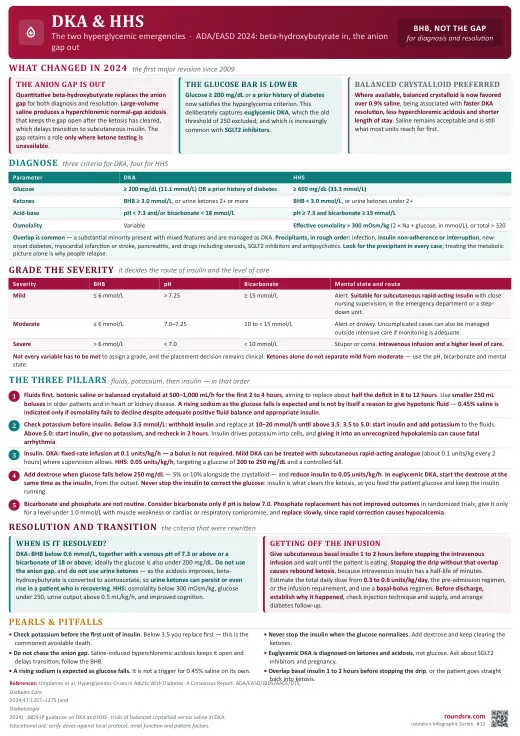
Text version
- BG ≥ 200 mg/dL or known diabetes
- pH < 7.3 and/or Bicarb < 18
- BHB ≥ 3.0 mmol/L (or urine ketones 2+)
- Anion gap NOT a criterion (ADA/EASD 2024)
- Euglycemic DKA: BG normal on SGLT2i
- Infection (30–40%)
- Missed insulin (20–25%)
- New diagnosis T1DM
- MI, pancreatitis, surgery
- SGLT2 inhibitor use
- BG every 1h (POC)
- BMP q2–4h
- BHB q2–4h (the marker to follow)
- Venous pH q2–4h until resolved
- UOP ≥ 0.5 mL/kg/hr
- Insulin with K⁺ < 3.5
- Stopping drip at BG normal
- Missing euglycemic DKA
- No SQ overlap
- Missing precipitant
- pH < 7.0 / bicarb < 10
- Altered mental status
- Hemodynamic instability
- K⁺ < 3.0 with ECG changes
- ADA/EASD 2024: BHB replaces the anion gap for diagnosis and resolution
- Resolution: BHB < 0.6; saline-induced hyperchloremic acidosis closes the gap while the bicarb and pH stay low, so neither is a reliable endpoint
- Bicarb: Only if pH < 7.0 (not routine)