Dialysis Indications
| Letter | Indication | Details |
|---|---|---|
| A | Acidosis | Severe metabolic acidosis (pH < 7.1) refractory to bicarb. Especially toxic ingestions (methanol, ethylene glycol -dialysis removes the toxin AND corrects acidosis). |
| E | Electrolytes | Refractory hyperkalemia not responding to medical management (calcium, insulin/glucose, albuterol, bicarb). K⁺ > 6.5 with ECG changes + anuric patient → emergent HD. |
| I | Ingestion | Toxic alcohols (methanol, ethylene glycol), lithium, salicylate, theophylline, metformin (with severe lactic acidosis). Dialysis removes the toxin directly. |
| O | Overload (volume) | Pulmonary edema refractory to diuretics. Anuric patient with flash pulmonary edema → emergent ultrafiltration/HD. |
| U | Uremia | Uremic symptoms: encephalopathy (AMS, asterixis), pericarditis (friction rub → can progress to tamponade), uremic bleeding (platelet dysfunction), intractable nausea/vomiting. Uremic pericarditis = absolute indication -can cause fatal tamponade. |
| Feature | Intermittent HD | CRRT | PD |
|---|---|---|---|
| Setting | Outpatient dialysis center, inpatient | ICU only | Home (chronic) or inpatient |
| Access | AV fistula, AV graft, or dialysis catheter (IJ preferred) | Dialysis catheter (large bore, dual lumen) | PD catheter (Tenckhoff, peritoneal) |
| Duration | 3–4 hours, 3×/week | Continuous (24/7) | Overnight (APD) or 4× daily exchanges (CAPD) |
| Hemodynamic stability | Rapid fluid/solute shifts → hypotension risk | Gentler -preferred for hemodynamically unstable patients (septic shock, cardiogenic shock) | Gentle, minimal hemodynamic effects |
| Solute clearance | Fast, efficient for small molecules | Slower per hour but continuous → equivalent over 24h | Less efficient for small molecules |
| Best for | Outpatient ESKD, emergent dialysis (fast K⁺ removal), toxin removal | ICU patients who are hemodynamically unstable. AKI in shock. Cerebral edema (slower osmolar shifts). | Chronic CKD/ESKD who want home-based therapy. Preserve residual renal function longer. |
| Mode | Mechanism | Use |
|---|---|---|
| CVVH (Continuous VenoVenous Hemofiltration) | Convection (hydrostatic pressure pushes fluid + solutes across membrane, replaced with clean fluid) | Volume overload, middle-molecule clearance |
| CVVHD (Continuous VenoVenous Hemodialysis) | Diffusion (solute moves down concentration gradient across membrane via dialysate) | Small molecule clearance (urea, K⁺, toxins) |
| CVVHDF (Continuous VenoVenous Hemodiafiltration) | Both convection + diffusion | Most commonly used in ICU. Combines benefits of both. Best overall solute + fluid clearance. |
- AV fistula -gold standard for chronic HD. Lowest infection rate, longest patency. Place when eGFR ~20 (needs 2–3 months to mature). Radiocephalic (wrist) → brachiocephalic (upper arm).
- AV graft -synthetic conduit. Can use in 2–3 weeks. Higher infection and thrombosis rate than fistula.
- Tunneled dialysis catheter (Permacath) -for patients awaiting fistula maturation or not candidates for fistula. Highest infection rate. Right IJ preferred (straightest path to RA).
- Non-tunneled temporary catheter -emergent dialysis only. IJ or femoral. Should be replaced within 1–2 weeks.
- BMP -K⁺, BUN, Cr, bicarb
- ABG -acidosis severity
- CXR -pulmonary edema
- ECG -hyperK changes
- Tox levels if ingestion
- Access assessment
- AEIOU: Acidosis pH<7.1, Electrolytes (K⁺ refractory), Ingestion, Overload, Uremia
- HD: stable patients, 3-4h sessions
- CRRT: hemodynamically unstable ICU
- IDH prevention: slow UF, cool dialysate 35.5°C, midodrine, hold antihypertensives HD days
| Drug (Brand) | Dose | Route | Indication | Notes |
|---|---|---|---|---|
| CIRCUIT ANTICOAGULATION | ||||
| Heparin | Per protocol (bolus + infusion) | IV | HD circuit anticoagulation | Standard for intermittent HD. Monitor aPTT. Hold if active bleeding -run without anticoag. |
| Citrate (regional) | Per CRRT protocol | IV | CRRT anticoagulation | Preferred for CRRT -chelates calcium in circuit. Monitor ionized calcium closely (systemic and circuit). Risk: metabolic alkalosis, hypocalcemia. |
| CKD-MBD MANAGEMENT | ||||
| Sevelamer (Renvela) | 800–1600 mg with meals | PO | Phosphate binder | Non-calcium binder -preferred to avoid vascular calcification. Take with every meal. |
| Calcium acetate (PhosLo) | 667 mg (1–2 tabs) with meals | PO | Phosphate binder | Calcium-based binder. Avoid if hypercalcemic or high Ca x PO4 product. |
| Cinacalcet (Sensipar) | 30–180 mg PO daily | PO | Secondary hyperparathyroidism | Calcimimetic -activates CaSR on parathyroid → suppresses PTH. GI side effects common. For dialysis patients with refractory hyperPTH. |
| Calcitriol (Rocaltrol) | 0.25–0.5 mcg PO daily | PO | Active vitamin D | For secondary hyperPTH. Monitor calcium (risk of hypercalcemia). Alternative: paricalcitol (Zemplar). |
| ANEMIA MANAGEMENT | ||||
| Epoetin alfa (Procrit) | 50–300 units/kg 3x/week | IV/SQ | Anemia of CKD/ESKD | Iron-replete first (ferritin > 200, TSAT > 20%). Target Hgb 10–11.5. Never > 13. |
| Darbepoetin (Aranesp) | 0.45 mcg/kg q2 weeks or monthly | IV/SQ | Anemia of CKD/ESKD | Long-acting ESA -less frequent dosing. Same Hgb target. |
| Iron sucrose (Venofer) | 100–200 mg IV per HD session | IV | Iron deficiency on dialysis | Given during HD sessions. Target ferritin 200–500, TSAT 20–30%. Must replete iron before starting ESA. |
Patient: 58M with ESKD on MWF HD (missed 2 sessions). K⁺ 7.2, peaked T waves → widened QRS on ECG. Cr 14.2, BUN 128. Bilateral crackles, JVD.
Key findings: Life-threatening hyperkalemia with ECG changes + volume overload from missed dialysis. AEIOU indications met: Electrolytes (refractory K⁺) + Overload (pulmonary edema).
Management:
- Calcium gluconate 3g IV over 5 min (membrane stabilizer, buys time, does NOT lower K⁺)
- Insulin 10 units IV + D50 1 amp (shifts K⁺ intracellularly, onset 15 min, lasts 4-6h)
- Emergent hemodialysis, call nephrology and dialysis nurse STAT. Most effective K⁺ removal
- Albuterol 10-20 mg nebulized (shifts K⁺, additive to insulin)
- Kayexalate is NOT emergent therapy (onset 6-12h, causes GI necrosis risk)
Teaching point: The order matters: stabilize the membrane (calcium) → shift K⁺ (insulin/albuterol) → remove K⁺ (dialysis). Calcium gluconate does not lower potassium, it prevents cardiac arrest while you arrange definitive removal.
Patient: 67F in ICU with septic shock on norepinephrine 0.25 mcg/kg/min. Oliguric AKI (Cr 1.1 → 5.8 in 3 days). K⁺ 5.9, pH 7.18, HCO₃ 12. Volume overloaded (6L positive).
Key findings: AKI with multiple dialysis indications (acidosis, hyperkalemia, volume overload) but hemodynamically unstable, cannot tolerate intermittent HD (rapid fluid shifts → hypotension).
Management:
- CRRT (continuous venovenous hemodiafiltration, CVVHDF) rather than intermittent HD
- CRRT advantages in shock: slow continuous fluid removal (50-100 mL/hr net UF), hemodynamically gentle
- Dialysis catheter: temporary non-tunneled in right IJ (preferred site for flow)
- Anticoagulation for CRRT circuit: citrate regional anticoagulation (preferred) or heparin
- Monitor ionized calcium closely if using citrate (citrate chelates calcium → hypocalcemia risk)
Teaching point: CRRT is not "better" than intermittent HD, it's gentler. The AKIKI, 2016 trial showed no mortality benefit for early vs delayed RRT initiation in ICU. Start CRRT for absolute indications (AEIOU), not prophylactically.
Patient: 52M on HD via left brachiocephalic AV fistula × 3 years. Presents with left arm swelling, difficulty cannulating the fistula, and prolonged bleeding after last HD session. Thrill diminished on exam.
Key findings: AV fistula stenosis with signs of access failure: diminished thrill (should be palpable), prolonged bleeding (elevated venous pressure), difficult cannulation, arm edema (central venous stenosis).
Management:
- Duplex ultrasound of fistula to confirm stenosis location and degree
- Fistulogram (contrast venography) with angioplasty if stenosis > 50% with clinical symptoms
- If angioplasty fails: surgical revision or new access creation
- Temporary dialysis catheter if fistula nonfunctional and dialysis cannot wait
- AV fistula hierarchy: radiocephalic (wrist) → brachiocephalic → brachiobasilic transposition → AV graft → tunneled catheter (last resort)
Teaching point: AV fistula is the gold standard for HD access (lowest infection rate, longest patency). Fistula first, always plan access early (6 months before anticipated HD start for fistula maturation). Catheters should be a bridge, not permanent.
| Parameter | Frequency | Target / Action |
|---|---|---|
| Pre/post BUN, K+, bicarb, Ca, PO4 | Each HD session (or daily for CRRT) | Assess clearance adequacy. Post-HD K+ should be 3.5–5.0. Bicarb > 22. PO4 3.5–5.5. |
| Weight (dry weight target) | Pre/post each HD session | Fluid removal goal = pre-HD weight minus dry weight. Reassess dry weight monthly -clinical exam (edema, JVP, BP) guides adjustment. |
| Access assessment (AV fistula) | Every HD session | Check thrill and bruit -absence suggests thrombosis or stenosis. Inspect for signs of infection, aneurysm, steal syndrome (cold/pale hand). |
| Kt/V | Monthly | Dialysis adequacy: target Kt/V ≥ 1.4 (single-pool) for thrice-weekly HD. URR (urea reduction ratio) > 65% is alternative measure. |
| Hgb / iron studies | Monthly | Hgb target 10–11.5 g/dL. Ferritin 200–500, TSAT 20–30%. Replete iron before adjusting ESA dose. |
| PTH | Every 3 months | Target 2–9x upper limit of normal for dialysis patients. Rising PTH → increase phosphate binders, add cinacalcet or calcitriol. |
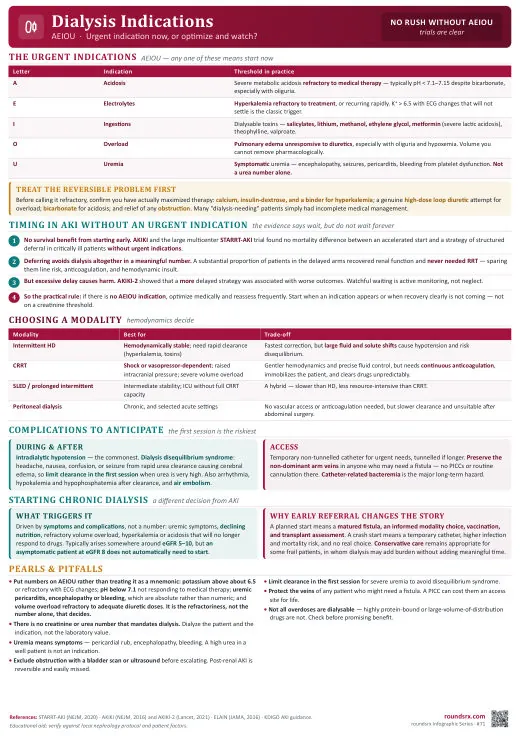
Text version
- Late fistula referral (needs months to mature)
- IDH from aggressive UF rate (slow down, cool dialysate)
- Dialysis disequilibrium in first session (cerebral edema)
- Not adjusting medications for HD clearance