DIC
| Lab | Finding | Why |
|---|---|---|
| Platelets | ↓↓ | Consumed in microthrombi ISTH DIC Score, Taylor 2001 |
| Fibrinogen | ↓ (< 100 = severe) | Consumed. Most specific for DIC severity. |
| PT/INR, aPTT | ↑ | Clotting factors consumed |
| D-dimer | ↑↑↑ | Massive fibrinolysis |
| Smear | Schistocytes | RBCs sheared through fibrin strands |
- Sepsis (~35% -most common)
- Trauma / major surgery
- Malignancy -APL, mucin-secreting adenocarcinomas (pancreas, prostate)
- Obstetric -placental abruption, amniotic fluid embolism, HELLP
- Massive transfusion, large aortic aneurysm, envenomation
| Component | Replacement | Target |
|---|---|---|
| Fibrinogen | Cryoprecipitate 10 units | > 100–150 mg/dL. Most critical to replace. ISTH DIC Guidelines, Levi 2009 |
| Platelets | Platelet transfusion | > 50K if bleeding; > 10K if not |
| Factors | FFP 15 mL/kg | INR < 1.5 if bleeding |
| RBCs | pRBCs | Hgb > 7 (or > 8 if active bleed) |
| Product | Indication | Dose | Target |
|---|---|---|---|
| Platelets | Plt <10K (any) or <50K with active bleeding | 1 apheresis unit or 6-pack | Plt >50K if bleeding, >10K if stable |
| Cryoprecipitate | Fibrinogen <100-150 mg/dL | 10 units (pools) | Fibrinogen >150 mg/dL. Each pool raises fibrinogen ~50 mg/dL. |
| FFP | PT/aPTT >1.5× normal WITH active bleeding | 15 mL/kg (typically 4 units) | INR <1.5. Replaces all clotting factors. |
| pRBCs | Hgb <7 (or <8 if active hemorrhage) | Per transfusion protocol | Hemodynamic stability, adequate oxygen delivery. |
| Heparin SELECT CASES | Chronic/compensated DIC with thrombosis predominance | Low-dose UFH or prophylactic LMWH | Only when thrombosis outweighs bleeding risk (e.g., Trousseau syndrome, purpura fulminans). Contraindicated in acute DIC with active hemorrhage. |
| Tranexamic acid | Hyperfibrinolysis-predominant DIC | 1g IV load then 1g over 8h | Consider in APL-associated DIC or trauma. Use with caution -can worsen microvascular thrombosis. |
Patient: 65M with septic shock from E. coli urosepsis. Developing diffuse oozing from IV sites, petechiae, and hematuria.
Key findings: Plt 28K, INR 3.2, fibrinogen 62, D-dimer > 20,000. Peripheral smear: schistocytes. ISTH DIC score 7 (overt DIC). Factor VIII LOW (confirming DIC, not liver disease).
Management:
- Treat the underlying cause, antibiotics + source control (this is the ONLY curative treatment)
- Cryoprecipitate 10 units for fibrinogen < 100 (each unit raises fibrinogen ~5-10 mg/dL)
- Platelet transfusion for plt < 50K + active bleeding
- FFP 4 units for prolonged INR + active bleeding
- Trend fibrinogen, plt, INR q4-6h, fibrinogen is the key lab to follow
- Do NOT give heparin (bleeding-predominant DIC)
Teaching point: Fibrinogen is the most specific and actionable lab in DIC. Factor VIII is LOW in DIC but ELEVATED in liver disease, this is the single best lab to differentiate them when the clinical picture is unclear.
Patient: 32F presenting with pancytopenia and gum bleeding. Peripheral smear: blasts with Auer rods. Diagnosed with acute promyelocytic leukemia (APL). Labs: plt 18K, INR 1.8, fibrinogen 85, D-dimer 12,000.
Key findings: APL-associated DIC, unique because it has both bleeding AND thrombotic features. APL blasts release tissue factor and annexin II causing consumptive coagulopathy.
Management:
- Start ATRA (all-trans retinoic acid) immediately, do not wait for confirmatory testing
- Aggressive blood product support: keep fibrinogen > 150, plt > 50K in APL
- Cryoprecipitate and platelet transfusions as needed
- Hematology/oncology emergent consult
- DIC typically resolves within 48-72h of ATRA initiation
Teaching point: APL is a hematologic emergency because of severe DIC. ATRA corrects the DIC by inducing differentiation of the leukemic promyelocytes. In APL, maintain higher fibrinogen (> 150) and platelet (> 50K) thresholds than typical DIC.
Patient: 44F with thrombocytopenia (plt 22K), schistocytes on smear, and elevated LDH. Presenting with confusion and fever. Is this DIC or TTP?
Key findings: PT/INR NORMAL. Fibrinogen 310 (NORMAL). D-dimer mildly elevated. Cr 2.1. This is NOT DIC, normal coags with thrombocytopenia + MAHA = TTP until proven otherwise.
Management:
- Send ADAMTS13 activity level URGENTLY (do not wait for result to treat)
- Start plasma exchange (PLEX) immediately, untreated TTP mortality > 90%
- Do NOT transfuse platelets in TTP (fuels thrombosis, "adding fuel to fire")
- Start steroids (methylprednisolone 1 g/day x 3 days)
- Consult hematology emergently
Teaching point: The key differentiator: DIC = prolonged PT/INR + low fibrinogen + very high D-dimer. TTP = NORMAL PT/INR + NORMAL fibrinogen. Both have MAHA + thrombocytopenia. If coags are normal, think TTP. Platelet transfusion is treatment in DIC but contraindicated in TTP.
| Parameter | Frequency | Target / Action |
|---|---|---|
| CBC (platelets, Hgb) | q6-8h in acute DIC | Platelet trend (rising = improving). Hgb drop = ongoing hemorrhage or hemolysis. Check smear for schistocytes. |
| Fibrinogen | q6-8h in acute DIC | Target >150 mg/dL. Most specific lab for DIC severity. Replete with cryoprecipitate if <100-150. |
| PT/INR, aPTT | q6-8h in acute DIC | Trend toward normalization. Prolonged + bleeding → FFP. Improving PT/fibrinogen = resolving DIC. |
| D-dimer | q6-12h | Massively elevated in DIC. Trending down = resolving. Not specific -use in context of ISTH score. |
| ISTH DIC score | Daily recalculation | ≥5 = overt DIC. Track serial scores -declining score confirms resolution. Components: platelets, D-dimer, PT, fibrinogen. |
| Clinical bleeding assessment | q2-4h | IV sites, surgical sites, mucosal bleeding, petechiae, hematuria, GI bleeding. Simultaneous bleeding AND thrombosis is pathognomonic. |
| Thrombotic complications | Each assessment | Skin necrosis (purpura fulminans), acral ischemia, organ dysfunction (renal, hepatic). DVT/PE screening if clinical concern. |
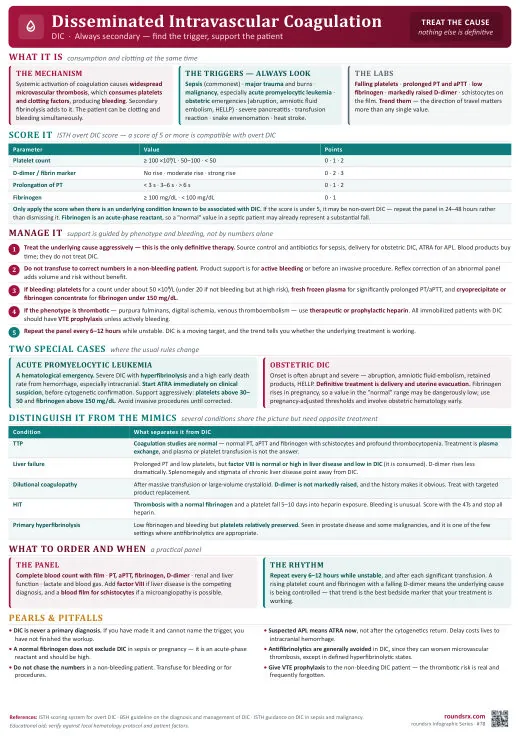
Text version
🧪 Workup: Focused labs + imaging → see Workup tab
⚡ Treat: Evidence-based algorithm → see Management tab
💊 Drugs: Key medications with dosing → see Medications tab
📣 Present: One-liner + key points → see Rounds tab
- CBC + smear -thrombocytopenia + schistocytes
- PT/INR, aPTT -prolonged
- Fibrinogen -most specific. Cryo if <100.
- D-dimer -markedly elevated
- Factor VIII -LOW in DIC, HIGH in liver disease
- ISTH DIC score ≥5