Discharge Planning Checklist
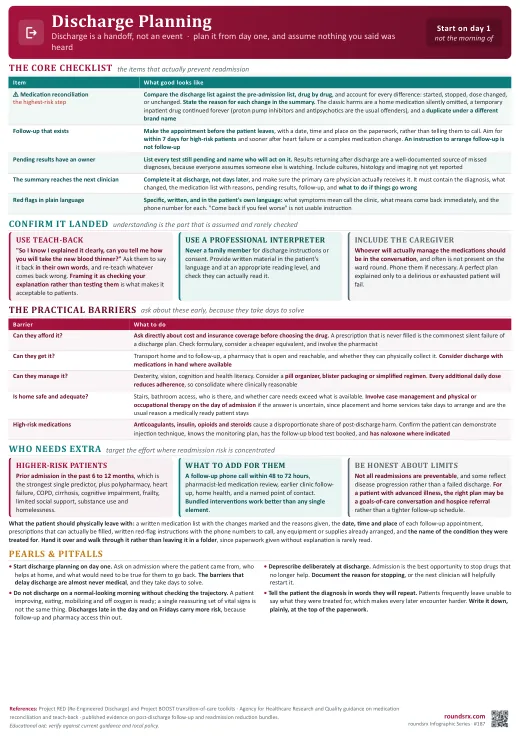
- Medication reconciliation -compare admission meds vs discharge meds. What was added? Changed? Stopped? Does the patient understand each change and why?
- Labs pending? -do NOT discharge with critical pending results (blood cultures, pathology). If minor labs pending → ensure follow-up plan for results.
- Follow-up appointments -PCP within 7–14 days for all discharges. Specialist follow-up as needed (cardiology post-ACS, surgery post-op, oncology). High-risk patients: follow-up within 48–72h.
- Discharge medications prescribed + sent to pharmacy. Verify the patient can afford them. Prior authorizations done? Assistance programs if needed.
- Patient education -diagnosis explained in plain language. Red flags to return to ED. Medication side effects. Activity restrictions. Diet changes (low-sodium for HF, renal diet for CKD).
- Durable medical equipment -O₂ arranged? CPAP? Walker/wheelchair? Home health nursing?
- Social work / care coordination -safe living situation? Capable of ADLs? Need rehab (SNF, acute rehab, LTAC)? Substance use resources? Mental health follow-up?
- VTE prophylaxis post-discharge -does the patient need extended prophylaxis (post-major orthopedic surgery × 35 days, post-cancer surgery)?
- Discharge summary completed -timely, sent to PCP. Include: admission diagnosis, hospital course, key results, discharge meds (with changes highlighted), pending results, follow-up plan, and code status discussion if applicable.
| Condition | Key Discharge Interventions |
|---|---|
| Heart Failure | Daily weights at home. Fluid restrict 1.5–2 L/day. Low-sodium diet. Follow-up within 7 days. Action plan: "If weight ↑ 3 lbs in 2 days → call clinic / double Lasix." |
| COPD | Inhaler technique reviewed (observed return demonstration). Action plan. Smoking cessation. Pulmonary rehab referral. Prednisone taper if applicable. |
| Pneumonia | Complete antibiotic course. CXR follow-up in 6–8 weeks (to ensure resolution, rule out underlying mass). Smoking cessation. |
| ACS | DAPT education (do NOT stop without cardiology approval). Cardiac rehab referral. Statin, BB, ACEi. Nitroglycerin SL PRN prescription + instruction. Follow-up within 2 weeks. |
| Domain | Before Discharge |
|---|---|
| Clinical stability | Afebrile ≥ 24h, improving trajectory, tolerating PO, ambulatory (or at baseline), stable vitals off telemetry |
| Pending results | Blood cultures, biopsy, imaging reads, consult recs -assign follow-up responsibility for each. Document who will call patient. |
| Medication reconciliation | Compare admission meds → current → discharge. Mark: NEW / CHANGED / STOPPED. Verify patient can access + afford meds. |
| Follow-up arranged | PCP within 7 days (48–72h if high-risk). Specialist follow-up with date. Labs with specific date and location. |
| Transitions of care | Discharge summary sent to PCP SAME DAY. Include: diagnosis, hospital course, pending results, medication changes, follow-up plan. |
| Situation | Risk | Mitigation |
|---|---|---|
| New anticoagulation | Bleeding, missed doses, drug interactions | Teach signs of bleeding, drug-food interactions (warfarin), ensure INR follow-up if warfarin |
| New insulin | Hypoglycemia, dosing errors | Teach-back injection technique, glucose monitoring, hypo treatment. Diabetes educator consult. |
| Heart failure | 30-day readmission (25%) | Daily weights, sodium restriction, diuretic adjustment plan, 48–72h follow-up, call if gain > 3 lbs/2 days |
| COPD exacerbation | Readmission, ongoing steroid needs | Ensure inhaler technique (observed), prednisone taper written, pulmonary rehab referral, quit smoking |
| AMA discharge | Poor outcomes, medicolegal risk | Document capacity assessment, risks explained, medications offered, follow-up arranged despite AMA. Patients retain right to receive discharge meds and instructions. |
| Letter | Meaning | Example |
|---|---|---|
| I | Illness severity | "Stable" / "Watcher" / "Unstable" |
| P | Patient summary | "72M with COPD exacerbation, day 3 of prednisone, on 2L NC" |
| A | Action list | "Repeat BMP at 6 AM for K⁺ recheck. Call if below 3.5." |
| S | Situation awareness | "May need BiPAP if RR > 30 or SpO₂ < 88%. Has been borderline." |
| S | Synthesis by receiver | Receiving team reads back key action items and contingency plans. |
| Step | Action |
|---|---|
| 1. Compare lists | Home meds → inpatient meds → discharge meds. Use pharmacy reconciliation if available. |
| 2. Mark changes | Flag: * = NEW, Δ = CHANGED dose/frequency, ✕ = STOPPED. Explain WHY for each change. |
| 3. Teach-back | Review each changed med with patient. "Tell me how you'll take this at home." Low health literacy = use plain language. |
| 4. Access check | Can patient afford meds? Has pharmacy? Need prior auth? Provide 30-day bridge if insurance gap. |
~20% of patients have adverse events within 3 weeks of discharge. ~40% involve medication errors. I-PASS handoff, bedside med reconciliation, teach-back, and 48h phone calls reduce readmissions.
Patient: 72M with HFrEF (EF 25%), admitted for acute decompensation (fluid overload). Now euvolemic on furosemide 80 mg PO BID. Lives alone, limited health literacy. Eats canned soups daily.
Key findings: HF is the #1 readmission diagnosis (~25% 30-day readmission rate). High-risk features: lives alone, limited literacy, dietary non-adherence. Most HF readmissions are from volume overload due to dietary indiscretion or medication non-compliance.
Management:
- Teach-back method: "Tell me in your own words when you should call your doctor" (verifies comprehension)
- Daily weight instructions: "Weigh yourself every morning after using the bathroom. If you gain 3 lbs in 1 day or 5 lbs in 1 week, take an extra Lasix AND call us"
- Dietary counseling: 2g sodium restriction, avoid canned foods, read labels (involve family/caregiver)
- Follow-up within 48-72h (HF clinic or PCP). Transitional care nurse phone call within 48h
- Medication reconciliation at bedside with patient: review each med, what it's for, when to take it
Teaching point: The discharge summary is a medical document, the discharge CONVERSATION is what prevents readmissions. Teach-back is more valuable than any written instruction. If a patient can't explain their weight monitoring plan back to you, they're not ready for discharge.
Patient: 58M admitted for NSTEMI, underwent PCI with DES to LAD. Started on DAPT (ASA + ticagrelor), high-intensity statin, beta-blocker, ACEi. Home meds included clopidogrel (prior stroke), PPI, metformin. Multiple medication changes.
Key findings: High-complexity medication reconciliation: new DAPT (replacing prior clopidogrel monotherapy), new statin dose, new BB and ACEi. Risk: patient may continue old clopidogrel + new ticagrelor (double P2Y12), or stop ASA thinking it's redundant.
Management:
- Create a clean medication list with "STOP" and "NEW" clearly marked
- STOP: clopidogrel (replaced by ticagrelor). CONTINUE: ASA 81 mg (part of DAPT)
- NEW: ticagrelor 90 mg BID (must take twice daily, missed doses increase stent thrombosis risk)
- PPI: continue (GI prophylaxis on DAPT). Note: omeprazole interacts with clopidogrel but NOT ticagrelor
- Cardiology follow-up within 1-2 weeks. Emphasize: do NOT stop ticagrelor or ASA without calling cardiologist
Teaching point: Post-PCI patients who stop DAPT prematurely have a 5-10% risk of stent thrombosis (often fatal STEMI). The discharge conversation must include: "Do not stop these two blood thinners for ANY reason without calling your cardiologist first, not even for a dental cleaning."
Patient: 45F admitted for pancreatitis × 7 days, received IV hydromorphone for pain control. Now tolerating PO, pain 3/10. Team wants to transition to oral and prepare for discharge. Patient has no prior opioid use.
Key findings: Opioid-naive patient on IV opioids × 7 days, at risk for physical dependence and outpatient opioid misuse. Must taper appropriately and set clear expectations for discharge prescribing.
Management:
- Convert IV hydromorphone to oral equivalent (2 mg IV hydromorphone ≈ 8 mg PO hydromorphone)
- Reduce by 25-50% when converting IV → PO (incomplete cross-tolerance)
- Discharge with 3-5 day supply of oral opioid MAXIMUM with no refills (short-course prescribing)
- Co-prescribe: acetaminophen 1g TID + ibuprofen 400 mg TID (multimodal, reduces opioid need by 30-40%)
- Set expectations: "Pain should improve daily. If it's getting worse rather than better, call us, that's not normal"
Teaching point: The #1 risk factor for chronic opioid use is the initial prescription length. Prescribing > 7 days of opioids for acute pain doubles the risk of chronic use at 1 year. Always prescribe the minimum effective course with a clear taper plan.
| Domain | Checklist Item | Action / Details |
|---|---|---|
| Medication reconciliation | Complete and reviewed at bedside | Compare admission → discharge meds. Mark NEW / CHANGED / STOPPED. Ensure patient understands each change and why. Verify meds are affordable and filled. |
| Follow-up appointments | Scheduled before discharge | PCP within 7–14 days (48–72h if high-risk: HF, ACS, COPD). Specialist follow-up as needed with date and location confirmed. Patient has written appointment details. |
| Patient education | Red flags and return precautions | Disease-specific return precautions explained in plain language. Teach-back method: patient explains warning signs in their own words. Written instructions provided. |
| Discharge summary | Completed and sent to PCP | Sent same day. Include: admission diagnosis, hospital course, key results, medication changes with rationale, pending results, follow-up plan, code status. |
| Pending labs/results | Responsible provider assigned | Every pending result (blood cultures, pathology, imaging reads) must have a named provider responsible for follow-up. Document who will contact the patient. |
| VTE prophylaxis | Post-discharge plan if applicable | Extended prophylaxis for: post-major orthopedic surgery (35 days), post-cancer surgery (28 days). Ensure prescription and patient education on injection technique if applicable. |
| Code status | Confirmed and documented | Especially for patients with serious illness, recurrent admissions, or goals-of-care discussions during hospitalization. Ensure advance directive is in the chart. |
| Timeframe | Action |
|---|---|
| 24–48 hours | Post-discharge phone call (nursing or pharmacy). Confirm: meds filled, understanding discharge instructions, no new symptoms. |
| 48–72 hours | High-risk follow-up: HF (weight, diuretic response), AKI (Cr recheck), new anticoag (INR if warfarin), new insulin (glucose log). |
| 7 days | PCP follow-up for most patients. Review hospital course, pending results, medication changes. |
| 30 days | Specialist follow-up. Labs (Cr, CBC, LFTs as indicated). Functional status assessment. |
Text version
- Med reconciliation by chart review only (must be at bedside with patient)
- Discharge summary not sent to PCP same day
- No specific return precautions given
- Pending results not handed off to outpatient provider