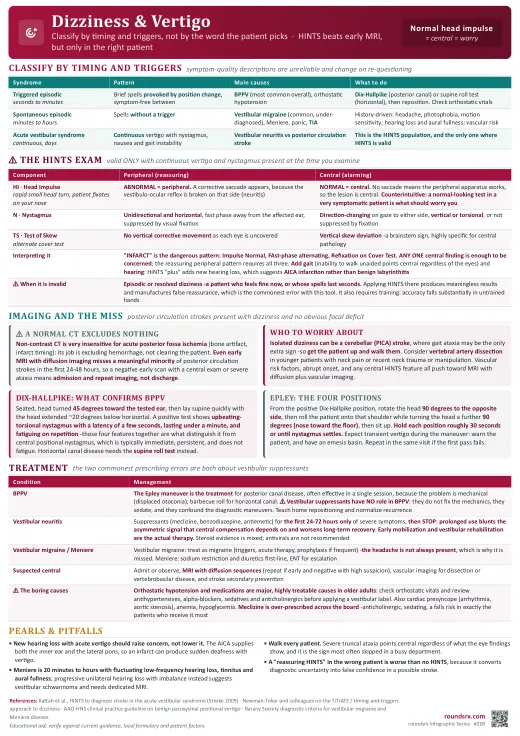
Dizziness & Vertigo
The old teaching -ask the patient to describe the sensation- performs badly, because descriptions are unreliable and change on re-questioning. Timing and triggers classify the problem, and in continuous vertigo the HINTS exam outperforms early MRI for detecting stroke, but only when applied to the right patient and performed correctly. Both of those conditions are frequently violated.
🔍 Overview
Stop asking "what do you mean by dizzy?" as the organizing question. Symptom-quality descriptions (spinning vs lightheaded vs off-balance) were the traditional teaching but are unreliable and inconsistent on re-questioning, and patients frequently endorse several. Classify by TIMING and TRIGGERS instead -how long does it last, and what brings it on. That framework (the ATTEST / TiTrATE approach) maps directly onto the diagnostic categories and tells you which exam to perform.
The Three Syndromes (timing and triggers)
| Syndrome | Pattern | Main causes | What to do |
|---|---|---|---|
| Triggered episodic seconds to minutes | Brief spells provoked by position change, symptom-free between | BPPV (most common), orthostatic hypotension | Dix-Hallpike (posterior canal) or supine roll test (horizontal canal), then treat with a repositioning maneuver. Check orthostatic vitals. |
| Spontaneous episodic minutes to hours | Spells arising without a trigger | Vestibular migraine (commonly missed), Meniere disease, panic disorder, TIA | History-driven. Ask about headache, photophobia and motion sensitivity; hearing loss and aural fullness; vascular risk factors. |
| Acute vestibular syndrome continuous, days | Continuous vertigo with nausea, nystagmus and gait instability, lasting days | Vestibular neuritis vs posterior circulation stroke | This is the HINTS population -and the only one in which HINTS is valid. |
Why This Matters
- Posterior circulation strokes are the misses. They present with dizziness and often without obvious focal deficits, and they are disproportionately missed in the emergency department compared with anterior circulation strokes.
- Isolated dizziness can be a stroke -particularly cerebellar (PICA) infarcts, where gait ataxia may be the only additional sign, so getting the patient up to walk is not optional.
- Do not rely on early CT. Non-contrast CT is very insensitive for acute posterior fossa ischemia; a normal CT does not exclude stroke and should never be the reassurance that ends the workup. Even early MRI with diffusion imaging misses a meaningful minority of posterior circulation strokes in the first 24-48 hours.
🧭 HINTS Exam
HINTS is valid ONLY in acute vestibular syndrome: continuous, ongoing vertigo with nystagmus, present at the time you examine. Applying it to a patient with intermittent dizziness, or to a patient who currently feels fine, produces meaningless results -and this is the single commonest error. It also requires an examiner trained in it; performed by untrained clinicians its accuracy falls substantially.
The Three Components
| Component | Peripheral (reassuring) | Central (alarming) |
|---|---|---|
| HI -Head Impulse rapid small-amplitude head turn while patient fixates on your nose | ABNORMAL test = peripheral: a corrective saccade appears, meaning the vestibulo-ocular reflex is broken on that side (vestibular neuritis) | NORMAL test = central: no corrective saccade, so the peripheral apparatus works and the lesion is central. This is the counterintuitive one |
| N -Nystagmus | Unidirectional, horizontal, fast phase away from the affected ear, suppressed by visual fixation | Direction-changing on gaze to either side, vertical or torsional, or not suppressed by fixation |
| TS -Test of Skew alternate cover test | No vertical corrective movement when each eye is uncovered | Vertical skew deviation present -a brainstem sign, highly specific for central pathology |
Interpreting It
- "INFARCT" is the dangerous pattern: Impulse Normal, FAst-phase alternating (direction-changing nystagmus), Refixation on Cover Test. Any one of the three being central is enough to be concerned -you do not need all three.
- The reassuring peripheral pattern requires all three: abnormal head impulse, unidirectional horizontal nystagmus, and no skew.
- In trained hands, HINTS is more sensitive than early MRI for posterior circulation stroke in acute vestibular syndrome -which is why it is worth learning properly rather than performing approximately.
- Add hearing: HINTS "plus" incorporates new hearing loss, which in acute vestibular syndrome suggests AICA territory infarction rather than a benign labyrinthitis -sudden hearing loss with vertigo should raise concern rather than lower it.
- Always assess gait. A patient who cannot stand or walk unaided has severe truncal ataxia, which points central regardless of the eye findings.
🧪 Causes
Peripheral
- BPPV -the most common cause overall. Brief (under a minute) positional vertigo from otoconia in a semicircular canal, usually posterior. Diagnosed by Dix-Hallpike showing upbeating-torsional nystagmus with latency and fatigability; horizontal canal variant is found with the supine roll test.
- Vestibular neuritis -acute vestibular syndrome without hearing loss, presumed post-viral; labyrinthitis is the same with hearing loss.
- Meniere disease -episodic vertigo lasting 20 minutes to hours with fluctuating low-frequency hearing loss, tinnitus and aural fullness.
- Vestibular schwannoma -progressive unilateral hearing loss and imbalance more than true vertigo; needs MRI with internal auditory canal views.
Central and Systemic
- Posterior circulation stroke or TIA -the diagnosis the whole evaluation exists to catch. Vertebral artery dissection deserves specific thought in younger patients with neck pain or recent neck trauma or manipulation.
- Vestibular migraine -probably the most common cause of spontaneous episodic vertigo and widely under-diagnosed; headache need not accompany every episode, so ask about migraine history, photophobia, phonophobia and motion sensitivity.
- Orthostatic hypotension and medications -a major and highly treatable cause in older patients; check orthostatic vitals and review antihypertensives, alpha-blockers, sedatives and anticholinergics. The Parkinson topic covers neurogenic orthostatic hypotension in depth.
- Cardiac causes -arrhythmia, aortic stenosis and structural disease presenting as presyncope rather than true vertigo.
- Metabolic and other -anemia, hypoglycemia, dehydration, thyroid disease, and persistent postural-perceptual dizziness (chronic non-vertiginous dizziness worsened by upright posture and visual motion).
🚨 Management
BPPV: Reposition, Do Not Medicate
- The Epley maneuver is the treatment for posterior canal BPPV and is highly effective, often in a single session -it physically returns the otoconia to the utricle. The barbecue roll maneuver treats horizontal canal disease.
- Vestibular suppressants have no role in BPPV and are actively counterproductive: they blunt the very signal that repositioning depends on and delay central compensation.
- Teach home repositioning and reassure that recurrence is common and re-treatable rather than a sign of something new.
Vestibular Neuritis
- Short-course vestibular suppressants (meclizine, or benzodiazepines, or antiemetics) for the first 24-72 hours only, for severe nausea and vertigo.
- Then stop them -prolonged use delays central compensation and worsens long-term outcomes, which is the most commonly violated principle in this diagnosis. Patients discharged with an open-ended meclizine prescription do worse.
- Early mobilization and vestibular rehabilitation therapy speed recovery; refer if symptoms persist beyond the first weeks.
- Glucocorticoids are sometimes used but the evidence is mixed; antivirals are not recommended.
The Others
- Vestibular migraine -treat as migraine: trigger management, acute therapy, and prophylaxis where episodes are frequent.
- Meniere disease -sodium restriction and diuretics are traditional first-line; refer to ENT for escalation.
- Suspected central cause -admit or observe, image with MRI including diffusion sequences (repeat or delay imaging if early and negative but suspicion is high), vascular imaging for dissection or vertebrobasilar disease, and manage as stroke with the usual secondary prevention.
- Orthostatic and medication-related -deprescribe, hydrate, and address the mechanism rather than prescribing a vestibular suppressant.
- Meclizine is over-prescribed across the board -it is anticholinergic, sedating, contributes to falls in the elderly, and treats almost none of these conditions properly.
🏥 Rounds
Pimp Questions
❓ In the HINTS exam, why does a NORMAL head impulse test suggest a stroke?
Because the head impulse test measures the vestibulo-ocular reflex, whose pathway runs through the peripheral vestibular apparatus and vestibular nerve. In vestibular neuritis that pathway is damaged, so the eyes fall off target and a corrective saccade appears -an abnormal test, which is reassuring. In a central lesion the peripheral apparatus and nerve are intact, so the VOR works and the test is normal, which is alarming in a patient with continuous vertigo who clearly has something wrong. It is genuinely counterintuitive: a normal-looking test in a very symptomatic patient is the finding that should worry you.
❓ When is HINTS invalid, and why does that matter?
HINTS is validated only for acute vestibular syndrome: continuous, ongoing vertigo with nystagmus, present at the moment of examination. Applying it to episodic or resolved dizziness -a patient who feels fine now, or whose spells last seconds- produces meaningless results, and this misapplication is the commonest error in practice. It also requires training: in untrained hands accuracy drops substantially. A "reassuring HINTS" in the wrong patient is worse than no HINTS, because it manufactures false confidence in a possible stroke.
❓ A patient with acute continuous vertigo has a normal head CT. Is stroke excluded?
No, and this is a classic fatal reassurance. Non-contrast CT is very insensitive for acute posterior fossa ischemia -bone artifact and the timing of infarct evolution mean small cerebellar and brainstem strokes are routinely invisible. Its real job is excluding hemorrhage. Even early MRI with diffusion-weighted imaging misses a meaningful minority of posterior circulation strokes within the first 24-48 hours, so a negative early MRI with a central HINTS pattern or severe gait ataxia warrants admission and repeat imaging rather than discharge.
❓ Why should meclizine not be prescribed for BPPV, and why should it be stopped early in vestibular neuritis?
In BPPV the problem is mechanical -displaced otoconia- so the treatment is a repositioning maneuver, and vestibular suppressants do not fix it; they merely sedate the patient and can make the diagnostic maneuvers harder to interpret. In vestibular neuritis, suppressants help the first 24-72 hours of severe nausea, but prolonged use blunts the asymmetric vestibular signal that central compensation depends on, delaying and worsening recovery. Meclizine is also anticholinergic and sedating, and contributes to falls in exactly the older population that gets it most.
❓ What does new hearing loss in acute vestibular syndrome suggest?
It should raise concern rather than reassure. The intuitive reading is "labyrinthitis, a peripheral problem," but the AICA supplies both the inner ear (via the labyrinthine artery) and the lateral pons and cerebellum, so an AICA territory infarct can produce sudden hearing loss with vertigo. That is why HINTS "plus" adds a hearing assessment to the three eye findings. Combined vertigo and sudden unilateral hearing loss deserves careful central evaluation, not a labyrinthitis label.
Sample Presentation
Mr. Larsen is a 68-year-old man with hypertension, diabetes and smoking history, brought in with 14 hours of continuous vertigo, nausea and unsteadiness that began abruptly. He has no headache, no hearing change, no focal weakness. On exam he has horizontal nystagmus that changes direction with gaze, a normal head impulse test, no skew, and he cannot walk without holding the wall. A non-contrast head CT is normal.
Key Points: (1) This is acute vestibular syndrome, so HINTS applies -and two features are central: direction-changing nystagmus and a normal head impulse test. Any one central feature is enough; he has two, plus severe gait ataxia. (2) The normal CT excludes nothing -it is insensitive for posterior fossa ischemia and only rules out hemorrhage. He needs MRI with diffusion sequences plus vascular imaging, admission, and stroke pathway management, with the knowledge that even early MRI can miss posterior circulation infarcts, so a negative scan does not send him home. (3) The wrong move here is meclizine and discharge with "vestibular neuritis," which is exactly how these strokes get missed.
Clinic & ED Checklist
- Classified by timing and triggers, not by asking the patient to describe the sensation.
- Triggered positional spells: Dix-Hallpike performed and Epley delivered in the same visit if positive.
- Continuous vertigo: HINTS performed only if symptoms and nystagmus are present now, with gait tested and hearing asked about.
- Gait assessed in everyone -inability to walk unaided points central regardless of the eye exam.
- Vascular risk and dissection considered (neck pain, recent trauma or manipulation, young patient).
- Orthostatic vitals and a medication review in older patients with non-vertiginous dizziness.
- No open-ended meclizine; suppressants limited to 24-72 hours in neuritis and not used for BPPV.
- Vestibular rehabilitation referral for persistent symptoms.
📋 Summary
Summary
Classify by Timing and Triggers
Abandon "what do you mean by dizzy?" -symptom-quality descriptions are unreliable and change on re-questioning. Ask how long it lasts and what brings it on: triggered episodic (seconds, positional) is BPPV or orthostasis; spontaneous episodic (minutes to hours) is vestibular migraine, Meniere or TIA; continuous for days is acute vestibular syndrome -neuritis versus stroke.
HINTS Applies to One Syndrome Only
Valid solely in acute vestibular syndrome with symptoms and nystagmus present at the time of examination. Using it on episodic or resolved dizziness produces meaningless results and manufactures false reassurance -the commonest error with this tool. It also requires training; accuracy falls substantially in untrained hands.
The Counterintuitive Head Impulse
ABNORMAL head impulse (corrective saccade) = peripheral and reassuring, because the vestibulo-ocular reflex is broken as expected in neuritis. NORMAL head impulse = central and alarming, because an intact reflex in a patient with continuous vertigo means the lesion is not peripheral. A normal-looking test in a very symptomatic patient is the finding that should worry you.
One Central Feature Is Enough
"INFARCT" = Impulse Normal, FAst-phase alternating, Refixation on Cover Test. Any single central finding warrants concern; the reassuring peripheral pattern requires all three (abnormal impulse, unidirectional horizontal nystagmus, no skew). Add gait and hearing: inability to walk unaided points central, and new hearing loss suggests AICA infarction rather than benign labyrinthitis.
A Normal CT Excludes Nothing
Non-contrast CT is very insensitive for acute posterior fossa ischemia -its job is excluding hemorrhage, not clearing the patient. Even early MRI with diffusion imaging misses a meaningful minority of posterior circulation strokes in the first 24-48 hours, so a negative early scan with a central exam or severe ataxia means admission and repeat imaging, not discharge.
BPPV Is Treated Mechanically
Dix-Hallpike diagnoses it and the Epley maneuver treats it, often in a single session, because the problem is displaced otoconia. Vestibular suppressants have no role -they do not fix the mechanics, they sedate, and they confound the maneuvers. Teach home repositioning and normalize recurrence.
Suppressants Are a 72-Hour Drug
In vestibular neuritis, meclizine or a benzodiazepine helps the first 24-72 hours of severe symptoms, then must stop: prolonged use blunts the signal central compensation depends on and worsens long-term recovery. Early mobilization and vestibular rehabilitation are the actual therapy. Meclizine is anticholinergic, sedating and a falls risk in exactly the elderly patients who receive it most.
Do Not Forget the Boring Causes
Orthostatic hypotension and medications are major, highly treatable causes of dizziness in older adults -check orthostatic vitals and review antihypertensives, alpha-blockers, sedatives and anticholinergics before reaching for a vestibular label. Consider cardiac presyncope (arrhythmia, aortic stenosis), anemia, hypoglycemia, and vestibular migraine, which is common and under-diagnosed because the headache is not always there.