VTE Prophylaxis
| Tool | Population | Threshold |
|---|---|---|
| Padua Score | Medical inpatients | ≥ 4 = high risk → pharmacologic prophylaxis |
| Caprini Score | Surgical patients | Score-based: 0 = early ambulation, 1–2 = SCDs, 3–4 = pharmacologic, ≥ 5 = extended prophylaxis |
| IMPROVE Bleed Score | Medical inpatients | Assesses bleeding risk -high score → mechanical prophylaxis instead |
- Active cancer (+3)
- Previous VTE (+3)
- Reduced mobility (+3)
- Known thrombophilia (+3)
- Recent trauma/surgery (+2)
- Age ≥ 70 (+1)
- Heart or respiratory failure (+1)
- AMI or stroke (+1)
- Acute infection or rheumatic disorder (+1)
- Obesity BMI ≥ 30 (+1)
- Hormonal therapy (+1)
| Population | Recommendation | Notes |
|---|---|---|
| Pregnancy | Enoxaparin preferred; avoid warfarin | Increased VTE risk in pregnancy + postpartum. Warfarin is teratogenic (crosses placenta). |
| Cancer patients | LMWH superior to UFH | Consider extended prophylaxis post-discharge (COMPASS-CAT score for risk stratification). CASSINI/AVERT, 2019 |
| Orthopedic surgery (hip/knee) | Extended prophylaxis × 35 days post-op | LMWH, rivaroxaban, or apixaban all acceptable ADVANCE-3, 2010. Standard 10-14 days is insufficient. |
| Morbid obesity (BMI >40) | Standard enoxaparin 40 mg may be subtherapeutic | Consider enoxaparin 40 mg q12h or UFH 7,500 units q8h for adequate prophylaxis. |
| CKD (CrCl <30) | Use UFH instead of LMWH | LMWH is renally cleared and accumulates → increased bleeding risk. |
| HIT history | Mechanical only or fondaparinux | NO heparin products (UFH or LMWH). Fondaparinux does not cross-react with HIT antibodies. |
| ICU patients | Pharmacologic + mechanical | Highest risk population, combination prophylaxis recommended. |
Travel / Thrombophilia · Hypercoagulable / HRT · Recent surgery · Obesity / Oral contraceptives · Malignancy · Bed rest / immobility · Obstetric (pregnancy) · Smoking · Injury / Inflammation · Sickle cell / SLE
Patient: 72M admitted for pneumonia, BMI 25, no active bleeding.
Risk assessment (Padua Score):
- Acute infection (+1)
- Age ≥ 70 (+1)
- Reduced mobility (+3)
- Total = 5 → High risk
IMPROVE Bleed Score: Low → pharmacologic prophylaxis appropriate.
Order: Enoxaparin 40 mg SC daily + SCDs.
Key lesson: Most medical inpatients with acute illness + reduced mobility will score ≥ 4 on Padua. Always calculate, always prophylax.
Patient: 55F post-hip replacement, no active bleeding risk.
Risk assessment: Caprini ≥ 5 (major orthopedic surgery).
Order:
- Inpatient: Enoxaparin 40 mg SC daily starting 12h post-op.
- Extended prophylaxis: Continue × 35 days post-op (not just until discharge).
- At discharge: May switch to rivaroxaban 10 mg PO daily for convenience.
Key lesson: Hip and knee replacement require extended prophylaxis × 35 days. VTE risk persists well beyond hospitalization. Standard 10–14 days is insufficient.
Patient: 68M with CKD stage 4 (CrCl 22 mL/min), admitted for CHF exacerbation.
Why LMWH is contraindicated: Enoxaparin is renally cleared. CrCl < 30 → drug accumulates → bleeding risk.
Order:
- Heparin 5,000 units SC q8h (hepatic metabolism, not renally cleared)
- SCDs (combination prophylaxis for added protection)
Key lesson: Always check CrCl before ordering enoxaparin. CrCl < 30 = use UFH. This is one of the most common prophylaxis errors on wards.
| Method | Option | Dose |
|---|---|---|
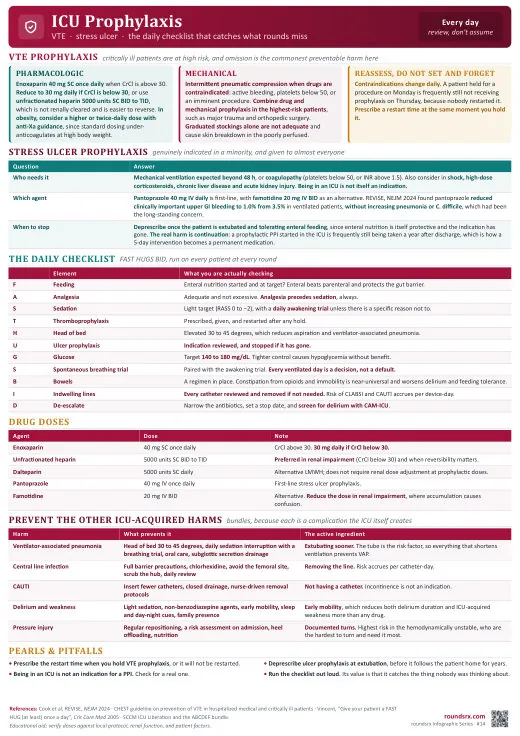
| Pharmacologic (preferred) | Enoxaparin (Lovenox) | 40 mg SC daily (or 30 mg SC q12h if BMI > 40 or CrCl < 30 → use UFH) |
| Heparin (unfractionated) | 5,000 units SC q8h (preferred if CrCl < 30 or high bleed risk -shorter half-life) | |
| Mechanical | SCDs (sequential compression devices) | Both legs, worn whenever in bed |
| Extended prophylaxis | Rivaroxaban (Xarelto) or Enoxaparin (Lovenox) | Post-discharge for high-risk medical (MARINER) or post-surgical (hip/knee) |
- Active bleeding
- Severe thrombocytopenia (platelets < 50K)
- Recent intracranial hemorrhage
- Epidural/spinal anesthesia (hold LMWH around procedure)
- HIT (heparin-induced thrombocytopenia) -use mechanical only or argatroban if treatment-dose needed
- Padua Score (medical) or Caprini Score (surgical) -on admission
- IMPROVE Bleed Score -if considering pharmacologic
- Platelet count -< 50K → mechanical only
- Creatinine/CrCl -CrCl < 30 → use UFH instead of LMWH
- Review medications -anticoagulants already on board?
| Drug | Dose | Key Notes |
|---|---|---|
| Enoxaparin (Lovenox) | 40 mg SC daily | Preferred LMWH. Predictable pharmacokinetics. No monitoring needed. |
| Heparin (UFH) | 5,000 units SC q8h | Use if CrCl < 30, high bleed risk (shorter half-life), or obese patients. |
| Fondaparinux (Arixtra) | 2.5 mg SC daily | Alternative if HIT. Factor Xa inhibitor. Renally cleared. |