2026 ACC/AHA/Multisociety Dyslipidemia Guideline
First major update since 2018. Released March 13, 2026 by ACC/AHA with AACVPR/ABC/ACPM/ADA/AGS/APhA/ASPC/NLA/PCNA. Retitled from "Blood Cholesterol" to "Dyslipidemia" to reflect the broader scope (LDL + non-HDL + apoB + Lp(a) + remnants). Core principle: "lower LDL for longer is better" -cumulative exposure analogous to pack-years. Here is everything that changed from the 2018 guideline and why it matters for your practice.
⚖️ 2018 Cholesterol Guideline vs 2026 Dyslipidemia Guideline
Full Comparison Table
| Domain | 2018 ACC/AHA Cholesterol Guideline | 2026 ACC/AHA/Multisociety Dyslipidemia Guideline | Impact |
|---|---|---|---|
| Risk Calculator | 2013 Pooled Cohort Equation (PCE). Validated age 40-79, race input (Black / non-Black), 10-yr risk only. | PREVENT-ASCVD (Khan et al, Circulation 2024) replaces PCE. Validated age 30-79, race removed, adds eGFR / UACR (CKD), HbA1c, BMI, social deprivation index. Estimates 10-year AND 30-year ASCVD risk. Generally produces lower 10-yr estimates than PCE, especially in Black patients and the elderly. | Major |
| Risk Categories | Low < 5%, borderline 5-7.5%, intermediate 7.5-20%, high ≥ 20% (10-yr ASCVD). | New thresholds: low < 3%, borderline 3-< 5%, intermediate 5-< 10%, high ≥ 10%. Bands lowered to compensate for PREVENT producing lower scores than PCE -population qualifying for statin is roughly preserved, but the math is more equitable (no race input). | Major |
| Primary Prevention LDL Goal | No numeric LDL goal. Recommended "≥ 50% LDL reduction" with high-intensity statin in high-risk; "30-49%" with moderate-intensity in intermediate. No mg/dL target. | NEW: numeric primary-prevention LDL goals. PREVENT ≥ 10% → LDL < 70 mg/dL. PREVENT 5-< 10% → LDL < 100 mg/dL. Brings primary prevention closer to the secondary-prevention framework. | Major |
| Secondary Prevention LDL Goal (clinical ASCVD) | LDL < 70 mg/dL universally for clinical ASCVD. "Very-high-risk" (2018 / 2022 consensus) suggested < 55 but was less formally codified. | Split into two tiers, codified. Very-high-risk ASCVD → LDL < 55 mg/dL, non-HDL-C < 85. Standard-risk ASCVD (clinical ASCVD without VHR features) → LDL < 70, non-HDL-C < 100. Most patients with clinical ASCVD qualify as very high risk. Elevated Lp(a) (≥ 50 mg/dL) does not change the very-high-risk definition; with ASCVD and goals unmet on a maximally tolerated statin it makes a PCSK9 antibody the recommended add-on (Class 1). | Major |
| Lp(a) Testing | "May be considered" as a risk enhancer in selected patients (FH, premature ASCVD family hx). Not routine. | Recommend Lp(a) measurement once per lifetime in all adults. Lp(a) ≥ 50 mg/dL (≥ 125 nmol/L) is a major risk enhancer. Lp(a) ≥ 50 + established ASCVD with goals unmet on a maximally tolerated statin → add a PCSK9 antibody (Class 1); it does not redefine very high risk. Cascade-screen family. PCSK9i / inclisiran lower Lp(a) modestly (~15-25%); investigational siRNA/ASO agents are in trials. | Major |
| ApoB Testing | Listed as an optional risk enhancer; no quantitative target. | Routine measurement in patients with elevated TG (> 200), diabetes, low LDL on therapy, or borderline-risk decisions. The guideline sets no tiered apoB goals. The paired numeric goals are LDL-C and non-HDL-C (< 55 / < 85, < 70 / < 100, < 100 / < 130). ApoB is a measurement recommendation: check it once LDL-C and non-HDL-C goals are met to find residual particle burden (Class 2a on lipid-lowering therapy, particularly ASCVD, CKM syndrome, type 2 diabetes or TG ≥ 150; Class 2b if not on therapy). The only numbers the guideline attaches to apoB are ≥ 120 as a risk enhancer, ≥ 140 alongside LDL ≥ 190 as severe hypercholesterolemia, and a single conditional apoB < 55 in that severe-hypercholesterolemia group once LDL < 55 and non-HDL < 85 are achieved. ApoB above goal when LDL appears at goal → intensify therapy (small-dense-LDL / remnant pattern). | Major |
| Early Intervention (young patients) | No formal "early intervention" category. Young patients with LDL 160-189 and no other risk factors mostly received lifestyle counseling unless severe (LDL ≥ 190 / FH). | NEW dedicated category. Start statin earlier when any of: HeFH at diagnosis (including children age 8-10), age ≤ 30 with LDL ≥ 160, strong family hx of premature ASCVD, or high 30-year PREVENT risk. Rationale: cumulative LDL exposure ("LDL pack-years") drives lifetime ASCVD risk; delaying treatment in young high-LDL patients wastes the longest-yield treatment window. | Major |
| Diabetes Statin Indication | DM age 40-75 with LDL 70-189 → moderate-intensity statin. High-intensity if ASCVD risk ≥ 7.5% or risk enhancers. | Moderate-intensity statin for everyone aged 40-75 with diabetes, regardless of the risk score (Class 1). Extended down to age 20-39 for long-duration diabetes (type 2 ≥ 10 yr, type 1 ≥ 20 yr) or a diabetes-specific risk enhancer: albuminuria ≥ 30 mg/g, eGFR < 60, retinopathy, neuropathy or ABI < 0.9 (Class 2b). High-intensity when there are multiple ASCVD risk factors (Class 2a). At 10-year PREVENT-ASCVD ≥ 10% the guideline adds ezetimibe or a PCSK9 antibody rather than changing statin intensity (Class 2b), established ASCVD, or multiple risk enhancers. ADA-aligned LDL goal < 70 if ASCVD; < 100 otherwise. | Moderate |
| Heterozygous FH (HeFH) | High-intensity statin recommended; treatment age generally adult. | Treat at diagnosis regardless of age. Supports statin in HeFH children from age 8-10. Combination therapy (statin + ezetimibe → PCSK9i / inclisiran) initiated earlier to reach goal. Cascade screening of first-degree relatives reinforced. | Moderate |
| Non-Statin Add-On Strategy | Stepwise ladder: statin → ezetimibe → PCSK9i mAb. Inclisiran not yet approved at time of 2018 publication; bempedoic acid had limited outcomes data. | Reframed as parallel options. After max-tolerated statin: ezetimibe / bempedoic acid / PCSK9i mAb (alirocumab, evolocumab) / inclisiran. Choose by cost, route preference, comorbidities, adherence. Combination therapy is the rule, not the exception, for very-high-risk ASCVD -starting two or three agents simultaneously is now explicitly supported when far from goal. | Major |
| Bempedoic Acid | Limited mention; outcome data not yet available. | Formally included as a non-statin option, especially for statin-intolerant patients. Supported by CLEAR Outcomes, 2023 -13% MACE reduction in statin-intolerant patients. PO daily; muscle symptoms minimal; small ↑ in uric acid / gout risk. | New |
| Inclisiran (siRNA) | Not approved; not in 2018 guideline. | Now formally included. Small-interfering RNA targeting hepatic PCSK9 mRNA. SC every 6 months after loading dose. ~50% LDL reduction; major adherence advantage. ORION-10/11, 2020. CV outcomes trial (ORION-4) ongoing. | New |
| HIV Primary Prevention | Treat per general primary-prevention guidance (PCE-driven); no HIV-specific recommendation. | Pitavastatin 4 mg recommended for primary prevention in HIV adults age 40-75 regardless of standard LDL threshold. Driven by REPRIEVE, 2023 -35% MACE reduction over 5 yr in low-to-moderate-risk HIV patients with LDL below traditional treatment threshold. Avoid simvastatin / lovastatin with protease inhibitors (CYP3A4). | New |
| Hypertriglyceridemia (ASCVD) | Statin first; fish oil / fibrate roles modest. REDUCE-IT not yet published. | Icosapent ethyl 2 g BID recommended for patients with established ASCVD (or DM with risk factors) and persistent TG 150-499 on statin. REDUCE-IT, 2019: 25% MACE reduction. Fibrate-class CV benefit beyond statin disproven by PROMINENT, 2022; fenofibrate retained only for pancreatitis prevention at TG ≥ 500. | Moderate |
| Lifetime Exposure Framing | Risk-based framework with discrete decisions at index visit. | "Lower LDL for longer is better" codified as a guiding principle. Cumulative LDL exposure ("LDL pack-years") drives lifetime ASCVD risk; CTT meta-analysis: each ~39 mg/dL LDL drop ≈ 22% MACE reduction per year, compounding over time. Drives earlier starts and lower targets. | Moderate |
| Statin Intensity Definitions | High (≥ 50% LDL ↓), moderate (30-49%), low (< 30%) with specific drug-dose mapping. | Unchanged from 2018 -atorva 40-80 / rosuva 20-40 = high-intensity; atorva 10-20 / rosuva 5-10 = moderate. No new drug-dose tiers introduced. | Maintained |
| CAC Scoring | Tiebreaker for borderline 5-7.5% PCE; "powerdown" strategy (CAC = 0 → defer statin) supported in selected patients. | Upgraded to Class 1 (2018: Class 2a) when the decision is uncertain at intermediate risk (5 to <10%) or in selected borderline-risk (3 to <5%) adults; men ≥ 40, women ≥ 45. Each CAC stratum now sets a goal: 1-99 → LDL < 100; 100-999 → LDL < 70 (300-999 reasonable to push to < 55); ≥ 1000 → LDL < 55. CAC = 0 still supports deferring a statin with repeat CAC in 3 to 7 years (2018: 5 to 10), but not with diabetes over age 40, current smoking, FH or LDL > 190, or a strong family history of premature ASCVD, because a zero does not de-risk those groups. | Major |
| Lipid Screening Age | Adults starting at age 20; repeat every 4-6 yr if normal. | Maintained. Adults starting at age 20; repeat every 4-6 yr if normal. New 2026 layer: measure Lp(a) once per lifetime, apoB in selected patients (see above). | Maintained |
| Fasting vs Non-Fasting | Non-fasting acceptable; fasting if TG > 400 needed for Friedewald. | Maintained. Non-fasting acceptable; redraw fasting if TG > 400. Friedewald LDL inaccurate at TG > 400 or LDL < 70 -use direct LDL or Martin-Hopkins method in those settings. | Maintained |
🔥 Key Changes at a Glance
Bottom Line: The 2026 ACC/AHA/Multisociety Dyslipidemia Guideline shifts lipid management toward earlier, lower, longer. PREVENT-ASCVD replaces the 2013 PCE (no race input, ages 30-79, 10- and 30-year risk). Primary prevention gets numeric LDL goals for the first time (< 70 high-risk, < 100 intermediate). Secondary prevention is split into very-high-risk (< 55) vs standard-risk (< 70). Lp(a) is measured once per lifetime in all adults, apoB routinely in residual-risk patients. Non-statin therapies are parallel options rather than a strict ladder. A new early-intervention category formalizes statin starts in young high-LDL patients (HeFH, age ≤ 30 with LDL ≥ 160, strong family hx).
🚨 The 7 Biggest Changes
1. PREVENT replaces the Pooled Cohort Equation
PREVENT-ASCVD is now the recommended risk tool for primary prevention age 30-79. Removes race as input, adds CKD (eGFR / UACR), HbA1c, BMI, social deprivation. Estimates 10- and 30-year risk. Generally produces lower 10-yr scores than PCE -especially in Black patients and the elderly.
2. New Risk Bands
Low < 3% / borderline 3-< 5% / intermediate 5-< 10% / high ≥ 10%. Replaces the 2018 PCE bands (< 5 / 5-7.5 / 7.5-20 / ≥ 20%). Lowered to compensate for PREVENT producing lower scores -population qualifying for statin is roughly preserved.
3. Numeric LDL Goals in Primary Prevention
NEW: PREVENT ≥ 10% → LDL < 70. PREVENT 5-< 10% → LDL < 100. 2018 had no numeric primary-prevention goal -only "≥ 50% reduction." Brings primary prevention closer to secondary-prevention math.
4. Two LDL Targets in Secondary Prevention
Very-high-risk ASCVD → LDL < 55, non-HDL-C < 85. Standard-risk ASCVD → LDL < 70, non-HDL-C < 100. Most patients with clinical ASCVD qualify as very high risk (multiple major events, or one event plus multiple high-risk conditions). 2018 used < 70 universally; 2022 consensus first proposed < 55, codified in 2026.
5. Lp(a) and ApoB Become Routine
Lp(a) once per lifetime in all adults. ApoB is measured once the LDL-C and non-HDL-C goals are met, particularly with TG ≥150, DM, or achieved LDL < 70, to expose residual particle burden the standard panel underestimates. The guideline sets no apoB goal tiers: the paired numeric goals are LDL-C with non-HDL-C (< 55 / < 85, < 70 / < 100, < 100 / < 130), and its only apoB numbers are ≥ 120 as a risk enhancer and ≥ 140 as a severe-hypercholesterolemia equivalent.
6. Early-Intervention Category
NEW: formalizes earlier statin starts in HeFH at diagnosis (incl. children 8-10), age ≤ 30 with LDL ≥ 160, strong family hx of premature ASCVD, or high 30-year PREVENT. Rationale: cumulative LDL exposure ("LDL pack-years") drives lifetime risk -don't waste the longest-yield treatment window.
7. Non-Statin Add-Ons as Parallel Options
Reframed from strict ladder to parallel options: ezetimibe / bempedoic acid (CLEAR Outcomes 2023) / PCSK9i mAb / inclisiran (siRNA, SC q6mo). Choose by cost, route, comorbidity, adherence. Combination therapy is the rule, not the exception, for very-high-risk ASCVD -start two or three agents simultaneously when far from goal.
📊 By the Numbers
10
Endorsing Societies
8
Years Since Last Update
< 55
LDL Goal (Very-High-Risk ASCVD)
30-79
PREVENT Validated Age Range
Full Clinical Protocol: Outpatient Lipid Management Topic → |
External: Full Guideline (Circulation) → |
ACC Press Release →
🆕 Entirely New in 2026
What's Genuinely New (Not Just Refined)
Several elements of the 2026 guideline did not exist in any form in 2018. These are the highest-yield "this is new" topics for board review and clinic.
📐 PREVENT 30-Year Risk Estimation
PCE only estimated 10-year risk. PREVENT estimates BOTH 10- and 30-year ASCVD risk. The 30-year horizon enables the new "early intervention" category -treat young patients with high lifetime exposure even when their 10-year score is low.
🎯 Numeric Primary-Prevention LDL Goals
For the first time in an ACC/AHA cholesterol guideline, primary prevention has explicit mg/dL targets: < 70 (high-risk) and < 100 (intermediate-risk). 2018 only specified percentage reductions without numeric goals. Aligns primary prevention with the secondary-prevention framework.
🧬 Routine Lp(a) Measurement
Once per lifetime in all adults. Genetic, doesn't change with lifestyle or statin. Lp(a) ≥ 50 mg/dL (≥ 125 nmol/L) = major risk enhancer. Lp(a) ≥ 50 plus established ASCVD with goals unmet on a maximally tolerated statin → add a PCSK9 antibody (Class 1); it does not by itself redefine very high risk. Cascade-screen first-degree relatives. PCSK9i and inclisiran lower Lp(a) modestly (~15-25%); investigational siRNA / ASO agents (pelacarsen, olpasiran, lepodisiran) in late-phase trials.
🧪 Routine ApoB Measurement
ApoB counts every atherogenic particle (one apoB per LDL, VLDL, IDL, Lp(a)). When LDL appears at goal but apoB exceeds it, the patient has small-dense-LDL or remnant-rich profile -still residual ASCVD risk. The 2026 guideline does not publish apoB goal tiers: it recommends measuring apoB to expose residual risk once the LDL-C and non-HDL-C goals are met (Class 2a on therapy, Class 2b off therapy), and its only apoB numbers are ≥ 120 as a risk enhancer and ≥ 140 as a severe-hypercholesterolemia equivalent. 2018 mentioned apoB only as an optional risk enhancer.
🌱 Early-Intervention Category
Statin start before the traditional age-40 cutoff for any of: HeFH at diagnosis (including children 8-10), age ≤ 30 with LDL ≥ 160, strong family hx of premature ASCVD, or high 30-year PREVENT. Rationale: cumulative LDL exposure ("LDL pack-years") drives lifetime ASCVD risk -delaying treatment in young high-LDL patients wastes the longest-yield treatment window.
💊 Inclisiran (siRNA)
Small-interfering RNA targeting hepatic PCSK9 mRNA. SC injection at day 0, 90, then every 6 months. ~50% LDL reduction, sustained. Twice-yearly dosing is a major adherence advantage vs PCSK9 mAbs (q2-4 wk). ORION-10/11, 2020; CV outcomes trial (ORION-4) ongoing. Not in the 2018 guideline at all.
💊 Bempedoic Acid (Outcomes Data)
ATP-citrate lyase inhibitor; activated only in liver, not muscle (no myalgia). PO daily. CLEAR Outcomes, 2023: 13% MACE reduction in statin-intolerant patients with or at high risk for ASCVD. Now formally included in the 2026 ladder. Watch for ↑ uric acid / gout.
🦠 HIV Primary Prevention (REPRIEVE)
Pitavastatin 4 mg recommended in HIV adults age 40-75 regardless of standard LDL threshold. REPRIEVE, 2023: 35% MACE reduction over 5 yr. Avoid simva / lova with protease inhibitors (CYP3A4); pitavastatin or pravastatin preferred.
🐟 Icosapent Ethyl for Residual TG-Driven Risk
Icosapent ethyl 2 g BID for ASCVD (or DM with risk factors) and persistent TG 150-499 on statin. REDUCE-IT, 2019. Distinct from generic OTC fish oil (mixed EPA / DHA), which has not shown CV benefit. PROMINENT, 2022 closed the door on fibrate-class CV benefit beyond statin -fenofibrate retained for pancreatitis prevention at TG ≥ 500.
📜 "Lower for Longer" Mantra
First time codified as a guiding principle in an ACC/AHA cholesterol document. Cumulative LDL exposure ("LDL pack-years") drives lifetime ASCVD risk; CTT meta-analysis shows each ~39 mg/dL LDL drop ≈ 22% MACE reduction per year, compounding over time. Drives earlier starts and lower targets.
Key Trials Supporting the 2026 Changes
| Trial | Year | Finding | 2026 Impact |
|---|---|---|---|
| FOURIER | 2017 | Evolocumab on top of statin: 15% MACE reduction; safe down to LDL ~ 30 | Supports lower LDL targets and PCSK9i add-on |
| ODYSSEY OUTCOMES | 2018 | Alirocumab post-ACS: 15% MACE reduction; mortality benefit in LDL ≥ 100 subgroup | Supports PCSK9i in very-high-risk ASCVD |
| REDUCE-IT | 2019 | Icosapent ethyl 2 g BID on statin (TG 135-499): 25% MACE reduction | Codifies icosapent ethyl for residual TG-driven risk |
| ORION-10/11 | 2020 | Inclisiran q6mo: ~50% LDL reduction sustained | Inclisiran formally entered the 2026 ladder |
| PROMINENT | 2022 | Pemafibrate: lowered TG ~26% but NO MACE reduction | Closed the door on fibrate-class ASCVD benefit; fenofibrate now only for pancreatitis prevention |
| CLEAR Outcomes | 2023 | Bempedoic acid in statin-intolerant: 13% MACE reduction | Bempedoic acid formally entered the 2026 ladder |
| REPRIEVE | 2023 | Pitavastatin 4 mg in HIV age 40-75 below standard LDL threshold: 35% MACE reduction | HIV-specific primary-prevention statin recommendation |
| PREVENT (Khan et al) | 2024 | New ASCVD risk equations: race-free, ages 30-79, adds CKD / HbA1c / SDI, 10-yr + 30-yr | Replaced the 2013 PCE as the recommended risk tool |
| CTT meta-analysis | 2010 / 2015 | Each ~39 mg/dL LDL drop ≈ 22% MACE reduction per year | Foundation for "lower for longer is better" principle |
Full Clinical Protocol: Outpatient Lipid Management Topic → |
External: Full Guideline (Circulation) → |
ACC Press Release → |
National Lipid Association Summary →
📄 One Pager
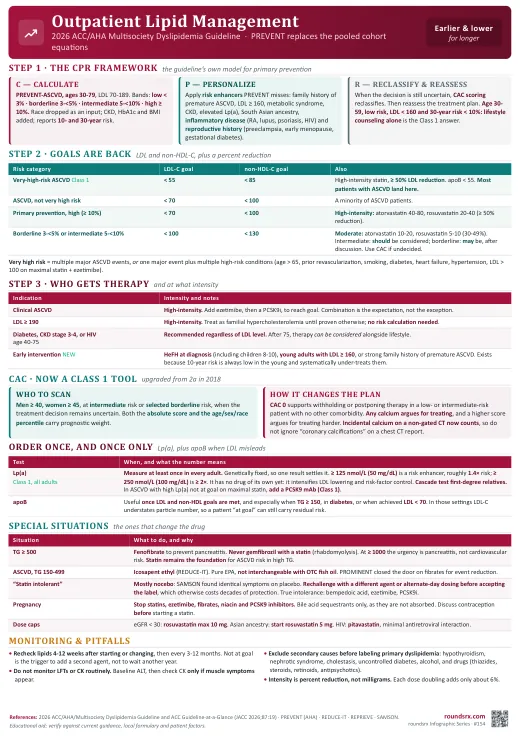
Text version
CARDIOLOGY · One Pager
2026 ACC/AHA Dyslipidemia Guideline: What Changed
First major update since 2018, and the whole document rests on one principle: lower LDL for longer is better, because cumulative exposure works like pack-years.
New Risk Tool and Bands
- PREVENT-ASCVD replaces the 2013 Pooled Cohort Equation. Validated ages 30–79, race removed, adds eGFR / UACR, HbA1c, BMI, and social deprivation index, and estimates 10-year AND 30-year risk.
- New bands: low <3%, borderline 3 to <5%, intermediate 5 to <10%, high ≥10%. Replaces <5 / 5–7.5 / 7.5–20 / ≥20%.
- Why the bands dropped: PREVENT produces lower 10-year estimates than PCE, especially in Black patients and the elderly, so lowering the thresholds keeps roughly the same population eligible for statin while removing race from the math.
- The 30-year horizon is what enables the new early-intervention category, since a young patient with high lifetime exposure can have a low 10-year score.
- Lipid screening unchanged: adults from age 20, repeat every 4–6 years if normal. New layer on top is Lp(a) once per lifetime and apoB in selected patients.
- Fasting rules unchanged: non-fasting acceptable, redraw fasting if TG >400. Friedewald is inaccurate at TG >400 or LDL <70, so use direct LDL or Martin-Hopkins there.
New LDL-C and Non-HDL-C Goals
- Very-high-risk ASCVD: LDL <55 mg/dL, non-HDL-C <85. 2018 used <70 universally; the 2022 consensus proposed <55 and 2026 codified it.
- Standard-risk ASCVD (clinical ASCVD without very-high-risk features): LDL <70.
- Primary prevention, PREVENT ≥10%: LDL <70. Genuinely new, since 2018 had no numeric primary-prevention goal at all, only "≥50% reduction."
- Primary prevention, PREVENT 5 to <10%: LDL <100. 2018 only said "30–49% reduction" with a moderate-intensity statin.
- Every LDL-C goal is paired with a non-HDL-C goal, not an apoB goal: <55 / <85, <70 / <100, <100 / <130. The guideline publishes no apoB goal tiers. ApoB is measured after those two goals are met, because a high apoB with LDL at goal means a small-dense-LDL or remnant pattern with residual risk; its only numbers are ≥120 (risk enhancer) and ≥140 (severe-hypercholesterolemia equivalent).
- Elevated Lp(a) (≥50 mg/dL) with ASCVD does not redefine very high risk; it makes a PCSK9 antibody the recommended add-on (Class 1) when LDL-C and non-HDL-C goals are unmet on a maximally tolerated statin. Very high risk itself means multiple major ASCVD events, or one event plus multiple high-risk conditions, and covers most patients with clinical ASCVD.
The Seven Biggest Changes
1
PREVENT replaces the PCE: ages 30–79, no race input, adds CKD / HbA1c / BMI / social deprivation, gives 10-year and 30-year risk.
2
New risk bands: <3 / 3 to <5 / 5 to <10 / ≥10%, lowered to compensate for PREVENT scoring lower than PCE.
3
Numeric LDL goals in primary prevention for the first time: <70 if PREVENT ≥10%, <100 if 5 to <10%. This brings primary prevention into the same framework as secondary prevention.
4
Secondary prevention split into two tiers: very-high-risk gets LDL <55 with non-HDL-C <85, standard-risk stays at LDL <70 with non-HDL-C <100.
5
Lp(a) and apoB become routine: Lp(a) once per lifetime in all adults, apoB routinely when TG ≥150, diabetes, low LDL on therapy, or a borderline-risk decision.
6
New early-intervention category: HeFH at diagnosis including children age 8–10, age ≤30 with LDL ≥160, strong family history of premature ASCVD, or high 30-year PREVENT. Delaying treatment in a young high-LDL patient wastes the longest-yield treatment window.
7
Non-statin add-ons reframed as parallel options, not a strict ladder: ezetimibe / bempedoic acid / PCSK9i mAb / inclisiran, chosen by cost, route, comorbidity, and adherence. Combination therapy is the rule, not the exception, for very-high-risk ASCVD.
Drugs New or Newly Positioned
Bempedoic acidPO daily; formally included, especially for statin-intolerant patients. Muscle symptoms minimal; watch uric acid and gout
Inclisiran (siRNA)SC every 6 months after loading; ~50% LDL reduction, major adherence advantage. Not in the 2018 guideline at all
PCSK9i mAbalirocumab or evolocumab; now a parallel option rather than the last rung of a ladder
Pitavastatin4 mg for primary prevention in HIV adults age 40–75 regardless of standard LDL threshold
Icosapent ethyl2 g BID for established ASCVD (or DM with risk factors) and persistent TG 150–499 on statin
Fenofibrateretained only for pancreatitis prevention at TG ≥500, because fibrate-class CV benefit beyond statin was disproven
What Stayed the Same
- Statin intensity definitions unchanged: atorvastatin 40–80 or rosuvastatin 20–40 is high-intensity, atorvastatin 10–20 or rosuvastatin 5–10 is moderate. No new drug-dose tiers.
- Lipid screening from age 20, repeat every 4–6 years if normal.
- Non-fasting panels remain acceptable, with a fasting redraw only if TG >400.
- CAC was upgraded to Class 1 (2018: Class 2a) when the decision is uncertain at intermediate risk (5 to <10%) or in selected borderline-risk (3 to <5%) adults, and each stratum now sets a goal: 1–99 → LDL <100; 100–999 → LDL <70; ≥1000 → LDL <55. CAC = 0 still supports deferring a statin (repeat in 3 to 7 years), but not with diabetes over 40, smoking, FH, or a strong family history of premature ASCVD, since a zero does not de-risk those groups.
Pitfalls
- Do not carry forward the old PCE bands. Calling 7.5% "intermediate" is a 2018 reflex; under PREVENT, 7.5% sits in the 5 to <10% intermediate band with an LDL goal of <100.
- Do not apply a percentage rule to a patient with prior ASCVD. The <55 goal comes from feature-based very-high-risk classification, not from a risk score.
- Do not quote any apoB goal tiers. The 2026 guideline publishes none, so <55 / <70 / <90 and <55 / <65 / <80 / <90 are both misattributions. Pair the LDL-C goal with the non-HDL-C goal instead, and use apoB as a measurement that exposes residual risk once those are met.
- Do not substitute mixed omega-3 for icosapent ethyl. The outcome data belongs to icosapent ethyl.
- Do not treat a normal LDL as the end of the assessment when apoB exceeds the matched target; that residual particle burden still carries ASCVD risk.
- Do not avoid simvastatin or lovastatin questions in HIV. They interact with protease inhibitors via CYP3A4 and must be avoided.
Population-Specific Changes
- Diabetes, EXPANDED: 2018 covered age 40–75; 2026 adds age 30–39 when LDL ≥160 or 30-year PREVENT is elevated. Intensification is driven by 10-year PREVENT ≥10%, established ASCVD, or multiple risk enhancers. Goal LDL <70 if ASCVD, <100 otherwise.
- Heterozygous FH, EARLIER START: treat at diagnosis regardless of age, with statin supported in HeFH children from age 8–10. Combination therapy is started earlier to reach goal, and cascade screening of first-degree relatives is reinforced.
- HIV, NEW: pitavastatin 4 mg for primary prevention in adults age 40–75 regardless of the standard LDL threshold.
- Hypertriglyceridemia: icosapent ethyl 2 g BID for ASCVD or DM with risk factors and persistent TG 150–499 on statin; fenofibrate now only for pancreatitis prevention at TG ≥500.
- Lp(a), MAJOR: measure once per lifetime in all adults. ≥50 mg/dL (≥125 nmol/L) is a major risk enhancer, and cascade screening of family follows. PCSK9i and inclisiran lower Lp(a) only modestly (~15–25%).
Key Evidence Behind the Changes
- CTT meta-analysis, 2010 / 2015: each ~39 mg/dL LDL drop is about a 22% MACE reduction per year, compounding over time. This is the arithmetic behind "lower for longer."
- FOURIER, 2017: evolocumab on top of statin cut MACE 15% and was safe down to LDL ~30, supporting lower targets.
- ODYSSEY OUTCOMES, 2018: alirocumab post-ACS cut MACE 15%, supporting PCSK9i in very-high-risk ASCVD.
- REDUCE-IT, 2019: 25% MACE reduction, which is what codified icosapent ethyl for residual TG-driven risk.
- ORION-10/11, 2020: ~50% LDL reduction sustained, bringing inclisiran into the 2026 options. CV outcomes trial ORION-4 is ongoing.
- PROMINENT, 2022: pemafibrate lowered TG ~26% with no MACE reduction, which closed the door on fibrate-class CV benefit beyond statin.
- CLEAR Outcomes, 2023: 13% MACE reduction in statin-intolerant patients, formally putting bempedoic acid on the list.
- REPRIEVE, 2023: 35% MACE reduction over 5 years in HIV patients whose LDL sat below the traditional treatment threshold.
- PREVENT (Khan et al), 2024: the race-free equations, ages 30–79, adding CKD / HbA1c / SDI with 10-year and 30-year output, that replaced the PCE.