Ebola Virus Disease
A filovirus causing severe viral hemorrhagic fever with case-fatality 25 to 90% by species. The intern’s job is recognition, isolation, and calling the right people. Aggressive supportive care saves lives independent of any drug. Inmazeb, Ebanga, and Ervebo are Zaire-ebolavirus-only, the active 2026 outbreak is Bundibugyo virus, so the approved drugs do not apply.
🔍 Overview
🚨 Active 2026 Outbreak (PHEIC declared May 17, 2026): Ebola disease caused by Bundibugyo ebolavirus in the Democratic Republic of the Congo (DRC) and Uganda. As of May 26, 2026: DRC has 121 confirmed cases (17 deaths) plus 1,077 suspected cases (238 deaths) in Ituri, North Kivu, and South Kivu provinces. Uganda has 7 confirmed cases (1 death). Two suspected travel-related cases in Lombardy, Italy (returning from Uganda) tested negative on May 25, 2026.
Why this is clinically critical: Inmazeb (atoltivimab/maftivimab/odesivimab), Ebanga (ansuvimab), and the Ervebo (rVSV-ZEBOV-GP) vaccine are all approved for Zaire ebolavirus only. Against Bundibugyo, none of them are indicated. Supportive care is the entire toolkit for the current outbreak strain. Sources: WHO Disease Outbreak News (May 2026); ECDC; CDC Travel Health Notices.
Why this is clinically critical: Inmazeb (atoltivimab/maftivimab/odesivimab), Ebanga (ansuvimab), and the Ervebo (rVSV-ZEBOV-GP) vaccine are all approved for Zaire ebolavirus only. Against Bundibugyo, none of them are indicated. Supportive care is the entire toolkit for the current outbreak strain. Sources: WHO Disease Outbreak News (May 2026); ECDC; CDC Travel Health Notices.
What Ebola is
Ebola virus disease (EVD) is a severe, often fatal illness caused by viruses in the Filoviridae family (same family as Marburg). Five species infect humans, with different geography and lethality. Transmission is by direct contact with body fluids (blood, vomit, diarrhea, saliva, breast milk, semen, sweat) of a symptomatic case or recently-deceased body, or with contaminated surfaces and fomites. Not airborne under standard conditions. Incubation is 2 to 21 days (most 8 to 10).
The Five Species (and Why It Matters at the Bedside)
| Species | Geography | Case Fatality | Approved MCM | Approved Vaccine |
|---|---|---|---|---|
| Zaire ebolavirus | DRC, West Africa (2014–16 epidemic), most US-imported cases | 40–90% (untreated); ~28–35% with MCM + supportive care | Inmazeb (atoltivimab/maftivimab/odesivimab); Ebanga (ansuvimab) | Ervebo (rVSV-ZEBOV-GP), single dose, ages ≥12 |
| Sudan ebolavirus | Uganda, Sudan/South Sudan | 40–60% | None approved. cAd3-EBO-S and ChAd3-SUDV candidates deployed under trial protocols during outbreaks. | None approved. |
| Bundibugyo ebolavirus 2026 OUTBREAK | DRC, Uganda (2007, 2012, 2026) | 25–50% | None approved. Investigational MCMs case-by-case via NIH/CDC; cross-reactivity of Zaire-targeted antibodies is incomplete and not a substitute. | None approved. |
| Tai Forest ebolavirus | Côte d’Ivoire (single human case, 1994) | Single survivor | None approved. | None approved. |
| Reston ebolavirus | Philippines, China (in non-human primates and swine) | No human disease documented | Not applicable | Not applicable |
Why this table matters: the species drives whether any species-specific drug is even on the menu. If a returning traveler from DRC or Uganda in 2026 presents with Ebola, the working assumption is Bundibugyo until species-confirmed, and the medication shelf is empty. Supportive care is the proven backbone. Reaching for Inmazeb in a Bundibugyo case is not just unhelpful, it can delay supportive interventions and falsely reassure the team.
Transmission
- Direct contact with body fluids of a symptomatic case (blood, vomit, diarrhea, saliva, semen, breast milk, sweat, urine) or with corpses (funeral practices are a major outbreak amplifier in endemic regions).
- Fomites: needles, bedding, exam gloves, environmental surfaces contaminated by body fluids. Virus persists hours to days on surfaces depending on conditions.
- Healthcare-associated transmission is the dominant pattern in hospital outbreaks, driven by inadequate PPE and high-risk procedures (suctioning, intubation, dialysis, post-mortem handling).
- Sexual transmission from male survivors documented up to 12+ months post-recovery (semen RT-PCR can remain positive for >1 year). Breast milk and ocular fluid also harbor persistent virus.
- Not airborne in routine clinical settings. Aerosol-generating procedures (intubation, BiPAP, open suctioning, CPR) can produce infectious droplet nuclei, which is why those procedures require enhanced PPE and ideally a negative-pressure room.
- Patients are not contagious before symptom onset, which is the basis for 21-day contact monitoring rather than blanket isolation.
Clinical Phases
| Phase | Days | Features | Why It Matters |
|---|---|---|---|
| 1. Early febrile (“dry”) | Days 1–3 | Abrupt fever, severe fatigue, myalgia, headache, sore throat, conjunctival injection. Looks like flu or malaria. | Most cases get missed here. Travel history within 21 days is the single most important screening question. Pretest probability is everything. |
| 2. GI (“wet”) | Days 3–10 | Severe vomiting, profuse watery diarrhea (5–10 L/day), abdominal pain, anorexia, hiccups. Maculopapular rash in ~25% (often missed on darker skin). | This is where supportive care saves lives. Hypovolemic shock and electrolyte derangements (hypokalemia, hypomagnesemia, hypocalcemia) are the proximate killers, not the virus itself. IV fluids and electrolyte repletion are the highest-yield interventions. |
| 3. Critical / shock | Days 7–12 | Hypovolemic and/or distributive shock, AKI, hepatitis (AST > ALT, often 5–10× ULN), encephalopathy, hemorrhage in ~20% (GI bleeding, petechiae, gingival, conjunctival, IV-site oozing). | Hemorrhage is not universal and not required for diagnosis. The classic “hemorrhagic fever” image is overstated, most patients die from shock and multi-organ failure, not exsanguination. |
| 4. Recovery or death | Days 8–16 | Death typically days 8–16. Survivors enter prolonged convalescence with fatigue, arthralgias, uveitis, hearing loss, neurocognitive symptoms. | Post-Ebola syndrome is real and underrecognized. Survivors need ophthalmology, audiology, and mental health follow-up; CNS, ocular, and genital tract are sanctuary sites where virus can persist. |
When to Suspect (Triage Red Flags)
Suspect Ebola if BOTH:
- Clinical: fever ≥38°C OR any compatible symptom (severe headache, myalgia, vomiting, diarrhea, abdominal pain, unexplained bleeding).
- Exposure within 21 days: travel to or residence in an active Ebola outbreak country (currently DRC, Uganda); OR contact with a known/suspected Ebola case; OR contact with body fluids of a sick or deceased person in an outbreak area; OR direct handling of bats, non-human primates, or bushmeat in endemic regions; OR work in a lab handling filoviruses.
Differential Diagnosis in a Febrile Returning Traveler
- Malaria (Plasmodium falciparum), by far the most common cause of febrile illness in returning travelers from sub-Saharan Africa, and the most likely diagnosis even when Ebola is on the differential. Always rule out malaria first with thick and thin smears or rapid diagnostic test, even before Ebola PCR. Missed falciparum kills within 24 hours.
- Typhoid fever (Salmonella Typhi), 1–2 week onset, relative bradycardia, rose spots, hepatosplenomegaly.
- Other viral hemorrhagic fevers: Marburg (filovirus, same family, same PPE), Lassa (West Africa, rat-borne, distinct epidemiology), Crimean-Congo (tick-borne, Eurasia/Africa), severe dengue (Asia, Latin America).
- Rickettsial disease (African tick bite fever, scrub typhus), eschar, regional adenopathy, treat empirically with doxycycline.
- Leptospirosis, freshwater exposure, conjunctival suffusion, jaundice + AKI.
- Meningococcemia, petechiae or purpura fulminans, requires immediate ceftriaxone.
- Acute HIV seroconversion, viral hepatitis (A, B, E), measles, also on the list for nonspecific febrile illness.
🧪 Workup
The CDC Framework: Identify, Isolate, Inform
This is the entire intern playbook. Three steps, in order, before any other workup.
- Identify, screen every febrile patient at triage for travel history and exposure within 21 days. One question added to triage is the difference between a contained case and a hospital outbreak.
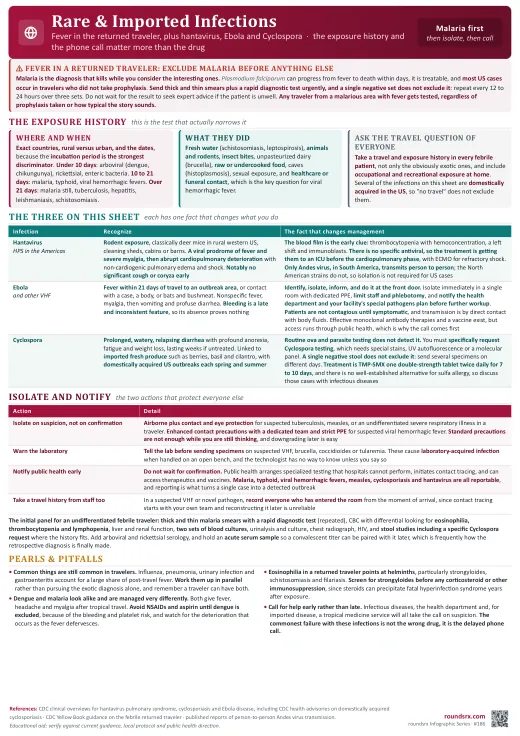
- Isolate, immediately to a single room with private bathroom (or dedicated commode), door closed, dedicated equipment, sign-in log. Limit entries to essential personnel only. Mask the patient. PPE for anyone entering (see Prevention tab).
- Inform, in this order: charge nurse → hospital infection control / hospital epidemiologist → state or local health department → CDC Emergency Operations Center 770-488-7100 (24/7).
What NOT to Do Until Cleared
Until the patient is risk-stratified and public health has guided next steps:
- No routine venipuncture or blood draws, every blood-handling step is an exposure. Only essential labs for clinical decision-making (malaria smear, basic chemistries, CBC), drawn by experienced staff in proper PPE, processed in a sealed transport container, lab notified in advance.
- No central lines, no arterial lines, no LP, no surgery unless absolutely life-saving. Every needle stick is a potential transmission event.
- No aerosol-generating procedures (intubation, BiPAP, open suctioning, nebulizers, bronchoscopy) without enhanced PPE and a negative-pressure room.
- No transport for imaging until cleared. Bedside chest X-ray and ultrasound only.
- No moving the patient through public spaces. No family visits. No food trays in and out without containment.
Laboratory Workup (Once Approved)
- Ebola RT-PCR from EDTA whole blood, the gold standard. Run through the Laboratory Response Network (LRN) via the state public health lab, never the routine hospital lab. RT-PCR can be falsely negative within the first 72 hours of symptoms, repeat at 72 hours from symptom onset if initial test is negative and clinical suspicion persists. PCR sensitivity is >95% once symptomatic for >72 hours.
- Malaria thick and thin smears AND malaria RDT, mandatory and immediate. A returning traveler with fever has falciparum until proven otherwise.
- CBC with differential, leukopenia early then leukocytosis with left shift, thrombocytopenia (often <100K), lymphopenia.
- BMP, Mg, Phos, ionized Ca, profound electrolyte derangements drive the morbidity. Track every 6–12 hours during the wet phase.
- LFTs, AST > ALT (often 5–10× ULN), suggests hepatocellular injury and is a useful severity marker. Bilirubin often only mildly elevated.
- Coags + fibrinogen + D-dimer, DIC pattern in severe disease (prolonged PT/aPTT, low fibrinogen, very high D-dimer).
- Lactate, troponin, CK, end-organ markers; lactate tracks shock severity.
- Blood cultures × 2, gram-negative bacteremia from gut translocation is common and treatable; do not skip just because you suspect Ebola.
- Pregnancy test in any woman of reproductive age, EVD in pregnancy is nearly uniformly fatal to the fetus and risk to mother is high; changes counseling and obstetric coordination.
- Type and screen, HIV, hepatitis serologies, anticipate transfusion needs and confirm baseline status.
Imaging and Bedside Tests
- Bedside CXR, usually unremarkable early; ARDS pattern if pulmonary involvement or fluid overload from over-resuscitation.
- Bedside ultrasound (POCUS), IVC for volume status, lungs for B-lines, FAST for free fluid in the abdomen if hemorrhage suspected. POCUS minimizes patient movement and exposure.
- ECG, baseline QTc before any QT-prolonging antiemetics or antibiotics; myocarditis can occur.
Risk Stratification by CDC Exposure Tier
| Tier | Definition | Action |
|---|---|---|
| High risk | Percutaneous or mucous-membrane exposure to body fluids of a confirmed case; unprotected direct contact with a corpse in an outbreak area; lab handling without proper PPE. | Direct active monitoring × 21 days. Confine movement. Public health-supervised isolation if symptomatic. |
| Some risk | Household contact with confirmed case; direct contact with case while wearing PPE; healthcare worker in an outbreak setting with PPE breaches. | Active monitoring × 21 days. Restricted travel. Symptom-triggered isolation. |
| Low (but not zero) risk | Travel from outbreak country without specific contact; brief direct contact (e.g., handshake) with a symptomatic case while wearing PPE. | Passive self-monitoring × 21 days with reporting to public health if febrile. |
| No identifiable risk | Travel from non-outbreak countries adjacent to affected areas; contact with asymptomatic person who later tested negative. | No restrictions. |
🩺 Management
Cornerstone: aggressive supportive care drops mortality from ~50% toward 25% even without any species-specific drug. This is true for every Ebola species. The intern’s leverage is on volume, electrolytes, glucose, and infection control, not on chasing a monoclonal antibody.
Volume Resuscitation
- Balanced crystalloid (LR or Plasma-Lyte) IV, large volumes are often needed during the wet phase (losses of 5–10 L/day). Match output plus insensible losses. Avoid normal saline alone in large volumes, the chloride load worsens an already-deranged acid-base picture (hyperchloremic acidosis on top of lactic acidosis from shock).
- Strict I/O, with hourly nursing assessment during the wet phase. Daily weights when feasible.
- Oral rehydration (WHO ORS) is the global standard when IV access is unavailable; in US ICUs, IV is faster but ORS still has a role in stable patients with persistent diarrhea.
- Avoid fluid overload, capillary leak makes pulmonary edema easy to precipitate in late disease. Re-assess with POCUS, do not just keep bolusing.
Electrolyte and Metabolic Repletion
- Hypokalemia, replete to K ≥4.0 mEq/L; oral KCl preferred when tolerated to limit invasive lines. Hypomagnesemia coexists and must be corrected first or potassium will not stay in (renal wasting in the presence of low Mg).
- Hypocalcemia, hypomagnesemia, hypophosphatemia, frequent and severe with massive GI losses. Check ionized calcium, not just total.
- Hypoglycemia, common, especially in pediatric and malnourished patients; check glucose every 4–6 hours, treat with D10 or D50 IV depending on severity.
- Acidosis, lactic acidosis from shock, anion-gap acidosis from AKI, hyperchloremic from NS over-use; fix the perfusion problem, not the bicarbonate number. Bicarb infusion only if pH <7.1 with hemodynamic compromise.
Hemodynamic Support
- Norepinephrine first-line vasopressor for shock unresponsive to volume. Target MAP ≥65.
- Vasopressin as second agent if escalating norepinephrine.
- Stress-dose hydrocortisone (50 mg IV q6h) if catecholamine-refractory shock, same SSC 2026 logic as any septic shock.
- Avoid invasive lines until PUI status is clarified. When a central line is unavoidable, ultrasound-guided single-pass attempt by the most experienced operator, dedicated sharps disposal at the bedside, never recap a needle.
Bleeding Management (if Present)
- Hemorrhage occurs in ~20% of cases and is rarely the immediate cause of death; do not let “hemorrhagic fever” framing distract from the bigger threats (shock, electrolytes, AKI).
- Transfusion thresholds, same as any critically ill patient: Hb 7 g/dL (TRICC/TRISS), platelets <10K prophylactic or <50K with active bleeding, FFP and cryoprecipitate guided by INR / fibrinogen.
- Tranexamic acid 1 g IV in active hemorrhage with hemodynamic compromise, extrapolated from CRASH-2.
- DIC pattern is common in late disease, treat the underlying virus and shock, transfuse to clinical bleeding rather than chasing numbers.
Symptom Control
- Antiemetics, ondansetron 4–8 mg IV q8h, watch QTc (already at risk in shock and electrolyte chaos). Metoclopramide is a backup.
- Antidiarrheals, loperamide is controversial because of theoretical concerns about retained virus; in practice WHO and CDC permit it for severe diarrhea once infectious gastroenteritis (C. diff, Salmonella) is excluded.
- Fever and pain, scheduled acetaminophen. Avoid NSAIDs and aspirin, they worsen AKI and amplify bleeding risk in DIC. Opioids cautiously for severe pain.
- Anxiety, delirium, low-dose haloperidol or quetiapine; benzodiazepines second-line and avoid in hemodynamically unstable patients.
Species-Specific Monoclonal Antibodies
⚠️ Critical species caveat: the two FDA-approved Ebola monoclonal antibodies, Inmazeb and Ebanga, are licensed only for Zaire ebolavirus. They are not indicated and are not expected to work for Sudan, Bundibugyo, Tai Forest, or Reston ebolaviruses. For the 2026 Bundibugyo outbreak, neither drug is on the menu.
| Drug | Composition | Dose | Indication | Evidence |
|---|---|---|---|---|
| Inmazeb (REGN-EB3) | Cocktail of three human monoclonal antibodies (atoltivimab, maftivimab, odesivimab) targeting Ebola glycoprotein | 50 mg/kg of each component (150 mg/kg total) IV ×1 | Zaire ebolavirus only, adults and pediatric including neonates born to Ebola-positive mothers | PALM, 2019 reduced 28-day mortality to 33.5% vs 49.7% with ZMapp |
| Ebanga (ansuvimab, mAb114) | Single human monoclonal antibody against Ebola glycoprotein, derived from a 1995 Kikwit survivor | 50 mg/kg IV ×1 | Zaire ebolavirus only, adults and pediatric including neonates | PALM, 2019 28-day mortality 35.1%, comparable to Inmazeb |
- Both monoclonals work best when given early, mortality benefit is strongest in patients with lower viral loads at presentation. Do not delay supportive care while arranging drug access.
- How to access: in the US, both are stockpiled by HHS / BARDA and released through the Strategic National Stockpile during an outbreak. Coordinate via state health department and CDC EOC; do not call the pharmacy expecting it on the shelf.
- For Sudan, Bundibugyo, Tai Forest, no approved MCM. Investigational antibodies (e.g., MBP134 cross-reactive cocktail) may be available case-by-case under expanded access via NIH/CDC; supportive care remains the proven intervention.
- Remdesivir and ZMapp are no longer recommended for Ebola, both were inferior to Inmazeb and Ebanga in PALM, do not substitute for the licensed drugs.
Empiric Co-Infection Coverage
- Empiric anti-malarial, artemether-lumefantrine or IV artesunate based on severity, until smear and RDT are negative. Falciparum kills faster than Ebola in the first 48 hours and is treatable.
- Empiric broad-spectrum antibiotics, ceftriaxone 2 g IV daily covers gram-negative bacteremia from gut translocation, common in advanced EVD. Add vancomycin if line infection suspected. Continue 5–7 days or until cultures clarify.
- Antifungal coverage not routine; consider if prolonged broad-spectrum antibiotic exposure or invasive lines.
Complications to Watch
- AKI, from volume depletion, direct viral cytopathy, and pigmenturia (myoglobin, hemoglobin). Daily renal function. Renal replacement therapy (CRRT preferred over intermittent HD because of hemodynamic instability) for refractory acidosis, volume overload, or uremia.
- ARDS, from over-resuscitation, capillary leak, or aerosol exposure. Lung-protective ventilation (TV 6 mL/kg PBW, plateau ≤30, prone if P/F <150) per ARDSNet and PROSEVA.
- Myocarditis, troponin elevation and depressed EF can occur; supportive, no specific therapy.
- Hepatitis, AST > ALT, transaminases often 5–10× ULN; supportive.
- Encephalopathy, multi-factorial (uremia, electrolytes, fever, direct CNS involvement). Address reversible causes.
- Late: post-Ebola syndrome, fatigue, arthralgia, headache, mood disturbance, hearing loss, uveitis, all reported in survivors months to years out. Ophthalmology follow-up at 1 month is the bedside high-yield recommendation, uveitis can cause irreversible vision loss.
- Persistent virus in sanctuary sites, eye humor, CSF, semen, breast milk. Documented sexual transmission from male survivors up to 12+ months out, counsel safer sex and serial semen RT-PCR until two consecutive negatives.
🛡️ Prevention
PPE for Ebola: Layered, Not Standard
Standard isolation PPE is not enough. Ebola PPE is full-body coverage with no skin exposed and a buddy-supervised donning and doffing protocol. The doffing step is where most healthcare-worker infections happen, not direct patient care.
- Respiratory: PAPR (powered air-purifying respirator) preferred for aerosol-generating procedures; fitted N95 + full face shield acceptable for routine care. Surgical mask is not enough.
- Body: impermeable coverall or gown PLUS a separate fluid-resistant apron over the gown, surgical hood covering head and neck.
- Hands: double gloves (inner glove tucked under sleeve, outer glove over cuff).
- Feet: waterproof knee-high boots or boot covers over closed-toe shoes.
- Trained observer, a second trained person watches every donning and every doffing, reads the checklist out loud, calls out breaches in real time.
- Doffing area, designated dedicated space immediately outside the patient room, with ABHR (alcohol-based hand rub) and waste containment at each step.
- Limit personnel, the more people in the room, the more exposure events. Cohort one nurse and one MD per shift when possible; no trainees, no observers, no rotating teams.
Vaccine: Ervebo (rVSV-ZEBOV-GP)
- FDA-approved single-dose live-attenuated vaccine using vesicular stomatitis virus expressing Ebola Zaire glycoprotein. Approved for ages ≥18 in 2019, expanded to ≥12 in July 2023.
- Protects against Zaire ebolavirus only. Does not protect against Sudan, Bundibugyo, Tai Forest, or Reston. For the 2026 Bundibugyo outbreak, Ervebo is not the answer.
- Efficacy: Guinea ring vaccination trial (2015) showed 100% protection at ≥10 days post-vaccination against Zaire, real-world effectiveness ~84–97% in DRC outbreaks.
- Used as: (1) pre-exposure for frontline workers in outbreak countries (healthcare staff, contact tracers, lab personnel, burial teams) and surrounding high-risk countries (Uganda, Rwanda, South Sudan, Burundi); (2) post-exposure ring vaccination around confirmed Zaire cases (~10 days to protection).
- For Sudan ebolavirus, no approved vaccine. Candidate vaccines (Sabin’s cAd3-EBO-S, IAVI’s ChAd3-SUDV) deployed under clinical-trial protocols during Sudan outbreaks (e.g., Uganda 2022, 2025).
- For Bundibugyo, no approved or trial-ready vaccine; supportive care plus PPE plus contact tracing are the entire prevention toolkit for the 2026 outbreak.
Contact Tracing and Ring Vaccination
- Identify all contacts within 21 days of the case’s symptom onset. Categorize by exposure tier (see Workup tab).
- Daily symptom check × 21 days from last exposure, looking for fever ≥38°C, severe headache, GI symptoms, unexplained bleeding.
- Ring vaccination, vaccinate contacts and contacts-of-contacts around each confirmed Zaire case. Highly effective. Not applicable to Bundibugyo, no approved vaccine.
- Active vs passive monitoring, high and some-risk tiers get direct public-health observation; low-risk tiers self-monitor with daily reporting.
Returning Traveler Counseling
- 21-day vigilance after return from an outbreak country. Any febrile illness within 21 days → seek medical care immediately and call ahead, so the clinic or ED can mask and isolate before arrival. Walking unannounced into a waiting room is the single biggest amplifier of healthcare exposure.
- Avoid travel to active outbreak areas, check CDC Travel Health Notices before any sub-Saharan Africa travel.
- Healthcare workers and aid workers returning from outbreak areas, pre-arranged active monitoring with state public health; clear plan for symptom-triggered isolation and testing.
- Survivors, safer sex (condoms) or abstinence until two consecutive negative semen RT-PCRs at least one week apart, typically 12+ months post-recovery for men. Breastfeeding mothers, defer breastfeeding until milk RT-PCR negative.
Environmental and Waste Decontamination
- Surfaces, EPA-registered hospital disinfectant with label claim against non-enveloped viruses (Ebola is enveloped and easier to kill, but use the higher bar to be safe). 1:10 bleach solution acceptable for spills.
- Waste, Category A infectious substance, requires specialized packaging and transport per 49 CFR. Do not put Ebola waste in routine medical waste bins.
- Linens, single-use disposable preferred; if reusable, autoclave or incinerate.
- Sharps, dedicated puncture-resistant container at the bedside, sealed and labeled when full, hand-carried to disposal by trained staff.
📋 Rounds
Pimp Questions
What two pieces of information do you need to suspect Ebola at triage?
(1) Compatible clinical syndrome, fever ≥38°C OR any compatible symptom (headache, myalgia, vomiting, diarrhea, abdominal pain, unexplained bleeding). (2) Exposure within 21 days, travel to or residence in an active outbreak country (currently DRC, Uganda in 2026), contact with a known case, body-fluid contact with sick or deceased in an outbreak area, or lab handling. Both required to trigger the Identify-Isolate-Inform pathway.
Why don’t Inmazeb and Ebanga work for the 2026 outbreak?
Both are Zaire-ebolavirus-only. The 2026 outbreak in DRC and Uganda is caused by Bundibugyo ebolavirus, a different species. Inmazeb (a 3-antibody cocktail) and Ebanga (ansuvimab) target the Zaire glycoprotein and have no proven activity against Bundibugyo. Reaching for them in a Bundibugyo case is not just unhelpful, it can delay supportive interventions and create false reassurance. Supportive care is the proven backbone regardless of species.
What kills patients with Ebola?
Not hemorrhage. Most deaths are from hypovolemic shock and electrolyte derangements driven by 5 to 10 L/day of GI losses during the wet phase, plus multi-organ failure (AKI, ARDS, hepatitis, myocarditis). Visible bleeding occurs in only ~20%. The bedside lever is aggressive fluid resuscitation, electrolyte and glucose repletion, and infection control, not chasing the “hemorrhagic fever” framing.
A returning traveler from Uganda has fever. What test do you order first?
Malaria thick and thin smears plus rapid diagnostic test. Falciparum malaria is by far the most common cause of febrile illness in returning sub-Saharan Africa travelers and kills within 24 hours if missed. Ebola PCR comes after isolation is in place and malaria is being addressed in parallel. Always rule out malaria first.
Why is doffing PPE the highest-risk step?
Most healthcare-worker Ebola infections occur during PPE removal, not direct patient care. Contaminated gloves and gowns transfer virus to skin and mucous membranes through small breaches in sequence (touching the face, snagging the gown, removing the mask before the gloves). Mitigation: a trained observer reads the doffing checklist out loud, in a designated doffing area with hand rub at each step. Buddy system is non-negotiable.
Who do you call (and in what order)?
Charge nurse → hospital infection control / hospital epidemiologist → state or local health department → CDC Emergency Operations Center 770-488-7100 (24/7). Public health authorizes testing through the LRN, never the routine hospital lab. Do not draw routine labs until guidance is given.
Sample Intern Scenario, Day-1 Cross-Cover
2 a.m. page from the ED: “Hi, we have a 34-year-old man, returned from Kampala 5 days ago, came in with fever 38.9°C, vomiting, watery diarrhea ×2 days. He’s in fast-track right now. Can you come down?”
What you do in the next 5 minutes:
What you do in the next 5 minutes:
- Stop the patient from moving. Ask the ED to mask him, place him in a private room with the door closed (any private room is better than fast-track). No more visitors. No more staff in/out.
- Page charge nurse and ED attending, confirm the exposure history with the patient directly (Uganda travel within 21 days? contact with sick person? handling animals?).
- Page hospital infection control immediately. They activate the institution’s Special Pathogens Response Team or equivalent.
- State health department, then CDC EOC 770-488-7100.
- Order malaria smear and RDT (single dedicated draw with full PPE), and start empiric artemether-lumefantrine if any delay in smear results.
- No central line, no LP, no routine labs until cleared. Bedside POCUS for volume status, peripheral IV by experienced nurse, IV fluids LR via syringe pump in sealed administration set.
- Document exposure list, every staff member who has touched or been within 1 m of the patient since arrival, with timestamp. This is the contact-tracing dataset if the case turns positive.
📌 Summary
EBOLA AT A GLANCE
- Family: Filoviridae. Five species: Zaire, Sudan, Bundibugyo, Tai Forest, Reston. Case fatality 25–90% by species.
- Transmission: direct contact with body fluids of symptomatic cases or corpses. Not airborne under standard conditions. Patients are not contagious before symptom onset (basis for 21-day contact monitoring).
- Incubation: 2–21 days (most 8–10).
- Phases: early febrile (days 1–3) → wet/GI (days 3–10) → critical/shock (days 7–12) → recovery or death (days 8–16).
- Suspect if: fever or compatible symptom AND exposure within 21 days (travel to outbreak country, contact with case, body fluids in outbreak area, lab handling).
- Identify → Isolate → Inform. CDC EOC 770-488-7100.
- Rule out malaria first in returning sub-Saharan Africa traveler. Falciparum kills faster than Ebola in the first 48 hours.
- Supportive care is the backbone: aggressive volume (LR, not large-volume NS), strict electrolyte and glucose repletion, norepinephrine for shock, empiric antimalarial and broad-spectrum antibiotics for co-infection.
- Species-specific drugs (Zaire only): Inmazeb (50 mg/kg of each of 3 antibodies IV ×1), Ebanga (50 mg/kg IV ×1). 28-day mortality dropped to ~33–35% in PALM 2019.
- No approved drug or vaccine for Sudan, Bundibugyo, Tai Forest, Reston. 2026 Bundibugyo outbreak: supportive care is the entire toolkit.
- PPE: PAPR or N95 + face shield, double gloves, impermeable coverall + apron, hood, knee-high boots. Trained observer. Doffing is the highest-risk step.
- Vaccine Ervebo (rVSV-ZEBOV-GP): single dose, ages ≥12, Zaire only. Used as pre-exposure for frontline workers and as post-exposure ring vaccination around Zaire cases.
- Survivors: virus persists in semen, eye humor, breast milk, CSF. Safer sex / abstinence until two consecutive negative semen RT-PCRs. Ophthalmology follow-up for uveitis at ~1 month.
📄 One Pager
Text version
Infectious Disease · One Pager
Ebola Virus Disease
The intern's job is recognition, isolation, and calling the right people. Aggressive supportive care saves lives independent of any drug, and for the 2026 Bundibugyo outbreak it is the entire toolkit.
Identify, Isolate, Inform
- Suspect if BOTH: (1) fever ≥38°C OR any compatible symptom (severe headache, myalgia, vomiting, diarrhea, abdominal pain, unexplained bleeding), AND (2) exposure within 21 days: travel to or residence in an active outbreak country (currently DRC, Uganda), contact with a known or suspected case, contact with body fluids of a sick or deceased person in an outbreak area, handling bats, non-human primates, or bushmeat, or lab work with filoviruses
- Identify: screen every febrile patient at triage for travel and exposure within 21 days. One added triage question is the difference between a contained case and a hospital outbreak
- Isolate: mask the patient, single room with private bathroom or dedicated commode, door closed, dedicated equipment, sign-in log, entries limited to essential personnel
- Inform, in this order: charge nurse → hospital infection control / hospital epidemiologist → state or local health department → CDC Emergency Operations Center 770-488-7100 (24/7)
- Transmission: direct contact with body fluids of a symptomatic case or a recently deceased body, plus fomites. Not airborne under standard conditions. Patients are not contagious before symptom onset, which is why contacts are monitored for 21 days rather than isolated outright
- Incubation: 2 to 21 days, most 8 to 10
What NOT to Do Until Cleared
- No routine venipuncture or blood draws. Every blood-handling step is an exposure. Only essential labs for clinical decisions (malaria smear, basic chemistries, CBC), drawn by experienced staff in proper PPE, sealed transport container, lab notified in advance
- No central lines, arterial lines, LP, or surgery unless life-saving, because every needle stick is a potential transmission event
- No aerosol-generating procedures (intubation, BiPAP, open suctioning, nebulizers, bronchoscopy) without enhanced PPE and a negative-pressure room
- No transport for imaging. Bedside chest X-ray and ultrasound only
- No moving the patient through public spaces, no family visits, no food trays in and out without containment
- The wrong move is drawing a CBC, BMP, cultures, and an ABG in the first 10 minutes "just to get them done"
Supportive Care: The Actual Treatment
1
Rule out malaria first: thick and thin smears AND rapid diagnostic test, mandatory and immediate. Falciparum is the most common cause of fever in a returning sub-Saharan Africa traveler and kills faster than Ebola in the first 48 hours. Start empiric artemether-lumefantrine, or IV artesunate by severity, if results are delayed
2
Volume, with balanced crystalloid (LR or Plasma-Lyte): wet-phase losses run 5 to 10 L/day, so match output plus insensible losses. Avoid large-volume normal saline, the chloride load stacks hyperchloremic acidosis on top of the lactic acidosis of shock
3
Electrolytes and glucose: replete K to ≥4.0 mEq/L, but correct magnesium first or potassium will not stay in (renal wasting when Mg is low). Check ionized calcium, not total. Glucose q4 to 6h, hypoglycemia is common, treat with D10 or D50 by severity
4
Shock: norepinephrine first-line for volume-unresponsive shock, target MAP ≥65; vasopressin as the second agent; stress-dose hydrocortisone 50 mg IV q6h if catecholamine-refractory. Avoid fluid overload, capillary leak makes pulmonary edema easy to precipitate, so reassess with POCUS instead of reflex bolusing
5
Cover co-infection: ceftriaxone 2 g IV daily for gram-negative bacteremia from gut translocation, common in advanced disease, 5 to 7 days or until cultures clarify. Add vancomycin if line infection is suspected
6
Symptom control: ondansetron 4 to 8 mg IV q8h with QTc awareness, scheduled acetaminophen for fever and pain, and avoid NSAIDs and aspirin because they worsen AKI and amplify bleeding risk in DIC
Species-Specific Drugs (Zaire Only)
Inmazeb (REGN-EB3)50 mg/kg of each of 3 antibodies (150 mg/kg total) IV ×1
Ebanga (ansuvimab, mAb114)50 mg/kg IV ×1
Ervebo (rVSV-ZEBOV-GP) vaccinesingle dose, ages ≥12, Zaire only
- All three are Zaire-ebolavirus-only. The active 2026 outbreak is Bundibugyo, so none of them apply and supportive care is the entire toolkit
- Both monoclonals work best given early, the mortality benefit is strongest at lower viral loads, but never delay supportive care to chase drug access
- Access: stockpiled by HHS / BARDA and released through the Strategic National Stockpile, coordinated via state health department and CDC EOC. It is not on the hospital pharmacy shelf
- No approved drug or vaccine for Sudan, Bundibugyo, Tai Forest, or Reston. Investigational antibodies case-by-case via NIH/CDC
- Remdesivir and ZMapp are no longer recommended, both were inferior in PALM
Monitoring and Labs
- Ebola RT-PCR from EDTA whole blood through the Laboratory Response Network via the state public health lab, never the routine hospital lab. It can be falsely negative within the first 72 hours of symptoms, so repeat at 72 hours from onset if suspicion persists; sensitivity is >95% once symptomatic >72 hours
- BMP, Mg, Phos, ionized Ca every 6 to 12 hours during the wet phase, because the electrolyte derangements are what drive the morbidity
- CBC: leukopenia early then leukocytosis with left shift, thrombocytopenia (often <100K), lymphopenia
- LFTs: AST > ALT, often 5 to 10× ULN, a useful severity marker; bilirubin usually only mildly up
- Coags, fibrinogen, D-dimer for the DIC pattern of severe disease, plus lactate, troponin, CK as end-organ markers
- Blood cultures × 2, do not skip them just because you suspect Ebola, gram-negative bacteremia is common and treatable
- Pregnancy test in any woman of reproductive age, it changes counseling and obstetric coordination
- Bedside POCUS (IVC for volume, lungs for B-lines, FAST if hemorrhage suspected) because it minimizes patient movement and exposure. Baseline ECG for QTc before QT-prolonging drugs
Pitfalls
- Reaching for Inmazeb in a Bundibugyo case. Not just unhelpful, it delays supportive interventions and falsely reassures the team
- Letting "hemorrhagic fever" framing drive the plan. Bleeding occurs in only ~20% and is rarely the immediate cause of death; shock, electrolytes, and multi-organ failure are
- Missing the case in the dry phase (days 1 to 3), when it looks like flu or malaria. Travel history within 21 days is the single most important screening question
- Trusting a negative PCR drawn in the first 72 hours. Repeat it
- Skipping the malaria workup because Ebola is the exciting diagnosis
- Over-resuscitating into ARDS. Capillary leak in late disease makes pulmonary edema easy to cause
- Putting Ebola waste in routine medical waste bins. It is a Category A infectious substance requiring specialized packaging and transport per 49 CFR
PPE: Layered, Not Standard
- Standard isolation PPE is not enough. Full-body coverage with no skin exposed, plus a buddy-supervised donning and doffing protocol
- Respiratory: PAPR preferred for aerosol-generating procedures; fitted N95 plus full face shield acceptable for routine care. A surgical mask is not enough
- Body: impermeable coverall or gown PLUS a separate fluid-resistant apron over it, and a surgical hood covering head and neck
- Hands: double gloves, inner glove tucked under the sleeve, outer glove over the cuff
- Feet: waterproof knee-high boots or boot covers over closed-toe shoes
- Trained observer watches every donning and doffing, reads the checklist out loud, and calls out breaches in real time, because doffing is where most healthcare-worker infections happen, not direct patient care
- Designated doffing area immediately outside the room with alcohol-based hand rub and waste containment at each step
- Limit personnel: cohort one nurse and one MD per shift when possible. No trainees, no observers, no rotating teams, since every extra person is another exposure event
Key Evidence and Numbers
- PALM, 2019: Inmazeb cut 28-day mortality to 33.5% vs 49.7% with ZMapp; Ebanga 35.1%. This is what made both drugs standard for Zaire
- Supportive care alone drops mortality from ~50% toward 25%, without any species-specific drug, in every species
- Case fatality 25 to 90% by species: Zaire 40 to 90% untreated (~28 to 35% with MCM plus supportive care), Sudan 40 to 60%, Bundibugyo 25 to 50%
- Ervebo efficacy: Guinea ring vaccination trial (2015) showed 100% protection at ≥10 days post-vaccination against Zaire, real-world effectiveness ~84 to 97% in DRC outbreaks
- Phases: early febrile days 1 to 3, wet/GI days 3 to 10, critical/shock days 7 to 12, recovery or death days 8 to 16
- Survivors: virus persists in semen, ocular fluid, breast milk, and CSF. Safer sex or abstinence until two consecutive negative semen RT-PCRs at least one week apart, typically 12+ months. Ophthalmology follow-up at ~1 month, since uveitis can cause irreversible vision loss