Family Meeting Framework
| Step | Component | Example |
|---|---|---|
| S | Setting | Private room, sit down, phone off, tissues available. Ensure right people present. |
| P | Perception | "What is your understanding of what's been happening with your mom's health?" |
| I | Invitation | "Would it be okay if I shared some information about the test results?" |
| K | Knowledge | Use a warning shot: "I'm afraid I have some difficult news..." Then share information clearly. |
| E | Emotions | NURSE: Name, Understand, Respect, Support, Explore. "I can see this is really hard." |
| S | Summary/Strategy | Summarize, outline next steps, provide follow-up plan. "Let me make sure we're on the same page." |
- Pre-meeting huddle -align the medical team on prognosis and recommendations
- Identify decision-maker -who has POA/proxy? Who else should attend?
- Review chart -know the clinical facts, prognosis, treatment options
- Set agenda -what decisions need to be made?
- Book a private room -never deliver bad news in a hallway or shared space
- Introductions -everyone states their name and role
- Ask before telling -"What is your understanding of what's been going on?"
- Use clear, simple language -avoid jargon. Say "died" not "passed away"
- Allow silence -silence after bad news is therapeutic, not awkward
- Address emotions before information -respond to tears/anger before continuing
- Make a recommendation -families want guidance, not just options
- Summarize and document
| Situation | Phrase |
|---|---|
| Warning shot | "I'm afraid I have some difficult news..." / "I wish I had better news to share..." |
| Exploring understanding | "What is your understanding of what's been happening?" |
| Expressing empathy | "I can see how difficult this is." / "I wish things were different." |
| Making a recommendation | "Based on what you've told me about [patient's] values, I would recommend..." |
| Addressing "do everything" | "Help me understand what 'everything' means to you." |
| Prognostic honesty | "I hope for the best, but I'm worried that..." |
| Reframing for surrogates | "If [patient] could speak right now, what would they tell us?" |
| Time-limited trial | "Let's try this for [X days] and reassess. If we don't see [specific goal], that will help guide us." |
- New serious diagnosis (cancer, terminal illness)
- Clinical deterioration despite treatment
- Goals of care / code status discussion
- Transition to comfort measures
- Surrogate decision-making (incapacitated patient)
- Family conflict about care plan
- Prolonged ICU stay without improvement
Scenario: 72F with metastatic pancreatic cancer, now with new liver metastases after 2nd-line chemo. ECOG 3. Oncologist says no further treatment options. Family wants to discuss "what's next."
Approach:
- Pre-meeting: Huddle with oncology - confirm no further disease-directed therapy. Align on prognosis (weeks to months).
- Setting: Private conference room, oncologist + primary team + social work + chaplain if desired
- Perception: "What is your understanding of where things stand with your mom's cancer?"
- Warning shot: "I wish I had better news to share with you today..."
- Knowledge: "The cancer has continued to grow despite treatment. We've reached a point where more chemo would cause harm without benefit."
- Emotions: Pause. Allow silence. NURSE responses. "I can see how painful this is."
- Recommendation: "Based on what you've told me about your mom valuing comfort and being at home, I'd recommend we focus entirely on her comfort and quality of life."
Teaching point: Always make a recommendation. Families in crisis cannot process open-ended options. "Given what you've told me about [patient's values], I would recommend..." is more helpful than listing choices.
Scenario: 68M with severe stroke, intubated, GCS 5. No advance directive. Wife and adult children disagree - wife wants comfort care, son insists on "doing everything." Day 14 in ICU.
Approach:
- Pre-meeting: Confirm with neurology: prognosis for meaningful recovery is very poor. Identify legal decision-maker (wife = default surrogate in most states).
- Reframe: "We're not asking what YOU want - we're asking what [patient] would want if he could speak for himself."
- Explore values: "What did [patient] say about situations like this? Did he ever talk about what quality of life meant to him?"
- Address the son: "I can see how much you love your dad. Wanting everything done comes from that love. Help me understand what 'everything' means to you."
- Time-limited trial: If no consensus, propose a defined period (e.g., 72h) with specific goals. "If we don't see improvement by Friday, that will help guide our next conversation."
- Ethics consult: If conflict persists despite multiple meetings
Teaching point: Surrogate decision-making uses substituted judgment ("what would the patient want?") not best interest. Address the most resistant family member's underlying emotion - it's almost always fear or guilt, not medical disagreement.
Scenario: 45M admitted for routine cholecystectomy. Intraoperative finding of disseminated peritoneal carcinomatosis. Pathology pending. Wife is in the waiting room expecting a routine post-op update.
Approach:
- Setting: Move to a private room immediately. Do NOT deliver this news in the waiting area. Sit down, make eye contact.
- Perception: "I know you were expecting a routine update about the gallbladder surgery..."
- Warning shot: "During the surgery, we found something unexpected that I need to talk to you about."
- Knowledge: "We found abnormal tissue throughout the abdomen that is very concerning for cancer. We've sent samples to pathology and should have more information in a few days."
- Emotions: Stop talking. Let her react. "I'm so sorry. This is not the news anyone expected." Do NOT fill silence with medical details.
- Next steps: "We don't have all the answers yet, but here is what we know and what happens next..." Arrange oncology consult. Offer social work/chaplain.
Teaching point: When delivering unexpected bad news, resist the urge to give all information at once. Give small pieces, pause, check understanding, respond to emotions, then continue. The family will not remember details from this conversation - they will remember how you made them feel.
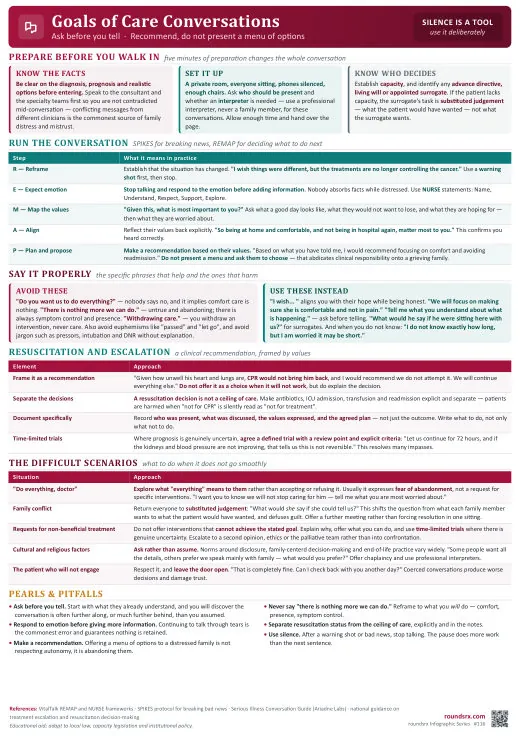
Text version
- Pre-meeting huddle: align the medical team on prognosis and the recommendation, because a family that hears two different prognoses will anchor on the more optimistic one.
- Identify the decision-maker: who holds POA or proxy, and who else needs to be in the room so the meeting does not have to be repeated.
- Review the chart: know the clinical facts, prognosis, and remaining options before you walk in.
- Set the agenda: name the specific decisions that need to be made, otherwise the meeting drifts and ends without one.
- Book a private room: never deliver bad news in a hallway or shared space.
- New serious diagnosis (cancer, terminal illness)
- Clinical deterioration despite treatment
- Goals of care or code status discussion
- Transition to comfort measures
- Surrogate decision-making for an incapacitated patient
- Family conflict about the care plan
- Prolonged ICU stay without improvement
- Introductions: everyone states name and role, so the family knows who is speaking for what.
- Ask before telling, every time.
- Plain language, no jargon. Say "died," not "passed away," because softened words get misheard as ambiguity.
- Allow silence. Silence after bad news is therapeutic, not awkward; filling it with medical detail steals the family's processing time.
- Emotions before information: respond to the tears or the anger before you continue, or nothing after that point is absorbed.
- Make a recommendation. Families want guidance, not a menu of options they are not equipped to rank.
- Ask-tell-ask: ask what they understand, tell in clear language, ask what they took away, which prevents monologue-style information dumping.
- Summarize and document: attendees, discussion, decisions, follow-up plan, updated code status, then communicate to the team.
- Talking too much, listening too little: the single most common mistake. Jumping to medical facts before exploring understanding and emotion means the family cannot absorb any of it.
- Arguing facts with an angry family member: anger is almost always fear, grief, or helplessness. Do not get defensive, name the emotion, validate it, explore it, and only then return to medical information.
- Taking "I want everything done" literally: it rarely means a request for futile intervention. It usually means "I love this person and don't want them abandoned or suffering." Explore the fear and comfort-focused goals often follow.
- Confusing code status with goals of care: code status is specific interventions, goals of care is values and priorities. Goals drive code status, never the reverse.
- Delivering unexpected bad news all at once: give small pieces, pause, check understanding, respond, continue. The family will not remember the details, they will remember how you made them feel.
- Palliative care consult for prognostic uncertainty, family conflict, complex symptom management, cultural barriers, repeated meetings without resolution, or trainee discomfort. Every physician should still be able to run a basic goals-of-care discussion independently.
- Separate meetings when one family member dominates the room, so quieter voices can be heard.
- Refocus on the patient when families disagree: "If [patient] could speak for themselves, what would they say?" The disagreement is usually about differing understanding of prognosis, culture or religion, guilt, or old family dynamics, not about medicine.
- Ethics consult for conflict that persists across multiple meetings.
- Chaplain and social work when spiritual or practical support is wanted; offer rather than wait to be asked.
- Baile, 2000 SPIKES, validated for breaking bad news in oncology.
- Back, 2005 NURSE and ask-tell-ask, the VitalTalk frameworks for responding to emotion and structuring serious-illness conversations.
- Back, 2007 VitalTalk training measurably improves resident communication skills and family satisfaction, so this is a teachable skill, not a personality trait.
- Temel, 2010 early palliative care improves quality of life and may extend survival.