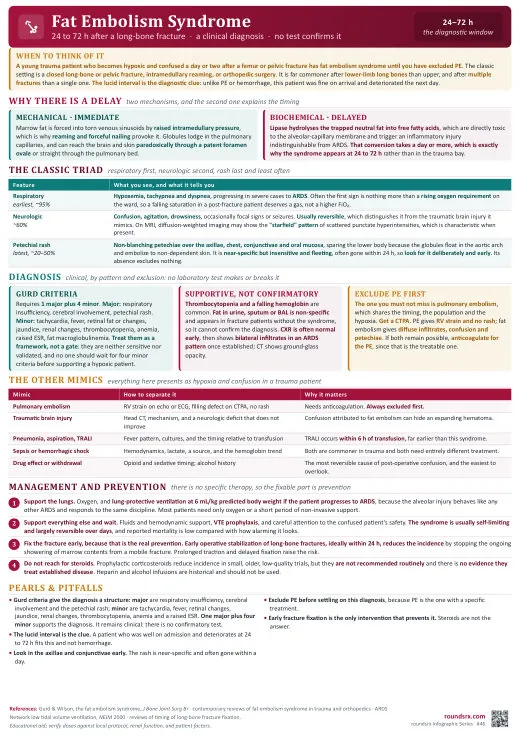
Fat Embolism Syndrome
Fat embolism syndrome (FES) occurs when fat globules enter the venous system, leading to pulmonary and systemic embolization with an inflammatory cascade. Classic triad: (1) hypoxemia/respiratory distress, (2) neurological changes (confusion, AMS), (3) petechial rash. Onset is typically 24-72 hours after the inciting event. Incidence: up to 10% of long bone fractures, but clinically significant FES is less common (~1-3%).
- Long bone fractures -most common cause, especially femur and tibia
- Orthopedic surgery -intramedullary nailing, joint arthroplasty
- Multiple fractures / polytrauma -risk increases with number of fractures
- Liposuction
- Burns, pancreatitis, sickle cell fat marrow necrosis (rare causes)
Fat globules from bone marrow enter the venous system through disrupted medullary vessels. In the lungs, fat is hydrolyzed by lipase into free fatty acids, which cause endothelial damage, inflammation, and increased capillary permeability (chemical pneumonitis). Fat also passes through the pulmonary vasculature or a PFO into systemic circulation, causing CNS and skin manifestations.
| Risk tier | Mechanism / patient profile | Approximate FES incidence |
|---|---|---|
| Highest risk | Bilateral femur fractures · multiple long bone fractures · pelvic fracture + femur · intramedullary nailing without venting · younger adult (20-40 yo, more marrow fat) · closed fracture (pressurizes the canal) · delay to fixation > 24-48 h | 5-10% clinically significant |
| Moderate risk | Single femur fracture · tibia fracture · hip fracture in elderly · IM nailing of single long bone · joint arthroplasty (especially THA, TKA) · liposuction | 1-3% |
| Lower risk | Upper extremity fractures · open fractures (clot-burden lower; canal vented through wound) · external fixation · non-orthopedic causes (pancreatitis, sickle cell, burns) | < 1% |
| Feature | Fat Embolism Syndrome (FES) | Pulmonary Embolism (PE) |
|---|---|---|
| Timing post-fracture | 24-72 h (peaks 48 h) | Usually > 3-5 days, but can occur any time post-immobilization |
| CT-PA findings | NO filling defects. May show diffuse ground-glass / "snowstorm" pattern. | Filling defects in pulmonary arteries (lobar, segmental, or subsegmental) |
| Petechial rash | YES (chest, axillae, conjunctivae) -only ~50% of cases but specific | NO |
| Neurologic changes | YES -confusion, AMS, seizures, focal deficits (cerebral fat emboli) | Rare (occasional syncope from Category E PE) |
| Thrombocytopenia / anemia | YES -platelet consumption + hemolysis from FFAs | Usually no (unless DIC from Category E PE) |
| D-dimer | Elevated (non-specific in trauma) | Elevated, but Wells + age-adjusted cutoff guide use |
| RV strain on echo | Possible if extensive pulmonary fat embolization | Common in Category C3 to E PE |
| Brain MRI | "Starfield" pattern -punctate T2/FLAIR bright lesions throughout brain (microemboli) | Normal unless cardioembolic stroke from PFO |
| Treatment | SUPPORTIVE (O2, vent, fluids, fracture fixation). NO anticoagulation for FES itself. | Anticoagulation ± thrombolysis ± thrombectomy |
SUPPORTIVE -there is no specific treatment for fat embolism syndrome.
- Supplemental oxygen -high-flow nasal cannula, NIPPV, or mechanical ventilation as needed
- Mechanical ventilation -lung-protective ventilation if ARDS develops (low tidal volume 6 mL/kg PBW, PEEP, plateau pressure <30 cmH2O)
- Fluid resuscitation -maintain intravascular volume. Avoid hypovolemia (worsens tissue hypoperfusion).
- Early fracture fixation -reduces ongoing fat embolization. Definitive surgical fixation within 24h when possible.
- Supportive ICU care -vasopressors if hemodynamically unstable, seizure management if needed.
- Early fracture stabilization -most important preventive measure. External fixation or definitive internal fixation within 24h reduces FES incidence.
- Corticosteroids for PREVENTION: Methylprednisolone 1.5 mg/kg IV q8h x 3 doses before surgery -some evidence of benefit in high-risk patients (bilateral femur fractures, polytrauma). Not universally adopted due to mixed trial results. Schonfeld, Ann Intern Med 1983
FES is a clinical diagnosis. No single test is diagnostic. The following support the diagnosis:
- ABG -hypoxemia (PaO2 <60 mmHg). Often the earliest finding.
- CXR -bilateral diffuse infiltrates, "snowstorm" pattern. May take 12-24h to develop. Non-specific.
- CBC -thrombocytopenia (platelet consumption), anemia (from hemolysis by free fatty acids)
- Lipase -may be elevated (fat hydrolysis)
- CT-PA -primarily to rule out pulmonary embolism (PE and FES can both occur after fractures/surgery). FES does NOT show filling defects.
- Retinal exam -cotton-wool spots, petechiae, fat emboli visible in retinal vessels (Purtscher-like retinopathy)
- Bronchoalveolar lavage (BAL) -may show fat-laden macrophages (oil red O stain), but this finding is NOT specific for FES (can occur in other conditions).
- MRI brain -if neurological symptoms prominent. May show "starfield" pattern of punctate T2/FLAIR bright lesions (microembolic infarcts).
Requires at least 1 major + 4 minor criteria, OR 2 major criteria:
- Major: Axillary/subconjunctival petechiae, hypoxemia (PaO2 <60), CNS depression, pulmonary edema
- Minor: Tachycardia, fever, retinal changes, fat in urine, thrombocytopenia, elevated ESR, fat globules in sputum
Sum of weighted findings; ≥ 5 points = FES diagnosis. More sensitive than Gurd in mild/moderate cases.
| Finding | Points |
|---|---|
| Petechiae | 5 |
| Diffuse infiltrates on CXR | 4 |
| Hypoxemia (PaO₂ < 70 mmHg) | 3 |
| Confusion / AMS | 1 |
| Fever > 38°C | 1 |
| Heart rate > 120 bpm | 1 |
| Respiratory rate > 30/min | 1 |
When fat globules cross the pulmonary capillary bed (or shunt through a patent foramen ovale), they reach the systemic circulation and lodge in cerebral microvasculature. Cerebral fat embolism (CFE) can occur with or without prominent pulmonary findings -occasionally as the dominant presentation.
- Presentation: confusion, agitation, seizures, focal deficits (hemiparesis, aphasia), coma in severe cases. Can mimic stroke.
- Onset: usually 12-72 h post-injury, often before petechiae or hypoxemia become prominent.
- MRI findings: the pathognomonic "starfield" pattern -multiple small punctate T2 / FLAIR / DWI hyperintensities scattered throughout subcortical white matter, basal ganglia, cerebellum, and corpus callosum. Highly specific for CFE in the right clinical context.
- EEG: diffuse slowing, may show non-convulsive seizures.
- Patent foramen ovale (PFO): identified in ~25% of severe CFE cases. Echo with bubble study can reveal right-to-left shunt.
- Prognosis: CFE often has good recovery with supportive care if patient survives the acute phase. Most neuro deficits resolve over weeks to months. Persistent cognitive deficits in severe cases.
- Treatment: SUPPORTIVE -airway protection, seizure management (levetiracetam preferred), maintain cerebral perfusion (MAP 65-70). No specific therapy.
| Drug | Indication | Dose | Notes |
|---|---|---|---|
| Methylprednisolone | Prevention (high-risk) | 1.5 mg/kg IV q8h x 3 doses preop | Some evidence for prophylaxis in high-risk long bone fractures. Not universally adopted. Start before surgical fixation. Schonfeld, Ann Intern Med 1983 |
| Heparin | VTE prophylaxis | 5000 units SQ q8h or enoxaparin 40 mg SQ daily | Standard VTE prophylaxis in trauma patients. Does NOT treat FES specifically, but prevents concomitant VTE. |
| Norepinephrine | Hemodynamic support | 0.1-2 mcg/kg/min IV | If hypotension from RV failure or distributive shock component. Titrate to MAP >65. |
| Levetiracetam (Keppra) | Seizure management | 500-1000 mg IV BID | If seizures from cerebral fat embolism. No specific seizure prophylaxis indicated without seizure activity. |
Note: Treatment is predominantly supportive. No specific pharmacotherapy has proven benefit for established FES.
Mr. Rodriguez is a 24-year-old man admitted 48 hours ago after a motor vehicle collision with bilateral femoral shaft fractures, now s/p external fixation. Overnight he developed acute respiratory distress, confusion, and tachycardia. VS: T 38.5, HR 122, RR 28, BP 110/70, SpO2 82% on RA. Exam: confused, GCS 13 (E3V4M6), petechial rash across the chest and bilateral axillae, bilateral crackles on lung exam. Labs: PaO2 52 on ABG, platelets dropped from 210 to 98, Hgb from 11 to 8.5. CXR: bilateral diffuse infiltrates. CT-PA negative for PE.
- Continuous pulse oximetry -hypoxemia is often the earliest sign. O2 sat drop in a trauma patient 24-72h post-fracture should raise suspicion.
- ABG -q6-12h if developing respiratory failure. Monitor for worsening hypoxemia and need for escalation.
- CBC q12h -trending platelets (thrombocytopenia) and hemoglobin (hemolysis). Nadir typically at 48-72h.
- Neurologic exam -serial assessments. AMS can range from confusion to coma. GCS trending.
- CXR daily -track bilateral infiltrates. Monitor for progression to ARDS.
- Skin exam -check chest, axillae, conjunctivae for petechiae q shift. Often transient (may last only 24-48h).
- Urine output -monitor for renal dysfunction. Fat emboli can cause AKI.