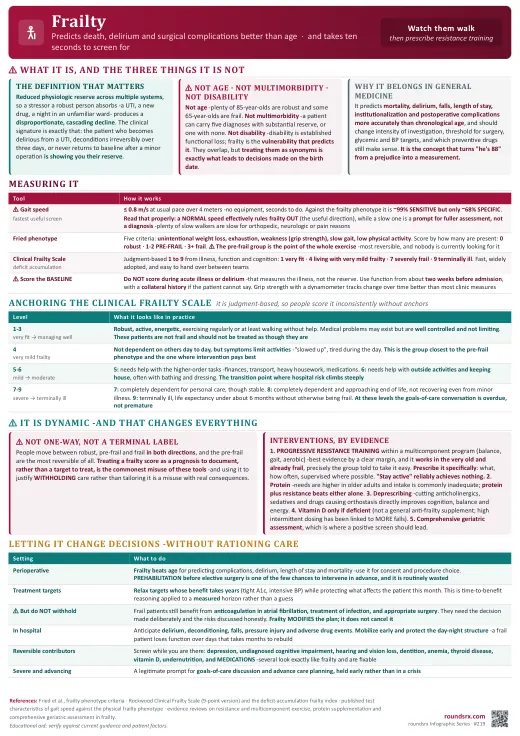
Frailty
- Frailty is a state of reduced physiologic reserve across multiple systems, such that a stressor which a robust person absorbs -a urinary tract infection, a new drug, a night in an unfamiliar ward- produces a disproportionate and often cascading decline.
- ⚠ It is distinct from the three things it is usually confused with. Not age: plenty of 85-year-olds are robust and some 65-year-olds are frail. Not multimorbidity: a patient can carry five diagnoses and substantial reserve, or one diagnosis and none. Not disability: disability is established loss of function, whereas frailty is the vulnerability that predicts it. They overlap, but treating them as synonyms is what leads to decisions made on the birth date.
- The clinical signature is the disproportionate response. The patient who becomes delirious from a UTI, deconditions irreversibly over a three-day admission, or never returns to their baseline after a minor operation is showing you their reserve.
- Sarcopenia is the loss of skeletal muscle mass and strength. It is a major driver of the physical frailty phenotype, and the two share the same gait-speed cutoff, but frailty is the broader multisystem state that also encompasses cognition, nutrition and energy.
- The practical overlap is the treatment: resistance training and adequate protein address both, which is why the exercise prescription below is the single highest-yield action on this page.
| Model | How it works, and where it fits |
|---|---|
| Physical phenotype Fried criteria | Five criteria: unintentional weight loss, exhaustion, weakness (grip strength), slow gait speed, and low physical activity. Scoring is simply how many are present -0 is robust, 1 to 2 is PRE-FRAIL, and 3 or more is frail. The pre-frail group is the point of the whole exercise, because that is where intervention has the most to gain and where nobody is currently looking. |
| Deficit accumulation frailty index, Clinical Frailty Scale | Counts accumulated deficits across symptoms, diseases, disabilities and abnormal findings as a proportion of those assessed. In practice the bedside version is the Clinical Frailty Scale, a judgment-based 1 to 9 score built from illness, function and cognition -1 very fit, 4 living with very mild frailty, 7 severely frail, 9 terminally ill. Fast, widely adopted, and easy to communicate between teams. |
- Assess at the patient's baseline, not at their worst. Scoring someone during an acute delirium or on day two of a pneumonia measures the illness, not their reserve. Ask about function two weeks before admission, and ask a relative if the patient cannot say.
- Grip strength with a dynamometer is quick and reproducible where available, and it tracks change over time better than most things you can measure in clinic.
- Comprehensive geriatric assessment is the definitive multidisciplinary evaluation -medical, functional, cognitive, nutritional, psychological and social- and it is what a positive screen should ultimately lead to, since the interventions come from it.
- ⚠ Screen for the reversible contributors while you are there: depression, undiagnosed cognitive impairment, hearing and vision loss, poor dentition, anemia, thyroid disease, vitamin D deficiency, undernutrition, and medications -several of which look exactly like frailty and are fixable.
| Intervention | Detail |
|---|---|
| Resistance and multicomponent exercise the strongest single measure | Progressive resistance training combined with balance, gait and aerobic work improves strength, gait speed and function, and is the intervention with the best evidence by a clear margin. It works in the very old and in those already frail, which is precisely the group most often told to take it easy. Prescribe it specifically -what, how often, supervised where possible- rather than advising the patient to "stay active", which reliably achieves nothing. |
| Protein and nutrition | Older adults need more protein per kilogram than younger adults to maintain muscle, and intake is commonly inadequate. Address appetite, dentition, swallowing, isolation and cost, and involve a dietitian. Protein plus resistance training outperforms either alone. |
| Deprescribing | Reducing anticholinergic burden, sedatives and drugs causing orthostasis directly improves the things frailty is made of -cognition, balance and energy. See the deprescribing topic for the method. |
| Vitamin D | Replace where deficient, particularly with falls or low bone density. Not a general anti-frailty supplement, and high intermittent dosing has been associated with more falls rather than fewer. |
| Comprehensive geriatric assessment | Multidisciplinary assessment with a coordinated plan improves outcomes including the likelihood of remaining at home. This is where a positive screen should lead. |
| Treat the contributors | Depression, pain, hearing and vision, anemia, heart failure, and the social situation. Frailty is frequently the visible surface of a fixable list underneath. |
- Perioperatively, frailty predicts complications, delirium, length of stay and mortality better than age, and it should inform consent, prehabilitation and the choice of procedure. Prehabilitation before elective surgery is one of the few chances to intervene in advance, and it is routinely wasted.
- Relax targets that take years to pay off -tight glycemic control, intensive blood pressure targets- while protecting what affects the patient this month. This is the time-to-benefit reasoning applied to a measured horizon rather than a guess.
- ⚠ But do not use frailty as a reason to withhold effective treatment. Frail patients still benefit from anticoagulation in atrial fibrillation, from treatment of infection, and from appropriate surgery; they simply need the decision made deliberately and the risks discussed honestly. Frailty modifies the plan, it does not cancel it.
- Anticipate the hospital risks: delirium, deconditioning, falls, pressure injury and adverse drug events. Mobilize early and keep the day-night structure intact, because a frail patient loses function over days that takes months to rebuild.
- Where frailty is severe and advancing, it is a legitimate prompt for a goals-of-care conversation and for advance care planning, held early rather than in a crisis.
"Mr. H is an 84-year-old man admitted with a urinary tract infection who became acutely confused, which is itself the clinical signature of poor reserve -a stressor a robust patient absorbs producing a disproportionate decline. I did not score his frailty on admission because he was delirious and that would measure the illness rather than his baseline. Taking a collateral history from his daughter about two weeks before admission, he had lost around 5 kg unintentionally over the year, described being exhausted most days, had stopped his usual walking, and she reports he had become noticeably slower. That is four of the five Fried criteria, so he is frail rather than pre-frail, and his Clinical Frailty Scale is about 6. This matters concretely for three decisions: he is at high risk of further delirium and deconditioning, so I want him mobilized early with the day-night structure protected rather than kept in bed; his tight A1c of 6.3% on a sulfonylurea is a hypoglycemia risk with a benefit horizon he may not have, so I want that relaxed; and I would specifically not use his frailty as a reason to withhold anticoagulation for his atrial fibrillation. On the reversible side I have checked vitamin D, thyroid function and a full blood count, reviewed his anticholinergic burden, and referred to physiotherapy for progressive resistance training, which is the intervention with the best evidence and works even at his age."
- Baseline function established from before the acute illness, with a collateral history where needed.
- A frailty measure recorded -gait speed, Fried criteria or Clinical Frailty Scale- and communicated, not left implicit.
- Reversible contributors screened: depression, cognition, hearing and vision, dentition, anemia, thyroid, vitamin D, nutrition, medications.
- Early mobilization ordered, and the day-night structure protected to reduce delirium and deconditioning.
- Targets reviewed for treatments whose benefit takes years, without withdrawing treatments that work now.
- Exercise prescribed specifically, with a physiotherapy referral rather than advice to stay active.
- Goals of care discussed early where frailty is severe and advancing, rather than during a crisis.
| Point | Detail |
|---|---|
| Define it | Reduced physiologic reserve across systems, so a stressor a robust person absorbs causes disproportionate decline. NOT age, NOT multimorbidity, NOT disability -overlapping but distinct, and conflating them is how decisions get made on the birth date. |
| Why it matters | Predicts mortality, delirium, falls, length of stay, institutionalization and postoperative complications better than chronological age. It turns "he's 88" from a prejudice into a measurement. |
| ⚠ Fastest screen | Gait speed ≤ 0.8 m/s over 4 meters. ~99% sensitive but only ~68% specific -so a normal speed rules frailty OUT (the useful direction), while a slow one is a prompt for assessment, not a diagnosis. |
| Fried phenotype | Weight loss, exhaustion, weakness (grip), slow gait, low activity. 0 robust · 1-2 PRE-FRAIL · 3+ frail. The pre-frail group is the point -most reversible, and nobody is looking for it. |
| Clinical Frailty Scale | Judgment-based 1 to 9 from illness, function and cognition: 1 very fit, 4 very mild frailty, 7 severe, 9 terminally ill. Fast and easy to hand over between teams. |
| ⚠ Score the baseline | Do NOT score during acute illness or delirium -that measures the illness, not the reserve. Use function from about two weeks before admission, with a collateral history. |
| ⚠ It is DYNAMIC | Not one-way, not a terminal label. People move in both directions. Treating the score as a prognosis to document rather than a target to treat is the commonest misuse. |
| Best intervention | Progressive RESISTANCE training within a multicomponent program -best evidence by a clear margin, and it works in the very old and already frail. Prescribe it specifically; "stay active" achieves nothing. Add protein (needs are higher in older adults, and protein plus resistance beats either alone), deprescribing, vitamin D if deficient, and comprehensive geriatric assessment. |
| Change decisions | Perioperatively it beats age for predicting complications -use it for consent and prehabilitation. Relax targets whose benefit takes years (tight A1c, intensive BP). Mobilize early in hospital: days of lost function take months to rebuild. |
| ⚠ But do not withhold | Frail patients still benefit from anticoagulation in AF, treatment of infection and appropriate surgery. Frailty modifies the plan; it does not cancel it. |
- Watch them walk. A normal gait speed rules it out in seconds; a slow one earns a proper look.
- Prescribe resistance training, not encouragement. It is the one intervention that reliably moves people back down the scale.
- Frailty tailors care, it does not ration it. Using the score to withhold treatment is the misuse that does harm.