Fungal Infections
| Organism | Risk Factors | Key Features |
|---|---|---|
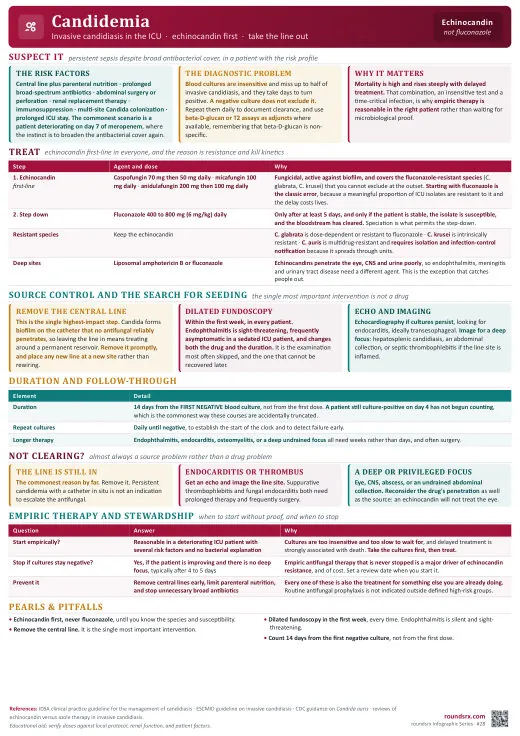
| Candida | ICU, central lines, TPN, broad-spectrum abx, neutropenia | Candidemia, oral thrush, esophagitis. Remove lines. Echinocandin first-line. |
| Aspergillus | Neutropenia, transplant, chronic steroids, COPD | Invasive pulmonary aspergillosis (IPA). "Halo sign" on CT. Galactomannan antigen. |
| Cryptococcus | HIV (CD4 < 100), transplant | Meningitis -headache, fever. India ink, cryptococcal antigen (CrAg). Elevated opening pressure. |
| Histoplasma | Ohio/Mississippi River Valley, bat/bird guano | Pneumonia ± mediastinal LAD. Urine/serum antigen. Can mimic sarcoidosis. |
| Coccidioides | Southwestern US deserts | "Valley fever." Pneumonia, erythema nodosum, meningitis (if disseminated). |
| PJP (Pneumocystis) | HIV (CD4 < 200), immunosuppression | Bilateral ground-glass opacities. ↑ LDH. TMP-SMX treatment AND prophylaxis. |
| Infection | First-Line | Duration |
|---|---|---|
| Candidemia | Micafungin (Mycamine) 100 mg IV daily or Caspofungin (Cancidas) 70mg load then 50mg daily | 14 days after first negative blood culture. REMOVE all central lines. |
| Invasive Aspergillus | Voriconazole (Vfend) 6mg/kg IV q12h × 2, then 4mg/kg q12h | 6–12 weeks minimum. Check voriconazole trough levels. |
| Crypto meningitis | Amphotericin B (AmBisome) + Flucytosine (Ancobon) × 2 wk → Fluconazole (Diflucan) | Induction 2 wk → consolidation 8 wk → maintenance 1 yr |
| PJP (moderate-severe) | TMP-SMX (Bactrim) 15–20 mg/kg/day IV (TMP component) + prednisone if PaO₂ < 70 | 21 days. Add steroids if hypoxic. |
| Histoplasmosis (severe) | Amphotericin B (AmBisome) → Itraconazole (Sporanox) | Ampho × 1–2 wk → itra × 12 months |
| Site | Significance | Action |
|---|---|---|
| Blood (even 1 bottle) | Always real -never contaminant | Echinocandin + remove ALL lines + ophtho consult + echo + blood cx q48h until clearance. 14 days after first negative cx. |
| Urine (candiduria) | Usually colonization, especially with Foley | Do NOT routinely treat. Treat only if: symptomatic UTI, neutropenic, pre-urologic procedure, or renal transplant. Remove/replace Foley first. |
| Sputum | Almost always colonization | Do NOT treat. Candida pneumonia is exceedingly rare. Sputum Candida does not warrant antifungals. |
| Wound / drain | Often colonization | Treat only if deep tissue/peritoneal culture + clinical signs of infection. Surface swabs are unreliable. |
| Peritoneal fluid | Significant if from surgical sample | Treat -intra-abdominal candidiasis. Echinocandin + source control. |
- Blood cultures -Candida grows in standard cultures. Aspergillus rarely grows from blood.
- Galactomannan antigen -serum test for Aspergillus (sensitivity ~70% in neutropenic)
- Beta-D-glucan (BDG) -pan-fungal marker. Elevated in Candida, Aspergillus, PJP. NOT in Crypto or Mucor.
- Cryptococcal antigen (CrAg) -serum and CSF. Very sensitive and specific.
- India ink stain -CSF for Crypto (encapsulated yeast). Less sensitive than CrAg.
- Histoplasma/Coccidioides urine antigen
- CT chest -halo sign (aspergillus), ground-glass (PJP), cavitary (histo, coccidio)
| Drug Class | Agents | Key Notes |
|---|---|---|
| Echinocandins | Micafungin (Mycamine), Caspofungin (Cancidas), Anidulafungin (Eraxis) | First-line candidemia. NO activity vs Cryptococcus or Mucor. Well tolerated. |
| Azoles | Fluconazole (Diflucan), Voriconazole (Vfend), Itraconazole (Sporanox), Posaconazole (Noxafil) | Vori = first-line aspergillus. Fluconazole for step-down Candida. Check levels for vori. |
| Polyenes | Amphotericin B Liposomal (AmBisome) | Broadest spectrum. Nephrotoxic (liposomal form less so). Use for severe/refractory infections. |
Patient: 58M in the MICU after abdominal surgery for perforated diverticulitis. Day 12 postop. On pip-tazo + vancomycin. Receiving TPN via PICC. New fever to 39.2°C, WBC 18K.
Labs: 2/2 blood cultures (PICC and peripheral draw) grow Candida albicans. Creatinine 1.4 (baseline 0.9).
Key Decision Points:
- Start micafungin 100 mg IV daily, echinocandin is first-line for candidemia in critically ill patients (superior tolerability, unknown susceptibility)
- Remove the PICC line immediately, Candida forms biofilm on catheters; antifungals cannot penetrate biofilm. New access at a different site.
- Ophthalmology consult within 24 hours, endophthalmitis in 2-4% of candidemia; can cause blindness if missed
- Echocardiogram, candidal endocarditis is rare but devastating; prosthetic valves at especially high risk
- Blood cultures every 48 hours until two consecutive negatives. Duration: 14 days from first negative culture.
- Step-down to fluconazole PO once stable, cultures clear, and susceptibilities confirm sensitivity
Teaching point: Candidemia risk = central line + TPN + broad-spectrum antibiotics + abdominal surgery + ICU days. All four present here = start antifungals without delay once blood cultures return positive.
Patient: 45M with AML, day 18 post-induction chemotherapy. ANC 80. New persistent fever despite broad-spectrum antibiotics × 5 days. Dry cough, mild hemoptysis.
Imaging: CT chest: 2.3 cm right lower lobe nodule with surrounding ground-glass halo ("halo sign").
Labs: Serum galactomannan 1.8 (positive; threshold ≥0.5). Beta-D-glucan positive. BAL galactomannan 3.2.
Management:
- Start voriconazole IV: 6 mg/kg q12h × 2 loading doses, then 4 mg/kg q12h. Switch to oral voriconazole once tolerating PO (excellent bioavailability).
- Check voriconazole trough at day 5-7, target 1–5.5 mcg/mL. Below threshold = treatment failure. Above = hepatotoxicity, QTc, neurotoxicity.
- Duration: 6–12 weeks minimum, continue until ANC recovery and CT improvement
- Alternative if voriconazole fails: isavuconazole (fewer drug interactions, no QTc) or liposomal amphotericin B
- Bronchoscopic biopsy not required when galactomannan + CT are diagnostic in high-risk neutropenic host
Teaching point: Aspergillus does NOT grow from routine blood cultures, serum galactomannan and CT findings are your diagnosis. The halo sign is most sensitive early; cavitation with air-crescent sign appears later as the infarct liquefies.
Patient: 34F with HIV (not on ART), CD4 42. Three weeks of worsening headache, photophobia, mild confusion. Temperature 38.5°C. No focal deficits.
LP results: Opening pressure 42 cmH₂O. CSF: 35 WBC (lymphocytic), protein 89, glucose 32 (serum 110). India ink: budding yeast with thick capsule. Serum CrAg titer 1:1024. CSF CrAg positive.
Management steps:
- Immediate therapeutic LP: Drain CSF to opening pressure <20 cmH₂O (remove 20–30 mL now). Elevated ICP is the leading cause of early death, this is urgent.
- Induction: Liposomal amphotericin B 3–4 mg/kg IV daily + flucytosine 25 mg/kg PO q6h × 2 weeks
- Consolidation: Fluconazole 400 mg daily × 8 weeks
- Maintenance: Fluconazole 200 mg daily × 1 year (until CD4 >100 + suppressed viral load on ART)
- Daily LPs until two consecutive normal pressures. If >4 LPs needed, place lumbar drain or VP shunt.
- Delay ART 5–10 weeks, starting ART immediately risks IRIS (cryptococcal-IRIS can be fatal)
Teaching point: CrAg is far more sensitive than India ink or culture, use it for screening and diagnosis. Elevated ICP management (LP drainage) is as critical as antifungal therapy. Do NOT use acetazolamide or steroids for ICP in cryptococcal meningitis.