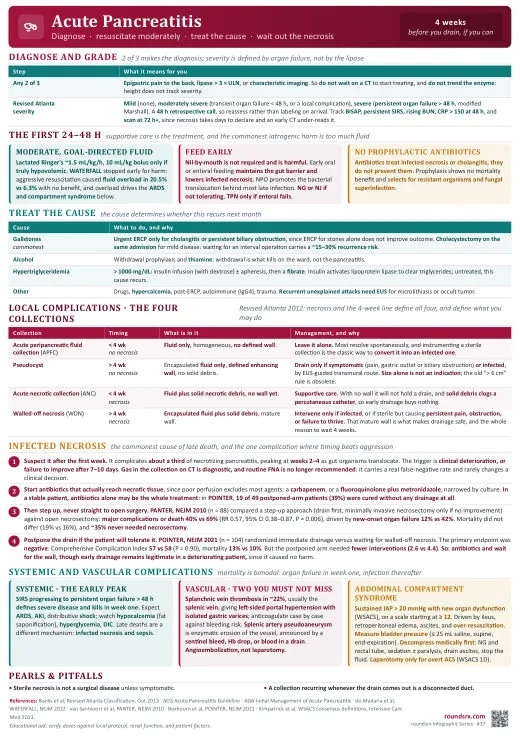
Gallstones cause ~40% of acute pancreatitis. Stone impacts at ampulla of Vater โ blocked pancreatic duct โ autodigestion. Key difference from alcoholic pancreatitis: gallstone pancreatitis needs CHOLECYSTECTOMY during the same admission. ALT > 150 has ~85% PPV for gallstone etiology.
๐ Overview
Epidemiology & Pathophysiology
Gallstones cause ~40% of acute pancreatitis (alcohol ~40%, other ~20%)
Stone impacts at ampulla of Vater โ blocked pancreatic duct โ premature activation of pancreatic enzymes โ autodigestion
Key difference from alcoholic pancreatitis: gallstone pancreatitis needs CHOLECYSTECTOMY
Diagnosis
Lipase > 3ร ULN -most sensitive and specific single test
ALT > 150 U/L has ~85% PPV for gallstone etiology -very helpful clue!
RUQ ultrasound showing gallstones ยฑ CBD dilation
Clinical: epigastric/RUQ pain radiating to back, nausea/vomiting
๐จ Management
Initial Management (Same as All Pancreatitis)
Goal-directed IV LR -NOT aggressive fluids. WATERFALL, 2022 showed aggressive fluids โ fluid overload without benefit.
Pain control -hydromorphone/morphine, ondansetron for nausea
Early feeding -low-fat solid diet as tolerated. No need to wait for lipase to normalize.
NO prophylactic antibiotics
Cholecystectomy Timing
Severity
Timing
Rationale
Mild pancreatitis
Same admission (ideally within 72h)
Delaying to outpatient โ 25โ30% recurrence rate. PONCHO, 2015 showed same-admission chole is safe and reduces recurrence.
Severe/necrotizing
Delay 4โ6 weeks
Operating during severe pancreatitis = higher complication rate. Wait for inflammation to resolve.
ERCP Indications
Only if concurrent cholangitis (fever + jaundice + RUQ pain = Charcot triad)
OR persistent CBD obstruction (elevated bilirubin not improving)
Routine ERCP for all gallstone pancreatitis is NOT recommended -APEC, 2024
Do NOT discharge gallstone pancreatitis without cholecystectomy or a plan for same-admission cholecystectomy. Recurrence rate is 25โ30% if you send them home with gallbladder in situ. PONCHO, 2015 showed same-admission cholecystectomy is safe and reduces recurrence.
Updated Practice - Old teaching: get ERCP for all gallstone pancreatitis. WRONG -ERCP is only indicated if there is concurrent cholangitis (Charcot triad) or persistent bile duct obstruction. Routine ERCP in resolving gallstone pancreatitis does not improve outcomes.
BISAP Score (predict severity at admission): BUN > 25, Impaired mental status, SIRS, Age > 60, Pleural effusion. Score >= 3 = predicted severe pancreatitis. Simple, fast bedside tool. Use within 24h of admission to guide ICU triage and resource planning.
When to get CT: Do NOT get CT at presentation (too early for necrosis). CT is indicated at 72-96h IF: (1) no clinical improvement, (2) worsening despite treatment, (3) suspected local complication (necrosis, pseudocyst, abscess). Contrast-enhanced CT is the gold standard for detecting pancreatic necrosis (>= 30% non-enhancement = necrotizing pancreatitis). ACR, 2019
Early feeding is safe: Start low-fat solid diet within 24h as tolerated. No need to wait for pain resolution or lipase normalization. Clear liquid progression is unnecessary - go straight to low-fat solids. Early feeding reduces hospital stay and infectious complications. If unable to eat after 72h, start enteral nutrition (nasogastric or nasojejunal tube). TPN only as last resort. Bakker et al. (PYTHON), 2014
Rectal indomethacin for post-ERCP pancreatitis: When ERCP IS indicated (cholangitis, persistent obstruction), give indomethacin 100 mg PR immediately before or after the procedure. Reduces post-ERCP pancreatitis from ~17% to ~9% in high-risk patients. Now standard of care at all major centers. Elmunzer et al. (NEJM), 2012
๐งช Workup
Test
Purpose / Key Values
Lipase
> 3ร ULN diagnostic. Don't need to normalize before feeding/surgery.
Severity marker. CRP > 150 at 48h suggests severe pancreatitis.
RUQ ultrasound
Gallstones, CBD dilation (> 6 mm suggests obstruction)
MRCP
If diagnostic uncertainty -avoids invasive ERCP. Better for CBD stone detection.
CT abdomen/pelvis
Only if not improving by day 3โ5 (assess for necrosis, complications)
๐ Medications
Drug
Dose
Notes
Lactated Ringer's
Goal-directed (not aggressive)
WATERFALL 2022: aggressive fluids โ overload, no benefit
Hydromorphone (Dilaudid)
0.5โ1 mg IV q3โ4h PRN
Pain control. Morphine is also acceptable.
Ondansetron (Zofran)
4 mg IV q6h PRN
Nausea/vomiting
NO prophylactic antibiotics
-
Antibiotics only if infected necrosis or cholangitis confirmed
๐ On Rounds
Pimp Questions
When should you get an ERCP in gallstone pancreatitis?
Only two indications: (1) Concurrent cholangitis -Charcot triad (fever + jaundice + RUQ pain). ERCP for biliary decompression. (2) Persistent CBD obstruction -bilirubin not improving, CBD remains dilated. Routine ERCP for all gallstone pancreatitis is NOT recommended. APEC, 2024 showed no benefit of early routine ERCP.
What is the significance of ALT > 150 in pancreatitis?
ALT > 150 U/L has ~85% positive predictive value for gallstone etiology. This is one of the most useful lab clues to distinguish gallstone pancreatitis from alcoholic pancreatitis. It reflects transient biliary obstruction causing hepatocyte injury. A normal ALT does not rule out gallstones, but a markedly elevated ALT strongly supports it. Always get a RUQ ultrasound to confirm.
Same-admission vs delayed cholecystectomy -what does the evidence say?
PONCHO, 2015 showed same-admission cholecystectomy (within 72h) for mild gallstone pancreatitis reduced gallstone-related complications from 17% to 5%. The recurrence rate if you discharge without chole is 25โ30%. For severe/necrotizing pancreatitis, delay 4โ6 weeks (operating in acute severe inflammation โ complications).
Why not routine ERCP for gallstone pancreatitis?
Most gallstones that cause pancreatitis pass spontaneously -the stone transiently impacts the ampulla then dislodges. By the time you do ERCP, the stone is often already gone. APEC, 2024 confirmed that routine ERCP in gallstone pancreatitis (without cholangitis) does not improve outcomes and exposes patients to ERCP risks (post-ERCP pancreatitis 3โ5%, bleeding, perforation). Reserve ERCP for cholangitis or persistent obstruction.
How do you distinguish gallstone pancreatitis from alcoholic pancreatitis?
Key differentiators: (1) ALT > 150 U/L has ~85% PPV for gallstone etiology. (2) RUQ ultrasound showing gallstones or CBD dilation. (3) History - gallstone pancreatitis often in females, obese, age 40+. Alcoholic pancreatitis in chronic drinkers with recurrent episodes. (4) Gallstone pancreatitis typically has more abrupt onset with biliary-pattern pain (RUQ radiating to back). (5) LFTs: gallstone pancreatitis often shows obstructive pattern (elevated ALP, GGT, direct bili).
What fluid resuscitation strategy is recommended for acute pancreatitis?
Goal-directed moderate IV fluid resuscitation with lactated Ringer's. The WATERFALL trial (2022) showed aggressive fluids (3 mL/kg/hr) increased fluid overload without improving outcomes vs moderate fluids (1.5 mL/kg/hr). Current recommendation: initial bolus of 1.5 mL/kg then maintenance at 1.5 mL/kg/hr, titrated to clinical targets (UOP >= 0.5 mL/kg/hr, HR < 120, MAP > 65). LR preferred over NS (less hyperchloremic acidosis). WATERFALL, 2022
What is the Revised Atlanta Classification for acute pancreatitis severity?
Three severity categories: (1) Mild - no organ failure, no local complications (80% of cases, mortality < 1%). (2) Moderately severe - transient organ failure (< 48h) OR local complications (peripancreatic fluid collection, pseudocyst, walled-off necrosis). (3) Severe - persistent organ failure > 48h (cardiovascular, pulmonary, or renal). Severity determines ICU need, feeding strategy, and cholecystectomy timing. BISAP and APACHE II scores predict severity at admission.
When should you start feeding in acute pancreatitis?
Early oral feeding (within 24h) as tolerated with a low-fat solid diet. Old teaching was NPO until pain resolves and lipase normalizes - this is WRONG. Multiple RCTs show early feeding reduces hospital stay and complications without increasing pain recurrence. No need to wait for lipase normalization. Start with low-fat solid diet (not clear liquids first). If unable to tolerate PO after 72h, consider nasogastric or nasojejunal tube feeding (NOT TPN). Li et al., 2013
What are the indications for antibiotics in acute pancreatitis?
Prophylactic antibiotics are NOT recommended for acute pancreatitis - even in severe/necrotizing disease. The only indications for antibiotics: (1) Confirmed or strongly suspected infected pancreatic necrosis (fever, rising WBC, gas on CT, positive FNA culture). (2) Concurrent cholangitis. (3) Extrapancreatic infections (pneumonia, UTI, line sepsis). For infected necrosis: carbapenems (meropenem 1g IV q8h) have the best pancreatic tissue penetration. AGA Guidelines, 2018
Clinical Examples
๐ Case 1, Mild Gallstone Pancreatitis
Patient: 48F with sudden epigastric pain radiating to back after fatty meal. Lipase 3200, ALT 280, T. bili 2.8, CBD 7 mm on RUQ US with gallstones. HR 92, BP 128/78. No fever.
Key findings: Gallstone pancreatitis (ALT > 150 = ~85% PPV for gallstone etiology). No cholangitis (afebrile, no Charcot triad). Mild disease, no organ failure.
Management:
Goal-directed LR at 1.5 mL/kg/hr ร 24h (aggressive hydration within first 24h is key)
Pain control: hydromorphone 0.5 mg IV q3h PRN (no evidence morphine causes sphincter of Oddi spasm)
Early feeding: low-fat solid diet as tolerated (no need to wait for lipase to normalize or pain to resolve)
No ERCP, bilirubin trending down, stone likely passed. No cholangitis. APEC, 2024
Same-admission cholecystectomy within 72h PONCHO, 2015
Teaching point: Old teaching: NPO until pain-free and lipase normalizes. New evidence: early oral feeding is safe and reduces LOS. Don't delay feeding waiting for lab improvement.
๐ Case 2, Severe Necrotizing Pancreatitis
Patient: 55M heavy drinker. Lipase 8400, Cr 2.1, lactate 3.8, HR 118, BP 88/52. CT (72h): > 50% pancreatic necrosis with peripancreatic fluid collections. CRP 340 at 48h.
Key findings: Severe pancreatitis (organ failure + necrosis). BISAP โฅ 3. Alcoholic etiology. High risk for infected necrosis (30-40% of necrotizing pancreatitis).
Management:
ICU admission, aggressive IVF resuscitation (LR), vasopressors if refractory
No prophylactic antibiotics (no mortality benefit in sterile necrosis)
If infected necrosis suspected (gas in collection, clinical deterioration): CT-guided FNA โ carbapenems if confirmed
Step-up approach for infected necrosis: percutaneous drain first โ if fails, minimally invasive necrosectomy PANTER, 2010
Delay cholecystectomy 4-6 weeks if gallstone etiology (operating in severe inflammation โ complications)
Teaching point: The step-up approach (drain โ endoscopic/minimally invasive necrosectomy โ open surgery) has replaced open necrosectomy as standard of care. ~35% of patients improve with drainage alone.
๐ Case 3, Gallstone Pancreatitis with Cholangitis
Patient: 62F with epigastric pain, lipase 1800, T. bili 6.4 (rising), fever 39.1ยฐC, rigors. WBC 18K. RUQ US: CBD 12 mm, gallstones, no intrahepatic dilation.
Key findings: Charcot triad (fever + jaundice + RUQ pain) = cholangitis. This is the one indication for urgent ERCP in gallstone pancreatitis. Rising bilirubin with fever = impacted stone with biliary sepsis.
Management:
Blood cultures ร 2, start piperacillin-tazobactam 4.5g IV q6h (cover GN rods + enterococcus)
Urgent ERCP within 24h for biliary decompression (stone extraction + sphincterotomy)
IVF resuscitation, correct coagulopathy before procedure
If ERCP fails or unavailable: percutaneous transhepatic biliary drain (PTBD)
Same-admission cholecystectomy after cholangitis resolves (prevent recurrence)
Teaching point: Cholangitis is the ONLY absolute indication for ERCP in gallstone pancreatitis. Without cholangitis, most stones pass spontaneously and ERCP adds risk without benefit.
๐ฃ Sample Presentation
One-Liner
"Ms. Garcia is a 45-year-old woman with BMI 34, presenting with epigastric pain radiating to the back, lipase 2800, ALT 320, bilirubin 3.2, RUQ US showing gallstones and CBD 8 mm -gallstone pancreatitis."
Key Points to Cover on Rounds
Gallstone pancreatitis (ALT 320 -high PPV for gallstone etiology). Goal-directed LR. Pain controlled with hydromorphone. Tolerating low-fat diet. Bilirubin trending down (3.2 โ 2.1) -stone likely passed, no ERCP needed. No cholangitis. Surgery consulted -plan for same-admission laparoscopic cholecystectomy tomorrow (within 72h of admission per PONCHO). No prophylactic antibiotics. CRP at 48h: 80 (mild disease).
Monitoring
Parameter
Frequency
Target / Action
Lipase
Trending (not daily)
Don't need to normalize before feeding or surgery
LFTs (bilirubin, ALT)
Daily
Improving bilirubin = stone likely passed. Persistently elevated โ ERCP.
BMP
Daily
Cr (organ failure), calcium (severity marker)
CRP at 48h
Once at 48h
> 150 = likely severe pancreatitis
CT abdomen
Only if not improving day 3โ5
Assess for necrosis, pseudocyst, fluid collections
Surgical consult
Early (same admission)
Cholecystectomy timing -don't discharge without a plan
โก Summary
Etiology
Gallstones ~40% of pancreatitis. ALT > 150 = ~85% PPV for gallstones.
Initial Rx
Goal-directed LR (not aggressive per WATERFALL). Pain control. Early feeding. No prophylactic abx.
Cholecystectomy
Same admission for mild (PONCHO). Delay 4-6 wk for severe. 25-30% recurrence if discharged without.
ERCP
Only for cholangitis or persistent obstruction. NOT routine (APEC 2024).
Key Trials
PONCHO 2015 (same-admission chole), WATERFALL 2022 (no aggressive fluids), APEC 2024 (no routine ERCP).
Monitoring
LFTs daily (improving bili = stone passed). CRP 48h. CT only if not improving day 3-5.