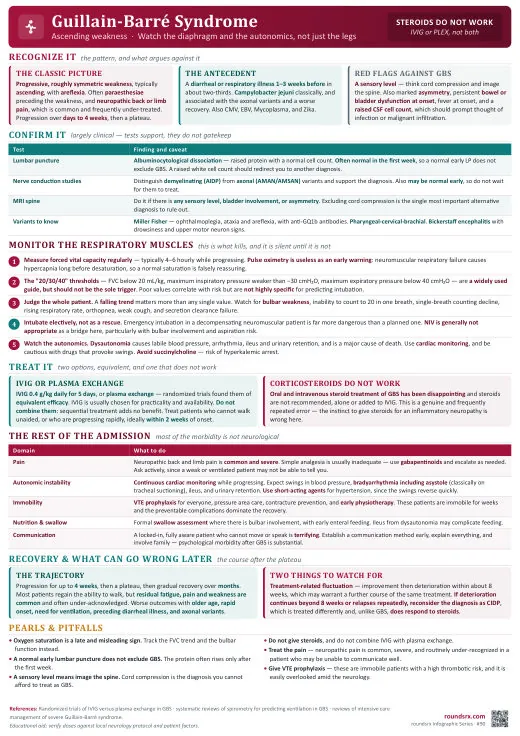
Guillain-Barré Syndrome
- Ascending symmetric weakness -starts in legs, progresses to arms, trunk, respiratory muscles, cranial nerves
- Areflexia or hyporeflexia -characteristic finding
- Preceded by infection 1–4 weeks prior in ~70%: Campylobacter jejuni (#1), CMV, EBV, HIV, Mycoplasma, Zika
- Autonomic dysfunction (~70%): labile BP, tachycardia, bradycardia, arrhythmias, urinary retention, ileus
- Neuropathic pain (~60%) -may be the presenting symptom before weakness
- Facial weakness bilateral (facial diplegia) in ~50%. Bulbar weakness → dysphagia, aspiration risk.
| Test | Findings |
|---|---|
| CSF (LP) | Albuminocytologic dissociation: elevated protein (> 45 mg/dL) with normal WBC (< 10). May be normal in first week. If WBC > 50 → think HIV, Lyme, sarcoidosis, or lymphomatous meningitis. |
| Nerve conduction studies / EMG | Demyelination pattern: prolonged distal latencies, conduction block, slowed conduction velocity, absent F waves. May be normal first few days. Repeat at 2 weeks if initially normal. |
| Anti-ganglioside antibodies | Anti-GM1 (AMAN variant), anti-GQ1b (Miller Fisher -ophthalmoplegia + ataxia + areflexia). Not required for diagnosis. |
| Treatment | Dose | Notes |
|---|---|---|
| IVIG 1ST LINE | 0.4 g/kg/day IV × 5 days | Equivalent efficacy to plasmapheresis. Easier to administer. Side effects: headache, renal failure (check IgA first -IgA-deficient patients get anaphylaxis), aseptic meningitis, thromboembolic events. GBS IVIG Trial, 1992 |
| Plasmapheresis (PLEX) EQUIVALENT | 5 exchanges over 2 weeks | Equivalent to IVIG. Preferred if IVIG contraindicated. Requires large-bore central access. More hemodynamic effects. Guillain-Barré Syndrome Study Group, 1985 |
- ICU admission for all moderate-severe GBS (rapid progression, bulbar involvement, autonomic dysfunction)
- FVC + NIF q4–6h -trend is more important than single values
- DVT prophylaxis -immobile patient, high VTE risk. Enoxaparin + SCDs.
- Pain management -gabapentin or pregabalin for neuropathic pain. Opioids if severe. Pain is often undertreated.
- Autonomic monitoring -telemetry (bradycardia, heart block possible). Gentle fluid management (labile BP). Avoid β-blockers (can worsen bradycardia episodes).
Patient: 42M with ascending bilateral leg weakness × 4 days, now unable to walk. Had Campylobacter gastroenteritis 2 weeks ago. Areflexic throughout. Bilateral facial weakness. FVC 22 mL/kg (declining from 30 mL/kg 12h ago).
Key findings: Classic GBS (AIDP): ascending weakness + areflexia + preceding infection. FVC < 20 mL/kg = intubation threshold ("20-30-40 rule": FVC < 20, MIP < -30, MEP < 40). FVC trending down = impending respiratory failure.
Management:
- ICU admission, check FVC q4-6h (the single most important monitoring parameter)
- IVIG 0.4 g/kg/day × 5 days (first-line, equal efficacy to PLEX, easier to administer)
- Intubate when FVC < 20 mL/kg or declining rapidly, do NOT wait for hypoxia or hypercapnia
- DVT prophylaxis (immobilized), pain management (neuropathic pain is severe, gabapentin), autonomic monitoring (dysautonomia: HR/BP lability)
- NO steroids (do not help GBS, may worsen outcome)
Teaching point: Serial FVC is the most critical measurement in GBS, not SpO₂. By the time SpO₂ drops, the patient is in extremis. The "20-30-40 rule" provides objective intubation thresholds. ~30% of GBS patients require mechanical ventilation.
Patient: 55F with 3 days of double vision, unsteady gait, and bilateral ptosis. Areflexia. No limb weakness. Recent URI 2 weeks ago. MRI brain normal.
Key findings: Miller Fisher syndrome triad: ophthalmoplegia + ataxia + areflexia. A GBS variant. Anti-GQ1b antibodies positive in > 90%. Does NOT typically cause limb weakness or respiratory failure (unlike classic GBS).
Management:
- IVIG 0.4 g/kg/day × 5 days (standard treatment, though most cases self-resolve)
- Check anti-GQ1b antibodies (confirmatory, highly specific for Miller Fisher)
- Monitor FVC despite no limb weakness (overlap with GBS can develop, 5-10% progress to AIDP)
- LP: albuminocytologic dissociation (elevated protein, normal WBC), same as classic GBS
- Prognosis excellent: most recover fully within 2-3 months without residual deficits
Teaching point: Miller Fisher is the most common GBS variant. The triad of ophthalmoplegia + ataxia + areflexia after a viral infection should trigger immediate GQ1b testing and admission for FVC monitoring, even though prognosis is better than classic AIDP.
Patient: 60M with progressive proximal and distal weakness over 3 months. Initially diagnosed as GBS 10 weeks ago and treated with IVIG, improved briefly then relapsed. Now wheelchair-bound. Areflexic. No preceding infection.
Key findings: Progression > 8 weeks = by definition NOT GBS (GBS peaks by 4 weeks). This is CIDP (chronic inflammatory demyelinating polyneuropathy). The relapse after IVIG and chronic course are diagnostic clues. CIDP responds to steroids (unlike GBS).
Management:
- NCS/EMG: demyelinating pattern (prolonged distal latencies, temporal dispersion, conduction block)
- Prednisone 1 mg/kg daily × 4-8 weeks → slow taper (first-line for CIDP, unlike GBS, steroids work)
- IVIG 2 g/kg over 2-5 days (alternative first-line, some patients prefer to avoid steroids)
- If steroid/IVIG-refractory: PLEX, rituximab, or other immunosuppressants
- Long-term maintenance therapy often required (CIDP is chronic, relapsing)
Teaching point: The critical distinction: GBS = monophasic, peaks ≤ 4 weeks, steroids DON'T work. CIDP = chronic/relapsing, progresses > 8 weeks, steroids DO work. Any "GBS" that relapses or progresses beyond 8 weeks should be reclassified as CIDP.
| Parameter | Frequency | Target / Action |
|---|---|---|
| FVC (forced vital capacity) | q4–6h (the #1 priority) | Intubate if FVC < 20 mL/kg or declining > 30% from baseline. FVC is the vital sign in GBS -do NOT rely on SpO2 or ABG (lagging indicators). |
| NIF (negative inspiratory force) | q4–6h (with FVC) | Intubate if weaker than -20 to -30 cmH2O. Declining NIF indicates diaphragmatic weakness. |
| HR / BP (autonomic dysfunction) | Continuous telemetry | Labile BP, tachycardia/bradycardia, arrhythmias in ~70% of GBS. Avoid beta-blockers (can worsen bradycardia episodes). Gentle fluid management for BP lability. Note: this is autonomic dysfunction, not autonomic dysreflexia (which is a spinal cord injury phenomenon). |
| I&Os (neurogenic bladder) | Strict | Urinary retention is common from autonomic dysfunction. Monitor for distension. May need intermittent catheterization or Foley. |
| Daily neuro exam | Daily (at minimum) | Track progression: proximal vs distal strength (MRC scale), cranial nerve function, bulbar weakness (swallowing, cough). Nadir typically at 2–4 weeks. |
| Pain assessment | Each shift | Neuropathic pain in ~60% -often undertreated. Use gabapentin or pregabalin. Opioids if severe. |
- LP -high protein, normal WBC
- NCS/EMG -demyelinating vs axonal
- FVC q4-6h -intubate <20mL/kg
- NIF -intubate <−30
- Anti-ganglioside Ab
- MRI spine -rule out cord compression
| Drug | Dose | Route | Notes |
|---|---|---|---|
| IMMUNOTHERAPY (choose ONE) | |||
| IVIG PREFERRED | 0.4 g/kg/day x 5 days | IV | Preferred due to easier administration. Check IgA level first (IgA-deficient → anaphylaxis risk). Side effects: headache, renal failure, aseptic meningitis, thrombotic events. |
| Plasma exchange (PLEX) | 5 sessions over 2 weeks | IV (large-bore access) | Equivalent efficacy to IVIG. Use if IVIG contraindicated. Requires central access. More hemodynamic effects. |
| Do NOT combine IVIG + PLEX (PLEX removes IVIG). Steroids are NOT effective in GBS. | |||
| SUPPORTIVE CARE | |||
| Gabapentin (Neurontin) | 100–900 mg TID, titrate up | PO | Neuropathic pain -first-line. Pain is present in ~60% and often undertreated. |
| Pregabalin (Lyrica) | 75–150 mg BID | PO | Alternative to gabapentin for neuropathic pain. |
| Enoxaparin (Lovenox) MANDATORY | 40 mg SQ daily | SQ | DVT prophylaxis is mandatory. Immobile patients at very high VTE risk. Add SCDs. Continue until ambulatory. |