Hantavirus (HPS & HFRS)
Why this matters clinically: Andes is the only hantavirus with documented person-to-person transmission (respiratory droplets in close-contact settings). Maintain droplet/airborne precautions for any suspected case with recent South America travel or cruise-ship exposure. Sources: WHO Disease Outbreak News (DON599, May 2026); CDC Newsroom; CIDRAP.
| HPS (Hantavirus Pulmonary Syndrome) | HFRS (Hemorrhagic Fever with Renal Syndrome) | |
|---|---|---|
| Region | Americas (New World hantaviruses) | Eurasia (Old World hantaviruses) |
| Major viruses | Sin Nombre virus (US, dominant), Andes virus (S. America), Bayou, Black Creek Canal, Choclo | Hantaan (severe, China/Korea), Dobrava (Balkans), Seoul (worldwide), Puumala (mild, Scandinavia/Europe) |
| Reservoir rodent | Deer mouse (Peromyscus maniculatus), cotton rat, rice rat (US); long-tailed pygmy rice rat (Andes virus, S. America) | Striped field mouse (Hantaan), bank vole (Puumala), brown rat (Seoul) |
| Phenotype | Cardiopulmonary: non-cardiogenic pulmonary edema, refractory shock | Renal + hemorrhagic: AKI, retroperitoneal/GI bleeding, capillary leak |
| Mortality | 35–50% (Sin Nombre), ~40% (Andes) | 0.1% (Puumala) to 10–15% (Hantaan, Dobrava) |
| Person-to-person? | YES for Andes virus only (respiratory droplets, close-contact settings, household and healthcare). NO for Sin Nombre or other US strains. | NO for any HFRS-causing virus. |
- ~30–40 US cases per year, ~890 cumulative cases since CDC surveillance began in 1993, ~35% case-fatality rate.
- ~95% of cases west of the Mississippi. Highest incidence in Four Corners region (NM, AZ, CO, UT) where deer mouse populations are densest.
- Recent US notable cases: Gene Hackman's wife Betsy Arakawa (Santa Fe, NM, February 2025); Mammoth Lakes, CA cluster (early–mid 2025).
- Risk activities: cleaning out cabins, sheds, barns, garages with rodent infestation; camping in rodent-prone areas; rural occupations (farming, forestry, military field exercises).
- 2026 cruise-ship cluster (Andes virus, M/V Hondius) is unusual: ship-board transmission with documented person-to-person spread is a new pattern outside South American endemic regions.
- Hantavirus infects vascular endothelium via β3-integrin receptor, especially pulmonary capillary endothelium (HPS) or renal/glomerular endothelium (HFRS).
- Viral replication triggers a cytokine storm (IL-6, TNF-α, IFN-γ) and immune-mediated endothelial injury → capillary leak.
- HPS: capillary leak in pulmonary vasculature → non-cardiogenic pulmonary edema and ARDS-like picture; superimposed myocardial depression → cardiogenic component → refractory shock.
- HFRS: capillary leak in renal vasculature + retroperitoneum → AKI (proteinuria, hematuria, oliguria) + hemorrhagic phenomena (petechiae, GI/retroperitoneal bleeds, conjunctival hemorrhage).
- Why mortality is so high in HPS: the cardiopulmonary phase progresses over hours, often before diagnosis is made. Capillary leak resists fluid resuscitation (more fluid worsens pulmonary edema). The myocardial depression component reduces cardiac output independent of preload.
| Phase | Duration | Features | Why It Matters |
|---|---|---|---|
| 1. Prodromal | 3–6 days | Fever, severe myalgias (especially thighs, hips, lower back), headache, nausea, vomiting, abdominal pain. Looks like flu or gastroenteritis. | Most missed phase. Dry cough or dyspnea is uncommon early. Diagnosis often made retrospectively. |
| 2. Cardiopulmonary | Hours to a few days | Rapid-onset dyspnea, tachypnea, hypoxemia, pulmonary edema, refractory hypotension. CXR: bilateral interstitial → alveolar infiltrates ± pleural effusions. Often progresses to intubation in < 24h. | Lethal phase. Most deaths here. Distinguish from cardiogenic shock by echo (preserved EF). Distinguish from septic shock by lab triad (thrombocytopenia + hemoconcentration + immunoblasts). |
| 3. Diuretic | 1–2 days | Rapid resolution of capillary leak: brisk diuresis, restored BP, improving oxygenation. | If patient survives phase 2, recovery can be dramatic. Cautious volume management as fluid mobilizes. |
| 4. Convalescent | Weeks to months | Persistent fatigue, exertional dyspnea, weakness. | Most survivors return to baseline. |
- Influenza, COVID-19, RSV, look-alike prodromes; hantavirus has more profound thrombocytopenia, hemoconcentration, and rapid progression to ARDS without typical respiratory prodrome.
- Sepsis with ARDS, blood cultures, procalcitonin help; sepsis usually has a clear source.
- Leptospirosis, also rodent contact, but causes biphasic illness with renal failure, jaundice, and conjunctival suffusion; treat empirically with doxycycline if exposure overlap.
- Plague (pneumonic), rare but possible exposure overlap (rodents/fleas); rapid bacterial pneumonia + sepsis; covered by aminoglycosides or doxycycline.
- Q fever, tularemia, similar zoonotic exposures, atypical pneumonia patterns.
- Cardiogenic shock, echo with preserved EF rules out in HPS context.
- Thrombocytopenia (often < 100K, sometimes < 50K), present in > 90%.
- Hemoconcentration (rising hematocrit from capillary leak losing intravascular fluid).
- Immunoblasts on peripheral smear (> 10% atypical lymphocytes with abundant basophilic cytoplasm). Hand-counted smear, not flagged by automated CBC.
- CBC with manual differential: thrombocytopenia, hemoconcentration (rising Hct), immunoblasts (atypical lymphocytes > 10%), often left shift.
- BMP, Mg, phos: AKI common in HPS (less prominent than HFRS but present), hyperkalemia, lactic acidosis.
- LDH, AST, ALT: ↑ from capillary leak / tissue ischemia / mild hepatitis.
- Lactate: ↑ from tissue hypoperfusion in shock.
- Coags (PT/INR, aPTT, fibrinogen): mild coagulopathy in HPS; more prominent (DIC-like) in HFRS.
- Albumin: ↓ from capillary leak.
- Troponin, BNP/NT-proBNP: trop often mildly ↑ from myocardial depression; BNP normal-to-low (helps distinguish from cardiogenic edema).
- Blood cultures, respiratory viral panel, COVID-19 NAT, urine Legionella/Strep pneumoniae antigens: exclude alternatives.
- Hantavirus IgM and IgG by ELISA, sensitivity ~95% by the time cardiopulmonary phase begins (IgM positive almost always at admission; paired serology helps if early). Available through state public health labs and CDC.
- RT-PCR for viral RNA from blood or tissue, useful in early infection before serology turns positive. CDC and reference labs.
- Andes virus-specific testing if exposure history fits (recent South America, M/V Hondius, close contact with confirmed Andes case).
- Notify public health immediately on suspicion, hantavirus is reportable in all US states.
- CXR: bilateral interstitial infiltrates (early) → alveolar infiltrates with perihilar predominance and Kerley B lines, ± pleural effusions. Looks like ARDS or cardiogenic edema.
- Bedside echo: preserved or only mildly depressed EF (key discriminator from cardiogenic shock). May show small chamber size from preload depletion.
- POCUS lung: B-lines bilaterally (non-specific for non-cardiogenic vs cardiogenic edema; combine with echo).
- CT chest (if stable enough): bilateral ground-glass and consolidation, perihilar predominant.
| Step | Intervention | Why It Matters |
|---|---|---|
| 1. Early ICU + isolation | Transfer to ICU at first sign of pulmonary involvement. Droplet + airborne precautions for any suspected Andes virus or undifferentiated case. | Decompensation is rapid (hours). Andes virus has documented person-to-person spread; standard hantavirus species do not, but until species is identified, full precautions are safer. |
| 2. Lung-protective ventilation | Tidal volume 4–6 mL/kg ideal body weight, plateau pressure < 30 cmH₂O, PEEP titrated, FiO₂ to SpO₂ 88–94%. Prone if P/F < 150. | HPS pulmonary edema behaves like ARDS. ARDSnet protocol applies. ARMA, 2000 |
| 3. RESTRICT fluids | Avoid liberal crystalloid resuscitation. Target euvolemia or mild dryness. Use albumin in select cases (preserves oncotic pressure during capillary leak). | This is the pitfall. The instinct in shock is to give fluids; in hantavirus the capillary is leaking and more fluid worsens pulmonary edema while not raising BP. Pressors over volume. |
| 4. Early vasopressors | Norepinephrine first-line, titrate to MAP ≥ 65. Add vasopressin 0.03 units/min if escalating. Epinephrine if myocardial component dominant. | Hypotension here is distributive + cardiogenic, not hypovolemic. Pressors restore perfusion without worsening pulmonary edema. |
| 5. Consider VA-ECMO early | Refer to ECMO center if: refractory shock on 2+ pressors, refractory hypoxemia despite proning, cardiac index < 2.2, lactate rising. Do not wait for crash. | The single intervention that has moved HPS mortality from ~35% to ~50–65%. VA-ECMO bridges the patient through the cardiopulmonary phase (typically 3–7 days); diuretic phase begins and patient can be weaned. |
| 6. Inotropic support if EF depressed | Epinephrine drip or milrinone (if SBP allows) for myocardial component. | HPS has a real myocardial depression component (immune-mediated myocarditis-like). Inotropes when EF is reduced. |
| 7. Notify public health + isolate | Reportable disease in all US states. Andes virus exposure history → contact tracing. | Critical for outbreak control, especially Andes virus where person-to-person spread occurs. |
| 8. Avoid corticosteroids for HPS | No proven benefit; may worsen viral replication. | Routine steroids are NOT supported by evidence. Reserve for refractory ARDS per standard ARDS protocols. |
| 9. Ribavirin: NOT for HPS; YES for HFRS | HPS: ribavirin trials negative, do not use. HFRS: IV ribavirin (33 mg/kg load → 16 mg/kg q6h × 4d → 8 mg/kg q8h × 6d) reduces mortality if started within 7 days of onset. | This is a syndrome-specific distinction. Don't reflex ribavirin for HPS; it doesn't work. HFRS is the syndrome where it has documented benefit. |
| 10. Renal support (HFRS >> HPS) | CRRT or HD for AKI with refractory hyperkalemia, volume overload, severe acidosis, or uremia. | HFRS often has prominent AKI requiring temporary dialysis. HPS has milder AKI usually. |
| 11. Investigational | Convalescent plasma (case reports), Andes virus-specific monoclonal antibodies (in development as of 2026). | No standard-of-care role yet. Consider through clinical trial enrollment if available. |
- Single-patient room, negative-pressure if airborne procedures planned (intubation, bronchoscopy).
- Droplet precautions (mask within 6 ft) + airborne precautions during aerosol-generating procedures (N95, eye protection).
- Contact precautions (gown, gloves) for any patient contact.
- Healthcare worker monitoring: symptom watch × 6 weeks (Andes virus incubation 7–42 days, typically 14–21).
- Household contact tracing if Andes virus.
- Sin Nombre virus and other US strains: standard precautions sufficient (no documented person-to-person spread). But until species confirmed, treat as Andes-like.
| Drug | Dose | Role | Notes |
|---|---|---|---|
| Norepinephrine FIRST-LINE | 0.05–1 mcg/kg/min IV | Vasopressor for distributive/mixed shock | Titrate to MAP ≥ 65. Central access preferred. Peripheral OK as bridge. |
| Vasopressin | 0.03 units/min IV (fixed) | Adjunct vasopressor | Add when escalating norepinephrine; spares catecholamine dose. |
| Epinephrine | 0.05–1 mcg/kg/min IV | Inopressor when myocardial depression dominant | Useful when EF depressed and MAP low. Can cause tachyarrhythmias. |
| Milrinone | 0.25–0.75 mcg/kg/min IV (no bolus typically) | Inotrope for myocardial depression with adequate BP | Avoid if hypotensive (vasodilator effect). Useful if cardiogenic component limits ECMO bridge. |
| Albumin 5% | 250–500 mL IV PRN | Volume expander preserving oncotic pressure | Selective use during capillary leak; avoid liberal crystalloid. |
| Ribavirin HFRS ONLY | IV: 33 mg/kg load → 16 mg/kg q6h × 4d → 8 mg/kg q8h × 6d | Antiviral, HFRS only (NOT HPS) | Most effective if started within 7 days of symptom onset. Side effects: hemolytic anemia, teratogenic (FDA category X). Useless in HPS, do not use. |
| Doxycycline | 100 mg PO/IV BID | Empiric coverage for leptospirosis until ruled out | If exposure overlap with leptospirosis (rodent + freshwater), cover empirically while awaiting hantavirus testing. |
| Vancomycin + cefepime or pip-tazo | Renal-dose-adjusted | Empiric sepsis/CAP coverage | Until hantavirus confirmed and bacterial sepsis ruled out, cover broadly. |
- Refractory shock requiring norepinephrine > 0.5 mcg/kg/min plus a second pressor
- Cardiac index < 2.2 L/min/m² with elevated lactate
- Refractory hypoxemia: P/F < 80 despite optimal vent + proning
- pH < 7.20 from mixed acidosis, not improving
- Echo with EF significantly depressed (< 40%) in the cardiopulmonary phase
- Direct rodent contact, bites, scratches, or handling without gloves
- Eating food contaminated with rodent excreta
- Touching contaminated surfaces, then touching eyes, nose, or mouth
- Person-to-person, only Andes virus (respiratory droplets in close-contact household and healthcare settings). All other hantaviruses, including Sin Nombre virus (the dominant US strain), do NOT spread between people.
- Ventilate first. Open all doors and windows for at least 30 minutes before entering. Leave the area while it ventilates. Why: this lets airborne virus particles disperse before you walk in.
- Put on protective gear: N95 respirator (or higher), nitrile or rubber gloves, eye protection, long sleeves, closed shoes. A surgical mask is NOT adequate.
- Mix a 1:10 bleach solution (1 part household bleach to 9 parts water = 10% bleach) OR an EPA-registered disinfectant labeled for viruses. Pour into a spray bottle.
- Spray or pour disinfectant directly onto droppings, urine, and nesting material until thoroughly soaked. Let sit for at least 5 minutes. Why: contact time matters; bleach inactivates the virus on contact but needs the wet exposure.
- Wipe up with paper towels or a damp cloth. Do not sweep, vacuum, or use a duster. Place all waste in a sealable plastic bag.
- Disinfect the area again after wiping (sprayer or mop with bleach solution).
- For dead rodents: spray the carcass and the surrounding area with disinfectant, soak for 5 minutes, place in a plastic bag, double-bag, and dispose in covered trash. Wash any traps with the same bleach solution.
- Wash gloves before removing them, then wash hands thoroughly with soap and water for at least 20 seconds.
- Wash any contaminated clothing in hot water and detergent.
- Inspect the home exterior for openings 1/4 inch (6 mm) or larger. Mice can squeeze through gaps the size of a dime.
- Seal gaps around pipes, utility cables, vents, and dryer outlets with steel wool plus caulk, or hardware cloth (1/4-inch mesh).
- Repair gaps in foundations, siding, and door/window frames.
- Install door sweeps. Why: most rodent entry happens at ground level under doors.
- Snap traps are preferred over glue traps and live traps. Why: glue traps don't kill quickly and stress the rodent (can promote viral shedding); live traps require handling the animal, which is high-risk.
- Bait with peanut butter or oats; place along walls where rodents travel.
- Check traps daily. Disinfect traps and rodent carcasses with the cleanup protocol above.
- Store all food (including pet food and birdseed) in rodent-proof metal or thick plastic containers with tight lids. Don't leave pet food bowls out overnight.
- Wash dishes, clean counters, and store leftovers promptly.
- Remove brush, woodpiles, junk, and abandoned vehicles from within 100 feet of the home. These are nesting sites.
- Keep grass mowed short.
- Elevate woodpiles and hay bales at least 1 foot off the ground.
- Approach from outside. Open all doors and windows from outside before entering, then leave the cabin airing out for at least 30 minutes.
- Inspect for evidence of rodents from the doorway: droppings, gnawed food packaging, nesting material, urine stains, dead rodents, mouse smell. Heavy evidence = call professionals.
- Don and spray. If contamination is light to moderate and you'll clean yourself: N95, gloves, eye protection. Spray all visible droppings and nests with 10% bleach. Let sit 5 minutes.
- Wet-wipe everything. Counters, floors, tabletops, the inside of drawers and cabinets. Discard exposed food.
- Wash bedding, towels, and any cloth items in hot water before use.
- Set traps for next time. Place snap traps along walls before you leave so the next visit starts cleaner.
- Avoid sleeping on bare ground in known rodent-active areas (mountain meadows, abandoned structures). Use a tent with a floor or hammock.
- Don't disturb rodent burrows, dens, or nests.
- Store food in rodent-proof containers (sealed bear canisters work, OdorBarrier sacks, or hung at least 12 ft up and 6 ft out from a tree branch).
- Camp in clean, dry sites; avoid trash piles or evidence of rodent activity.
- Never handle wild rodents, dead or alive.
- Self-monitor for symptoms × 6 weeks from last possible exposure (Andes virus incubation 7–42 days, typically 14–21).
- Seek medical care immediately if you develop fever, severe muscle pain (especially thighs and lower back), nausea/vomiting, headache, or shortness of breath. Mention the cruise exposure, this changes diagnostic suspicion and treatment.
- Avoid close contact with others if you become ill (Andes virus has documented person-to-person transmission via respiratory droplets, especially in household settings).
- Notify your local public health department, hantavirus is reportable in all US states.
| Setting | Precautions | Rationale |
|---|---|---|
| Suspected hantavirus, species unknown | Airborne + droplet + contact. Single-patient negative-pressure room. N95 (or PAPR), eye protection, gown, gloves. | Until species is confirmed, treat as if Andes virus (the only person-to-person transmissible strain). Better to over-protect early. |
| Confirmed Andes virus | Continue full airborne + droplet + contact precautions. Restrict visitors. Aerosol-generating procedures (intubation, bronchoscopy, suctioning) require full PPE + negative pressure. | Andes virus has documented household and nosocomial spread, including healthcare-worker infections in Argentina and Chile. |
| Confirmed Sin Nombre or other US strain | Standard precautions sufficient. | No documented person-to-person spread. Rodent-acquired only. |
| Healthcare worker post-exposure | Symptom monitoring × 6 weeks (Andes incubation 7–42 days). Report immediately if febrile illness develops. | No post-exposure prophylaxis exists. Early recognition is the only mitigation. |
- Don't panic but don't ignore it. Most exposures don't cause infection; the attack rate after typical exposure is low. But hantavirus has no specific antiviral, so early recognition is critical.
- Watch for symptoms over 6 weeks. Most cases present 14–21 days after exposure with fever, severe muscle aches (especially thighs, lower back, hips), headache, nausea, and vomiting. Cough and shortness of breath develop later (the cardiopulmonary phase, often days 4–7 of illness).
- Seek emergency care for any of: shortness of breath, chest tightness, hypoxia, or rapid worsening. The cardiopulmonary phase progresses in hours; do NOT wait it out.
- Tell the medical team about your exposure history, rodent contact, cabin cleaning, recent South America travel, M/V Hondius cruise, close contact with a confirmed case. This changes diagnostic suspicion and may save your life.
- No vaccine is available in the US. Hantaan-virus vaccines are licensed in South Korea and China but not for Andes or Sin Nombre virus.
Patient: 42M, no PMH, cleaned out uncle's cabin in N. New Mexico last weekend (visible rodent droppings). 4 days of fever, severe thigh/back myalgia, GI symptoms; today acute dyspnea + hypoxia.
Key findings: SpO₂ 82% RA, BP 82/48, HR 130. Plt 62, Hct 52% (baseline 42), 12% immunoblasts on smear, LDH 580, lactate 4.8. CXR: bilateral perihilar interstitial infiltrates. Echo: preserved EF.
Management:
- ICU + intubation + ARDSnet ventilation
- Norepinephrine + vasopressin (avoid liberal fluids, capillary leak)
- Hantavirus IgM/IgG + RT-PCR sent; state public health notified
- Empiric doxycycline (lepto coverage) + vanc/cefepime until cultures back
- ECMO consult, transferred to ECMO center given P/F 70 and lactate rising
- Standard precautions (US strain, no person-to-person spread)
Teaching point: Four Corners + cabin cleaning + prodrome with severe myalgias + thrombocytopenia + immunoblasts = HPS until proven otherwise. Treatment is supportive ICU + early ECMO referral.
Patient: 56F, 14 days post-disembarkation from M/V Hondius cruise (Ushuaia → Cabo Verde, March–April 2026). 5 days of fever and GI symptoms, now acute dyspnea.
Key findings: SpO₂ 86% RA, plt 48, Hct rising, immunoblasts present, lactate 5.2. CXR: bilateral infiltrates. Wife (close household contact during voyage) also developed mild fever.
Management:
- Airborne + droplet + contact precautions immediately (Andes virus suspected)
- Single-patient negative-pressure room; N95 + eye protection for staff
- Andes virus-specific RT-PCR (CDC); standard hantavirus serology
- State + CDC + WHO public health notification (international outbreak)
- Wife isolated and monitored for symptom development × 6 weeks
- Supportive care as in Case 1; early ECMO referral
Teaching point: 2026 outbreak alert. Recent South America travel or M/V Hondius itinerary + hantavirus syndrome → Andes virus suspect → airborne/droplet precautions + contact tracing of close contacts. Person-to-person spread is unique to Andes among hantaviruses.
Patient: 34M military service member, recently returned from field exercise in South Korea. Presents with 5 days of fever, severe lumbar/flank pain, and now oliguria.
Key findings: Cr 4.2 (baseline 0.9), proteinuria 3+, hematuria, plt 75, conjunctival hemorrhages on exam, mild facial flushing. CXR clear. BP 88/52.
Management:
- ICU monitoring; aggressive renal support (CRRT/HD as needed for AKI/hyperK)
- IV ribavirin 33 mg/kg load → 16 mg/kg q6h × 4d → 8 mg/kg q8h × 6d (HFRS, day 5 of symptoms, within 7-day window)
- Hantaan / Dobrava / Seoul serology + RT-PCR
- Watch for hemorrhagic complications (retroperitoneal/GI bleed)
- Vasopressors as needed; cautious fluids
Teaching point: HFRS is the Eurasian phenotype: renal-dominant + hemorrhagic. Ribavirin works here if started within 7 days of onset, unlike HPS where it is ineffective. Travel history (Korea, China, Russia, Balkans, Scandinavia) plus AKI + thrombocytopenia + hemorrhagic features = consider HFRS.
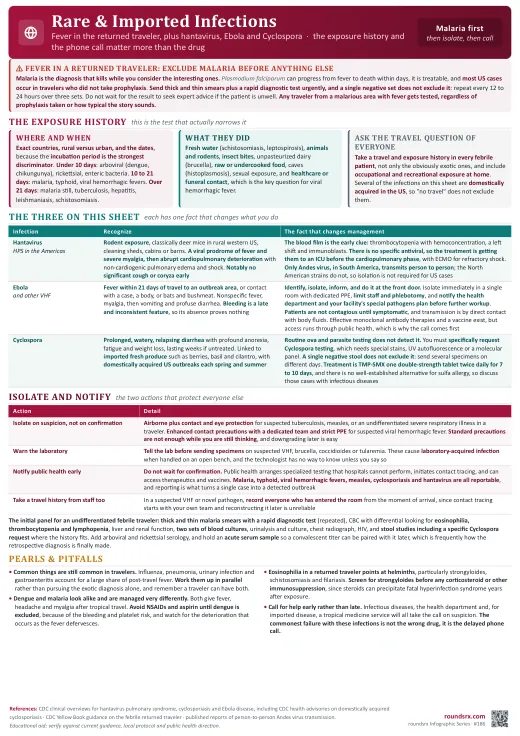
Text version
- Exposure: rodents (US, Four Corners) OR South America / cruise / close contact with Andes case
- Prodrome 3–6 days: fever, severe thigh/back myalgia, GI symptoms
- Cardiopulmonary phase: rapid hypoxia, bilateral infiltrates, refractory shock
- Triad: thrombocytopenia + hemoconcentration + immunoblasts on smear
- Echo: preserved EF (rules out cardiogenic shock)
- Confirm: hantavirus IgM/IgG, RT-PCR (state lab + CDC)
- Early ICU + airborne/droplet precautions (until species ID'd)
- ARDSnet ventilation (6 mL/kg PBW), prone if P/F < 150
- Restrict fluids (capillary leak, more fluid worsens edema)
- Norepinephrine + vasopressin first; epinephrine or milrinone for myocardial component
- Refer for VA-ECMO early if refractory shock, P/F < 80, EF < 40%, lactate rising
- Empiric doxycycline (lepto) + broad-spectrum antibiotics until cultures back
- Ribavirin for HFRS only within 7 days of onset; NOT for HPS
- Notify public health (reportable)
- Andes virus: contact tracing of close contacts × 6 weeks