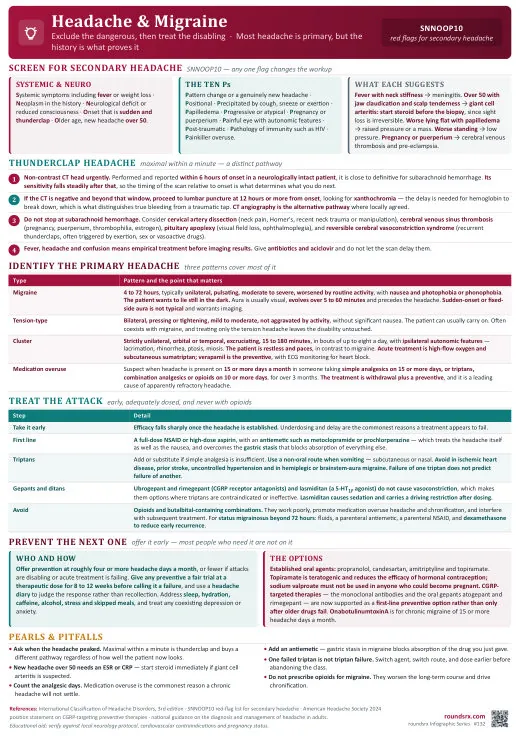
Headache & Migraine
| Type | Features | Duration |
|---|---|---|
| Migraine without aura | Unilateral, pulsating, moderate-severe, nausea/vomiting, photophobia/phonophobia, worse with activity | 4–72 hours |
| Migraine with aura | Visual (scintillating scotoma), sensory, or speech aura preceding headache by 5–60 min | 4–72 hours |
| Tension-type | Bilateral, pressing/tightening ("band-like"), mild-moderate, NO nausea/vomiting | 30 min–7 days |
| Cluster | Unilateral orbital/temporal, severe, with autonomic features (lacrimation, rhinorrhea, ptosis, miosis). Male predominance. | 15–180 min, occurs in clusters |
| Diagnosis | Key Features | Workup | Treatment |
|---|---|---|---|
| SAH | Thunderclap onset, "worst headache of life", neck stiffness | CT head (98% if <6h) then LP for xanthochromia | Secure aneurysm (coil/clip), nimodipine, ICU |
| Meningitis | Fever + headache + neck stiffness + photophobia. Kernig/Brudzinski signs | LP (CSF analysis), blood cultures | Empiric: ceftriaxone + vancomycin + dexamethasone de Gans & van de Beek, NEJM 2002 |
| Giant Cell Arteritis | Age >50, temporal tenderness, jaw claudication, vision changes, elevated ESR/CRP | ESR, CRP, temporal artery biopsy | Prednisone 60 mg/day immediately. Do NOT wait for biopsy |
| Idiopathic Intracranial HTN | Young obese female, daily headache, papilledema, pulsatile tinnitus, transient visual obscurations | MRI (empty sella, flattened globes), LP (opening pressure >25 cm H2O) | Weight loss, acetazolamide 500 mg BID, serial visual fields IIHTT, JAMA 2014 |
| Cerebral Venous Thrombosis | Headache (often progressive) + seizures or focal deficits. Risk: OCP, pregnancy, thrombophilia | MRI + MRV (filling defect in sinus). D-dimer may be elevated | Anticoagulation with heparin, even if hemorrhagic infarct present |
| Intracranial Mass | Progressive, worse in morning, with nausea/vomiting, focal deficits, seizures, papilledema | MRI brain with contrast | Dexamethasone (reduce edema), neurosurgery + oncology |
| Severity | Treatment |
|---|---|
| Mild-moderate | NSAIDs (Ibuprofen (Advil) 400–800mg, Naproxen (Aleve) 500mg) + Metoclopramide (Reglan) 10mg or antiemetic |
| Moderate-severe | Sumatriptan (Imitrex) 6mg SC or 50–100mg PO. Contraindicated in CAD, uncontrolled HTN, prior stroke. |
| ER/refractory | "Migraine cocktail": Ketorolac (Toradol) 30mg IV + Prochlorperazine (Compazine) 10mg IV + Diphenhydramine (Benadryl) 25mg IV + IV fluids |
| Status migrainosus | Dexamethasone (Decadron) 10mg IV + above cocktail. Dihydroergotamine (DHE) protocol if refractory. |
- Topiramate (Topamax) 25–100mg BID -weight loss side effect
- Propranolol (Inderal) 40–160mg daily -also treats anxiety, tremor
- Amitriptyline (Elavil) 10–75mg QHS -good for comorbid insomnia/tension-type
- Valproate (Depakote) 500–1500mg daily -teratogenic, weight gain
- CGRP monoclonal antibodies: Erenumab (Aimovig), Fremanezumab (Ajovy), Galcanezumab (Emgality)
| Setting | Treatment | Details |
|---|---|---|
| Acute (abortive) | High-flow O2 12-15 L via NRB | First-line. 78% response in 15 min. Cohen et al, JAMA 2009 |
| Acute (abortive) | Sumatriptan 6 mg SC | Second-line. SC only (oral too slow for 15-180 min attacks) |
| Prophylaxis (first-line) | Verapamil 240-960 mg/day | ECG monitoring (heart block risk at high doses). Takes 1-2 weeks to work |
| Bridge therapy | Prednisone 60 mg/day x 5d then taper | Rapid relief while verapamil takes effect |
| Refractory | Lithium, galcanezumab, occipital nerve block | Goadsby et al, NEJM 2019 |
| Product | Contents | Label Dose and Status |
|---|---|---|
| Fioricet | Butalbital 50 mg + acetaminophen 300 mg + caffeine 40 mg (brand capsule; many generics are 325 mg acetaminophen) | 1 to 2 capsules q4h, max 6/day. Carries the acetaminophen boxed hepatotoxicity warning: 6 capsules of the 325 mg product is 1,950 mg, so any other acetaminophen the patient takes can push past the 4 g/day ceiling. |
| Fiorinal | Butalbital 50 mg + aspirin 325 mg + caffeine 40 mg | Same 1 to 2 q4h, max 6/day. Schedule III. Fioricet is federally exempt from scheduling, though many generic labels still carry C-III and states differ, so check before assuming it is not controlled. |
| Fioricet with Codeine | The above plus codeine 30 mg | Schedule III. Adds opioid risk on top of barbiturate risk. |
- The label itself does not claim it works for recurrent headache. It is approved only for tension (muscle contraction) headache, and states that evidence for efficacy and safety in multiple recurrent headaches is unavailable. It is not approved for migraine, where butalbital combinations rate Level C, inadequate evidence, while plain acetaminophen/aspirin/caffeine rates Level A (AHS evidence assessment, 2015).
- It causes medication-overuse headache at a lower threshold than plain analgesics. Combination analgesics count at 10 or more days/month for over 3 months (ICHD-3), versus 15 or more for acetaminophen or NSAIDs alone. Two doses on 3 days a week already crosses it.
- It drives progression to chronic migraine. Barbiturate use roughly doubled the odds of episodic migraine becoming chronic over 1 year compared with acetaminophen (OR 2.06), with a dose-response, and the critical exposure was about 5 days/month, more pronounced in women AMPP, 2008.
- You cannot stop it abruptly in a heavy user. Butalbital is a barbiturate: convulsions and delirium can begin within 16 hours of the last dose and last up to 5 days, so someone taking large daily amounts needs a supervised taper, not a clinic instruction to quit.
- Thunderclap headache → CT head STAT → if negative, LP for xanthochromia (SAH)
- New neurologic deficits → CT/MRI + consider CTA/MRA
- New headache age > 50 → ESR, CRP (GCA) + imaging
- Positional headache → MRI brain + possible LP (CSF pressure)
- Progressive or worsening pattern → MRI with contrast
- Typical migraine with normal exam → generally NO imaging needed
| Drug | Dose | Use | Key Notes |
|---|---|---|---|
| Sumatriptan (Imitrex) | 50–100mg PO, 6mg SC | Acute migraine | Triptan class -5-HT1B/1D agonist. Avoid in CAD, prior stroke. |
| Ketorolac (Toradol) | 15–30mg IV/IM | Acute migraine (ER) | NSAID. Max 5 days. Renal caution. |
| Prochlorperazine (Compazine) | 10mg IV | Anti-emetic + anti-migraine | Dopamine antagonist. Give with diphenhydramine to prevent EPS. |
| Topiramate (Topamax) | 25–100mg BID | Prophylaxis | Weight loss, paresthesias, kidney stones, word-finding difficulty. |
| Butalbital combinations (Fioricet, Fiorinal) | 1–2 tabs q4h, max 6/day | Tension headache (labeled); not first-line for recurrent headache | Avoid. Butalbital 50 + caffeine 40 + acetaminophen 300–325 (Fioricet) or aspirin 325 (Fiorinal). MOH at ≥10 days/month, doubles the odds of chronic migraine, and abrupt withdrawal can cause seizures. See the butalbital box under Management. |
| Erenumab (Aimovig) | 70–140mg SC monthly | Prophylaxis | CGRP antibody. Few side effects. Constipation. |
Patient: 48F presents with "worst headache of my life" that reached peak intensity within 30 seconds while exercising. Associated with nausea and neck stiffness. No prior headache history. Exam: GCS 15, mild photophobia, no focal deficits.
Workup: Non-contrast CT head (within 2 hours of onset): negative for hemorrhage. Given early presentation, CT has ~98-100% sensitivity. Decision made to proceed with LP given high clinical suspicion.
LP results: Tube 1: 850 RBCs. Tube 4: 780 RBCs (no clearing). Xanthochromia positive by spectrophotometry.
Assessment: SAH with negative CT but positive LP (xanthochromia + non-clearing RBCs). Approximately 2-5% of SAH cases are CT-negative.
Management: CTA head: 4 mm anterior communicating artery aneurysm. Neurosurgery consulted. Endovascular coiling performed. Nimodipine 60 mg PO q4h for vasospasm prevention x 21 days. ICU monitoring with daily TCDs. Good outcome.
Patient: 32F with known migraines (6/month) presents with severe throbbing left-sided headache x 4 days that has not responded to home sumatriptan (used 3 doses) or ibuprofen. Nausea, vomiting, photophobia. Unable to work or sleep.
Exam: VS stable. Neurologic exam normal. No papilledema. No meningismus.
Assessment: Status migrainosus (migraine lasting >72 hours). Also using triptans >10 days/month, raising concern for medication overuse headache.
Management: Migraine cocktail: ketorolac 30 mg IV + prochlorperazine 10 mg IV + diphenhydramine 25 mg IV + 1L NS. Added dexamethasone 10 mg IV (reduces 72h recurrence by 25%). Pain improved 2h later. Discharged with: referral to headache specialist, topiramate 25 mg daily (prophylaxis), instructions to limit triptan use to <=2 days/week.
Patient: 72F with new-onset right temporal headache x 2 weeks, worse with chewing (jaw claudication). Also reports 10 lb weight loss and shoulder stiffness. No headache history.
Exam: Tender, non-pulsatile right temporal artery. Visual acuity 20/20 bilaterally (no vision loss yet). Fundoscopic exam normal.
Labs: ESR 95 (normal <30), CRP 8.2 (normal <0.5). CBC: mild normocytic anemia. Platelets 450k (reactive thrombocytosis).
Assessment: Giant cell arteritis (GCA). New headache age >50 + jaw claudication + markedly elevated ESR/CRP. High risk for irreversible vision loss if untreated.
Management: Started prednisone 60 mg/day immediately (do NOT wait for biopsy). Temporal artery biopsy scheduled within 1 week (remains positive up to 2 weeks after steroids). Ophthalmology consulted for baseline exam. Biopsy returned: granulomatous arteritis with giant cells. Slow steroid taper over 12-18 months guided by symptoms and ESR/CRP. Added PPI + calcium/vitamin D + DEXA scan for steroid bone protection.