Heart Block & Bradyarrhythmias
Conduction system disease from AV node to His-Purkinje. Know which blocks are benign (Mobitz I) vs which need pacing (Mobitz II, 3rd degree). Atropine is your bridge while you call for the pacer.
🔍 Overview
AV Block Classification
| Type | ECG Pattern | Level of Block | Clinical Significance | Needs Pacing? |
|---|---|---|---|---|
| 1st Degree | PR > 200 ms, every P followed by QRS | AV node delay | Benign. No treatment needed. Common in athletes, vagal tone, beta-blockers. | No |
| 2nd Degree -Mobitz I (Wenckebach) | Progressive PR prolongation → dropped QRS. Grouped beating pattern. | AV node (above His) | Usually benign. Common in inferior MI (RCA supplies AV node), athletes, digoxin. Often transient. | Rarely. Only if symptomatic (bradycardia with hemodynamic compromise). |
| 2nd Degree -Mobitz II | Constant PR interval → sudden dropped QRS. No progressive prolongation. | Below His bundle (infranodal) | DANGEROUS. High risk of progressing to complete heart block without warning. Often associated with anterior MI, structural disease. | Yes -pacemaker indicated even if asymptomatic. |
| 3rd Degree (Complete) | Complete AV dissociation. P waves march through at their own rate. QRS at escape rate (junctional 40–60 or ventricular 20–40). | Complete block at any level | EMERGENCY if symptomatic. May be stable if junctional escape with narrow QRS. Wide QRS escape = unstable, unreliable. | Yes -permanent pacemaker. |
Mobitz I = safe (AV node, usually transient). Mobitz II = dangerous (infranodal, can drop to complete block suddenly). The key distinction: does the PR progressively lengthen before the drop? Yes = Mobitz I. No = Mobitz II.
Common Causes
- Medications -beta-blockers, CCBs (verapamil/diltiazem), digoxin, amiodarone (most common reversible cause)
- Ischemia -inferior MI (AV node block, often transient), anterior MI (His-Purkinje, often permanent)
- Degenerative -fibrosis of conduction system (Lenegre disease, Lev disease) -most common in elderly
- Infiltrative -sarcoidosis (think cardiac sarcoid in young patient with unexplained heart block), amyloidosis
- Infectious -Lyme disease (early disseminated → AV block, usually reversible with antibiotics), endocarditis with abscess
- Post-surgical -TAVR, septal myectomy, congenital heart surgery
🚨 Management
Acute Symptomatic Bradycardia
Step 1
Atropine 0.5 mg IV q3–5 min (max 3 mg). Works for AV nodal block (1st degree, Mobitz I, junctional). Does NOT work for infranodal block (Mobitz II, 3rd degree with wide escape) -the block is below where atropine acts.
🔄 Updated Practice: Old teaching: atropine works for all types of heart block. Current practice: atropine only works for NODAL blocks (1st degree AV block, Mobitz Type I/Wenckebach) by increasing AV node conduction via vagolytic effect. It does NOT work for INFRANODAL blocks (Mobitz Type II, complete/3rd degree heart block), and can paradoxically worsen the block by increasing atrial rate without improving ventricular conduction. Infranodal blocks require transcutaneous or transvenous pacing.
Step 2
If atropine fails: transcutaneous pacing (external pads). Set rate 60–80, increase mA until capture. Sedate the patient -it's painful. This is a bridge.
Step 3
Transvenous pacing (temporary pacing wire via IJ/subclavian/femoral). Definitive temporary bridge until permanent pacer.
Bridge agents
While awaiting pacing: dopamine 5–20 mcg/kg/min or epinephrine 2–10 mcg/min or isoproterenol 2–20 mcg/min (β₁ chronotropy).
Permanent Pacemaker Indications
- 3rd degree AV block (symptomatic or asymptomatic) ACC/AHA/HRS Bradycardia Guidelines, Kusumoto 2019
- Mobitz II (symptomatic or asymptomatic -high progression risk)
- Symptomatic Mobitz I not due to reversible cause
- Symptomatic sinus node dysfunction (sick sinus syndrome, tachy-brady syndrome)
- Post-MI persistent 2nd or 3rd degree block
- Alternating bundle branch block (RBBB alternating with LBBB -impending complete block)
Always rule out reversible causes before permanent pacing: medication effect (hold offending drugs and reassess), Lyme disease (treat with IV ceftriaxone), inferior MI (AV block often resolves in 5–7 days), hyperkalemia, hypothyroidism. ACC/AHA/HRS, 2019
🧪 Workup
Workup
- ECG -degree and level of block
- BMP + Mg²⁺ -hyperkalemia
- Medication review -BB, CCB, digoxin, amiodarone
- TSH -hypothyroidism
- Lyme serology -AV block in Lyme carditis
- Troponin -inferior MI → AV node ischemia
- Echo -structural/infiltrative disease
📋 On Rounds
Why doesn't atropine work in Mobitz II or infranodal block?
Atropine is a parasympatholytic (anticholinergic) -it blocks vagal tone at the AV node, increasing conduction through the node. In Mobitz II and 3rd degree heart block with wide QRS, the block is below the AV node (in the His bundle or bundle branches) where there is no parasympathetic innervation. Atropine has no target to act on.
A 28-year-old presents with new-onset 3rd degree heart block. What diagnosis should you consider?
Lyme disease (Lyme carditis) and cardiac sarcoidosis. Lyme is the most important to catch -it's fully reversible with IV ceftriaxone (2g daily × 14–21 days). Occurs in early disseminated Lyme (weeks–months after tick bite). Get Lyme serologies in any young patient with unexplained heart block, especially in endemic areas.
What medications cause heart block, and which are reversible?
Reversible (hold and observe): beta-blockers (metoprolol, atenolol, carvedilol), non-DHP calcium channel blockers (diltiazem, verapamil), digoxin, amiodarone, clonidine. Metabolic causes (correct the cause): hyperkalemia (most dangerous -can cause any degree of block → sine wave → arrest), hypothyroidism, hypothermia.
An inferior STEMI patient develops complete heart block. Is this the same as chronic CHB?
No -and the management is different. Inferior MI causes AV node ischemia (supplied by RCA in 85%) → typically a junctional escape rhythm at 40-60 bpm (narrow QRS, relatively stable). This is usually transient (resolves in 2-7 days) as the AV node recovers. Management: temporary pacing if hemodynamically compromised, atropine may help (vagal-mediated). Does NOT routinely need a permanent pacer -monitor and reassess.
Case 1: Symptomatic Mobitz Type II
Presentation: 70M with recurrent syncope over 2 weeks, baseline HTN and prior anterior MI. Arrives after witnessed syncopal episode. HR 38, BP 88/54. ECG shows 2:1 AV block with wide QRS (RBBB morphology) and constant PR intervals on conducted beats, consistent with Mobitz Type II.
Management: Transcutaneous pacing pads placed immediately. Atropine 0.5 mg IV given, no response (expected: infranodal block has no vagal innervation to antagonize). Capture achieved with transcutaneous pacing at 70 mA. Dopamine drip started at 5 mcg/kg/min for BP support. EP consulted, permanent dual-chamber pacemaker (DDD) placed next day.
Teaching Point: Mobitz II with wide QRS = infranodal block. Atropine will not work. Do not delay pacing. Even asymptomatic Mobitz II is a Class I indication for permanent pacemaker.
Management: Transcutaneous pacing pads placed immediately. Atropine 0.5 mg IV given, no response (expected: infranodal block has no vagal innervation to antagonize). Capture achieved with transcutaneous pacing at 70 mA. Dopamine drip started at 5 mcg/kg/min for BP support. EP consulted, permanent dual-chamber pacemaker (DDD) placed next day.
Teaching Point: Mobitz II with wide QRS = infranodal block. Atropine will not work. Do not delay pacing. Even asymptomatic Mobitz II is a Class I indication for permanent pacemaker.
Case 2: Complete Heart Block Post-Inferior STEMI
Presentation: 58F with acute inferior STEMI (RCA occlusion) taken for PCI. Post-cath, develops new 3rd degree AV block with narrow QRS junctional escape rhythm at 42 bpm. BP 96/60, mildly symptomatic with lightheadedness but alert.
Management: Atropine 0.5 mg IV, HR improves transiently to 56 bpm (AV nodal block, so atropine has partial effect). Temporary transvenous pacing wire placed via RIJ as backup. Monitored on telemetry. By day 3, AV conduction returns, 1st degree AV block only. Pacing wire removed day 4.
Teaching Point: Inferior MI causes AV node ischemia (RCA supplies AV node in 85%). Heart block is usually transient (resolves in 2–7 days) with a stable junctional escape. Does NOT routinely require permanent pacing, monitor and reassess. Contrast with anterior MI, where heart block is infranodal and often permanent.
Management: Atropine 0.5 mg IV, HR improves transiently to 56 bpm (AV nodal block, so atropine has partial effect). Temporary transvenous pacing wire placed via RIJ as backup. Monitored on telemetry. By day 3, AV conduction returns, 1st degree AV block only. Pacing wire removed day 4.
Teaching Point: Inferior MI causes AV node ischemia (RCA supplies AV node in 85%). Heart block is usually transient (resolves in 2–7 days) with a stable junctional escape. Does NOT routinely require permanent pacing, monitor and reassess. Contrast with anterior MI, where heart block is infranodal and often permanent.
Case 3: Drug-Induced Bradycardia & High-Grade AV Block
Presentation: 82M with HFrEF and atrial fibrillation, on Metoprolol Succinate (Toprol-XL) 100 mg daily + Diltiazem (Cardizem) 120 mg TID + Digoxin (Lanoxin) 0.125 mg daily. Admitted with fatigue and near-syncope. HR 32, BP 84/50. ECG shows 1st degree AV block progressing to high-grade AV block (3:1 and 4:1 conduction) with narrow QRS.
Management: All three AV-nodal blocking agents held immediately. Atropine 1 mg IV, transient improvement to HR 48. Glucagon 3 mg IV bolus then 3 mg/hr drip (beta-blocker reversal). Digoxin level drawn, 2.4 ng/mL (elevated). Transcutaneous pads placed prophylactically. Over 36 hours, metoprolol and diltiazem cleared, HR improved to 64, normal sinus rhythm with 1st degree AV block only.
Teaching Point: Triple AV-nodal blockade (beta-blocker + non-DHP CCB + digoxin) is a common iatrogenic cause of high-grade AV block. First step: hold all offending agents and check digoxin level. Glucagon is the specific antidote for beta-blocker toxicity. Most drug-induced heart block resolves after drug washout, avoid permanent pacing until reversible causes are excluded.
Management: All three AV-nodal blocking agents held immediately. Atropine 1 mg IV, transient improvement to HR 48. Glucagon 3 mg IV bolus then 3 mg/hr drip (beta-blocker reversal). Digoxin level drawn, 2.4 ng/mL (elevated). Transcutaneous pads placed prophylactically. Over 36 hours, metoprolol and diltiazem cleared, HR improved to 64, normal sinus rhythm with 1st degree AV block only.
Teaching Point: Triple AV-nodal blockade (beta-blocker + non-DHP CCB + digoxin) is a common iatrogenic cause of high-grade AV block. First step: hold all offending agents and check digoxin level. Glucagon is the specific antidote for beta-blocker toxicity. Most drug-induced heart block resolves after drug washout, avoid permanent pacing until reversible causes are excluded.
📣 Sample Presentation
One-Liner
"Mr. Davis is a 76-year-old on metoprolol 200 mg daily presenting with dizziness and HR 34. ECG shows complete (third-degree) AV block with a ventricular escape rate of 34 bpm."
Key Points to Cover on Rounds
Third-degree AV block. Hemodynamically stable but symptomatic. Metoprolol held (reversible cause). Temporary transcutaneous pacing pads placed. Atropine 0.5 mg given with transient improvement to HR 48. Lyme screen and TSH sent. Troponin negative. EP consulted for permanent pacemaker. Plan: if no improvement after holding BB ×24h, transvenous pacing wire → permanent pacer.
💊 Medications
Key Medications -Heart Block & Bradycardia
| Drug | Dose | Route | Notes |
|---|---|---|---|
| Atropine 1ST LINE | 0.5-1 mg IV, repeat q3-5 min (max 3 mg) | IV push | Vagolytic -works for nodal block only (1st degree, Mobitz I). Will NOT work for Mobitz II or 3rd degree (infranodal) -no vagal innervation below AV node. Can paradoxically worsen infranodal block. |
| Isoproterenol (Isuprel) | 2-10 mcg/min IV drip | IV | Beta-1 + Beta-2 agonist. Increases HR and AV conduction. Bridge to pacing. Caution: increases myocardial O₂ demand. |
| Dopamine | 5-20 mcg/kg/min IV drip | IV | Chronotropic at 5-10 mcg/kg/min (beta effect). Alternative to isoproterenol if hypotensive. Higher doses add alpha vasoconstriction. |
| Epinephrine | 2-10 mcg/min IV drip | IV | For symptomatic bradycardia unresponsive to atropine. Potent chronotrope and vasopressor. |
| Transcutaneous pacing | Start 60-80 mA, rate 60-80 bpm | External pads | Bridge to transvenous pacing. Painful -requires sedation. Verify mechanical capture (palpable pulse with each complex). |
| Transvenous pacing | Per EP/cardiology | Central venous | Temporary pacing wire via RIJ or femoral vein. For refractory symptomatic bradycardia awaiting permanent pacemaker. |
First step: Review medication list -hold all AV-nodal blockers (beta-blockers, non-DHP CCBs, digoxin, amiodarone). Check K⁺ and Mg²⁺. Many cases of heart block are iatrogenic and reversible.
⚡ Summary
Summary
Mobitz I Is Safe, Mobitz II Is Not
Mobitz I (Wenckebach) is at the AV node, usually transient and often benign. Mobitz II is infranodal and can drop to complete block without warning, so it needs pacing. The discriminator is whether the PR interval progressively lengthens before the dropped beat: yes is Mobitz I, no is Mobitz II.
Atropine Only Works Above the Node
It is vagolytic, so it speeds conduction through the AV node. It works in first-degree block and Mobitz I. It does not work in Mobitz II or complete heart block, which are infranodal, and it can make them worse by increasing atrial rate without improving conduction. Move to pacing rather than repeating the dose.
Escalate in the Right Order for Unstable Bradycardia
Atropine 1 mg IV, repeatable to 3 mg, then transcutaneous pacing, then a chronotropic infusion (dopamine or epinephrine), then transvenous pacing. Sedate for transcutaneous pacing, which is painful, and confirm mechanical capture with a pulse, not just the pacing spikes on the monitor.
Look at the Medication List First
Many cases are iatrogenic and fully reversible. Hold every AV nodal blocking agent: beta blockers, non-dihydropyridine calcium channel blockers, digoxin, amiodarone, and also clonidine and cholinesterase inhibitors. Check potassium and magnesium. Reassess after the drug clears before committing to a device.
Exclude the Reversible Causes Before Pacing
Medication effect, hyperkalemia, hypothyroidism, and Lyme carditis, which is treated with IV ceftriaxone and typically resolves. Inferior MI causes AV block that usually resolves in 5 to 7 days, because it is nodal and vagally mediated, so it rarely needs a permanent device. Anterior MI with new block is different: it means extensive septal infarction, it is infranodal, and it does need permanent pacing.
Complete Heart Block Is Recognized by Dissociation
Regular P waves and regular QRS complexes marching independently, with a QRS rate slower than the P rate. The escape rhythm predicts the risk: a narrow junctional escape at 40 to 60 is relatively stable, while a wide ventricular escape at 20 to 40 is unreliable and can fail without warning.
Know the Pacing Indications
Symptomatic bradycardia of any type, Mobitz II, complete heart block, and advanced second-degree block, once reversible causes are excluded. Also alternating bundle branch block and symptomatic sinus node dysfunction. Asymptomatic Mobitz I and first-degree block do not need pacing, and treating a number rather than a patient is the commonest over-treatment here.
Consider the Other Diagnoses a Slow Heart Rate Signals
BRASH syndrome: bradycardia, renal failure, AV nodal blockade, shock and hyperkalemia, a self-reinforcing spiral in which each element worsens the others, and it needs all of them treated at once rather than the bradycardia alone. Also look for infiltrative disease, cardiac sarcoidosis and amyloidosis, in unexplained conduction disease in a younger patient, since finding it changes the treatment entirely.
📄 One Pager
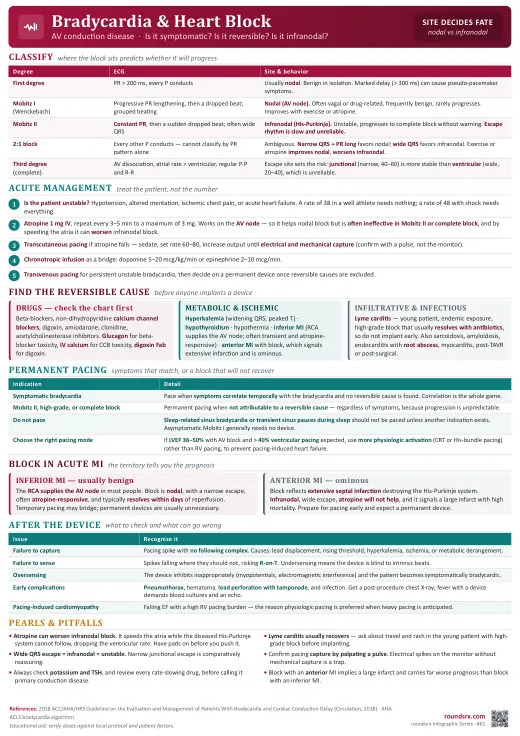
Text version
📄 One Pager
Cardiology · One Pager
Heart Block
Check meds and K⁺ first. Mobitz I = usually benign. Mobitz II or CHB = pacemaker. Don't delay temp pacing if symptomatic.
Types
- 1st degree: PR > 200ms. Benign. Observe.
- 2nd degree Mobitz I: progressive PR → dropped beat. AV nodal. Usually benign.
- 2nd degree Mobitz II: constant PR → sudden drop. Infranodal. DANGEROUS → pacer.
- 3rd degree (CHB): complete dissociation. Narrow escape = junctional (40-60). Wide = ventricular (20-40, unstable).
Management
- Check and hold offending meds: BB, CCB, digoxin, amiodarone
- Check K⁺ (hyperkalemia causes any degree of block)
- Symptomatic bradycardia → atropine 0.5 mg IV
- Transcutaneous pacing pads on standby
- Transvenous wire if unstable + awaiting permanent pacer
- Lyme screen and TSH if no obvious cause
When Does It Need a Pacer?
- Mobitz II (risk of sudden progression to CHB)
- Third-degree AV block (symptomatic or with wide escape)
- Symptomatic sinus node dysfunction
- Post-TAVR CHB (common, may resolve -observe 24-48h)
- Alternating bundle branch block
- Exception: inferior MI CHB often resolves (observe, don't rush to pacer)
Key Drugs
Atropine0.5 mg IV q3-5 min (max 3 mg)
Dopamine2-20 mcg/kg/min (bridge)
Epinephrine (Adrenalin)2-10 mcg/min (bridge)
Isoproterenol2-10 mcg/min (last resort)
Pitfalls
- Not checking med list first (most common cause)
- Missing hyperkalemia
- Rushing to permanent pacer in inferior MI CHB
- Not placing transcutaneous pads early
Related Topics
ACS OverviewAortic DissectionAortic StenosisArrhythmiasAtrial FibrillationCardiac Tamponade