Heat Stroke
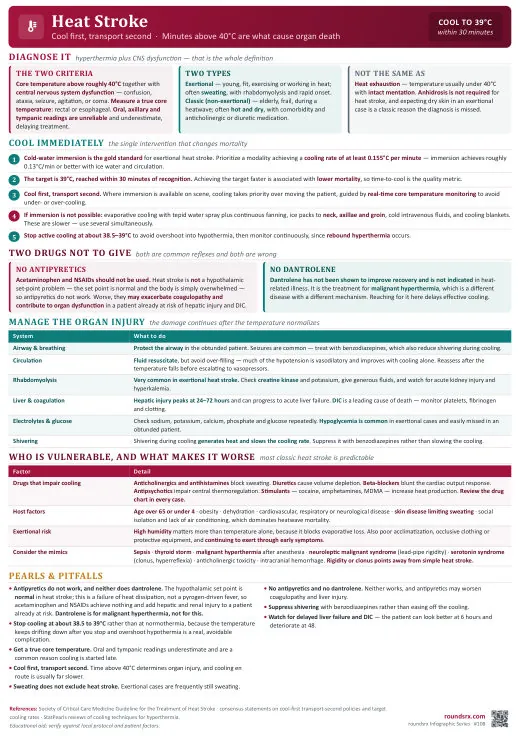
Core temperature >40°C (104°F) with CNS dysfunction (altered mental status, seizures, coma). A true medical emergency -mortality 10–50% depending on delay to cooling. The single most important intervention is rapid cooling to <39°C within 30 minutes. Every minute counts.
🔍 Overview
Classification
| Type | Setting | Mechanism | Key Features |
|---|---|---|---|
| Classic (non-exertional) | Elderly, chronic illness, medications, heat waves | Failure of thermoregulation -body cannot dissipate environmental heat | Develops over days. Skin often hot and dry (sweat glands exhausted). Elderly on anticholinergics, diuretics, beta-blockers at highest risk. |
| Exertional | Young, healthy individuals -athletes, military, laborers | Metabolic heat production overwhelms dissipation during intense physical activity | Develops over hours. Skin may still be diaphoretic. Often in hot, humid environments. Can occur even in cool conditions with extreme exertion. |
Heat Stroke vs Heat Exhaustion
| Feature | Heat Exhaustion | Heat Stroke |
|---|---|---|
| Core Temp | < 40°C (104°F) | > 40°C (104°F) |
| Mental Status | Normal or mild confusion | Altered -confusion, delirium, seizures, coma |
| Sweating | Present (profuse) | May be absent (classic) or present (exertional) |
| Organ Damage | Absent | Present -rhabdomyolysis, DIC, liver failure, AKI, ARDS |
| Treatment | Rest, oral rehydration, passive cooling | Aggressive cooling + ICU |
The defining feature of heat stroke is CNS dysfunction -not the temperature alone. A patient with temp 40.5°C and normal mentation has heat exhaustion. A patient with temp 40.1°C and confusion/seizures has heat stroke. Treat the brain, not the thermometer.
Risk Factors & Medications
- Anticholinergics -impair sweating (diphenhydramine, TCAs, antipsychotics)
- Diuretics -volume depletion impairs sweating
- Beta-blockers -blunt cardiac output response to heat stress
- Stimulants -amphetamines, cocaine, MDMA increase metabolic heat production
- Antipsychotics -impair thermoregulation centrally (especially in NMS overlap)
- Extremes of age -elderly (impaired thermoregulation) and infants (high surface area:volume)
- Obesity, deconditioning, dehydration
🚨 Management
Cooling -The Single Most Important Intervention
Target: core temperature < 39°C (102.2°F) within 30 minutes. Every minute of delay increases mortality and neurological injury. Start cooling BEFORE full workup. Do NOT wait for labs.
| Method | Technique | Effectiveness | Notes |
|---|---|---|---|
| Cold water immersion GOLD STANDARD | Immerse body (neck down) in ice water bath (1–3°C) | Cooling rate ~0.2°C/min -fastest available method | Gold standard for exertional heat stroke. Near-zero mortality if applied within 30 min. Logistically challenging in ED -need large tub. Monitor for shivering (counterproductive). |
| Evaporative cooling | Undress patient, mist with lukewarm water, fan continuously | Cooling rate ~0.05°C/min | Most practical in ED/ICU. Less effective than immersion but widely available. Combine with ice packs to axillae, groin, neck. |
| Ice packs | Apply to axillae, groin, neck, and scalp (high blood flow areas) | Adjunct -slow as standalone | Use in combination with other methods. Cover large surface area. Rotate frequently. |
| Cold IV fluids | 4°C normal saline bolus (not iced -just refrigerated) | Adjunct -modest cooling effect | Addresses volume depletion AND provides some cooling. Give 1–2L bolus. Do not use as sole cooling method. |
| Invasive cooling | Peritoneal lavage, bladder irrigation with cold saline, endovascular cooling catheter | Variable -reserved for refractory cases | Consider if temp >41°C and not responding to external cooling. Endovascular catheter allows precise temperature control. |
Stepwise Approach
- ABCs first -secure airway if GCS ≤ 8, intubate if needed
- Remove from heat -move to cool environment, remove clothing
- Begin cooling immediately -cold water immersion if available, otherwise evaporative + ice packs
- IV access + fluids -cold NS or LR 1–2L bolus. LR is safe even in liver disease (lactate is metabolized by kidneys and skeletal muscle, not just liver).
- Continuous core temperature monitoring -rectal or esophageal probe (NOT oral or axillary -inaccurate)
- Stop cooling at 39°C -overshoot hypothermia is a real risk
- Treat seizures -benzodiazepines (lorazepam 2–4 mg IV). Avoid phenytoin (ineffective for hyperthermia-related seizures).
- Avoid antipyretics -acetaminophen and NSAIDs do NOT work. Heat stroke is not a fever (no prostaglandin-mediated set point elevation). Antipyretics may worsen hepatic/renal injury.
Do NOT give antipyretics (acetaminophen, NSAIDs). Heat stroke is a failure of thermoregulation, not a prostaglandin-mediated fever. The hypothalamic set point is normal -the body simply cannot dissipate heat. Antipyretics are useless and hepatotoxic in this setting.
🧪 Workup
Diagnostic Evaluation
- Core temperature -rectal or esophageal probe. Oral/axillary/temporal are unreliable. Must be >40°C for diagnosis.
- CBC -leukocytosis common. Thrombocytopenia suggests DIC.
- BMP -hyperkalemia (rhabdo, cell lysis), AKI (elevated Cr), hypoglycemia (liver failure).
- LFTs -AST/ALT elevation is universal. Hepatic injury peaks at 48–72h. Fulminant liver failure is a major cause of death.
- CK (creatine kinase) -rhabdomyolysis (CK >5× ULN). Peak at 24–72h. Check q6–12h.
- Coagulation panel -PT/INR, PTT, fibrinogen, D-dimer. DIC is common and a major cause of death.
- Lactate -marker of tissue hypoperfusion and anaerobic metabolism.
- UA with myoglobin -dark urine, positive blood on dipstick but no RBCs on microscopy = myoglobinuria.
- ABG/VBG -mixed acid-base disturbances common (respiratory alkalosis from tachypnea + metabolic acidosis from lactic acid).
- CT head -if focal neurological deficits or seizures to rule out structural cause.
LFTs may be initially normal. Hepatic injury from heat stroke peaks at 48–72 hours. Recheck LFTs daily for 3–5 days. Fulminant hepatic failure requiring transplant can occur.
💊 Medications
Key Medications
| Drug | Dose | Role | Notes |
|---|---|---|---|
| Normal Saline (cold, 4°C) 1ST LINE | 1–2 L IV bolus | Volume resuscitation + adjunct cooling | Most patients are severely volume depleted. LR or NS are both acceptable -LR is safe even in liver disease (lactate is metabolized by kidneys and muscle, not just liver). Titrate to UOP 1–2 mL/kg/h (especially if rhabdo). |
| Lorazepam (Ativan) | 2–4 mg IV PRN | Seizures, shivering | Shivering during cooling is counterproductive (generates heat). Benzos suppress shivering. Also first-line for heat stroke seizures. |
| Dantrolene CONSIDER | 1–2.5 mg/kg IV | Refractory hyperthermia | Skeletal muscle relaxant. Consider if NMS or malignant hyperthermia cannot be excluded. Evidence for pure heat stroke is limited, but may help if significant muscle rigidity/rhabdo. |
| Sodium Bicarbonate | 150 mEq in 1L D5W | Urine alkalinization for rhabdomyolysis | Target urine pH >6.5 to prevent myoglobin-induced AKI. Use if CK >5,000 and rising. |
Medications that are CONTRAINDICATED or USELESS: Acetaminophen (no effect, hepatotoxic), NSAIDs (no effect, nephrotoxic), aspirin (no effect, worsens DIC), phenytoin (ineffective for hyperthermic seizures -use benzos).
📋 On Rounds
Pimp Questions
Why don't antipyretics work in heat stroke?
Fever is caused by prostaglandins raising the hypothalamic set point -antipyretics (acetaminophen, NSAIDs) work by blocking prostaglandin synthesis. In heat stroke, the hypothalamic set point is normal -the body simply cannot dissipate the heat load fast enough (overwhelmed thermoregulatory system). Since there is no prostaglandin-mediated set point elevation, antipyretics have zero effect.
What is the key difference between heat stroke and heat exhaustion?
CNS dysfunction. Heat exhaustion can cause fatigue, nausea, headache, and even syncope -but mental status remains intact. Heat stroke is defined by altered mental status (confusion, delirium, seizures, coma) + core temp >40°C. Heat exhaustion is a clinical continuum that can progress to heat stroke if not treated. The moment a patient develops AMS in the setting of hyperthermia, it's heat stroke until proven otherwise.
What is the gold standard cooling method and what cooling rate does it achieve?
Cold water immersion (ice water bath, 1–3°C) is the gold standard. Cooling rate ~0.2°C/min, which means a patient at 42°C can reach target (39°C) in ~15 minutes. Near-zero mortality when applied within 30 minutes. Compare with evaporative cooling (~0.05°C/min) -significantly slower. The military and sports medicine literature strongly supports ice water immersion as first-line.
How do you differentiate heat stroke from neuroleptic malignant syndrome (NMS)?
NMS presents with hyperthermia + AMS + lead-pipe rigidity + autonomic instability, typically after starting or increasing a dopamine antagonist (antipsychotics, metoclopramide). Key distinguishing features: (1) NMS has prominent muscle rigidity (heat stroke has flaccidity or mild rigidity), (2) NMS develops over days (exertional heat stroke over hours), (3) NMS has markedly elevated CK from rigidity
📣 Sample Presentation
One-Liner
"Mr. Thompson is a 22-year-old Army recruit who collapsed during a 10-mile run in 95°F heat, found unresponsive with rectal temp 41.8°C, GCS 7, tachycardic to 140, and diffusely diaphoretic."
Key Points to Cover on Rounds
Exertional heat stroke -core temp 41.8°C on arrival, GCS 7. Ice water immersion initiated in field within 15 min, continued in ED. Core temp down to 39.2°C at 20 min, cooling stopped at 38.8°C. Now GCS 11 (E3V3M5), improving. CK 12,400 and rising -aggressive IVF at 250 mL/hr with bicarb drip for urine alkalinization, target UOP >200 mL/h. LFTs: AST 320, ALT 180 -will recheck daily (peaks at 48–72h). Coags normal, no DIC. Lactate 6.2 → 3.1 trending down. Plan: ICU, continuous core temp monitoring, CK q6h, LFTs daily, neuro checks q2h, hold all nephrotoxins.
Monitoring Parameters
- Continuous core temperature -rectal or esophageal probe. Stop active cooling at 39°C to prevent overshoot hypothermia.
- Continuous telemetry -arrhythmias from hyperkalemia, hyperthermia-induced myocardial injury.
- Urine output -target 1–2 mL/kg/h (especially with rhabdomyolysis). Foley catheter essential.
- CK q6–12h -trend for rhabdomyolysis. Peak 24–72h. Aggressive IVF if CK rising.
- LFTs daily × 3–5 days -hepatic injury peaks at 48–72h. Watch for coagulopathy, hypoglycemia as signs of liver failure.
- Coags q12–24h -DIC panel (PT, PTT, fibrinogen, D-dimer). Fibrinogen < 150 = ominous.
- BMP q6–12h -hyperkalemia (rhabdo), AKI, hypoglycemia (liver failure).
- Neuro checks q1–2h -GCS trending. Persistent AMS after cooling suggests brain injury.
⚡ Summary
CNS Dysfunction Defines It
Heat stroke is hyperthermia plus altered mental status; heat exhaustion is hyperthermia with intact mentation. A patient at 40.5°C who is thinking clearly has heat exhaustion; a patient at 40.1°C who is confused or seizing has heat stroke. Treat the brain, not the thermometer.
Cool Immediately, Before the Workup
Target a core temperature below 39°C within 30 minutes. Every minute of delay increases mortality and neurologic injury, because the duration and degree of hyperthermia together determine the protein denaturation and cell death. Start cooling before the labs, before imaging, before the full history.
Cold Water Immersion Is the Best Method
It cools fastest and has the lowest mortality in exertional heat stroke. Evaporative cooling with misting and fans is the practical alternative in the elderly or when immersion is impractical, along with ice packs to the neck, axillae and groin, and cold IV fluids. Stop at about 38.5 to 39°C to avoid overshoot into hypothermia.
Do Not Give Antipyretics
Acetaminophen and NSAIDs do nothing. Heat stroke is a failure of heat dissipation, not a prostaglandin-mediated fever, and the hypothalamic set point is normal. Worse, both add hepatic and renal toxicity to organs that are already injured by the hyperthermia.
Do Not Give Dantrolene Either
It is the treatment for malignant hyperthermia and neuroleptic malignant syndrome, not for classic or exertional heat stroke, where it has shown no benefit. Consider those diagnoses instead when the history involves an anesthetic, succinylcholine or an antipsychotic, since the treatments genuinely differ.
Sedate for Shivering
Shivering during cooling generates heat and defeats the intervention. Use benzodiazepines, which also treat the agitation and seizures that accompany the syndrome. This is one of the commonest reasons active cooling appears to fail.
Separate Classic From Exertional
Classic: elderly, chronically ill, during a heat wave, often anhidrotic with hot dry skin, developing over days. Exertional: young, fit, exercising in the heat, frequently still sweating, so the presence of sweat does not exclude heat stroke. Exertional cases have far more rhabdomyolysis, DIC and acute kidney injury.
Anticipate Multi-Organ Failure
Rhabdomyolysis with acute kidney injury, hepatic injury, DIC, ARDS and arrhythmia. Give aggressive fluids and follow CK, renal function, liver tests, coagulation and electrolytes serially. Review the drugs that predisposed them: anticholinergics, antipsychotics, diuretics, beta blockers and stimulants all impair heat dissipation, and counsel about them before discharge.
Related Topics
Altered Mental Status & DeliriumGuillain-Barré SyndromeHeadache & MigraineIntracerebral HemorrhageMyasthenic CrisisNMS vs Serotonin Syndrome