Hemolytic Anemia
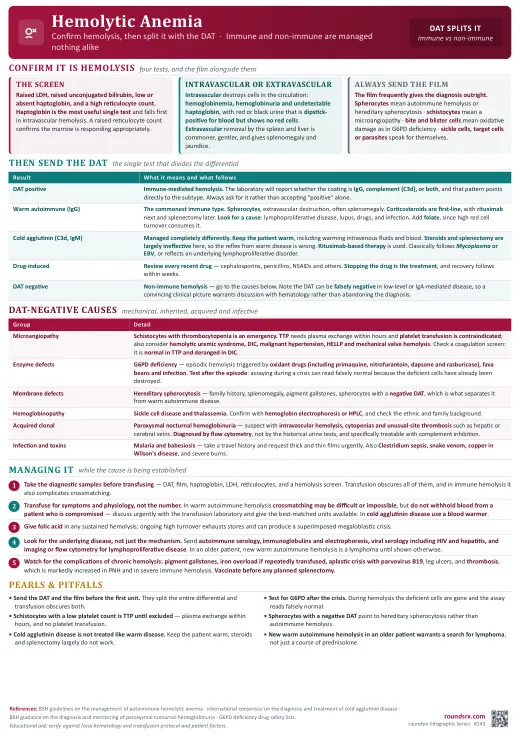
Hemolytic anemia = shortened RBC lifespan (< 120 days) causing anemia with compensatory reticulocytosis. Hallmark labs: elevated LDH, elevated indirect bilirubin, low/undetectable haptoglobin, elevated reticulocyte count. Two categories by mechanism: Intravascular hemolysis (RBCs destroyed in circulation -hemoglobinuria, hemoglobinemia, very low haptoglobin -PNH, TTP, mechanical valve, transfusion reaction, DIC). Extravascular hemolysis (RBCs destroyed by splenic macrophages -splenomegaly, jaundice, no hemoglobinuria -AIHA, hereditary spherocytosis, sickle cell, hypersplenism). The direct Coombs test (DAT) is the critical branch point: positive = antibody on RBCs → immune hemolysis. Negative = non-immune → check smear for mechanistic clues.
- Hemolysis labs: LDH (↑), haptoglobin (↓ or undetectable), indirect bilirubin (↑), reticulocyte count (↑). All four should be checked together.
- Direct Coombs test (DAT) -the branch point.
- DAT positive: warm AIHA (IgG -most common, responds to steroids), cold agglutinin disease (IgM + complement -associated with Mycoplasma, lymphoma), drug-induced (cephalosporins, piperacillin, methyldopa), transfusion reaction
- DAT negative: microangiopathic (TTP, DIC, HUS -schistocytes on smear), mechanical (prosthetic valve), PNH (flow cytometry for GPI-anchored proteins), intrinsic RBC defects (G6PD, hereditary spherocytosis, sickle cell, thalassemia). If TTP suspected → calculate PLASMIC score (predicts ADAMTS13 deficiency) PLASMIC Score, Bendapudi 2017
- Peripheral smear -essential. Schistocytes (TMA), spherocytes (AIHA, HS), sickle cells, bite cells (G6PD), target cells (thalassemia, liver)
- Flow cytometry -if PNH suspected (dark urine, pancytopenia, abdominal vein thrombosis). Tests for CD55/CD59 (GPI-anchored proteins absent in PNH).
- G6PD level -check BETWEEN episodes (level is falsely normal during acute hemolysis because young RBCs have more G6PD). Common triggers: sulfa drugs, dapsone, fava beans, infections.
- Cold agglutinin titer -if DAT positive for complement only (C3d) with IgG negative. Associated with Mycoplasma pneumonia, EBV, lymphoma.
- Osmotic fragility -hereditary spherocytosis (spherocytes lyse more easily in hypotonic solution)
- Warm AIHA (DAT positive, IgG):
- First-line: Prednisone 1 mg/kg daily → taper when Hgb stabilizing. Response in 70-85% within 1-3 weeks.
- Second-line: Rituximab 375 mg/m² × 4 (steroid-refractory or relapsing). Also consider: mycophenolate, azathioprine. Lechner & Jäger, 2015
- Third-line: Splenectomy (if failing medical therapy). Vaccinate before surgery.
- Transfuse if life-threatening anemia -DO transfuse despite positive DAT making crossmatch difficult. Use "least incompatible" units. The blood bank will work with you.
- Cold agglutinin disease (DAT positive, C3d): Keep patient warm (avoid cold exposure, warm IV fluids). Steroids less effective than in warm AIHA. Rituximab first-line. Sutimlimab (anti-C1s complement inhibitor) for chronic CAD CARDINAL, 2022. Avoid RBC transfusion if possible (complement activates on transfused cells).
- TTP/HUS: See TTP topic (PLEX, steroids, caplacizumab). HERCULES, Scully 2019
- PNH: Eculizumab (anti-C5 complement inhibitor) TRIUMPH, 2006. Meningococcal vaccine required before starting. Ravulizumab (longer-acting) available.
- G6PD: Remove trigger (stop offending drug, treat infection). Supportive care. Avoid oxidant drugs lifelong.
- Mechanical valve hemolysis: Usually mild. If severe → evaluate for paravalvular leak (echo). Iron/folate supplementation for chronic hemolysis.
| Drug | Dose | Route | Notes |
|---|---|---|---|
| Prednisone | 1 mg/kg daily → taper | PO | First-line for warm AIHA. 70-85% respond. Taper slowly (relapse if too fast). Chronic steroid toxicity limits duration. |
| Rituximab | 375 mg/m² weekly × 4 | IV | Second-line for warm AIHA, first-line for CAD. Anti-CD20. Screen HBV. Response in 1-3 weeks. |
| Eculizumab | 600 mg IV q7d × 4 → 900 mg q14d | IV | PNH -anti-C5 complement inhibitor. Meningococcal vaccine ≥ 2 weeks before. Lifelong therapy. TRIUMPH, 2006 |
Patient: 45F with SLE presenting with fatigue, jaundice, dark urine × 5 days. Hgb 5.8 (baseline 11.5), retic 14%, LDH 620, haptoglobin < 10, indirect bili 5.1. DAT positive (IgG + C3d). Smear: spherocytes.
Key findings: Warm AIHA, IgG antibodies on DAT, spherocytes from splenic macrophage partial phagocytosis. SLE is the classic autoimmune association. Severe anemia requiring urgent treatment.
Management:
- Prednisone 1 mg/kg/day (first-line, response in 60-80% within 1-3 weeks)
- Transfuse pRBCs, do NOT withhold despite "incompatible" crossmatch (all units will be incompatible; blood bank provides "least incompatible")
- Folic acid 1 mg daily (hemolysis depletes folate stores)
- If steroid-refractory or relapsing: rituximab 375 mg/m² weekly × 4 (second-line)
- Check for Evans syndrome (AIHA + ITP), check platelet count
Teaching point: Never withhold transfusion in AIHA because the crossmatch is incompatible. All crossmatches will be incompatible, the autoantibody reacts with all RBCs. Transfused cells are destroyed faster but provide critical oxygen delivery.
Patient: 68M with progressive fatigue and acrocyanosis (blue fingers/toes) in winter. Hgb 8.4, retic 8%, LDH 380, haptoglobin < 10. DAT positive (C3d only, IgG negative). Cold agglutinin titer 1:2048. SPEP: IgM kappa M-spike.
Key findings: Cold agglutinin disease, IgM antibodies bind RBCs at cold temperatures → complement activation → intravascular hemolysis. C3d-only DAT is the hallmark. IgM M-spike suggests underlying lymphoproliferative disorder (Waldenström's, marginal zone lymphoma).
Management:
- Avoid cold exposure (the most important intervention, prevents antibody binding)
- Steroids are INEFFECTIVE in cold agglutinin disease (unlike warm AIHA)
- Rituximab ± bendamustine for symptomatic disease requiring treatment Berentsen, 2020
- If transfusing: use blood warmer (cold blood triggers more agglutination)
- Hematology workup: CT chest/abdomen/pelvis, bone marrow biopsy (rule out lymphoma)
Teaching point: Cold agglutinin disease is fundamentally different from warm AIHA, steroids don't work, splenectomy doesn't help (complement-mediated destruction is intravascular, not splenic). Treatment targets the B-cell clone producing the IgM.
Patient: 28M of Mediterranean descent with acute onset dark urine, back pain, jaundice 2 days after starting TMP-SMX for UTI. Hgb 7.2 (was 14), retic 2% (inappropriately low acutely), LDH 1200, haptoglobin < 10. DAT negative. Smear: bite cells, Heinz bodies on supravital stain.
Key findings: G6PD deficiency, oxidant stress (TMP-SMX) → Heinz body formation → splenic "biting" of Heinz bodies → bite cells. DAT negative distinguishes from AIHA. Low retic acutely because marrow hasn't responded yet (rises by day 5-7).
Management:
- Stop the offending drug (TMP-SMX) immediately
- Supportive care: IVF hydration, transfuse if symptomatic or Hgb < 7
- Avoid oxidant triggers: sulfonamides, dapsone, nitrofurantoin, primaquine, fava beans, mothballs (naphthalene)
- Do NOT check G6PD level now (falsely normal during hemolysis, older cells already destroyed). Recheck in 2-3 months
- Hemolysis is self-limited, resolves once offending agent removed and affected RBCs cleared
Teaching point: G6PD level during acute hemolysis can be falsely normal because the most deficient cells have already been destroyed. A "normal" level during crisis does NOT exclude G6PD deficiency. Always recheck between episodes.
Mrs. Okafor is a 48-year-old woman with SLE presenting with fatigue, jaundice, and dark urine × 5 days. Exam: pallor, scleral icterus, mild splenomegaly. Labs: Hgb 6.2 (baseline 11), retic 12%, LDH 580, haptoglobin < 10, indirect bili 4.2. DAT strongly positive (IgG + C3d). Smear: spherocytes.
- Hemolysis markers q1-2 days during acute episode: LDH (simplest trending marker), haptoglobin, reticulocyte count
- Hgb daily during active hemolysis -transfuse if < 7 (or < 8 if symptomatic/cardiac)
- DAT -recheck if clinical picture changes or treatment response unexpected
- On steroids: blood glucose, BP, mood assessment, bone protection (calcium + vitamin D)
- On eculizumab/ravulizumab: meningococcal vaccination status, breakthrough hemolysis (LDH spike), Cr, CBC
- Cold agglutinin: titer levels, avoid cold triggers, monitor for worsening during winter
- Folate level -chronic hemolysis depletes folate → megaloblastic crisis if not supplemented