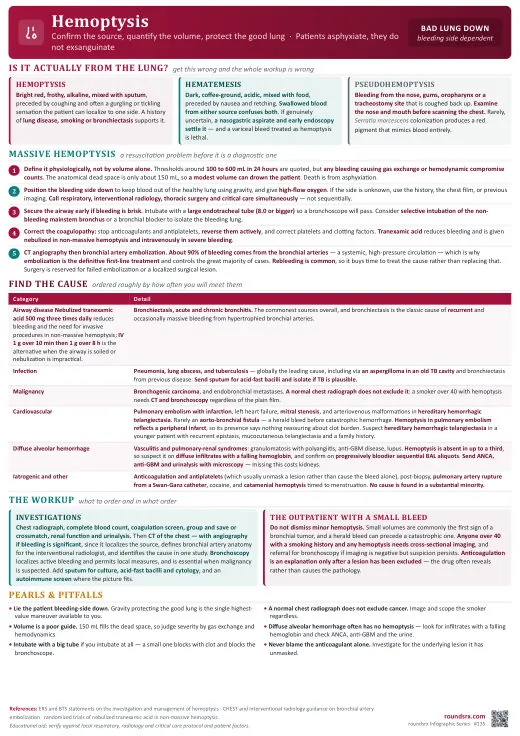
Coughing up blood from the tracheobronchial tree. Non-massive (most cases): workup to find the cause. Massive (> 500 mL/24h or hemodynamic instability): the patient dies from asphyxiation, not exsanguination. Protect the airway first.
๐ Overview
Classification
Category
Volume
Urgency
Non-massive (most common)
< 500 mL/24h, hemodynamically stable
Workup: CT chest, bronchoscopy if no source on CT. Outpatient if stable.
Massive
> 500 mL/24h (or > 100 mL/hr), or any amount causing hemodynamic instability or respiratory compromise [Crocco Classification, 1968
EMERGENCY. Airway protection โ bronchoscopy โ IR embolization or surgery.
Common Causes
Category
Examples
Airway (most common)
Bronchitis (#1 cause overall), bronchiectasis, lung cancer
Anticoagulation (unmasks underlying lesion), post-biopsy, PA catheter
๐จ Management
Massive Hemoptysis Protocol
Patients die from asphyxiation (drowning in blood), not hemorrhagic shock. Protect the airway. Identify the bleeding side. Isolate it. STEP Trial, Wand 2018
Immediate
Position bleeding side DOWN (gravity keeps blood in the affected lung, protects the good lung). Supplemental Oโ. Large-bore IV ร 2. Type and screen. Reverse anticoagulation if applicable. Hold antiplatelets.
Airway
If airway compromise โ intubate with large ETT (โฅ 8.0) to allow bronchoscopy through the tube. If bleeding side known โ mainstem intubation of the NON-bleeding lung (advance ETT into the good side to isolate it). Double-lumen ETT if available (lung isolation).
Bronchoscopy
Rigid bronchoscopy preferred for massive hemoptysis (better suctioning, can tamponade with the scope). Flexible bronchoscopy for localization. Interventions: cold saline lavage, epinephrine instillation, balloon tamponade, electrocautery.
Bronchial artery embolization (BAE)
Definitive treatment for massive hemoptysis. Interventional radiology. ~90% immediate success rate. Recurrence: ~10โ30% long-term. Complication: spinal cord ischemia (bronchial and spinal arteries share a common origin -artery of Adamkiewicz). Defined BAE Outcomes, Defined Mal 2010
Surgery
Last resort. Lobectomy/pneumonectomy if BAE fails, recurrent massive hemoptysis, or resectable lesion (e.g., aspergilloma, cancer). High surgical mortality in the emergent setting (~20โ40%).
๐ On Rounds
Why do patients die from massive hemoptysis -hemorrhage or asphyxiation?
Asphyxiation. The total dead space of the tracheobronchial tree is only ~150 mL. A relatively small amount of blood (compared to GI bleeding) can flood both lungs and cause fatal hypoxia. The patient doesn't bleed to death -they drown in their own blood. This is why airway management (positioning, intubation, lung isolation) takes priority over volume resuscitation.
What is the most dangerous complication of bronchial artery embolization?
Spinal cord ischemia (paraplegia). The artery of Adamkiewicz (the major anterior spinal artery, typically arising from T9โT12 intercostal arteries) can share a common trunk with bronchial arteries or arise nearby. Inadvertent embolization of this artery causes anterior spinal artery syndrome โ paraplegia. This occurs in ~1โ5% of BAE procedures. Careful angiographic identification of spinal feeders before embolization is essential.
How do you manage massive hemoptysis in the first 5 minutes?
Massive hemoptysis (> 500 mL/24h or > 100 mL/hr) = airway emergency. The patient usually drowns before they exsanguinate. Step 1: Position the patient bleeding side DOWN (lateral decubitus -prevents blood from flooding the good lung). Step 2: Call for help -anesthesia for intubation, IR for bronchial artery embolization, pulmonology for bronchoscopy, thoracic surgery. Step 3: Intubate with a large ETT (โฅ 8.0)
What is the most common cause of hemoptysis? (Hint: it's not cancer)
Acute bronchitis is the #1 cause of hemoptysis in the outpatient/ED setting -not cancer, not TB, not PE. Most hemoptysis is mild (< 30 mL) and self-limited from mucosal inflammation. However, the workup depends on risk factors: Low risk (age < 40, non-smoker, single episode, mild): CXR + symptomatic treatment, follow-up if persistent.
Clinical Examples
๐ Case 1, Massive Hemoptysis from Bronchiectasis
Patient: 58M with known bronchiectasis (chronic MAC infection). Sudden onset coughing up bright red blood, estimated 400 mL in 2 hours. HR 118, BP 100/62, SpOโ 88% on room air.
Key findings: Massive hemoptysis (> 300 mL/24h or > 100 mL/hr). Bronchiectasis causes hypertrophied bronchial arteries prone to rupture. Life-threatening, death is from asphyxiation (drowning in blood), not exsanguination.
Management:
Bleeding lung DOWN, lateral decubitus with affected side dependent (protect the good lung)
Intubate with large-bore ETT (โฅ 8.0) if unable to protect airway or maintain oxygenation
If BAE unavailable: rigid bronchoscopy for tamponade (Fogarty balloon catheter in bleeding segment)
Type and cross, resuscitate with blood products. TXA 1g IV
Teaching point: In massive hemoptysis, positioning is critical: bleeding lung DOWN prevents blood from flooding the contralateral lung. The cause of death is airway obstruction, not hemorrhagic shock, protecting the unaffected lung is the priority.
๐ Case 2, Hemoptysis in Lung Cancer
Patient: 67M, 40-pack-year smoker. Blood-streaked sputum ร 3 weeks, 10 lb weight loss. CXR: right hilar mass. CT: 4 cm central RUL mass encasing bronchus.
Key findings: Central lung mass in a heavy smoker, squamous cell carcinoma until proven otherwise (central location, endobronchial involvement). Hemoptysis from tumor erosion into bronchial vessels.
Management:
CT angiography chest to assess vascular involvement and bleeding risk
Bronchoscopy: diagnostic (biopsy) + therapeutic (laser/electrocautery for endobronchial component if actively bleeding)
Interventional pulmonology for endobronchial stent if obstructing airway
Oncology: chemoradiation if locally advanced; palliative radiation for hemoptysis control
Teaching point: Hemoptysis in a smoker > 40 is lung cancer until proven otherwise. Even mild hemoptysis in a high-risk patient requires CT chest and bronchoscopy, the amount of hemoptysis does not correlate with cancer severity.
Key findings: DAH + RPGN = pulmonary-renal syndrome. c-ANCA positive โ GPA (granulomatosis with polyangiitis). DAH confirmed by progressively bloodier BAL aliquots. Can also see hemosiderin-laden macrophages.
Management:
Pulse methylprednisolone 1g IV daily ร 3 days
Rituximab 375 mg/mยฒ weekly ร 4 (induction for ANCA vasculitis)
Plasma exchange for severe DAH or Cr > 5.7 PEXIVAS, 2020
Supportive: intubation if respiratory failure, transfuse to Hgb > 7, avoid invasive procedures
Renal biopsy when stable (expect pauci-immune crescentic GN)
Teaching point: DAH is diagnosed by progressively bloodier BAL returns, not by hemoptysis (1/3 of DAH patients have no hemoptysis). The triad of bilateral infiltrates + dropping Hgb + rising Cr should prompt immediate evaluation for pulmonary-renal syndrome.
๐ฃ Sample Presentation
One-Liner
"Mr. Davis is a 58-year-old smoker presenting with 2 episodes of hemoptysis (~50 mL total). Hemodynamically stable. CT chest: 2.5 cm RUL mass with surrounding hemorrhage."
Key Points to Cover on Rounds
Non-massive hemoptysis with concerning RUL mass (likely malignancy in a smoker). Stable -not massive (<500 mL/24h). CT angiography: no active extravasation. Bronchoscopy: scheduled for tomorrow (diagnostic -BAL, brushings, biopsy + evaluate for bleeding source). If active bleeding at bronchoscopy โ cold saline lavage, topical epinephrine, or bronchial blocker. Staging workup: PET-CT ordered, brain MRI. Smoking cessation counseled. Plan: bronchoscopy tomorrow for tissue diagnosis, multidisciplinary tumor board if malignancy confirmed. IR for bronchial artery embolization on standby if bleeding escalates.
๐งช Workup
Workup
See the Overview and Management tabs for the hemoptysis workup algorithm (massive vs non-massive triage, CXR โ CT โ bronchoscopy, and DAH evaluation).
๐ Medications
Medications
Medication details (TXA, reversal agents, antibiotics for infectious causes, cyclophosphamide/rituximab for DAH vasculitis) are in the Management tab with evidence-based dosing and trial citations.
Airway emergency. Bleeding side DOWN. Intubate (large ETT โฅ 8.0). Bronchoscopy for localization. IR for bronchial artery embolization. Surgery if refractory.
Workup
CXR (first). CT chest if CXR abnormal or high risk. Bronchoscopy if malignancy suspected or source unclear. CTA if massive or PE suspected.
Non-Massive
CXR + symptom management. If high risk (smoker, > 40, recurrent, > 30 mL) โ CT chest + bronchoscopy for tissue diagnosis.
DAH
Diffuse alveolar hemorrhage: bilateral GGO, dropping Hgb, hemoptysis. Causes: ANCA vasculitis, anti-GBM, SLE, drug-induced. Treat underlying cause + pulse steroids.
Bronchial Artery Embolization
IR procedure, definitive for ~90% of massive hemoptysis. Bronchial arteries (high-pressure) are the source in most non-PE hemoptysis. Can recur -may need repeat.
๐ One Pager
Pulmonology ยท One Pager
Hemoptysis
Most common = bronchitis. Most dangerous = massive (> 500 mL/24h) โ airway emergency. Bleeding side DOWN. Bronchoscopy + IR embolization. Always consider malignancy in smokers > 40.
AIRWAY EMERGENCY -patient drowns before exsanguinating. (1) Bleeding side DOWN. (2) Intubate (large ETT โฅ 8.0). (3) Bronchoscopy for localization. (4) IR bronchial artery embolization (definitive ~90%). (5) Surgery if refractory.