HIT (Heparin-Induced Thrombocytopenia)
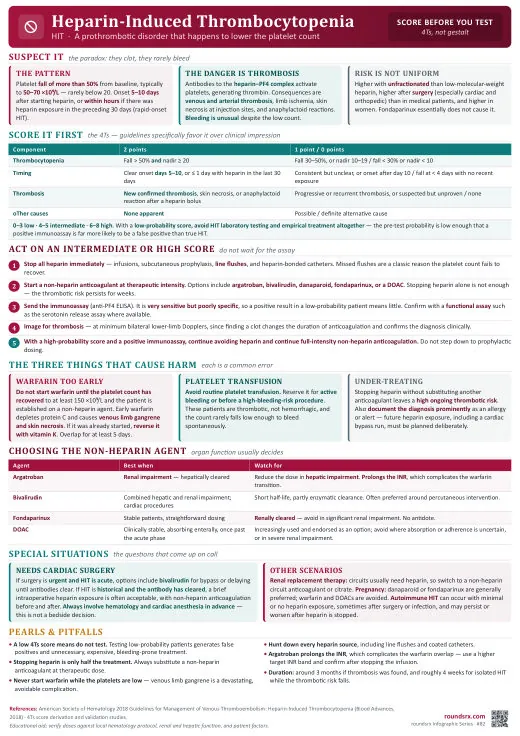
| Criterion | 2 Points | 1 Point | 0 Points |
|---|---|---|---|
| Thrombocytopenia | Drop > 50% AND nadir ≥ 20K | Drop 30–50% OR nadir 10–19K | Drop < 30% OR nadir < 10K |
| Timing | Days 5–10 OR ≤ 1 day if prior heparin within 30 days | Days 5–10 (unclear) OR > day 10 | < day 4 (no prior exposure) |
| Thrombosis | New thrombosis, skin necrosis, or anaphylaxis post-heparin bolus | Progressive or recurrent thrombosis | None |
| Other causes | No other cause for thrombocytopenia | Possible other cause | Definite other cause |
- Timing: platelet drop typically 5–10 days after heparin initiation (or within 24h if prior heparin exposure within 30 days -rapid onset HIT)
- Platelet drop: usually > 50% from baseline (not absolute count -a drop from 300K to 130K is HIT)
- Thrombosis in 50%: DVT/PE (most common), arterial (stroke, MI, limb ischemia), skin necrosis at heparin injection sites
- UFH >> LMWH for HIT risk (but LMWH can also cause it -cross-reactivity ~90%)
| Drug | Dose | Notes |
|---|---|---|
| Argatroban 1ST LINE | 0.5–2 mcg/kg/min IV (no bolus). Monitor aPTT. | Hepatically cleared -preferred in renal failure. Falsely elevates INR (complicates warfarin bridging). Reduce dose in hepatic impairment, ICU, post-cardiac surgery. |
| Bivalirudin 1ST LINE | 0.15–0.2 mg/kg/hr IV. Monitor aPTT. | Short half-life (~25 min). Preferred for PCI and cardiac surgery settings. Partially renally cleared. |
| Fondaparinux ALTERNATIVE | Weight-based SC (same as VTE dosing) | Pentasaccharide -does NOT cross-react with HIT antibodies. Off-label for HIT but widely used. No monitoring needed. Renally cleared -avoid if CrCl < 30. |
- 4T score -pre-test probability. ≥ 6 = high probability → start non-heparin anticoagulation immediately while awaiting confirmatory testing. 4-5 = intermediate → test. ≤ 3 = low → HIT unlikely. Components: Thrombocytopenia (% fall + nadir), Timing (day 5-10), Thrombosis (new), oTher cause (none identified). [4T Score Validation, 2006]
- PF4/heparin ELISA (PF4 antibody) -screening test. High sensitivity (~97%), moderate specificity (~75%). Negative ELISA essentially rules out HIT. Positive → need confirmatory test. OD > 2.0 strongly predictive.
- Serotonin release assay (SRA) -confirmatory gold standard. High specificity (~95%). Takes 3-7 days to result. Functional assay -measures actual platelet activation.
- CBC trend -platelet nadir typically 5-10 days after heparin exposure. Classic: > 50% drop from baseline (e.g., 250K → 80K). Nadir usually 20-80K. If < 20K → consider other diagnoses (DIC, TTP).
- Bilateral lower extremity duplex US -30-50% of HIT patients have occult DVT at diagnosis even without symptoms. Screen all confirmed/suspected HIT patients.
- Review ALL heparin exposure -IV drips, SQ prophylaxis, line flushes, heparin-coated catheters (dialysis, PICC lines), heparin in OR tubing. Even brief exposure counts.
- Timing clues: Typical onset day 5-10. Rapid-onset HIT (< 24h) = prior heparin exposure within 100 days (pre-formed antibodies). Delayed-onset HIT = develops after heparin stopped (rare, up to 3 weeks).
| Drug | Dose | Route | Notes |
|---|---|---|---|
| Argatroban | 2 mcg/kg/min (0.5-1.2 in liver disease) | IV drip | Direct thrombin inhibitor. Argatroban HIT Trial, 2001 Hepatically metabolized -reduce dose in liver failure. Titrate to aPTT 1.5-3× baseline. Falsely elevates INR → complicates warfarin transition. |
| Bivalirudin | 0.15-0.25 mg/kg/hr | IV drip | Alternative DTI. Shorter half-life (25 min vs 45 min) -preferred for PCI, cardiac surgery, or renal failure. Does not elevate INR. |
| Fondaparinux | 5-10 mg SQ daily | SQ | Factor Xa inhibitor. Off-label for HIT but widely used. No IV monitoring needed. Minimal cross-reactivity with HIT antibodies (< 1%). Renally cleared -avoid if CrCl < 30. |
| DO NOT use LMWH | - | - | 90% in-vitro cross-reactivity with HIT antibodies. Enoxaparin, dalteparin, tinzaparin are ALL contraindicated. |
| Warfarin transition | Start ONLY when platelets ≥ 150K | PO | Overlap argatroban for ≥ 5 days + INR ≥ 2 for 2 consecutive days. Starting warfarin too early depletes protein C Warfarin Limb Gangrene Study, 1997 → paradoxical thrombosis (venous limb gangrene, skin necrosis). Warfarin Limb Gangrene Study, 1997 |
| DOAC transition | Per agent dosing | PO | Rivaroxaban or apixaban increasingly used as alternatives to warfarin for long-term anticoagulation post-HIT. Start when platelets recovered. Duration: 3-6 months minimum (or longer if provoked thrombosis). |
Patient: 68M, PMH HTN, DM2. POD 8 from R total knee arthroplasty on enoxaparin prophylaxis. Nursing reports new R calf swelling and pain.
Key findings: Platelets dropped from 245K to 88K (64% decline) over 3 days. Duplex US: acute R popliteal DVT. 4T score: 7 (high probability).
Management:
- Stop ALL heparin products immediately (enoxaparin, flushes, line locks)
- Start argatroban 2 mcg/kg/min IV, titrate to aPTT 1.5-3x baseline
- Send PF4/heparin antibody (ELISA) and SRA (confirmatory)
- Do NOT start warfarin until platelets ≥ 150K; overlap with argatroban ≥ 5 days
- Anticoagulate for 3-6 months (HIT with thrombosis = HITT)
Teaching point: LMWH cross-reacts with HIT antibodies in ~90% of cases. A patient with HIT on UFH should NOT be switched to enoxaparin. Always use a non-heparin anticoagulant (argatroban, bivalirudin, fondaparinux).
Patient: 55F, PMH breast cancer s/p port placement 3 weeks ago (received heparin flushes). Admitted for chemo, started on UFH DVT prophylaxis. Platelets drop from 190K to 45K within 12 hours.
Key findings: Rapid platelet decline within 24h of heparin re-exposure. Prior heparin exposure < 30 days ago. 4T score: 6 (high).
Management:
- Stop heparin immediately
- Start argatroban; consider bivalirudin if hepatic dysfunction
- Bilateral LE duplex (30-50% have occult DVT)
- Send PF4 Ab + SRA
Teaching point: Rapid-onset HIT occurs within < 24h of re-exposure in patients with pre-formed antibodies from heparin exposure within the last 100 days. The 4T score timing criteria awards 2 points for platelet fall < 1 day with prior heparin exposure.
Patient: 72M in MICU on UFH for AF. Day 6, platelets drop from 180K to 105K (42% decline). Patient is septic from pneumonia with new pressor requirement.
Key findings: 4T score: 4 (intermediate). Sepsis is a common cause of thrombocytopenia in the ICU. No new thrombosis.
Management:
- Send PF4 antibody (ELISA) given intermediate probability
- If PF4 ELISA negative (OD < 0.40) → HIT essentially excluded (NPV > 99%)
- If PF4 positive → stop heparin, start argatroban, send SRA for confirmation
- Consider alternative causes: sepsis-associated thrombocytopenia, drug-induced (vancomycin, linezolid), dilutional
Teaching point: The 4T score's greatest value is its NPV at low scores (0-3), which essentially rules out HIT. At intermediate scores (4-5), the PF4 ELISA helps decide next steps. Sepsis is the #1 cause of thrombocytopenia in the ICU, not HIT.
- Platelet count daily -should begin recovering within 4-10 days of stopping heparin + starting alternative anticoagulation. If NOT recovering → reconsider diagnosis or check for new thrombosis.
- aPTT q6h while on argatroban -target 1.5-3× baseline. Avoid supratherapeutic levels (bleeding risk).
- INR for warfarin transition -argatroban falsely elevates INR. Check INR after holding argatroban × 4h to get true INR. Some centers use chromogenic factor X assay instead.
- Bilateral LE duplex US at diagnosis -even if no symptoms (30-50% occult DVT)
- Clinical assessment for new thrombosis daily -arterial (stroke, limb ischemia, MI) and venous (DVT, PE). HIT is a prothrombotic state -thrombosis risk highest in first 30 days.
- Skin exam -skin necrosis at injection sites (heparin-induced skin necrosis occurs before overt HIT)
- Duration of anticoagulation: minimum 4 weeks if HIT without thrombosis. 3-6 months if HIT with thrombosis (HIT-T). Some experts recommend extended anticoagulation for arterial HIT events.
Text version
- Not stopping ALL heparin (including flushes and line locks)
- Warfarin before plt ≥ 150K (limb gangrene risk)
- LMWH for HIT (cross-reacts in 90%)
- Not checking bilateral LE duplex (30-50% occult DVT)