Hepatic Encephalopathy & Acute Liver Failure
Acute Liver Failure (ALF): Rapid hepatic necrosis in a previously healthy liver: coagulopathy (INR > 1.5) + encephalopathy without prior liver disease. Medical emergency requiring ICU + transplant evaluation.
- T -Toxins/drugs (opioids, benzos, sedatives), Transjugular shunts
- I -Infection (SBP is most common! -always tap ascites), Increased protein load (GI bleed)
- P -Portal shunting, Portosystemic shunts
- S -Sodium low (hyponatremia), Surgical stress, Starvation
- Also: Constipation, Dehydration, Electrolyte disturbance (hypokalemia → alkalosis → ↑NH3)
- Acetaminophen toxicity (most common in US -50%)
- Viral hepatitis (HAV, HBV, HEV)
- Drug-induced (isoniazid, amoxicillin-clavulanate, NSAIDs)
- Autoimmune hepatitis
- Ischemic hepatitis ("shock liver")
- Wilson's disease, Budd-Chiari, pregnancy-related (AFLP, HELLP)
- LFTs, INR/PT -severity of liver dysfunction (most critical for staging)
- ⚠ Ammonia: do NOT order it to make the diagnosis, and do NOT trend it. CHANGED 2026 The ACG 2026 guideline recommends against using serum ammonia to diagnose overt HE, to start or titrate therapy, or to assess recurrence in the outpatient setting. Levels track poorly with severity and are distorted by tourniquet time, transport delay, and a recent protein meal. HE is a clinical diagnosis of exclusion, and a normal ammonia does not exclude it while a high one does not confirm it. Its only real use is when the diagnosis is genuinely in doubt in a patient without known liver disease.
- BMP -Na (hyponatremia worsens HE), K, BUN/Cr (renal function -HRS?)
- CBC -infection? thrombocytopenia (cirrhosis)?
- Diagnostic paracentesis -PMN count > 250 = SBP (most commonly missed precipitant); do this early
- ⚠ Do NOT order routine brain imaging in a cirrhotic with confusion and no new focal deficit NEW 2026. It rarely changes anything and delays the treatment that does. Image when there IS a focal deficit, a fall or head injury, a seizure, or when the patient fails to improve on adequate therapy, which is when you are looking for hemorrhage or stroke rather than confirming HE.
- Blood cultures + UA + urine culture -rule out infection triggering HE
- CXR -pulmonary infection
- Head CT -if focal neuro deficits or unclear diagnosis (rule out structural cause); not routine
- Acetaminophen level -most common cause of ALF in US (50%); check even without clear history
- Toxicology screen -rule out other drug/toxin causes
- Viral hepatitis panel (HAV IgM, HBsAg, HBV DNA, HCV RNA) -2nd most common etiology group
- Autoimmune hepatitis (ANA, ASMA, IgG) -treatable, do not miss
- Pregnancy test -AFLP and HELLP are obstetric emergencies
- Wilson's disease (ceruloplasmin, Kayser-Fleischer rings, urine copper) -rare but treatable in young patients
- Contact transplant hepatology early in ALF -before deterioration
The first ACG hepatic encephalopathy guideline (Am J Gastroenterol, March 2026, 24 GRADE recommendations) consolidates what had been split across older AASLD and EASL documents. 1. Ammonia is out as a management tool: do not use it to diagnose overt HE, to start or titrate therapy, or to judge outpatient recurrence. 2. Rifaximin moves earlier, added alongside lactulose in the acute episode rather than held back until lactulose fails. 3. Lactulose is titrated to 2 to 4 soft bowel movements daily acutely, 2 to 3 on prophylaxis. 4. No routine brain imaging without a new focal deficit. 5. Deprescribing is treatment: opioids, benzodiazepines, gabapentinoids and unnecessary PPIs. 6. Rifaximin 14 days before elective TIPS, continued at least 6 months. 7. Counsel against driving after an overt episode, in writing. UNCHANGED Protein stays at 1.2 to 1.5 g/kg/day and restriction remains harmful, and lactulose remains first-line.
- Patient: 62M with alcoholic cirrhosis (Child-Pugh C), brought in confused and somnolent. Asterixis present. NH3 68.
- Grade: West Haven Grade 3 (somnolent but arousable, confused, asterixis).
- Identify precipitant: Infection (SBP? UTI? Pneumonia?), GI bleed, constipation, medications (benzos, opioids), electrolyte derangement (hypokalemia, hyponatremia), non-compliance with lactulose. Check: CBC, BMP, UA, CXR, blood cultures, diagnostic paracentesis (ALWAYS if ascites -rule out SBP).
- Treatment:
- Lactulose (Kristalose) 30mL PO/NG q1-2h until first bowel movement → then titrate to 2-4 soft stools/day. Can give as enema (300mL in 700mL water) if unable to take PO.
- Rifaximin (Xifaxan) 550 mg PO BID -add it EARLY in acute overt HE, alongside lactulose. CHANGED 2026 The older framing treated rifaximin as a drug you reach for once lactulose has failed or for prevention only. ACG 2026 says add it in the acute episode rather than waiting, supported by trial data showing higher reversal rates, shorter length of stay and lower mortality when it is combined with lactulose from the start. It also continues as secondary prophylaxis after a recurrence despite lactulose, where it reduces recurrence by 58%.
- PEG 3350 (polyethylene glycol) NEW 2026 is a reasonable alternative when lactulose is not tolerated, or when you want faster catharsis. Useful in the patient who is vomiting lactulose or whose distension is intolerable.
- ⚠ Deprescribe before you escalate. NEW 2026 Stop or reduce opioids, benzodiazepines, gabapentinoids and unnecessary PPIs. Each independently precipitates or prolongs HE, and PPIs do it by promoting small-bowel bacterial overgrowth. Reviewing the medication list is often more effective than another dose of lactulose.
- Reassess at 48 to 72 hours. NEW 2026 If there is no improvement on adequate therapy, the diagnosis or the precipitant is wrong. That is the point to look for a subdural, a seizure, an unrecognised infection, or a non-hepatic cause of the encephalopathy.
- Protein restriction is OUTDATED -maintain 1.2-1.5 g/kg/day protein. Malnutrition worsens encephalopathy.
- Zinc 220 mg PO daily -zinc deficiency impairs the urea cycle, worsening ammonia metabolism. ACG 2026 positions it for persistent HE despite lactulose and rifaximin with a documented low zinc, as a low-cost, low-risk add-on rather than routine therapy.
- Before an elective TIPS: rifaximin 550 mg BID starting 14 days beforehand, continued at least 6 months. NEW 2026 Post-TIPS HE is common because the shunt is doing deliberately what portosystemic shunting does accidentally, and prophylaxis started in advance lowers that risk.
- Counsel against driving after an overt episode, particularly for the first 3 months NEW 2026, and give the advice in writing as well as verbally, to the patient and the caregiver. Covert HE impairs reaction time and attention while the patient feels normal, which is exactly why the conversation gets skipped.
- 🔄 Updated Practice: Old teaching: restrict protein intake in hepatic encephalopathy to reduce ammonia production. Current practice: protein restriction is HARMFUL, it worsens malnutrition (which is already severe in cirrhosis) and does NOT improve encephalopathy. Maintain protein intake at 1.2-1.5 g/kg/day. Branched-chain amino acid supplements may help in protein-intolerant patients.
- Key: NH3 level does NOT correlate with severity and should NOT be trended. Treat the patient, not the number. Lactulose titrated to stool output is the cornerstone.
- Patient: 61M with cirrhosis (Child-Pugh C), on lactulose and rifaximin, still Grade 3 HE (somnolent, confused). Ammonia 142.
- Key concept: FIND THE PRECIPITANT, not just increase lactulose.
- Precipitant checklist:
- GI bleed, do rectal exam. Melena?
- Infection / SBP, diagnostic paracentesis if ascites
- Constipation, when was last BM?
- Electrolyte abnormalities, hypokalemia and alkalosis worsen HE. Alkalosis converts NH4+ to NH3 which crosses BBB.
- Medications, benzos, opioids, PPIs. Stop all sedatives.
- Dehydration / renal failure
- Dietary protein excess, rare. Do NOT restrict protein; they need it.
- TIPS, if recent, may need revision.
- Treatment:
- Lactulose titrated to 3-4 BMs/day (NOT diarrhea, diarrhea causes dehydration → worsens HE).
- Rifaximin 550 mg BID -non-absorbable antibiotic that reduces ammonia-producing gut bacteria. Add-on to lactulose for recurrent HE; reduces breakthrough episodes by ~50% and HE-related hospitalizations by ~50% per Bass NEJM 2010.
- Treat the precipitant -GI bleed, infection (especially SBP), AKI/dehydration, electrolyte derangement (esp. hypokalemia → ↑ ammonia), constipation, sedatives, dietary protein load, TIPS-related, HCC. Without precipitant control, HE recurs regardless of lactulose dose.
- Consider zinc supplementation (cofactor in the urea cycle; cirrhotics are commonly deficient and modest data support reduced HE recurrence with repletion).
- Key Lesson: Refractory HE = hunt for the precipitant. The answer is almost never "more lactulose." Check for GI bleed, SBP, constipation, hypokalemia, and sedating medications.
- Patient: 55M with alcoholic cirrhosis, admitted with confusion, ataxia, and nystagmus. Team starts lactulose for presumed HE. Ammonia is only 45 (mildly elevated, does not correlate with HE severity).
- Clinical course: After 48h of lactulose, no improvement. Re-examine: classic triad of confusion + ataxia + ophthalmoplegia = Wernicke's encephalopathy from thiamine deficiency, NOT hepatic encephalopathy.
- Treatment:
- IV thiamine 500mg TID × 3 days → 250mg daily × 5 days (high-dose Caine criteria dosing).
- Must give thiamine BEFORE glucose (glucose without thiamine precipitates Wernicke's).
- Improvement expected within hours to days.
- Key Lesson: Not all confusion in cirrhotics is HE. Wernicke's and HE overlap significantly in alcoholic liver disease. Always give IV thiamine empirically. Ammonia levels do NOT reliably diagnose or exclude HE.
- ICU admission -all ALF patients
- N-acetylcysteine (NAC) -for acetaminophen ALF (and emerging evidence for non-acetaminophen ALF). 150 mg/kg IV over 1h, then 12.5 mg/kg/hr × 4h, then 6.25 mg/kg/hr × 16h. Start immediately if APAP toxicity possible.
- Liver transplant evaluation immediately -contact transplant center
- Manage ICP (cerebral edema risk in ALF) -head of bed 30°, avoid hypotonic fluids, consider ICP monitoring
- Correct coagulopathy only if actively bleeding (do NOT give FFP prophylactically -INR is prognostic)
- Avoid
| Drug | Dose | Route | Notes |
|---|---|---|---|
| Lactulose (Kristalose) 1ST LINE | 30 mL PO q1–2h until first BM → titrate to 3–4 soft stools/day | PO/NG/PR | Cornerstone of HE treatment. Acidifies colon → traps NH4+ → reduces ammonia absorption. Enema (300 mL in 700 mL water) if unable to take PO. Titrate to stool output, NOT ammonia level. |
| Rifaximin (Xifaxan) | 550 mg PO BID | PO | Non-absorbable antibiotic. Added to lactulose for recurrence prevention -reduces HE recurrence by 58% RFHE, 2010. Not just for acute treatment. Well tolerated, minimal systemic absorption. |
| Zinc sulfate | 220 mg PO daily | PO | Zinc deficiency impairs the urea cycle, worsening ammonia metabolism. Adjunctive therapy. Common deficiency in cirrhosis. |
| LOLA (L-ornithine L-aspartate) | Per protocol | PO/IV | Adjunct therapy. Provides substrates for ammonia metabolism (urea cycle and glutamine synthesis). Evidence modest -use as add-on when lactulose + rifaximin insufficient. |
| Metronidazole (Flagyl) | 250 mg PO TID | PO | Only if rifaximin unavailable. Reduces ammonia-producing gut bacteria. Limit duration -neurotoxicity with prolonged use (peripheral neuropathy, cerebellar dysfunction). Not first-line. |
Patient: 61M with alcohol-related cirrhosis (Child-Pugh B), presents with confusion and asterixis. Found to have melena. Family reports increasing somnolence over 24 hours.
Key findings: Temp 37.4°C, HR 104, BP 102/58. Disoriented to time and place, asterixis present, no focal neurological deficits. West Haven Grade III. Hgb 7.8 (baseline 10.2), ammonia 142, Cr 1.6. CT head: no acute abnormality.
Management:
- Lactulose 30 mL PO/NG q1-2h until first bowel movement, then titrate to 2-4 soft stools/day (acute overt HE target)
- Add rifaximin 550 mg BID (especially if recurrent episodes) Bass, 2010
- Treat precipitant: GI bleed workup, transfuse to Hgb 7, start octreotide and ceftriaxone
- Check for other precipitants: infection (SBP screen with paracentesis), electrolytes (hypokalemia, hyponatremia), constipation, medications (benzodiazepines, opioids)
Teaching point: Always identify and treat the precipitant. GI bleed is a common trigger because blood in the gut is a massive protein/nitrogen load that gut bacteria convert to ammonia. The ammonia level does NOT guide treatment -- treat the clinical grade.
Patient: 58F with NASH cirrhosis, admitted 3 days ago with Grade III HE. On lactulose 30 mL q6h with 3-4 stools/day but remains persistently confused and intermittently combative.
Key findings: Still disoriented, asterixis present, no improvement in West Haven grade despite adequate lactulose. All precipitants addressed: no infection, electrolytes corrected, no offending medications. Ammonia trending down but mental status unchanged.
Management:
- Ensure lactulose is actually producing stools (not just charted). Consider lactulose enemas (300 mL in 700 mL water PR) if oral route inadequate
- Add rifaximin 550 mg BID if not already on it
- Consider zinc supplementation 220 mg BID (cofactor for urea cycle; often deficient in cirrhotics)
- Rule out alternative diagnoses: Wernicke encephalopathy (give thiamine), subdural hematoma, metabolic encephalopathy, occult seizures (consider EEG)
Teaching point: When HE does not respond to lactulose, broaden the differential. Cirrhotic patients can have multiple simultaneous causes of altered mental status. Do not anchor on HE alone.
Patient: 64M with compensated HCV cirrhosis (Child-Pugh A), referred by hepatologist for cognitive complaints. Wife reports he has become forgetful, has difficulty managing finances, and had a minor car accident last month. No overt confusion or asterixis.
Key findings: Alert, oriented x3, no asterixis. However, psychometric testing (Stroop test, number connection test) is abnormal. Ammonia 68. MRI brain: no structural abnormality. Diagnosis: Covert (minimal) hepatic encephalopathy.
Management:
- Start rifaximin 550 mg BID (shown to improve cognitive function and driving performance in covert HE)
- Lactulose 15-30 mL titrated to 2-3 soft stools/day (the maintenance target, lower than the 2-4 used in an acute overt episode)
- Counsel on driving safety: covert HE significantly impairs reaction time and is a recognized cause of motor vehicle accidents
- Optimize nutrition: adequate protein intake (1.2-1.5 g/kg/day -- protein restriction is HARMFUL and outdated). Consider branched-chain amino acid supplementation
Teaching point: Covert HE affects up to 80% of cirrhotic patients and significantly impairs quality of life. Protein restriction is a harmful myth -- adequate protein intake is essential. Always screen for driving safety concerns.
| Parameter | Frequency | Target / Action |
|---|---|---|
| West Haven grade | q4–8h (more frequent if worsening) | Track mental status: orientation, asterixis, somnolence. Grade 3–4 → consider ICU for airway protection. |
| Asterixis | Each assessment | Negative myoclonus ("liver flap"). Presence confirms HE. Disappearance suggests improvement. |
| Orientation | Each assessment | Person, place, time, situation. Serial number connection test if able to participate. |
| Lactulose stool output | Strict I&O tracking | Target 3–4 stools/day. Too few → increase lactulose. Excessive diarrhea → dehydration → worsens HE. |
| Ammonia level | On admission only | Do NOT trend ammonia -it does NOT correlate with severity. An initial elevated ammonia supports the diagnosis but serial levels do not guide treatment. Treat clinically. |
| BMP (K+, Na+, Cr, BUN) | Daily | Hypokalemia → metabolic alkalosis → increased renal ammonia production → worsens HE. Hyponatremia worsens cerebral edema. Cr for HRS surveillance. |
| Infection workup | On admission + any worsening | CBC, blood cultures, UA/UCx, CXR, diagnostic paracentesis (rule out SBP -most commonly missed precipitant). Repeat paracentesis with any AMS change. |
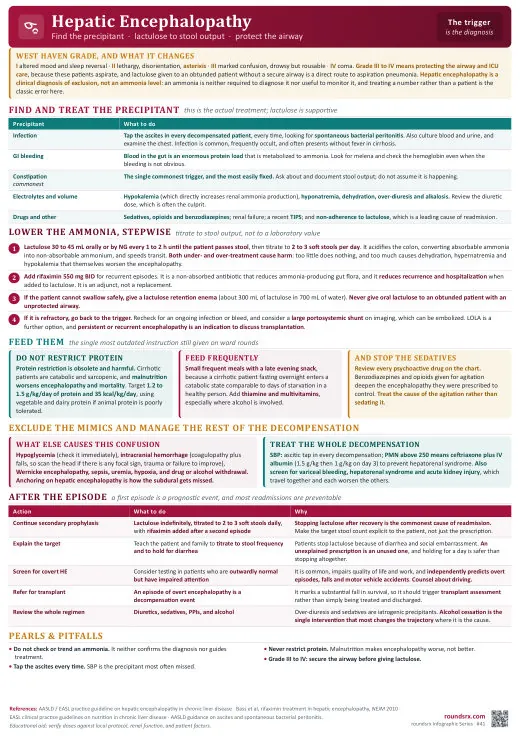
Text version
- T -Toxins/drugs, TIPS shunts
- I -Infection (SBP!), increased protein
- P -Portal shunting
- S -Sodium (hyponatremia), starvation
- Also: constipation, dehydration, hypokalemia
- PMN > 250/mm³ = SBP
- Treat: cefotaxime 2g IV q8h + albumin 1.5 g/kg day 1, 1 g/kg day 3
- Most commonly missed precipitant
- ICU admission
- NAC (especially APAP)
- Transplant evaluation NOW
- Do NOT correct INR prophylactically
- Not tapping ascites
- FFP prophylactically (obscures prognosis)
- Grade 3–4 → intubate early
- Lactulose without finding cause