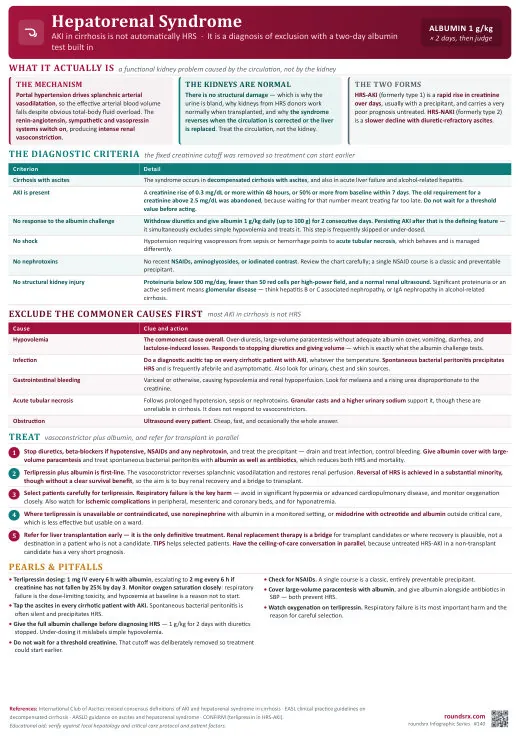
Hepatorenal Syndrome
- HRS-AKI (formerly Type 1): Rapid Cr rise > 0.3 mg/dL in 48h or doubling of Cr within 7 days. Median survival 2 weeks without treatment.
- HRS-CKD (formerly Type 2): Gradual, stable Cr elevation. Often associated with refractory ascites.
- Portal hypertension → splanchnic vasodilation (nitric oxide, other vasodilators)
- → Effective arterial underfilling → activation of RAAS, sympathetic nervous system, ADH
- → Renal vasoconstriction → decreased GFR
- → Kidneys are structurally normal but functionally failing
- If you transplant these kidneys into a healthy person, they work perfectly
| Test | Expected in HRS | Purpose |
|---|---|---|
| BMP | ↑ Cr, ↑ BUN | Baseline and trending renal function |
| UA with microscopy | Bland (no casts, no cells) | ATN has muddy brown casts; GN has RBC casts |
| Urine Na | < 10 mEq/L | Very low urine Na = avid renal sodium retention |
| FENa | < 1% | Pre-renal physiology (kidneys structurally normal) |
| Renal ultrasound | Normal kidneys | Rule out obstruction |
| Hepatic panel, INR, albumin | Deranged (cirrhosis) | Confirm underlying liver disease severity |
| Diagnostic paracentesis | Rule out SBP | SBP is a common trigger for HRS |
| Drug | Dose | Mechanism / Notes |
|---|---|---|
| Midodrine (ProAmatine) | 7.5–12.5 mg PO TID | Alpha-1 agonist → splanchnic vasoconstriction |
| Octreotide (Sandostatin) | 100–200 mcg SQ TID | Inhibits splanchnic vasodilation |
| Albumin 25% | 25–50 g IV daily | Volume expansion + oncotic pressure support |
| Terlipressin (Terlivaz) | 0.5–1 mg IV q6h | Vasopressin analog. FDA-approved for HRS 2022. Preferred over triple therapy if available. |
| Norepinephrine | 0.5–3 mcg/kg/min IV drip | ICU alternative to midodrine/octreotide. More potent vasoconstrictor. |
Patient: 58M with decompensated cirrhosis (Child-Pugh C), recently treated for SBP. Despite antibiotics and albumin, Cr rising from 1.2 to 3.8 over 4 days. UOP declining.
Key findings: Bland UA (no casts, no proteinuria). FENa < 1%. Urine Na < 10. No nephrotoxin exposure. No response to albumin challenge (1 g/kg x 2 days). Renal US normal.
Management:
- Stop diuretics, beta-blockers, NSAIDs, and all nephrotoxins
- Start midodrine 7.5 mg PO TID + octreotide 100 mcg SQ TID + albumin 25-50g IV daily
- Consider terlipressin if available (FDA-approved 2022) CONFIRM Trial
- Hepatology and transplant evaluation, liver transplant is the only definitive cure
- Monitor for volume overload (terlipressin risk: respiratory events)
Teaching point: SBP is the most common precipitant of HRS. The kidneys in HRS are structurally normal, if transplanted to a healthy recipient, they work perfectly. The problem is splanchnic vasodilation causing renal vasoconstriction.
Patient: 51F with cirrhosis, admitted with GI bleed and hypotension. Received NS resuscitation. Cr rising from 0.9 to 2.4. UA shows muddy brown casts.
Key findings: FENa 3.2%. Urine Na 45 mEq/L. Muddy brown granular casts on UA. This is ATN from hypoperfusion during the bleed, NOT HRS.
Management:
- Supportive care, ATN typically recovers with time
- Avoid further nephrotoxins (no contrast, no NSAIDs, no aminoglycosides)
- Continue volume resuscitation as needed for the GI bleed
- Monitor Cr trend, ATN typically peaks in 7-10 days then recovers
Teaching point: HRS = FENa < 1%, urine Na < 10, bland UA. ATN = FENa > 2%, urine Na > 20, muddy brown casts. This distinction is critical because HRS requires vasoconstrictor therapy while ATN is managed supportively.
Patient: 62M with NASH cirrhosis, MELD 32. Cr 4.2, rising despite albumin challenge. Diagnosed with HRS-AKI. Listed for liver transplant but unlikely to receive organ in time.
Key findings: Failed albumin challenge. No other cause of AKI identified. Hemodynamically: MAP 58, tachycardic. Volume status euvolemic by exam.
Management:
- Terlipressin 0.5 mg IV q6h (titrate up to 2 mg q6h if Cr not improving) + albumin CONFIRM Trial
- Monitor closely for respiratory adverse events (pulmonary edema), key safety concern
- Daily Cr, urine output, volume status assessment
- TIPS consideration as bridge to transplant in select patients
- Dialysis if refractory hyperkalemia, acidosis, or volume overload develops
Teaching point: Terlipressin (FDA-approved 2022) is the first drug specifically approved for HRS. It is a vasopressin analog that causes splanchnic vasoconstriction, redirecting blood flow to the kidneys. Key safety concern: respiratory events, especially in volume-overloaded patients.
| Parameter | Frequency | Target / Action |
|---|---|---|
| Creatinine | Daily (q12h if ICU) | Trending improvement = therapy working. No response by 48–72h → escalate. |
| Urine output | Strict I&Os | UOP > 0.5 mL/kg/hr. Oliguria common in HRS. |
| MAP | Continuous or q4h | Target MAP > 65–70. Midodrine/terlipressin should improve MAP. |
| Daily weights | Daily | Fluid balance assessment |
| Hepatic panel | Daily | Underlying liver disease trajectory |