Herpes Simplex (HSV)
HSV-1 and HSV-2 cause lifelong latent infections with episodic reactivation. Primary genital herpes is a clinical diagnosis, treat empirically, confirm with PCR. Acyclovir is the backbone of treatment. HSV encephalitis is a medical emergency requiring immediate IV acyclovir, do NOT wait for PCR results.
🔍 Overview
HSV-1 vs HSV-2
| Feature | HSV-1 | HSV-2 |
|---|---|---|
| Primary site | Orolabial (cold sores), keratitis, encephalitis | Genital herpes (but HSV-1 now causes 50%+ of new genital herpes in young adults) |
| Latency | Trigeminal ganglia | Sacral ganglia (S2–S4) |
| Seroprevalence | ~50–80% of adults | ~12–16% of adults (higher in HIV+, MSM) |
| Reactivation frequency | Less frequent genitally; orolabial ∼1–3/year | More frequent genitally (avg 4–5/year in year 1, decreasing over time) |
| Transmission | Oral contact, saliva | Sexual contact; asymptomatic shedding drives most transmission |
Clinical Syndromes
| Syndrome | Presentation | Key Points |
|---|---|---|
| Primary genital herpes | Painful grouped vesicles on erythematous base → shallow ulcers. Bilateral. Inguinal lymphadenopathy. Dysuria. Systemic symptoms (fever, malaise, myalgias) common. | Worst episode, lasts 2–3 weeks untreated. Often confused with chancroid, syphilis, or contact dermatitis. Primary HSV-1 genital is increasingly common. |
| Recurrent genital herpes | Unilateral grouped vesicles, fewer lesions, shorter duration (5–10 days). Often preceded by prodrome (tingling, burning, itching). | Less severe than primary. HSV-2 recurs more often than HSV-1 genitally. Frequency decreases over years. |
| Orolabial herpes (cold sores) | Painful vesicles at vermilion border of lip. Prodrome of tingling 24h before. | Usually HSV-1. Treat with topical or oral antivirals if caught early (within 72h of onset). |
| HSV keratitis | Eye pain, photophobia, tearing, decreased vision. Dendritic ulcer on slit-lamp fluorescein exam. | OPHTHALMOLOGY EMERGENCY, can cause corneal scarring and blindness. Treat with topical ganciclovir or trifluridine. Do NOT give topical steroids (worsens viral keratitis). |
| HSV encephalitis EMERGENCY | Fever, headache, altered mental status, seizures, focal neurologic deficits. Temporal lobe predilection on MRI. | Mortality 70% untreated. Start acyclovir 10 mg/kg IV q8h IMMEDIATELY if suspected, do NOT wait for CSF PCR. MRI: temporal lobe hyperintensity on T2/FLAIR. CSF: lymphocytic pleocytosis, elevated protein, RBCs. |
| Herpes whitlow | Painful vesicles on finger/thumb. Healthcare workers, thumb-sucking children. | Do NOT incise (not an abscess). Treat with oral acyclovir/valacyclovir. Self-limited in 2–3 weeks. |
| Eczema herpeticum | Widespread HSV over areas of eczema/atopic dermatitis. Punched-out erosions, fever. | Medical emergency in severe cases, IV acyclovir. Can be life-threatening in infants/immunocompromised. |
| Neonatal herpes | Skin/eye/mouth (SEM), CNS disease, or disseminated. Presents at 1–3 weeks of life. | Highest risk: primary maternal genital HSV near delivery. C-section if active lesions at labor. Mortality high if disseminated. |
HSV encephalitis is the #1 treatable cause of fatal sporadic encephalitis. Temporal lobe involvement on MRI is classic. Start IV acyclovir BEFORE lumbar puncture results, delay increases mortality from 30% to 70%. Treat for 14–21 days minimum.
🧪 Workup
Diagnostic Testing
| Test | When to Use | Key Points |
|---|---|---|
| HSV PCR (swab) | Active vesicles/ulcers, preferred test | Gold standard for genital/mucosal lesions. More sensitive than viral culture (3–5x). Swab base of unroofed vesicle. Can distinguish HSV-1 vs HSV-2. |
| HSV PCR (CSF) | Suspected HSV encephalitis or meningitis | Sensitivity 96–98%. Can be false-negative in first 72h, if high suspicion and initial PCR negative, repeat at 3–7 days. Do NOT stop acyclovir based on a single negative PCR early on. |
| Viral culture | Active vesicles (if PCR not available) | Sensitivity depends on lesion stage: highest in vesicles (> 90%), drops rapidly in crusted lesions (< 30%). Swab base of unroofed vesicle. Takes 2–5 days. |
| Type-specific serology (IgG) | No active lesions; screening; confirm past infection | HSV-1 IgG and HSV-2 IgG (glycoprotein G-based assays). Seroconversion takes 2–12 weeks after primary infection. IgM is NOT useful, cross-reacts, false positives, does not distinguish primary from recurrent. Do not order HSV IgM. |
| Tzanck smear | Bedside, rapid (if PCR unavailable) | Multinucleated giant cells = herpesvirus (HSV or VZV, cannot distinguish). Low sensitivity (60%). Largely replaced by PCR. |
Do NOT order HSV IgM. It has poor sensitivity and specificity, cross-reacts between HSV-1 and HSV-2, cannot distinguish primary from recurrent infection, and frequently gives false-positive results causing unnecessary anxiety. Use type-specific IgG (glycoprotein G-based) instead.
HSV Encephalitis Workup
- MRI brain with contrast, temporal lobe hyperintensity on T2/FLAIR (unilateral or bilateral) is classic. Sensitivity > 90%. CT misses early disease.
- LP with CSF studies, HSV PCR, cell count (lymphocytic pleocytosis), protein (elevated), glucose (usually normal), RBCs (often present from hemorrhagic necrosis)
- EEG, periodic lateralized epileptiform discharges (PLEDs) from temporal lobe. Helps if MRI equivocal.
- Start acyclovir 10 mg/kg IV q8h BEFORE results, empiric treatment is the standard of care. Duration: 14–21 days.
🚨 Management
Treatment by Syndrome
| Scenario | Treatment | Duration | Notes |
|---|---|---|---|
| Primary genital herpes | Valacyclovir (Valtrex) 1g PO BID or Acyclovir (Zovirax) 400 mg PO TID | 7–10 days | Start as soon as possible (best within 72h of onset). Reduces duration by 3–5 days and viral shedding. Extend if lesions not healed at day 10. |
| Recurrent genital herpes (episodic) | Valacyclovir 500 mg PO BID × 3 days or Valacyclovir 1g PO daily × 5 days or Acyclovir 800 mg PO TID × 2 days | Valacyclovir 500 mg BID: 3 days Valacyclovir 1g daily: 5 days Acyclovir 800 mg TID: 2 days | Most effective if started during prodrome or within 24h of lesion onset. Patient-initiated therapy, prescribe in advance so patient can start at first sign. |
| Suppressive therapy | Valacyclovir 500 mg PO daily (if ≤9 episodes/yr) Valacyclovir 1g PO daily (if ≥10 episodes/yr) | Ongoing (reassess annually) | Reduces outbreaks by 70–80% and transmission to seronegative partners by ~50%. Recommend if: ≥6 episodes/year, severe episodes, serodiscordant couple, significant psychological impact. |
| Orolabial herpes | Valacyclovir 2g PO q12h × 1 day or topical penciclovir (Denavir) cream q2h × 4 days | Valacyclovir: 1 day Penciclovir cream: 4 days | Start at prodrome (tingling). Systemic therapy more effective than topical. Sunscreen on lips prevents UV-triggered recurrences. |
| HSV encephalitis EMERGENCY | Acyclovir 10 mg/kg IV q8h | 14–21 days | Start empirically, do NOT wait for CSF PCR. Adjust for renal function (CrCl). Aggressive IV hydration to prevent acyclovir crystalluria/nephrotoxicity. Repeat CSF PCR near end of treatment to confirm clearance. |
| HSV in immunocompromised | Valacyclovir 1g PO BID (mild) Acyclovir 5–10 mg/kg IV q8h (severe) | 7–14 days (or until lesions healed) | Higher doses, longer courses. Consider acyclovir resistance if lesions not improving after 10 days, send for resistance testing. Treat resistant HSV with foscarnet 40 mg/kg IV q8h. |
| Neonatal herpes | Acyclovir 20 mg/kg IV q8h | 14 days (SEM) or 21 days (CNS/disseminated) | Neonatology/ID consult. High-dose acyclovir. Follow with suppressive oral acyclovir × 6 months after IV course. |
Valacyclovir vs acyclovir: Valacyclovir is the prodrug of acyclovir with 3–5x better oral bioavailability (55% vs 15–20%). Allows less frequent dosing and equivalent efficacy. Use valacyclovir for oral therapy; reserve IV acyclovir for severe disease (encephalitis, disseminated, immunocompromised).
Pregnancy Considerations
- Primary genital herpes near delivery (<6 weeks before) → highest risk of neonatal transmission (30–50%) → C-section recommended
- Recurrent genital herpes at delivery → much lower transmission risk (1–3%) → C-section if active lesions present at onset of labor
- Suppressive therapy from 36 weeks: Acyclovir 400 mg PO TID or Valacyclovir 500 mg PO BID starting at 36 weeks gestation to reduce outbreaks at delivery and avoid unnecessary C-sections ACOG, 2020
- Acyclovir/valacyclovir are safe in pregnancy (Category B), extensive safety data with no increased risk of birth defects
💊 Medications
Antiviral Medications for HSV
| Drug (Brand) | Mechanism | Dosing | Key Considerations |
|---|---|---|---|
| Acyclovir (Zovirax) | Nucleoside analog, activated by viral thymidine kinase → inhibits viral DNA polymerase | Oral: 200–800 mg, 2–5x daily (varies by indication) IV: 5–10 mg/kg q8h | Poor oral bioavailability (15–20%). Nephrotoxic (crystalluria), aggressive IV hydration, dose-adjust for CrCl. IV formulation for severe disease only. |
| Valacyclovir (Valtrex) | Prodrug of acyclovir, converted to acyclovir in gut/liver. Same mechanism. | 500 mg–2g PO, 1–2x daily (varies by indication) | Preferred oral agent, better bioavailability (55%) = less frequent dosing. Same efficacy as acyclovir. Dose-adjust for renal impairment. Rare: TTP/HUS at very high doses in immunocompromised. |
| Famciclovir (Famvir) | Prodrug of penciclovir, similar mechanism to acyclovir | 250–500 mg PO BID-TID | Third-line option. Similar efficacy. No IV formulation. Use if intolerant to valacyclovir. |
| Foscarnet (Foscavir) | Directly inhibits viral DNA polymerase (no thymidine kinase activation needed) | 40 mg/kg IV q8h | For acyclovir-resistant HSV (usually in immunocompromised). Highly nephrotoxic. Electrolyte wasting (Ca²⁺, Mg²⁺, K⁺). Painful genital ulcers as side effect. Monitor renal function and electrolytes closely. |
Acyclovir resistance: Suspect if lesions not improving after 10 days of appropriate-dose acyclovir in immunocompromised patient. Caused by thymidine kinase mutations (most common). Treat with foscarnet (does not require TK activation). Send viral culture with resistance testing. Resistance is rare in immunocompetent patients.
📋 On Rounds
What is the most important step in managing suspected HSV encephalitis?
Start IV acyclovir 10 mg/kg q8h immediately, do NOT wait for CSF PCR results or MRI. Mortality is 70% untreated vs ~20% with early acyclovir. Every hour of delay worsens outcomes. Treat for 14–21 days. Temporal lobe involvement on MRI is classic but not required to initiate treatment.
Why should you never order HSV IgM?
HSV IgM has poor sensitivity and specificity, cross-reacts between HSV-1 and HSV-2, cannot distinguish primary from recurrent infection, and frequently gives false-positive results. It causes unnecessary anxiety and does not change management. Use type-specific IgG (glycoprotein G-based) for serologic diagnosis or HSV PCR swab for active lesions.
When do you recommend suppressive therapy for genital herpes?
Suppressive therapy (valacyclovir 500 mg–1g daily) is recommended for: (1) ≥6 recurrences per year, (2) serodiscordant couples (reduces transmission by ~50%), (3) severe episodes causing significant morbidity, (4) significant psychological impact. Also start at 36 weeks gestation in pregnant women with history of genital herpes to reduce outbreaks at delivery.
What is the difference between HSV-1 and HSV-2 genital herpes?
HSV-1 now causes >50% of new genital herpes in young adults (via oral-genital contact). HSV-1 genital herpes recurs less frequently (avg 1/year vs 4–5/year for HSV-2). HSV-2 genital herpes recurs more often and has more asymptomatic shedding. Both respond to the same antivirals. Type-specific serology (IgG) or PCR swab can distinguish them, important for counseling on recurrence risk and transmission.
What is herpes whitlow and why should you NOT incise it?
Herpes whitlow is HSV infection of the finger, typically in healthcare workers (from contact with oral/genital secretions) or children who suck their thumbs. It presents as painful vesicles on the distal finger. Do NOT incise, it mimics a felon (bacterial abscess) but is viral. Incision can spread virus, cause secondary bacterial infection, and delay healing. Treat with oral antivirals (valacyclovir). Self-limited in 2–3 weeks.
📣 Sample Presentation
One-Liner
"Ms. Chen is a 24-year-old woman presenting with her first episode of painful genital vesicles and ulcers × 4 days, with inguinal lymphadenopathy and low-grade fever, consistent with primary genital herpes."
Key Points to Cover on Rounds
Primary genital herpes, clinical diagnosis with grouped vesicles on erythematous base. Sent HSV PCR swab for type-specific confirmation. Started valacyclovir 1g PO BID × 10 days. Counseling provided: lifelong infection, asymptomatic shedding, condom use, disclosure to partners, suppressive therapy options if frequent recurrences. Screened for other STIs (HIV, syphilis, gonorrhea, chlamydia). Not pregnant, no delivery planning needed. Follow-up with PCP for ongoing management.
⚡ Summary
Summary
Start Acyclovir Before the LP Result
HSV encephalitis is the leading treatable cause of fatal sporadic encephalitis. Delay raises mortality from about 30% to 70%, so IV acyclovir 10 mg/kg q8h goes in on suspicion, before the lumbar puncture is done and long before the PCR returns. Treat for 14 to 21 days.
Recognize the Encephalitis Picture
Fever, altered mental status, seizures and personality or behavioral change, with temporal lobe involvement on MRI. CSF shows a lymphocytic pleocytosis with red cells from the hemorrhagic necrosis, and PCR is the diagnostic test. A negative PCR in the first 72 h can be falsely negative, so repeat it rather than stopping treatment on one result.
Do Not Order HSV IgM
Poor sensitivity and specificity, cross-reacts between HSV-1 and HSV-2, cannot distinguish primary from recurrent infection, and produces false positives that cause real distress. Use PCR of a lesion swab or CSF, and type-specific IgG only when the question is whether someone has ever been infected.
Use Valacyclovir Orally and Acyclovir Intravenously
Valacyclovir is the prodrug with 3 to 5 times better oral bioavailability (55% vs 15 to 20%), allowing less frequent dosing at equivalent efficacy. Reserve IV acyclovir for severe or disseminated disease, encephalitis, neonatal infection and the immunocompromised. Hydrate with IV acyclovir, which crystallizes in the tubules and causes acute kidney injury.
Treat Early and Match the Syndrome
Antivirals shorten the episode but do not eradicate latent virus, so they work best started within 72 h of a primary outbreak or at the first prodromal symptom of a recurrence. Primary genital herpes needs 7 to 10 days; recurrences need 1 to 5 days; suppressive therapy is for frequent recurrences and reduces transmission to partners.
Do Not Miss Ocular and Whitlow Disease
HSV keratitis presents with a dendritic ulcer on fluorescein staining and needs same-day ophthalmology, and topical steroids without antiviral cover can cause corneal perforation and blindness. Herpetic whitlow is a painful finger infection acquired occupationally, and it is managed medically: incising it makes it worse.
Pregnancy Changes the Delivery Plan
Cesarean delivery for active genital lesions or prodromal symptoms at labor, since neonatal HSV carries high mortality and neurologic morbidity. Suppressive valacyclovir from 36 weeks in women with recurrent genital herpes reduces outbreaks and the need for cesarean. A primary infection acquired near term carries the highest transmission risk, because there are no maternal antibodies to transfer.
Suspect Resistance When It Will Not Heal
Lesions not improving after 10 days of correctly dosed acyclovir in an immunocompromised patient. Thymidine kinase mutations are the usual mechanism, which means the whole acyclovir family fails. Treat with foscarnet, which does not require TK activation, monitoring renal function and electrolytes, particularly calcium.
📄 One Pager
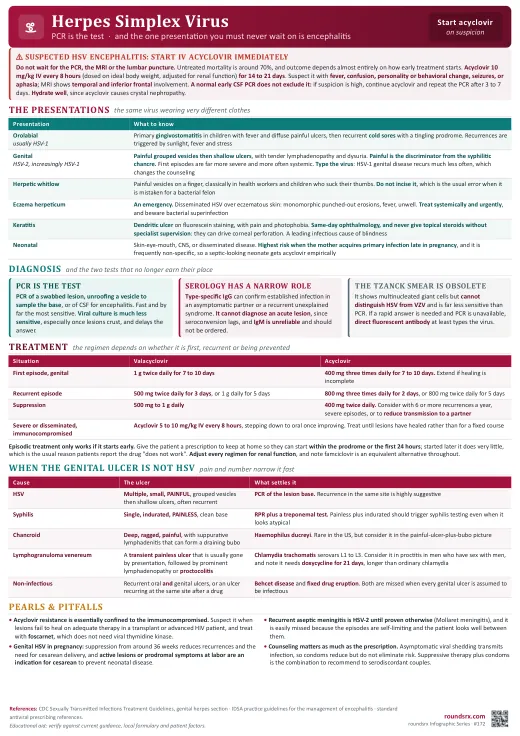
Text version
Herpes Simplex (HSV), Quick Reference Card
Print this page (Ctrl/Cmd + P) for a condensed reference card.
HERPES SIMPLEX (HSV), AT A GLANCE
📋 Diagnose: HSV PCR swab (active lesions), type-specific IgG (serology). Never IgM.
🧪 Workup: PCR swab unroofed vesicle. Encephalitis: MRI + CSF PCR + start acyclovir empirically.
⚡ Treat: Valacyclovir 1g BID × 7–10d (primary), 500 mg BID × 3d (recurrent), 500 mg–1g daily (suppressive).
💊 Encephalitis: Acyclovir 10 mg/kg IV q8h × 14–21d. DO NOT WAIT for results.
🤰 Pregnancy: Suppress from 36 wk. C-section if active lesions at labor.
⚠️ Resistance: Suspect if no improvement at 10d in immunocompromised → foscarnet.
🧪 Workup: PCR swab unroofed vesicle. Encephalitis: MRI + CSF PCR + start acyclovir empirically.
⚡ Treat: Valacyclovir 1g BID × 7–10d (primary), 500 mg BID × 3d (recurrent), 500 mg–1g daily (suppressive).
💊 Encephalitis: Acyclovir 10 mg/kg IV q8h × 14–21d. DO NOT WAIT for results.
🤰 Pregnancy: Suppress from 36 wk. C-section if active lesions at labor.
⚠️ Resistance: Suspect if no improvement at 10d in immunocompromised → foscarnet.
Related Topics
Cellulitis & Skin InfectionsCLABSI & Line InfectionsDiabetic Foot InfectionFungal InfectionsHantavirus (HPS & HFRS)Herpes Zoster (Shingles)