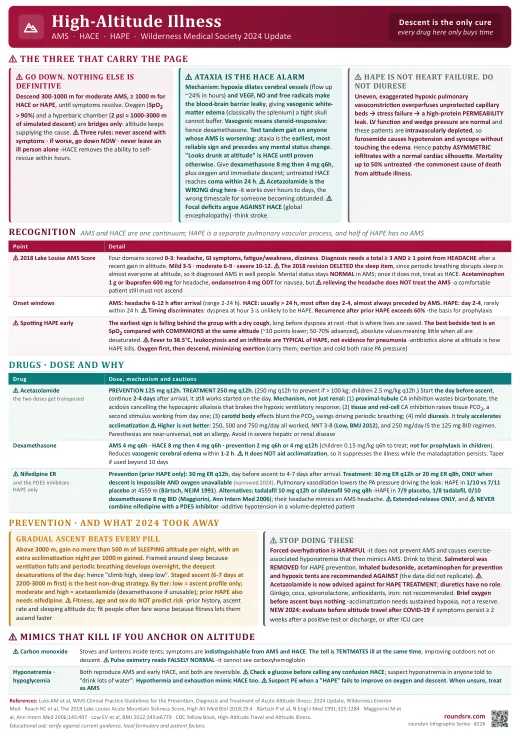
High-Altitude Illness (Altitude Sickness): AMS, HACE, HAPE
Three syndromes of hypobaric hypoxia: acute mountain sickness, high-altitude cerebral edema, and high-altitude pulmonary edema. Descent is the only definitive treatment, and every drug on this page buys time rather than replacing it. HAPE is the most common cause of death from altitude illness, with mortality up to 50% untreated. Guidance follows the Wilderness Medical Society 2024 Update.
🔍 Overview
Altitude illness is uncommon below 2500 m and rises steeply above it. That threshold is what the risk tiers and the decision to offer prophylaxis are keyed to, so 2500 m (8200 ft) of SLEEPING altitude is the number to carry. Above roughly 5500 m no one acclimatizes indefinitely, which is why time at extreme altitude is a countdown rather than an adaptation.
The Three Syndromes at a Glance
| Syndrome | Onset & How Common | Cardinal Feature | Mechanism of Action | Treatment, and How It Works |
|---|---|---|---|---|
| AMS Acute mountain sickness COMMON | 6–12 h typically (range 2–24 h). Rarely before 2 h, because the cerebral changes take time to develop. 25% at 2500–3000 m (Colorado resort altitudes), 50–85% above 4500 m with rapid ascent. The most common altitude problem a resident will hear about. | Headache plus at least one of GI upset, fatigue, or dizziness. Mental status is normal. | Hypoxia dilates cerebral vessels and cerebral blood flow rises about 24% within hours, raising capillary pressure, while VEGF, nitric oxide and free radicals make the blood-brain barrier leaky. The result is mild vasogenic edema that a tight skull cannot buffer. Note the honest caveat: MRI has not shown edema in mild AMS, so the early headache may be trigeminovascular rather than pressure-driven. | Stop ascending. That is the treatment, not just advice: halting the climb lets the renal side of acclimatization catch up, and most resolve in 24–72 h. Acetazolamide 250 mg q12h shortens it by forcing renal bicarbonate loss, which cancels the alkalotic brake on ventilation. If moderate to severe, descend 300–1000 m and/or give dexamethasone 4 mg q6h, which acts on the edema directly rather than on acclimatization. Left alone at altitude a minority progress to HACE, which is the whole reason ascent must stop. |
| HACE High-altitude cerebral edema LETHAL | Usually > 24 h, most often 2–4 days at altitude, and almost always preceded by AMS. < 1% at 4000–5000 m. Rare, but it is the end of the AMS spectrum and it kills. | Ataxia (earliest and most reliable), then altered mental status, confusion, drowsiness. | The same chain as AMS, carried further: sustained overperfusion plus frank barrier breakdown gives vasogenic edema of the white matter, classically the splenium of the corpus callosum, with cytotoxic edema only late. Because the edema is vasogenic it is steroid-responsive, which is exactly why dexamethasone works and acetazolamide does not. | Immediate descent of at least 1000 m, which removes the hypoxic stimulus driving the vasodilation and the leak. Add dexamethasone 8 mg once, then 4 mg q6h: it stabilizes the blood-brain barrier and reduces vasogenic edema within 1–2 h, which is why it is fast enough to matter. Oxygen to SpO2 > 90%. Acetazolamide is the wrong drug, since it does nothing to edema and works over days. Untreated: coma within 24 h, then herniation, so ataxia is an evacuation decision and not an observation decision. |
| HAPE High-altitude pulmonary edema LETHAL | 2–4 days at a new altitude. Uncommon within the first 24 h, and risk falls after about 5 days as acclimatization proceeds. 0.2–6% depending on ascent rate and altitude, up to 60%+ on re-exposure after a prior episode. | Exercise intolerance and dry cough out of proportion to companions, with an SpO2 well below theirs. | Not cerebral and not cardiac. Exaggerated and UNEVEN hypoxic pulmonary vasoconstriction forces cardiac output through the beds that did not constrict, so capillary pressure rises until the alveolar-capillary barrier physically fails. That leaks a high-protein fluid with a normal wedge pressure and normal LV function, which is why diuretics are wrong and pulmonary vasodilators are right. | Oxygen to SpO2 > 90% and descent of at least 1000 m, with the patient's own exertion minimized. Both work by the same route: they relieve alveolar hypoxia, so the pulmonary vasoconstriction relaxes, pressure falls and the leak stops. Nifedipine ER 30 mg q12h only when descent is impossible AND oxygen unavailable, giving the same pressure drop pharmacologically. No diuretics: the wedge pressure is normal and the patient is volume-depleted. Untreated mortality reaches 50%, the commonest cause of death from altitude illness. |
Each chain is worked through step by step, along with how every drug maps onto it, in the Mechanism tab.
A normal mental status does not exclude altitude illness. AMS and HACE share a mechanism and sit on one continuum, but HAPE is a separate pulmonary vascular process and roughly half of HAPE cases have no AMS at all. The trekker who is thinking clearly, denies headache, and simply cannot keep up on the trail may be the sickest person in the group.
Risk Factors, Ordered by How Much They Actually Predict
- Prior history of the same syndrome (strongest predictor by far). Susceptibility is individual and reproducible. A prior HAPE episode carries a 60% or higher recurrence on similar re-exposure, which is the entire justification for drug prophylaxis in that group.
- Rate of ascent and final sleeping altitude. The two variables that are actually modifiable, and the reason ascent protocols work better than any pill.
- Exertion at altitude. Raises pulmonary artery pressure and worsens hypoxemia, so heavy exertion on arrival day is a genuine risk factor and not just fatigue.
- Residence at low altitude before travel. Someone living at 1500 m has partial acclimatization that a sea-level resident does not.
- Patent foramen ovale. Substantially more prevalent in HAPE-susceptible individuals, since right-to-left shunting worsens hypoxemia which in turn worsens vasoconstriction.
- Structural pulmonary vascular abnormalities such as unilateral absence of a pulmonary artery, which forces the entire cardiac output through one lung and can cause HAPE at altitudes as low as 2500 m.
- What does NOT predict risk: physical fitness, age, and sex. Fit young athletes get altitude illness, and they get it more often because fitness lets them ascend faster and push harder. Never reassure a patient on the basis of conditioning.
🧬 Mechanism
How Altitude Illness Happens
One cause, one rate-limited defense, and two organ chains that share nothing but the trigger
Read it in three moves. One cause sits at the top, and it is a pressure problem, not an oxygen-fraction problem. The defense is rate-limited by the kidney, which is the slow step and therefore the one worth accelerating. The two chains are independent, sharing only the trigger, which is why roughly half of HAPE cases have no AMS and a clear-headed climber can be the sickest person on the mountain. Each drug is placed under the step it acts on, and oxygen and descent sit beneath everything because they remove the input rather than blunting a response to it.
Why any of this happens: the oxygen fraction never changes, the pressure does. FiO2 is 21% at sea level and 21% on the summit of Everest. What falls is barometric pressure, and inspired oxygen tension falls with it. At 5500 m barometric pressure is roughly half of sea level, so PiO2 is roughly halved. Everything below (the hyperventilation, the alkalosis, the cerebral vasodilation, the pulmonary vasoconstriction) is downstream of that single fact, which is why supplemental oxygen and descent both work and why nothing else works nearly as well.
Acclimatization: The Loop Acetazolamide Accelerates
- Hypoxia triggers the hypoxic ventilatory response via the carotid body, so minute ventilation rises within minutes of arrival. This is the body's only fast defense against a low PiO2.
- Hyperventilation blows off CO2, producing a respiratory alkalosis, and the alkalosis then brakes the very ventilation that caused it. The central chemoreceptors sense the high pH and pull back on respiratory drive, which is why the first day at altitude feels worse than the third.
- The kidney releases that brake over 24–48 h by excreting bicarbonate, normalizing pH and allowing ventilation to rise further. This renal step is the rate-limiting part of acclimatization, and it is precisely the step acetazolamide accelerates.
- Other adaptations are slower and do not help on a one-week trip: erythropoietin rises within hours but red cell mass takes weeks, and the 2,3-DPG and capillary density changes take longer still. Do not counsel a traveler that they will "adjust" over a few days beyond the ventilatory changes.
- Sleep is the vulnerable window. Ventilation falls during sleep and periodic (Cheyne-Stokes-like) breathing develops, producing repeated desaturations. This is why sleeping altitude, not the highest altitude reached during the day, drives illness, and why "climb high, sleep low" is the core of every ascent protocol.
The Cerebral Mechanism: How Hypoxia Becomes AMS and HACE
| Step | What Happens | Why It Matters |
|---|---|---|
| 1. Two opposing vascular forces | Hypoxia dilates cerebral vessels and cerebral blood flow rises by roughly 24% within hours of a rapid ascent. At the same time, the hypocapnia of hyperventilation constricts them. The net effect is whichever force wins. | This tension is the whole story. If hypocapnic vasoconstriction predominates, cerebral oxygenation falls; if hypoxic vasodilation predominates, the brain is overperfused and leaks. It also explains why the same altitude produces nothing in one person and HACE in another: the balance is individual. |
| 2. Overperfusion raises capillary pressure | Arterial and venous dilation transmits pressure to the capillary bed, raising capillary hydrostatic pressure and forcing fluid across the barrier. | The same physical principle as HAPE, in a different organ: pressure-driven leak across a barrier that was never designed to hold it. Note that vasodilation alone does not produce edema, which is why a permeability change has to be part of the explanation. |
| 3. The blood-brain barrier becomes leaky | Hypoxia upregulates mediators that increase permeability: vascular endothelial growth factor (VEGF), nitric oxide, bradykinin, inflammatory cytokines and free radicals. | VEGF is the one worth remembering, since it is a hypoxia-inducible permeability factor and its induction links the hypoxic stimulus directly to a leaking barrier. This biochemical step, not the mechanical one, is what converts high flow into edema. |
| 4. Vasogenic edema, then cytotoxic | Fluid crosses into the white matter interstitium, which is vasogenic edema. Cytotoxic (cellular) edema appears only in advanced stages, when cells can no longer maintain their ion gradients. | Vasogenic edema is steroid-responsive, which is exactly why dexamethasone works in HACE. It also explains the MRI signature: T2/FLAIR white matter change with the gray matter spared. |
| 5. The skull refuses to accommodate it TIGHT-FIT HYPOTHESIS | A swollen brain must be buffered by displacing CSF and venous blood. People with smaller ventricles and less craniospinal compliance have less room to buffer, so intracranial pressure rises further for the same amount of swelling. | The best available explanation for why susceptibility is so individual and so reproducible. It also predicts, correctly, that older adults with some cerebral atrophy are relatively protected while young people with tight, full skulls are more susceptible, which is one reason fitness and youth are not protective. |
| 6. Where it shows up | Edema and microhemorrhage concentrate in the splenium of the corpus callosum. Microbleeds are seen on susceptibility-weighted imaging, and the hemosiderin they leave behind can still be visible years later. | You will not have MRI in the field and must not wait for it. Its value is retrospective: it confirms the diagnosis afterwards, and the persistence of microbleeds is why HACE is treated as a permanent mark on a climber's history rather than an episode they simply recovered from. |
State the uncertainty honestly: this chain is well supported for HACE and for moderate-to-severe AMS, but it may not explain a mild AMS headache at all. MRI studies at simulated altitude have failed to demonstrate cerebral edema in people with mild AMS, so the early headache may be a trigeminovascular process closer to migraine than a pressure phenomenon. The practical consequence is unchanged, because the response to symptoms (stop ascending, and descend if worsening) does not depend on which mechanism is operating. But do not tell a resident that a mild AMS headache is proven cerebral edema, because it is not.
The Pulmonary Mechanism: Why HAPE Is Not Heart Failure
| Step | What Happens | Why It Matters at the Bedside |
|---|---|---|
| 1. Hypoxic pulmonary vasoconstriction | Alveolar hypoxia constricts pulmonary arterioles. In HAPE-susceptible people this response is exaggerated, driving pulmonary artery systolic pressures above 50 mmHg. | This is the therapeutic target. Anything that reverses it (oxygen, descent, nifedipine, a PDE5 inhibitor) treats HAPE. |
| 2. The vasoconstriction is uneven | Some vascular beds constrict, others do not. Cardiac output is therefore forced through the unprotected beds at high pressure. | Explains the patchy, asymmetric infiltrates on chest imaging. Uniform bilateral bat-wing edema should make you think cardiogenic instead. |
| 3. Capillary stress failure | Mechanical disruption of the alveolar-capillary barrier leaks a high-protein, mildly hemorrhagic fluid into alveoli. | It is a permeability leak driven by pressure, not a hydrostatic backup. Left atrial and wedge pressures are normal and LV function is normal. |
| 4. Impaired alveolar fluid clearance | Hypoxia downregulates the epithelial sodium channel and Na/K-ATPase that normally pump fluid out of the alveolus. | The lung loses its ability to drain itself, which is the rationale that was tested with beta-agonists. Salmeterol was removed from the WMS recommendations in 2024, so do not reach for it. |
The clinical consequence: do not treat HAPE like cardiogenic pulmonary edema. These patients are typically intravascularly depleted from insensible losses and poor intake at altitude, so diuretics risk hypotension and syncope on a mountain and are explicitly not recommended. Nitrates are similarly unhelpful. The treatment is oxygen and descent, not preload reduction.
How Acetazolamide Works: Four Mechanisms, Not One
The textbook answer (renal bicarbonate loss causes acidosis, which stimulates breathing) is correct but incomplete, and knowing why matters. Leaf and Goldfarb's review of the drug's mechanisms in Journal of Applied Physiology (2007) concluded that the renal explanation alone is unsatisfactory: animal and human data do not fit a model in which metabolic acidosis is doing all the work. Acetazolamide inhibits carbonic anhydrase everywhere the enzyme exists, and at least four of those sites contribute.
| Site | The Chain | What the Patient Gets |
|---|---|---|
| 1. Kidney THE CLASSIC ONE | Carbonic anhydrase in the proximal tubule is what allows filtered bicarbonate to be reclaimed. Inhibit it and bicarbonate is lost in the urine (bicarbonaturia), producing a mild metabolic acidosis. | The acidosis cancels the respiratory alkalosis that hyperventilation created, and it is that alkalosis which brakes ventilation at the central chemoreceptors. Released from the brake, the chemoreceptors can respond fully to the hypoxic stimulus and ventilation rises further. This is the step that normally takes the kidney 24 to 48 h, so the drug compresses acclimatization. |
| 2. Tissues and red cells | Carbonic anhydrase inside red cells and tissues converts CO2 to bicarbonate for transport. Inhibiting it slows that conversion, so CO2 lingers in the tissues and tissue PCO2 rises: a tissue respiratory acidosis. | A second, independent ventilatory stimulus that does not depend on the kidney at all. This is why the drug still helps when started on the day of ascent, before renal bicarbonate loss has had time to build a meaningful acidosis. |
| 3. Carotid body | Carbonic anhydrase inhibition alters chemosensing at the peripheral chemoreceptor. Because red cell inhibition also delays pulmonary CO2 washout, the PCO2 arriving at the carotid body falls less abruptly after each deep breath. | This is what smooths periodic breathing during sleep. The oscillation at altitude is a feedback loop: hypoxia drives a burst of breathing, the resulting hypocapnia shuts breathing off, apnea restores the hypoxia, and it repeats. Blunting the swing in PCO2 damps the loop, so the apneas and their desaturations stop. |
| 4. Fluid handling | Bicarbonate lost in the urine carries sodium and water with it, producing a mild diuresis. | Counteracts the fluid retention and relative antidiuresis that accompany AMS. Modest on its own, but it is the reason polyuria is such a reliable side effect, and it means a patient already volume-depleted on a mountain needs to keep drinking to thirst. |
Why the acidosis explanation matters clinically, not just academically. The metabolic acidosis has to be generated, which takes time and is dose-dependent, so acetazolamide is a prevention drug that also shortens mild AMS, never a rescue drug. It also explains the side effects exactly: paresthesias come from the carbonic anhydrase inhibition itself (not allergy), polyuria from the bicarbonate diuresis, and the flat taste of carbonated drinks from inhibition of the enzyme in the taste buds, which normally converts dissolved CO2 to the carbonic acid that produces the fizz sensation.
Right Drug, Right Mechanism: Why Each Agent Fits Where It Does
| Drug | Acts On | Therefore Right For | Therefore Wrong For |
|---|---|---|---|
| Acetazolamide | The acclimatization process itself, by removing the alkalotic brake on ventilation and adding a tissue acidosis. | Prevention of AMS and HACE, and shortening mild AMS. Also periodic breathing at altitude, via the carotid body and CO2 washout effects. | HACE, because it does nothing to vasogenic edema and works over hours to days while the patient is becoming obtunded. HAPE, where the 2024 update explicitly advises against it, since nothing in its mechanism addresses pulmonary vasoconstriction. |
| Dexamethasone | The leaky blood-brain barrier, stabilizing it and reducing vasogenic edema, with clinical effect in 1 to 2 h. | HACE, and moderate-to-severe AMS. It attacks the edema directly, which is why it is fast. | Being ascended on. It does nothing to the hypoxia or to acclimatization, so it removes the symptom while leaving the physiology unchanged. It is also the wrong tool for HAPE unless neurologic dysfunction persists after oxygenation is corrected, which means concurrent HACE. |
| Nifedipine, tadalafil, sildenafil | Hypoxic pulmonary vasoconstriction, lowering the pulmonary artery pressure that drives capillary stress failure. | HAPE, prevention in the susceptible and treatment when descent and oxygen are both unavailable. | AMS and HACE, which are cerebral problems with no pulmonary vascular component to treat. Lowering systemic pressure in a volume-depleted trekker buys nothing and risks syncope. |
| Oxygen and descent | The hypoxia itself, which is upstream of every mechanism on this page. | All three syndromes. Removing the stimulus reverses the cerebral vasodilation and the pulmonary vasoconstriction at once. | Nothing. This is the only intervention that treats the cause rather than a consequence, which is why no drug substitutes for it. |
🧪 Diagnosis
2018 Lake Louise AMS Score
What changed in 2018: the sleep item was removed. The older score included disturbed sleep, but sleep at altitude is disrupted by periodic breathing in nearly everyone, whether or not they have AMS. Keeping it inflated scores and diagnosed AMS in well people. CHANGED 2018 The revised score has four domains, and a fifth question on functional impact that is recorded but not added to the total.
| Domain | 0 | 1 | 2 | 3 |
|---|---|---|---|---|
| Headache MANDATORY | None | Mild | Moderate | Severe, incapacitating |
| GI symptoms | Good appetite | Poor appetite or nausea | Moderate nausea or vomiting | Severe, incapacitating nausea and vomiting |
| Fatigue / weakness | Not tired or weak | Mild | Moderate | Severe, incapacitating |
| Dizziness / lightheadedness | None | Mild | Moderate | Severe, incapacitating |
Diagnosis requires BOTH a total of ≥ 3 AND at least 1 point from headache, in the setting of a recent gain in altitude. Severity bands: mild 3–5, moderate 6–9, severe 10–12. The headache requirement is what stops the score from labelling ordinary trekking fatigue as AMS: a tired, queasy, dizzy climber with no headache scores 6 but does not have AMS by definition.
Recognizing HACE: Test the Gait
- Ataxia is the earliest and most reliable sign, and it usually appears before mental status changes. Test tandem gait (heel-to-toe along a straight line for 5 m) on anyone with AMS that is worsening. It takes fifteen seconds and it is the single highest-yield examination at altitude.
- "Looks drunk at altitude" is HACE until proven otherwise: staggering, slurred speech, poor judgment, inappropriate behavior and drowsiness. The resemblance to intoxication is close enough that companions routinely misattribute it.
- Progression is to confusion, then stupor, then coma, typically within 24 h of the first ataxia. That timeline is why HACE is treated on suspicion and not after confirmation.
- Focal neurologic deficits argue against HACE. HACE produces a global, non-focal encephalopathy. Hemiparesis, aphasia or a visual field cut should redirect you to stroke, which is a real competing diagnosis at altitude given hemoconcentration and dehydration.
- Retinal hemorrhages and papilledema may be present but are neither sensitive nor specific. High-altitude retinal hemorrhage occurs in many asymptomatic climbers above 5000 m, so do not use fundoscopy to rule HACE in or out.
- If imaging happens to be available, MRI shows T2/FLAIR white matter edema with a predilection for the splenium of the corpus callosum, plus microhemorrhages on susceptibility-weighted sequences that can persist for years. In the field, you will not have imaging, and you should not wait for it.
Recognizing HAPE: Trust the Pulse Oximeter Against the Group
| Stage | Findings | What to Do With It |
|---|---|---|
| Earliest | Decreased exercise performance and a dry cough. The patient is simply slower than they were yesterday and slower than their companions. | This is the stage where lives are saved. Falling behind on a trail is treated as fatigue by almost everyone, which is why the diagnosis is usually made late. Check an SpO2 and compare it with a companion at the same altitude. |
| Established | Dyspnea at rest, tachypnea, tachycardia, crackles (often starting in the right middle lobe), low-grade fever up to 38.5°C, leukocytosis. | The fever and leukocytosis routinely cause a misdiagnosis of pneumonia, and treating with antibiotics alone while the patient stays at altitude is fatal. Altitude plus hypoxia plus infiltrate is HAPE until it is disproven at a lower elevation. |
| Late | Cyanosis, pink frothy sputum, severe hypoxemia (SpO2 often 50–70%, roughly 10 points below healthy companions), obtundation from hypoxia or concurrent HACE. | Emergency. Oxygen and descent simultaneously. Do not walk them down under their own power if it can be avoided, because exertion raises pulmonary artery pressure and worsens the edema. |
The single most useful bedside test is a comparative SpO2. An absolute saturation is hard to interpret at altitude because everyone is desaturated. A saturation markedly below that of companions at the same elevation is the finding that separates HAPE from deconditioning. Point-of-care lung ultrasound showing B-lines is a reasonable adjunct where available, and chest radiography shows patchy asymmetric infiltrates with a normal cardiac silhouette.
Differential: What Else Does This At Altitude
| Mimic | Why It Gets Confused | How to Separate It |
|---|---|---|
| Carbon monoxide poisoning DO NOT MISS | Headache, nausea, dizziness and confusion in the exact pattern of AMS or HACE. Stoves and lanterns run inside tents and unventilated huts. | Multiple people in the same tent are ill simultaneously, and symptoms improve on going outside rather than on descending. Pulse oximetry is falsely normal because standard oximeters cannot distinguish carboxyhemoglobin from oxyhemoglobin. |
| Exhaustion and dehydration | Fatigue, headache and nausea overlap almost completely with AMS. | Responds to rest, food and fluid within hours and does not progress. When in doubt, treat as AMS, because the cost of over-calling is a rest day and the cost of under-calling is HACE. |
| Hyponatremia | Headache, nausea, confusion. Caused by the well-meaning advice to "drink lots of water" combined with exertional sodium loss. | History of very high fluid intake. This is the specific harm behind the recommendation against forced overhydration: pushing fluids does not prevent AMS and does cause exercise-associated hyponatremia. |
| Migraine | Severe headache with nausea and photophobia, and altitude is a recognized migraine trigger. | Prior identical episodes, aura, and response to the patient's usual abortive. A migraine history does not protect against AMS, so treat both if the picture is mixed. |
| Pneumonia or bronchitis | Cough, dyspnea, fever, infiltrate and leukocytosis, all of which HAPE also produces. | Productive purulent sputum and a focal consolidation favor pneumonia, but the safe move is to treat for both and descend. HAPE improves dramatically with oxygen and descent within hours; pneumonia does not. |
| Pulmonary embolism | Dyspnea and hypoxemia after long-haul travel, dehydration and immobility, all common in altitude travelers. | Pleuritic pain, unilateral leg findings and hypoxemia that does not improve on descent. Consider it strongly when a "HAPE" fails to respond to oxygen and descent. See Wells for PE. |
| Hypothermia | Ataxia, confusion, slurred speech and poor judgment, identical to HACE on inspection. | Core temperature. Both can be present at once in a storm-bound climber, and both need the same first move, which is getting off the mountain. |
| Hypoglycemia | Confusion, weakness, tremor after prolonged exertion with poor appetite, which altitude itself causes. | Point-of-care glucose. Check it before attributing any altered mental status to HACE, because it is instantly reversible and free to exclude. |
| Acute coronary syndrome | Chest discomfort and dyspnea at altitude, in a population that is often middle-aged and exerting hard in the cold. | ECG and the character of the pain. Cold plus exertion plus hypoxemia is a genuine ischemic stress, so this is not a theoretical concern. See Chest Pain Workup. |
🚨 Management
The three rules that prevent nearly every altitude death. (1) Do not ascend with symptoms of altitude illness. Continuing upward converts a self-limited illness into a lethal one. (2) If you are getting worse, go down. Not tomorrow, not after one more night. (3) Never leave someone with altitude illness alone. HACE progresses to an inability to self-rescue within hours, and the classic fatality is a person left in a tent "to rest" who is found obtunded.
Descent: The Only Definitive Treatment
| Syndrome | How Far Down | Urgency | Why That Distance |
|---|---|---|---|
| Mild AMS | Often none needed: stop ascending and rest at the current altitude for 12–48 h. | Elective. Most resolve where they are. | Halting ascent alone lets acclimatization catch up. Descending is offered for comfort or if symptoms do not improve. |
| Moderate to severe AMS | 300–1000 m (1000–3300 ft) | Same day. | Symptoms typically improve within hours at a modestly lower elevation, so a large descent is usually unnecessary and small drops are often achievable when a full evacuation is not. |
| HACE | At least 1000 m, and keep going until symptoms resolve | IMMEDIATE Do not wait for daylight or better weather if descent is at all feasible. | Cerebral edema does not reverse at the offending altitude. Every hour of delay is more edema, and the endpoint is herniation. |
| HAPE | At least 1000 m, with exertion minimized | IMMEDIATE | Descent drops alveolar hypoxia, which releases the pulmonary vasoconstriction that is driving the leak. Carry or assist the patient if possible, because exertion raises pulmonary artery pressure and can worsen the edema faster than the descent improves it. |
When descent is genuinely impossible (storm, terrain, darkness, no evacuation resources), the substitutes in order of preference are supplemental oxygen, a portable hyperbaric chamber, and then drugs. All three are bridges. Descend as soon as conditions allow, even if the patient looks better, because oxygen and drugs treat the consequence while altitude keeps supplying the cause.
Oxygen and the Portable Hyperbaric Chamber
- Supplemental oxygen, titrated to SpO2 > 90%. Usually 1–2 L/min relieves an AMS headache within about 30 minutes, with other symptoms resolving over hours. In HAPE, higher flows are needed, and oxygen alone can be as effective as descent because it directly reverses hypoxic pulmonary vasoconstriction. Where a monitored setting with oxygen exists, a stable HAPE patient can sometimes be treated in place rather than evacuated.
- Portable hyperbaric chamber (for example a Gamow bag), inflated to about 2 psi. This produces a simulated descent of roughly 1000–3000 m depending on the starting elevation. It is the right tool when descent is blocked and oxygen supplies are limited or exhausted.
- Know its limitations before you rely on it. It needs a patient who is conscious enough to clear their ears and not vomit, it requires someone pumping continuously, and the patient is sealed away from examination for the duration. Effects also fade after removal, so it buys time for evacuation rather than substituting for it. Typical sessions are 1–2 h with reassessment between.
- Combine it with drug therapy rather than choosing between them, since the chamber and dexamethasone or nifedipine act by different mechanisms and the chamber's benefit is temporary.
AMS: Stepwise Treatment
| Severity | Treatment | Rationale |
|---|---|---|
| Mild (Lake Louise 3–5) | Stop ascending. Rest, oral fluids to thirst, and symptomatic treatment: acetaminophen 1 g or ibuprofen 600 mg for headache, ondansetron 4 mg ODT for nausea. | Most cases resolve in 12–48 h once ascent halts. Analgesics treat the headache only and do not treat AMS itself, so a patient made comfortable must still not ascend. |
| Mild, wanting to speed recovery | Add acetazolamide 250 mg PO q12h (note this is the treatment dose, double the 125 mg prophylactic dose) until symptoms resolve. | It accelerates the renal bicarbonate excretion that is the rate-limiting step of acclimatization, so it shortens the illness rather than masking it. It is not fast, which is why it is inadequate as monotherapy for anything more than mild disease. |
| Moderate to severe (Lake Louise ≥ 6, or not improving) | Descend 300–1000 m and/or give dexamethasone 4 mg PO/IV/IM q6h. Add oxygen if available. | Dexamethasone reduces vasogenic cerebral edema and works within 1–2 h, far faster than acetazolamide. It is the right drug when someone is sick enough that waiting on acclimatization is not acceptable. |
| Any AMS that worsens despite treatment | Treat as HACE. Descend now, dexamethasone 8 mg then 4 mg q6h, oxygen. | The transition from AMS to HACE is a continuum with no clean boundary, so the safe practice is to act on the trajectory rather than wait for ataxia to declare itself. |
HACE: Treat on Suspicion
- Immediate descent of at least 1000 m, continuing until symptoms resolve. Everything else is adjunctive to this.
- Dexamethasone 8 mg once (PO, IV or IM), then 4 mg q6h until symptoms resolve. The route does not matter much for onset, so give it by whatever route the patient can take. It reduces the vasogenic edema and buys the hours an evacuation takes.
- Supplemental oxygen targeting SpO2 > 90%, which addresses the hypoxia generating the edema in the first place.
- Acetazolamide is NOT the treatment for HACE. It works by speeding acclimatization over hours to days, which is the wrong timescale entirely for someone becoming obtunded. It may be added as an adjunct, never as the primary agent.
- Do not resume ascent after giving dexamethasone. The drug suppresses symptoms without correcting the hypoxia, so the patient feels able to climb while the underlying process is unchanged, and this is a documented mechanism of altitude deaths.
- Portable hyperbaric chamber if descent is impossible, but only in a patient conscious enough to protect their own airway, since vomiting inside a sealed bag is a real hazard.
HAPE: Oxygen First, Then Down
| Intervention | Details | Why / Caveat |
|---|---|---|
| Supplemental oxygen FIRST | Titrate to SpO2 > 90%. Start on suspicion, before imaging or any confirmation. | Directly reverses hypoxic pulmonary vasoconstriction, which is the whole mechanism. Improvement is often dramatic within hours, and where oxygen and monitoring are available a stable patient may not need evacuation at all. |
| Descent FIRST | At least 1000 m. Minimize the patient's own exertion: carry, sled, or assist wherever terrain allows. | Exertion raises pulmonary artery pressure and can worsen the edema during the descent itself. This is the one situation where "walking it off" actively harms. |
| Rest and warmth | Keep the patient warm and at rest even while awaiting evacuation. | Cold raises pulmonary artery pressure, so a shivering patient in a tent is being made worse by their environment. |
| Nifedipine extended-release ONLY IF NEITHER ABOVE IS AVAILABLE | 30 mg ER q12h or 20 mg ER q8h. CHANGED 2024 WMS 2024: strong recommendation, low-quality evidence | Lowers pulmonary artery pressure, and it genuinely works: six climbers with established HAPE at 4559 m improved clinically and radiographically on nifedipine while still exercising at altitude and without supplemental oxygen Oelz, 1989. But that was six patients with no control group, which is exactly why the recommendation is graded low-quality and why the 2024 update narrowed it to descent being impossible AND supplemental oxygen or hyperbaric therapy unavailable: oxygen and descent are faster and better, not because the drug does nothing. Monitor blood pressure, and avoid immediate-release formulations, which drop pressure abruptly. |
| Tadalafil or sildenafil FOURTH LINE | Tadalafil 10 mg q12h or sildenafil 50 mg q8h, but only when descent is impossible, oxygen and hyperbaric therapy are unavailable, AND nifedipine is unavailable too. WMS 2024: weak recommendation, low-quality evidence | They have a sound physiologic rationale, since pulmonary vasodilation and a lower pulmonary artery pressure is precisely the mechanism of HAPE. What they lack is data: no systematic study has tested either drug for HAPE treatment, as monotherapy or as an add-on, so they sit behind nifedipine on evidence rather than on plausibility. Never combine them with nifedipine, because the hypotension is additive. |
| Portable hyperbaric chamber | When both oxygen and descent are unavailable. | Simulates descent. Same limitations as in HACE, with the added problem that a dyspneic patient may not tolerate lying sealed in a bag. |
| Dexamethasone | Only if neurologic dysfunction persists despite adequate oxygenation: 8 mg then 4 mg q6h. | Persistent confusion after the hypoxemia is corrected means concurrent HACE, not HAPE alone. Do not give it reflexively to every HAPE patient, since altered mentation from hypoxia resolves with oxygen. |
Do not read the ordering above as "vasodilators barely count in HAPE." They are the right drug class, acting on the actual mechanism, and for PREVENTION in a susceptible person they are first-line. Nifedipine ER 30 mg q12h is the standard prophylaxis after a prior HAPE episode, with tadalafil 10 mg q12h a well-supported alternative, and both have randomized evidence behind them Bärtsch, 1991 Maggiorini, 2006. The demotion applies only to TREATMENT, and only because oxygen and descent remove the hypoxic stimulus itself, which works faster and more completely than blunting the vascular response to it. Given a hypoxic patient and a cylinder of oxygen, reach for the oxygen; given neither oxygen nor a way down, reach for the nifedipine.
What NOT to do in HAPE, and why each is a real error rather than a theoretical one. No diuretics: this is a permeability leak with a normal wedge pressure in a patient who is usually volume-depleted, so furosemide produces hypotension and syncope without touching the edema. No acetazolamide: the WMS 2024 update explicitly advises against it for HAPE treatment. No salmeterol: removed from the recommendations in 2024 after the alveolar-clearance rationale failed to hold up. Do not combine nifedipine with a PDE5 inhibitor such as tadalafil or sildenafil, because the hypotension is additive and there is no evidence the combination outperforms either alone. Do not stop at antibiotics for a presumed pneumonia while the patient stays at altitude.
After Recovery: Can They Go Back Up
- AMS: once symptoms have fully resolved, ascent may resume, but slowly and only after the patient is asymptomatic off treatment. Resuming while still on dexamethasone is the classic error.
- HACE: do not re-ascend on that trip. Neurologic recovery can lag symptom resolution by days to weeks, and the susceptibility that produced it has not changed.
- HAPE: re-ascent is possible after full recovery with normal oxygenation at rest and on exertion, but it must be slow, and prophylaxis with nifedipine should be considered given a recurrence risk above 60% on similar re-exposure.
- Counsel every HAPE survivor that they are a susceptible individual for life, which changes how they should plan any future trip above 2500 m and is the single most useful thing you can tell them at discharge.
🛡️ Prevention
Gradual ascent is the single most effective preventive measure, and no drug substitutes for it. Acetazolamide roughly halves the incidence of AMS, but a sensible itinerary prevents far more illness than any prescription, and prophylaxis given alongside a reckless ascent profile mostly buys a false sense of security. Fix the itinerary first, then decide about drugs.
Ascent Rules
- Above 3000 m, increase SLEEPING altitude by no more than 500 m per night. Sleeping altitude is what matters because ventilation falls and periodic breathing develops during sleep, producing the deepest desaturations of the 24 h cycle. Climbing high during the day and coming down to sleep is safe and is the origin of "climb high, sleep low."
- Add an extra acclimatization night for every 1000 m of sleeping-altitude gain. This gives the kidney time to complete the bicarbonate excretion that lets ventilation rise further.
- Avoid going from low altitude to a sleeping altitude above 2750 m in a single day where the itinerary allows a choice. When air travel makes this unavoidable (Cusco, La Paz, Lhasa), plan a rest day on arrival with no exertion.
- Staged ascent works: 6–7 days at 2200–3000 m before going higher substantially reduces subsequent AMS. This is the most reliable non-drug strategy for someone with a prior history.
- Rules are guidance, not physiology. Individual susceptibility varies widely, so a person who follows the profile exactly can still get sick. The response to symptoms is the same regardless of how careful the itinerary was.
Risk Stratification and What Each Tier Gets
| Risk | Who | Prophylaxis |
|---|---|---|
| Low | No prior altitude illness and sleeping altitude staying below about 2800 m. Or any history, but ascending over 2 or more days to 2500–3000 m with ≤ 500 m nightly gains and an acclimatization day per 1000 m. | None. Gradual ascent alone. Counsel on recognizing symptoms and on not ascending with them. |
| Moderate | Prior AMS with a one-day ascent to 2500–2800 m. Or no prior AMS but a one-day ascent above 2800 m. Or ascent above 3000 m with nightly gains over 500 m while still taking an acclimatization day per 1000 m. | Acetazolamide should be strongly considered alongside a sensible profile. |
| High | Prior AMS with a one-day ascent above 2800 m. Any history of HACE or HAPE. Any one-day ascent above 3500 m. Very rapid ascents such as Kilimanjaro in under 7 days. Ascent above 3000 m with nightly gains over 500 m and no acclimatization days. | Acetazolamide recommended. Dexamethasone if acetazolamide is not tolerated. Add nifedipine for a prior HAPE history, since that susceptibility is specifically pulmonary and acetazolamide does not address it. |
CHANGED 2024 The 2024 update moved toward a less finely stratified approach and a broader application of prevention. Practically, that means erring toward offering prophylaxis when a traveler sits near a boundary, rather than withholding it because they technically fall in the tier below.
Drug Prophylaxis: AMS and HACE
| Drug | Dose | Timing | Why This One |
|---|---|---|---|
| Acetazolamide (Diamox) FIRST-LINE | 125 mg PO q12h. 250 mg q12h if body weight is over about 100 kg. Children 2.5 mg/kg q12h up to 125 mg. | Start the day before ascent, continue 2–4 days after reaching the target altitude, or until descent begins. | It is the only prophylactic agent that actually speeds acclimatization rather than suppressing symptoms, so it can be stopped without rebound and the patient is genuinely better adapted. It still works if started on the day of ascent, which matters for the traveler who calls from the airport. |
| Dexamethasone ALTERNATIVE | 2 mg PO q6h or 4 mg PO q12h. 4 mg q6h in very high-risk situations. Not recommended in children for prophylaxis. | Start the day before ascent, continue 2–4 days after arrival. Taper over a week if used beyond 10 days. | For people who cannot take acetazolamide. It prevents AMS without aiding acclimatization, so stopping it abruptly at altitude can unmask illness, and the patient is no better adapted than on day one. |
| Ibuprofen WEAKER OPTION | 600 mg PO three times daily, starting about 6 h before ascent. | Continue through the ascent and the first days at altitude. | An option when both first-line drugs are contraindicated or refused. Reduced AMS from 69% to 43% versus placebo Lipman, 2012, but it has been inferior to acetazolamide in head-to-head work, so it is a fallback rather than an equal. |
Drug Prophylaxis: HAPE (Only for a Prior HAPE History)
| Drug | Dose | Evidence |
|---|---|---|
| Nifedipine extended-release PREFERRED | 30 mg ER q12h, starting the day before ascent and continuing 4–7 days after reaching the target altitude or until descent. | In HAPE-susceptible mountaineers taken rapidly to 4559 m, HAPE occurred in 1 of 10 on nifedipine versus 7 of 11 on placebo Bärtsch, 1991. Only indicated for people with a prior episode, since prophylaxis in unselected travelers is not supported. |
| Tadalafil ALTERNATIVE | 10 mg PO q12h, same timing as nifedipine. | HAPE occurred in 7 of 9 on placebo, 1 of 8 on tadalafil and 0 of 10 on dexamethasone in HAPE-susceptible adults taken to 4559 m Maggiorini, 2006. Both drugs blunted the rise in systolic pulmonary artery pressure, confirming the mechanism. |
| Sildenafil | 50 mg PO q8h | A reasonable substitute where tadalafil is unavailable, acting by the same pulmonary vasodilator mechanism. Shorter dosing interval is the practical drawback on a mountain. |
| Dexamethasone RESERVE | 8 mg PO q12h | Effective in the same trial Maggiorini, 2006, but reserved for susceptible people who cannot take nifedipine or tadalafil, because a steroid carries more systemic burden than a vasodilator for what is a pulmonary vascular problem. |
What NOT to Use, and What Changed in 2024
| Intervention | Status | Why Not |
|---|---|---|
| Forced overhydration | HARMFUL | Does not prevent altitude illness and causes exercise-associated hyponatremia, which then mimics AMS and gets treated as AMS. Drink to thirst. |
| Salmeterol | REMOVED 2024 | Previously suggested as an add-on to nifedipine for HAPE prevention on an alveolar fluid clearance rationale. No longer recommended, and it should be dropped from any older protocol still carrying it. |
| Inhaled budesonide | NOT RECOMMENDED 2024 | A strong recommendation against, on high-quality evidence: the supporting studies had methodological problems and the results did not replicate. |
| Acetaminophen for prevention | NOT RECOMMENDED 2024 | The supporting studies used inadequate controls. It remains fine for treating an altitude headache, which is a different claim. |
| Hypoxic tents and commercial pre-acclimatization | NOT RECOMMENDED 2024 | A strong recommendation against on moderate-quality evidence. Real pre-acclimatization needs sustained exposure of at least 8 h daily over weeks, which is far beyond how these products are actually used, and results have been inconsistent. |
| Short-term supplemental oxygen before ascent | NOT USEFUL | Breathing oxygen before or briefly on arrival does not produce lasting protection, because acclimatization is driven by sustained hypoxia and not by an oxygen reserve. |
| Ginkgo biloba, coca leaf or tea, spironolactone, antioxidants, iron, dietary nitrates, leukotriene receptor blockers, sumatriptan | NOT RECOMMENDED | Either unstudied, inconsistently effective, or negative. Ginkgo in particular has failed to replicate, with results varying by preparation, which is a common problem with unregulated supplements. |
💊 Medications
For the physiology behind these drugs (how hypoxia becomes cerebral edema, and the four separate carbonic anhydrase effects that make acetazolamide work) see the Mechanism tab. This tab is the dosing reference.
The two acetazolamide doses are the most commonly transposed numbers on this page. Prevention is 125 mg q12h. Treatment is 250 mg q12h. Getting them backwards means either under-treating an ill patient or dosing a well traveler at double what they need and giving them paresthesias for a week. Write the indication next to the dose on every prescription.
Complete Drug Reference
| Drug | Indication and Dose | Mechanism (the why) | Cautions |
|---|---|---|---|
| Acetazolamide (Diamox) | AMS/HACE prevention: 125 mg PO q12h (250 mg q12h if > 100 kg). Children 2.5 mg/kg q12h, max 125 mg. AMS treatment: 250 mg PO q12h. Children 2.5 mg/kg q12h, max 250 mg. Periodic breathing at altitude: 125 mg at bedtime. |
Carbonic anhydrase inhibition causes renal bicarbonate wasting and a mild metabolic acidosis, which offsets the hypocapnic alkalosis that otherwise brakes the hypoxic ventilatory response. Ventilation therefore rises further and sooner, compressing 24–48 h of renal acclimatization into a shorter window. It also reduces the nocturnal desaturations of periodic breathing. | Paresthesias of fingers, toes and face are near-universal and are not an allergy, though they cause many people to stop the drug. Also polyuria, and a metallic taste that makes carbonated drinks taste flat. Avoid in severe hepatic disease (risk of hyperammonemia and encephalopathy) and in severe renal impairment. Watch for hypokalemia with concurrent diuretics. |
| Dexamethasone | AMS treatment: 4 mg PO/IV/IM q6h. Children 0.15 mg/kg q6h, max 4 mg. HACE: 8 mg once, then 4 mg q6h. Prevention: 2 mg q6h or 4 mg q12h. HAPE prophylaxis (reserve): 8 mg q12h. |
Reduces vasogenic cerebral edema and stabilizes the blood-brain barrier, with clinical effect within 1–2 h. Unlike acetazolamide it does not aid acclimatization, so it suppresses the illness while leaving the underlying maladaptation untouched. | Never resume ascent while taking it, because it masks symptoms without correcting hypoxia. Hyperglycemia, mood change, insomnia and dyspepsia are common at these doses. Taper over a week if used beyond 10 days to avoid adrenal suppression. Not used for prophylaxis in children. |
| Nifedipine extended-release | HAPE prevention: 30 mg ER q12h. HAPE treatment when descent is impossible and oxygen unavailable: 30 mg ER q12h or 20 mg ER q8h. |
Calcium channel blockade produces pulmonary vasodilation, lowering the pulmonary artery pressure that drives capillary stress failure. This targets the actual mechanism of HAPE rather than the fluid it produces. | Systemic hypotension in a patient who is usually volume-depleted at altitude, with a real risk of syncope on a mountainside. Use extended-release only: immediate-release nifedipine drops pressure abruptly. Never combine with a PDE5 inhibitor, as the hypotension is additive with no proven added benefit. |
| Tadalafil / Sildenafil | HAPE prevention: tadalafil 10 mg PO q12h, or sildenafil 50 mg PO q8h. HAPE treatment: same doses, but only when descent, oxygen and nifedipine are all unavailable. |
PDE5 inhibition increases cyclic GMP in pulmonary vascular smooth muscle, producing selective pulmonary vasodilation and blunting hypoxic pulmonary vasoconstriction. | Headache is the main practical problem and is indistinguishable from an AMS headache, which muddies assessment in exactly the patient you are watching most closely. Contraindicated with nitrates. Do not stack with nifedipine. |
| Ibuprofen | Prevention (fallback): 600 mg PO three times daily. Headache: 400–600 mg as needed. |
Prostaglandin inhibition reduces the headache and may blunt the inflammatory component of AMS. | Renal risk in a dehydrated traveler, and GI upset that is hard to distinguish from AMS nausea. Treating the headache does not treat the AMS, so a comfortable patient still must not ascend. |
| Acetaminophen | Headache: 1 g PO q6h as needed, max 4 g/day. | Central analgesia. As effective as ibuprofen for the altitude headache specifically. | Not recommended for prevention as of the 2024 update. Same caveat as ibuprofen: the headache improving is not the illness improving. |
| Ondansetron | Nausea: 4 mg ODT q8h as needed. | 5-HT3 antagonism. The orally dissolving form is practical when the patient is vomiting and in the field. | Purely symptomatic. Controlling vomiting matters because it lets the patient keep down acetazolamide or dexamethasone and stay hydrated, not because it treats the illness. |
Acetazolamide and Sulfa Allergy: A Question You Will Actually Be Asked
Acetazolamide is a non-antibiotic sulfonamide, and cross-reactivity with sulfa antibiotics is very unlikely. The structural feature responsible for most sulfonamide hypersensitivity is the aromatic amine at the N4 position, and acetazolamide does not have it. A simple rash, urticaria or GI intolerance from a sulfa antibiotic is not a contraindication. What is a contraindication is prior anaphylaxis to a sulfonamide or a history of Stevens-Johnson syndrome. For a patient with a worrying but unclear history who is heading somewhere remote, a supervised trial dose before the trip is the sensible middle path, because discovering a reaction at 4500 m is the scenario to avoid.
Why 125 mg Twice Daily and Not More
- Higher doses are not more effective, only more unpleasant. A meta-analysis comparing daily totals of 250, 500 and 750 mg found all three effective with a number needed to treat of 3 to 8, and no efficacy gain from going higher Low, 2012. 250 mg per day is exactly the 125 mg twice-daily regimen, which is where the guideline number comes from and a frequent source of confusion when reading older sources that quote daily totals.
- Going lower has been tested and is not established. A halved 62.5 mg twice-daily dose was compared with 125 mg twice daily in trekkers to Everest Base Camp, with AMS in 55.3% versus 60.0% and comparable side effects RADICAL, 2019. The authors concluded noninferiority but flagged that the trial was underpowered because AMS rates came in lower than expected, so 125 mg twice daily remains the recommended dose and the lower dose should not be used routinely.
- Practical consequence: do not escalate the dose when a traveler still feels unwell on prophylaxis. More acetazolamide will not help. Stopping the ascent will.
👥 Special Cases
Pre-existing Conditions and Altitude Travel
| Condition | Concern at Altitude | Advice |
|---|---|---|
| Sickle cell disease HIGH RISK | Hypoxia promotes sickling, precipitating vaso-occlusive crisis and splenic infarction. Sickle cell trait is not benign here: splenic infarction after high-altitude exposure is well described in trait carriers, including on unpressurized flights. | Avoid unacclimatized travel above about 2500 m in sickle cell disease. Counsel trait carriers on the risk and on presenting early with left upper quadrant pain. Consider screening before high-altitude travel in someone at risk who has never been tested. |
| Pulmonary hypertension | Hypoxic pulmonary vasoconstriction adds to an already elevated pulmonary artery pressure, risking right heart failure and HAPE. | Specialist assessment before travel. Supplemental oxygen is often required. Moderate to severe disease is a reason to advise against high-altitude travel. |
| Severe COPD or interstitial lung disease | Patients already near the steep part of the oxyhemoglobin dissociation curve desaturate profoundly for a small drop in PiO2, so a modest altitude produces a large fall in SaO2. | Consider a hypoxic challenge (altitude simulation) test before travel and arrange in-flight and on-site oxygen. Optimize the underlying disease first. See COPD GOLD Guidelines. |
| Coronary artery disease | Hypoxemia, cold, exertion and increased sympathetic tone together raise myocardial oxygen demand while supply falls. | Stable, well-controlled disease with good exercise tolerance generally tolerates moderate altitude. Recent ACS, unstable angina or decompensated heart failure should not travel until stabilized and reassessed. |
| Unrepaired congenital heart disease or a large intracardiac shunt | Hypoxic pulmonary vasoconstriction can increase right-to-left shunting and worsen hypoxemia. Absent or hypoplastic pulmonary artery predisposes to HAPE at unusually low altitudes. | Cardiology assessment before travel. Ask specifically about unilateral absence of a pulmonary artery in anyone with HAPE at a surprisingly low elevation, since it changes lifelong advice. |
| Pregnancy | Data are limited. Short recreational exposure to moderate altitude appears well tolerated; prolonged residence at high altitude is associated with lower birth weight. | Avoid sleeping above about 3000 m, avoid remote areas far from obstetric care, and avoid prophylactic drugs where possible given limited pregnancy safety data. Ascend slowly. |
| Obstructive sleep apnea | Altitude adds central apnea and periodic breathing on top of existing obstructive events, worsening nocturnal desaturation. | Continue CPAP where power allows. Acetazolamide 125 mg at bedtime reduces central apneas and periodic breathing, which is a distinct indication from AMS prophylaxis. See Obstructive Sleep Apnea. |
| Diabetes | Altitude and exertion alter insulin requirements, and glucometers can read inaccurately in cold and at altitude. AMS symptoms overlap closely with both hypoglycemia and DKA. | Keep meters and insulin warm and carry extra supplies. Check a glucose before attributing any confusion at altitude to HACE. |
| Recent COVID-19 NEW 2024 | Cardiopulmonary sequelae may impair the reserve needed to tolerate hypobaric hypoxia. | The 2024 update advises pre-travel evaluation for anyone with persistent symptoms at least 2 weeks after a positive test or after hospital discharge, and for anyone who required intensive care. Asymptomatic recovered patients need no special assessment. |
Children
- Children get AMS at rates similar to adults, and acetazolamide can be used for prophylaxis in children at 2.5 mg/kg q12h up to 125 mg.
- Dexamethasone is not recommended for prophylaxis in children, though it is used for treatment at 0.15 mg/kg q6h up to 4 mg.
- Preverbal children are the hard problem. Fussiness, poor feeding, poor sleep and reduced play are the only available signs, and every one of them has a dozen other causes. The safe default is to treat unexplained fussiness after ascent as AMS and not ascend further, because the alternative is missing HACE in a child who cannot report a headache.
- Ascend more conservatively with children than the adult profile requires, since the assessment is so much less reliable.
Other High-Altitude Syndromes Worth Knowing
| Entity | Features | Management |
|---|---|---|
| High-altitude headache | Headache without the other AMS criteria. Very common above 2500 m. | Analgesia and no further ascent until it settles. Watch it, because it is also how AMS starts. |
| Periodic breathing of altitude | Crescendo-decrescendo breathing with central apneas during sleep, with frequent awakenings and a sensation of suffocation. Occurs in most people above 3000 m whether or not they have AMS. | Reassurance plus acetazolamide 125 mg at bedtime, which reduces the apneas by stabilizing the ventilatory control loop. Avoid sedatives as a reflex, since they blunt the hypoxic ventilatory response you are relying on. |
| High-altitude peripheral edema | Facial and peripheral swelling, more common in women. Benign in isolation. | Resolves on descent. Its significance is as a marker: it is associated with AMS, so look harder for AMS when you see it. |
| High-altitude retinal hemorrhage | Retinal hemorrhages above roughly 5000 m, usually asymptomatic and found incidentally. | Descend if it involves the macula and vision is affected. Common in asymptomatic climbers, so it neither diagnoses nor excludes HACE. |
| High-altitude pharyngitis and bronchitis | Painful dry cough and sore throat from breathing large volumes of cold dry air through the mouth. | Hydration, lozenges, and breathing through a scarf or balaclava. The point is not to mistake it for HAPE: exercise tolerance and oxygen saturation are preserved. |
| Chronic mountain sickness (Monge disease) | Excessive erythrocytosis with hypoxemia in long-term residents at high altitude, causing headache, fatigue, cyanosis and eventually pulmonary hypertension. | Definitive treatment is descent to lower altitude. Acetazolamide and phlebotomy are used as temporizing measures. A disease of residents, not travelers. |
📋 On Rounds
Pimp Questions
Why does acetazolamide help with acclimatization?
Hypoxia drives hyperventilation, which blows off CO2 and creates a respiratory alkalosis that then brakes further ventilation at the central chemoreceptors. The kidney normally releases that brake over 24 to 48 h by excreting bicarbonate. Acetazolamide inhibits carbonic anhydrase, forcing that renal bicarbonate wasting immediately, so ventilation rises sooner and higher. It accelerates real acclimatization rather than masking symptoms, which is why it can be stopped without rebound.
What are the prophylactic and treatment doses of acetazolamide for AMS?
Prophylaxis 125 mg PO q12h. Treatment 250 mg PO q12h. These are the two most commonly transposed numbers in altitude medicine. Start prophylaxis the day before ascent and continue 2 to 4 days after reaching target altitude. Higher is not better: daily totals of 250, 500 and 750 mg were all effective with an NNT of 3 to 8 and no efficacy gain from the higher doses, only more paresthesias and polyuria.
A trekker at 4200 m is staggering and slurring his words. What is the diagnosis and what do you do first?
HACE until proven otherwise. Ataxia is the earliest and most reliable sign, and "looks drunk at altitude" is the classic description. Descend immediately, at least 1000 m, plus dexamethasone 8 mg then 4 mg q6h and oxygen to SpO2 above 90%. Check a glucose and exclude carbon monoxide and hypothermia, all of which mimic it. Untreated HACE progresses to coma within 24 h.
Why is acetazolamide the wrong drug for HACE?
Because it works on the wrong timescale and the wrong mechanism. Acetazolamide speeds acclimatization over hours to days by driving renal bicarbonate excretion. HACE is vasogenic cerebral edema in someone who may be comatose within 24 h. Dexamethasone is the drug, because it reduces the edema directly with clinical effect in 1 to 2 h. Acetazolamide may be added as an adjunct but never as the primary treatment.
Why are diuretics contraindicated in HAPE when the chest x-ray looks like pulmonary edema?
Because HAPE is non-cardiogenic. Exaggerated and uneven hypoxic pulmonary vasoconstriction overperfuses unprotected capillary beds, causing capillary stress failure and a high-protein permeability leak. LV function and wedge pressure are normal, and these patients are usually intravascularly depleted from insensible losses at altitude. Furosemide produces hypotension and syncope without touching the edema. Treat with oxygen and descent.
What is the 2018 Lake Louise AMS Score, and what changed from the earlier version?
Four domains scored 0 to 3 each: headache, GI symptoms, fatigue/weakness, dizziness/lightheadedness. Diagnosis requires a total of ≥ 3 AND at least 1 point from headache. Severity: mild 3 to 5, moderate 6 to 9, severe 10 to 12. The 2018 revision removed the sleep item, because periodic breathing disrupts sleep in nearly everyone at altitude regardless of AMS, so including it inflated scores and diagnosed AMS in well people.
A climber at 4500 m has a cough, fever of 38.2°C, an infiltrate and a leukocytosis. Why is "community-acquired pneumonia" a dangerous answer?
Because HAPE produces all four of those findings. Low-grade fever, leukocytosis and a patchy infiltrate are typical of HAPE, not evidence against it. Treating with antibiotics while leaving the patient at altitude is how HAPE deaths happen. The discriminator is a SpO2 markedly below companions at the same elevation, plus a dramatic response to oxygen and descent within hours. If genuinely uncertain, cover for both and descend.
Why must a patient never resume ascent after receiving dexamethasone?
Because dexamethasone suppresses symptoms without correcting the underlying hypoxia and does nothing to aid acclimatization. The patient feels well enough to climb while the physiologic derangement is unchanged, so they ascend into worse hypoxia with their warning system switched off. This is a documented mechanism of altitude deaths. Contrast with acetazolamide, which genuinely accelerates acclimatization.
Two people in the same tent at 4000 m develop headache, nausea and confusion overnight. What must you consider before HACE?
Carbon monoxide poisoning from a stove or lantern run inside the tent. The symptoms are indistinguishable from AMS and HACE, but simultaneous illness in tentmates is the tell. Pulse oximetry is falsely normal because standard oximeters cannot distinguish carboxyhemoglobin from oxyhemoglobin. Symptoms improve on getting into fresh air rather than on descending. Get everyone out of the tent and ventilate it.
Your patient reports a sulfa allergy. Can you still prescribe acetazolamide?
Almost always yes. Acetazolamide is a non-antibiotic sulfonamide and lacks the N4 aromatic amine responsible for most sulfonamide hypersensitivity, so cross-reactivity is very unlikely. A prior rash, urticaria or GI intolerance from a sulfa antibiotic is not a contraindication. Prior anaphylaxis or Stevens-Johnson syndrome is. For an unclear history before remote travel, arrange a supervised trial dose at home.
Which ascent rate rule matters, and why is it framed around sleeping altitude?
Above 3000 m, increase sleeping altitude by no more than 500 m per night, with an extra acclimatization night per 1000 m of sleeping-altitude gain. It is framed around sleep because ventilation falls and periodic breathing develops during sleep, producing the deepest desaturations of the day. That is why "climb high, sleep low" works and why a day trip to a high pass is safe if you come back down to sleep.
Name three things the 2024 WMS update tells you NOT to do that older sources still recommend.
(1) Salmeterol is no longer recommended as an add-on for HAPE prevention. (2) Inhaled budesonide is recommended against for prophylaxis, since the supporting data did not replicate. (3) Hypoxic tents are recommended against for pre-acclimatization. Also: acetaminophen is not recommended for prevention (it is fine for headache), acetazolamide is advised against for HAPE treatment, and forced overhydration is harmful because it causes hyponatremia without preventing AMS.
📣 Sample Presentation
One-Liner
"Mr. Reyes is a 34-year-old previously healthy man, evacuated by helicopter from 4600 m on day 3 of a Himalayan trek, who presents with 18 hours of progressive dyspnea, dry cough and exercise intolerance, hypoxic to 68% on room air on arrival with bilateral patchy infiltrates and a normal cardiac silhouette."
Key Points to Cover on Rounds
HAPE, with a classic profile: ascent from 2800 m to 4600 m over 2 days, so roughly 900 m per night, well above the 500 m rule, with no acclimatization day. Symptoms began on day 3 at the new altitude, which fits the usual 2 to 4 day window. Guide noted he was falling behind the group, the earliest sign, before any dyspnea at rest. No headache and no ataxia, so no evidence of concurrent AMS or HACE, which is consistent with roughly half of HAPE cases occurring without AMS. On arrival SpO2 68% on room air, now 94% on 6 L, and his work of breathing has settled. Temp 38.1°C with a WBC of 14.2, both expected in HAPE and not evidence of pneumonia, though we sent cultures and started empiric coverage until the trajectory is clear. Echo shows normal LV function with an estimated PASP of 55 mmHg, supporting a non-cardiogenic mechanism. No diuretics given, since wedge pressure is normal and he is volume-depleted. No nifedipine needed because oxygen and descent were both available. Plan: continue oxygen titrated to SpO2 above 90%, wean as tolerated, repeat imaging in 24 h, stop antibiotics if he continues to improve as expected. Counsel at discharge that he is now a HAPE-susceptible individual with recurrence risk above 60%, and that any future ascent above 2500 m needs a slow profile with nifedipine ER 30 mg q12h prophylaxis.
Monitoring Parameters
- Continuous pulse oximetry, titrating oxygen to SpO2 > 90%. A rising oxygen requirement despite descent means either a wrong diagnosis (PE, pneumonia) or a complication, so an escalating FiO2 is a reason to reopen the differential rather than just turn up the flow.
- Tandem gait check on every neurologic assessment in anyone with AMS. Ataxia is the earliest sign of HACE and it appears before mental status changes, so a gait test done every few hours is a higher-yield screen than asking how the headache is.
- Serial Lake Louise scoring in AMS. A rising score is the trigger to descend or start dexamethasone, and a falling score is what permits considering re-ascent later. Track the number, not just the impression.
- Work of breathing and crackles in HAPE, reassessed at least q4h initially. Response to oxygen is usually obvious within hours, so a patient who has not improved by then needs the diagnosis rechallenged.
- Blood pressure after any dose of nifedipine or a PDE5 inhibitor. These patients are volume-depleted, and symptomatic hypotension is the expected complication rather than a rare one.
- Glucose with any change in mental status. Hypoglycemia is instantly reversible, free to exclude, and looks exactly like early HACE in an exhausted trekker who has not eaten.
- Repeat chest imaging in HAPE at 24 to 48 h. Radiographic clearing lags clinical improvement, so use it to confirm the trajectory rather than to decide when to wean oxygen.
- Fluid balance without overcorrection. Give enough to correct genuine depletion, and no more, since forced hydration causes hyponatremia that then mimics the illness you are treating.
⚡ Summary
Summary
Descent Is the Only Definitive Treatment
Every drug on this page buys time rather than replacing descent. 300 to 1000 m for moderate AMS, at least 1000 m for HACE and HAPE, continuing until symptoms resolve. Oxygen and a portable hyperbaric chamber are bridges for when descent is genuinely impossible, and the patient should still go down as soon as conditions allow, because altitude keeps supplying the cause while the bridge only treats the consequence.
The Three Rules That Prevent Most Deaths
Do not ascend with symptoms of altitude illness, since continuing upward converts a self-limited illness into a lethal one. If you are getting worse, go down now. Never leave someone with altitude illness alone, because HACE removes the ability to self-rescue within hours and the classic fatality is a person left in a tent to rest.
Ataxia Is the HACE Alarm
Test tandem gait on anyone with worsening AMS. Ataxia is the earliest and most reliable sign and precedes mental status change. "Looks drunk at altitude" is HACE until proven otherwise. Dexamethasone 8 mg then 4 mg q6h plus immediate descent, because untreated HACE reaches coma within 24 h. Focal deficits argue against HACE and should redirect you to stroke.
HAPE Is Non-Cardiogenic, So Do Not Diurese
Uneven hypoxic pulmonary vasoconstriction overperfuses unprotected capillary beds, causing stress failure and a high-protein leak with a normal wedge pressure and normal LV function. These patients are volume-depleted, so furosemide causes hypotension without touching the edema. Oxygen and descent are the treatment, and nifedipine only when neither is available.
The Earliest HAPE Sign Is Falling Behind
Decreased exercise performance and a dry cough come before dyspnea at rest, and this is the stage where lives are saved. The single most useful bedside test is an SpO2 compared with companions at the same altitude, because absolute saturations are hard to read when everyone is desaturated. Roughly half of HAPE cases have no AMS at all, so a clear head does not reassure.
Get the Two Acetazolamide Doses Right
Prevention 125 mg q12h, treatment 250 mg q12h. Start the day before ascent and continue 2 to 4 days after arrival, though it still helps if started on the day of ascent. Higher doses add side effects and no efficacy (NNT 3 to 8 across 250, 500 and 750 mg daily). A sulfa antibiotic rash is not a contraindication; prior anaphylaxis or Stevens-Johnson syndrome is.
Never Ascend After Dexamethasone
It suppresses symptoms without correcting hypoxia and does not aid acclimatization, so the patient climbs with their warning system switched off. Acetazolamide is different, because it accelerates the renal bicarbonate excretion that is the rate-limiting step of real acclimatization, which is why it can be stopped without rebound.
Sleeping Altitude Drives the Rules
Above 3000 m, gain no more than 500 m of sleeping altitude per night, with an extra acclimatization night per 1000 m gained. Ventilation falls and periodic breathing develops during sleep, producing the deepest desaturations of the day, which is why "climb high, sleep low" works and why a gradual itinerary prevents more illness than any prescription.
Fitness Does Not Protect
The strongest predictor is a prior episode of the same syndrome, followed by ascent rate and sleeping altitude. Physical fitness, age and sex do not predict risk, and fit young people often fare worse because conditioning lets them ascend faster and push harder. Never reassure a patient on the basis of how fit they are.
Exclude the Mimics Before Committing
Carbon monoxide from a stove in a tent reproduces AMS and HACE exactly, and pulse oximetry reads falsely normal. Simultaneous illness in tentmates is the tell. Check a glucose before calling any confusion HACE, consider hyponatremia in anyone who was told to drink heavily, and consider PE when a HAPE fails to improve on oxygen and descent.
Prophylaxis Follows Risk Tier
Low risk gets gradual ascent and counseling only. Moderate and high risk get acetazolamide, with dexamethasone as the alternative when acetazolamide cannot be used. A prior HAPE history additionally needs nifedipine ER 30 mg q12h, because that susceptibility is pulmonary and acetazolamide does not address it. CHANGED 2024 The update favors broader use of prevention near tier boundaries.
What the 2024 Update Took Away
Salmeterol was removed for HAPE prevention, inhaled budesonide and hypoxic tents are recommended against, acetaminophen is no longer suggested for prevention, and acetazolamide is advised against for HAPE treatment. Forced overhydration is harmful, causing exercise-associated hyponatremia without preventing AMS. NEW 2024 Evaluate before travel after COVID-19 with persisting symptoms at 2 weeks or an ICU stay.