Hospice Eligibility Criteria
Hospice = comfort-focused care for patients with prognosis ≤ 6 months. It's a Medicare benefit, not giving up. Patients and families consistently say they wish hospice was offered earlier. Know the disease-specific criteria.
🕊️ Hospice Eligibility
General Criteria (All Diseases)
- Prognosis ≤ 6 months if disease runs its expected course (physician certification)
- Patient (or surrogate) elects comfort-focused care -no curative intent treatments
- General decline indicators: Karnofsky < 50% or PPS ≤ 50%, recurrent hospitalizations, progressive weight loss (> 10% in 6 months), declining functional status (increasing dependence in ADLs), albumin < 2.5
- "Surprise question": "Would you be surprised if this patient died in the next 6 months?" If no → hospice referral appropriate. SUPPORT Study, 1995
Disease-Specific Criteria
| Disease | Hospice-Eligible When |
|---|---|
| Heart Failure | NYHA Class IV at rest despite optimal therapy. EF ≤ 20%. Recurrent hospitalizations (≥ 3 in 6 months). Refractory to diuretics. Not a candidate for transplant/LVAD. Symptomatic hypotension limiting meds. |
| COPD / Pulmonary | FEV₁ < 30% predicted. Resting dyspnea on max therapy. O₂-dependent. Cor pulmonale / RHF. Recurrent exacerbations requiring hospitalization. pCO₂ > 50 or O₂ sat ≤ 88% on room air. |
| Dementia | FAST scale ≥ 7 (unable to ambulate, dress, bathe without assistance; < 6 intelligible words). Plus ≥ 1 complication in past 12 months: aspiration pneumonia, pyelonephritis, sepsis, decubitus ulcer stage III+, recurrent fever despite abx. |
| Cancer | Metastatic disease declining despite treatment or patient declines further disease-directed therapy. Poor performance status (ECOG 3–4). Progressive despite ≥ 2 lines of therapy. Hypercalcemia, malignant effusions, cachexia. |
| Liver disease | MELD ≥ 30 (not transplant candidate). Refractory ascites. SBP recurrence. HRS. Hepatic encephalopathy despite lactulose/rifaximin. Progressive jaundice. |
| Renal disease | CKD stage 5 (GFR < 15) and patient declines or discontinues dialysis. Creatinine clearance < 10 mL/min (CrCl < 15 for diabetics). Uremic symptoms not being treated with RRT. |
| Stroke / Neurologic | Coma or persistent vegetative state. Dysphagia with aspiration + declining to PEG. Progressive decline despite rehab. Recurrent aspiration pneumonia. |
What Hospice Provides
- Covered by Medicare Part A -no out-of-pocket cost to patient for hospice services
- Includes: RN visits (typically 1–3×/week), aide visits, social worker, chaplain, medications related to terminal diagnosis, DME (hospital bed, O₂, wheelchair), continuous care during crises, respite care (5 days), bereavement support for 13 months after death
- Does NOT mean stopping all meds. Comfort medications continue (pain, nausea, dyspnea, anxiety). Disease-modifying meds may continue if they provide symptom benefit. Temel et al., 2010
- Can be revoked at any time -patient can re-elect curative care if they change their mind
📋 On Rounds
Pimp Questions
A family asks: 'Does hospice mean you're giving up on my father?' How do you respond?
This is one of the most important conversations in medicine. The key reframe: 'Hospice isn't giving up -it's refocusing.' We're shifting from treatments that aren't working to treatments that improve quality of life. Hospice provides more care, not less: a nurse visits regularly, medications for comfort are covered, a chaplain and social worker support the family, and there's 24/7 phone access for crises.
What is the difference between hospice and palliative care?
Palliative care can be provided at any stage of serious illness, alongside curative treatment. It focuses on symptom management, goals of care, and quality of life. There is no prognosis requirement. Hospice is a specific Medicare benefit for patients with prognosis ≤ 6 months who elect comfort-focused care (no curative-intent treatments). Think of it this way: all hospice is palliative care, but not all palliative care is hospice.
What are the general hospice eligibility criteria beyond disease-specific ones?
General LCD (Local Coverage Determination) criteria: (1) Prognosis ≤ 6 months if disease runs its usual course (certified by 2 physicians), (2) Patient has elected comfort-focused care (no curative-intent treatments), (3) Functional decline: PPS (Palliative Performance Scale) ≤ 50% or declining, increasing dependence in ADLs, spending > 50% of day in bed
What symptoms can hospice patients still receive treatment for?
Hospice is NOT withdrawal of all treatment -it's refocusing on comfort. Hospice covers: (1) Pain: opioids, adjuvants (gabapentin, duloxetine, dexamethasone), nerve blocks, radiation for bone mets pain. (2) Dyspnea: morphine (first-line, low-dose), supplemental O₂ for comfort (not to chase SpO₂), fan directed at face, benzodiazepines if anxiety-related. (3) Nausea: ondansetron, haloperidol, metoclopramide, dexamethasone
📣 Sample Presentation
One-Liner
"Mrs. Martinez is a 78-year-old with metastatic pancreatic cancer, declining PPS (30%), unable to eat or ambulate, with increasing pain and dyspnea. Oncology confirms no further disease-directed therapy. Family meeting held -patient and family electing hospice."
Key Points to Cover on Rounds
Goals of care discussion completed using REMAP framework. Patient priorities: comfort, being at home, no more ER visits. Prognosis: weeks to low months (PPS 30%, declining trajectory). Code status: DNR/DNI documented and in chart. Hospice eligibility: metastatic cancer with declining functional status despite treatment -meets LCD criteria. Hospice agency contacted -admission tomorrow. Comfort medications ordered: morphine 5 mg PO q4h PRN pain, lorazepam 0.5 mg SL q4h PRN anxiety, ondansetron 4 mg q6h PRN nausea, glycopyrrolate 0.2 mg SL q4h PRN secretions. Unnecessary meds stopped: statin, metformin, lisinopril. Hospital bed and O₂ arranged for home.
Monitoring in Hospice
| Parameter | Approach | Notes |
|---|---|---|
| Symptom assessment | Each visit (RN 1-3x/week) | Pain, dyspnea, nausea, anxiety, delirium -use validated scales |
| Functional status | Weekly | PPS trending. Declining PPS confirms trajectory. Document for recertification |
| Medication review | Each visit | Are comfort meds working? Side effects? Need dose adjustment? Route change needed? |
| Caregiver assessment | Each visit | Burnout, coping, need for respite care, bereavement risk assessment |
| Labs | Generally NOT indicated | Labs rarely change management in hospice. Only draw if result will change comfort plan |
| Recertification | 90 days, 90 days, then 60-day periods | Two physicians must certify continued eligibility. Document ongoing decline |
Less is more in hospice monitoring. Stop checking labs that won't change management. Focus on symptoms, comfort, and family support -not numbers.
Monitoring Parameters -Opioid Rotation
| Parameter | Frequency | Target / Action |
|---|---|---|
| Pain scores | q4h + 1h after each PRN dose | Target ≤ 4/10 or functional goals (e.g., able to ambulate, sleep). Track breakthrough use -if > 3 PRN doses/day, increase scheduled dose. |
| Sedation (Pasero Opioid-Induced Sedation Scale) | q4h with vitals (q1–2h first 24h post-rotation) | S = sleep, easy to arouse; 1 = awake, alert (acceptable); 2 = slightly drowsy (acceptable); 3 = frequently drowsy (hold dose, reduce); 4 = somnolent (hold, consider naloxone). Naloxone (Narcan) must be at bedside. |
| Respiratory rate | q4h (q1h first 24h of new opioid) | RR < 10 → hold opioid. RR < 8 or unresponsive → naloxone 0.04–0.4 mg IV (titrate to respirations, not consciousness). Monitor closely × 48–72h after rotation. |
| Bowel regimen | Daily assessment (BM frequency) | Start bowel regimen with ALL opioids, PEG 3350 (MiraLAX) 17g daily + senna 8.6 mg BID. No BM × 3 days → add bisacodyl or methylnaltrexone (Relistor) 12 mg SC if refractory. Tolerance does NOT develop to constipation. Do not use docusate (no better than placebo, AGA-ACG 2023). |
| Pruritus | Each assessment | Common opioid side effect (histamine release). Rotation may resolve it. Treat with low-dose nalbuphine 2.5 mg IV or hydroxyzine 25 mg PO. Avoid diphenhydramine (additive sedation). |
| Nausea | Each assessment | Often resolves with rotation. Ondansetron 4 mg IV/PO q8h PRN. Haloperidol 0.5–1 mg PO/IV for refractory opioid-induced nausea. |
| Functional status | Daily | Can the patient ambulate, participate in PT, perform ADLs? Pain management goal is function, not a number. Reassess total opioid requirements and consider multimodal adjuncts. |
Monitor closely × 48–72h after any opioid rotation. Incomplete cross-tolerance means the new opioid may be unexpectedly potent. Have naloxone (Narcan) at bedside for all patients on opioid drips or after recent rotation. Adjust based on pain scores, breakthrough use, and side effect profile.
🧪 Workup
Hospice Evaluation
- Functional assessment: PPS (Palliative Performance Scale) or Karnofsky score. PPS ≤ 50% supports hospice eligibility
- Prognostic tools: "Surprise question" -would you be surprised if this patient died in 6 months? Disease-specific criteria (see Criteria tab)
- Goals of care discussion: Use REMAP framework -Reframe, Expect emotion, Map values, Align, Plan. Document in chart
- Review active medications: Identify meds to continue (comfort) vs discontinue (no longer beneficial). Stop statins, metformin, vitamins, screening meds
- Assess symptom burden: Pain (numeric scale), dyspnea (at rest vs exertion), nausea, anxiety, delirium, constipation
- Code status: Confirm and document DNR/DNI. Ensure POLST/MOLST form completed
- Caregiver assessment: Evaluate family support, caregiver burnout risk, need for respite care
💊 Medications
Comfort Medications in Hospice
| Symptom | First-Line | Dose | Notes |
|---|---|---|---|
| Pain | Morphine | 5-10 mg PO q4h PRN; 2-4 mg IV/SC q2h PRN | Gold standard. Also treats dyspnea. Reduce dose in renal failure |
| Pain (renal failure) | Hydromorphone | 0.5-1 mg PO q4h PRN | Safer than morphine in CKD/ESRD -no active metabolites |
| Pain (neuropathic) | Gabapentin | 100-300 mg TID, titrate | Adjuvant for neuropathic pain. Also helps anxiety/insomnia |
| Dyspnea | Morphine | 2.5-5 mg PO q4h PRN | Low-dose morphine is first-line. Fan to face also effective |
| Nausea | Ondansetron | 4 mg PO/IV q6h PRN | First-line. Haloperidol 0.5-1 mg PO/IV q6h is excellent alternative |
| Secretions (death rattle) | Glycopyrrolate | 0.2 mg SL/SC q4h PRN | Does not cross BBB (less delirium). Atropine 1% drops SL also works |
| Agitation/delirium | Haloperidol | 0.5-2 mg PO/IV/SC q4-6h | First-line for terminal delirium. Add lorazepam if refractory |
| Anxiety | Lorazepam | 0.5-1 mg PO/SL q4-6h PRN | Short-acting. Can be given sublingual if unable to swallow |
| Constipation | PEG 3350 + senna | Senna 2 tabs BID + MiraLAX 17g daily | Start with opioids. Methylnaltrexone SC if refractory. Docusate ineffective (AGA-ACG 2023) |
Key principle: Route matters at end of life. When patients can no longer swallow, switch to SL (sublingual), SC (subcutaneous), or rectal routes. IV access is rarely needed in hospice.
⚡ Summary
Summary
The General Criterion
A prognosis of 6 months or less if the disease follows its expected course, with the patient choosing comfort-focused care over disease-directed treatment. The 6-month estimate is a good-faith clinical judgment, not a guarantee: patients who live longer are recertified, and they are not discharged for outliving a prediction.
Two General Markers Cross All Diseases
Declining functional status, Palliative Performance Scale 50% or less or Karnofsky under 50, and progressive weight loss or nutritional decline. Add recurrent hospitalizations and increasing dependence in activities of daily living. Documenting the trajectory matters more than any single value.
Know the Disease-Specific Criteria
Heart failure: NYHA IV with symptoms at rest despite optimal therapy, EF 20% or below. COPD: disabling dyspnea at rest, recurrent infections, cor pulmonale, resting hypoxemia. Dementia: FAST stage 7, non-ambulatory, minimal speech, plus a complication such as aspiration pneumonia or a pressure ulcer. Liver disease: INR above 1.5 with albumin below 2.5 plus refractory ascites, SBP or hepatorenal syndrome.
Hospice Is Not Giving Up
It is a change in the goal of treatment, not a withdrawal of care. Patients on hospice frequently live as long or longer than those pursuing further disease-directed treatment in comparable populations, and quality of life is consistently better. Say that plainly, because families hear 'hospice' as abandonment.
Know What It Actually Provides
An interdisciplinary team, nursing visits, a 24-hour on-call line, medications related to the terminal diagnosis, equipment, respite care, social work, chaplaincy and 13 months of bereavement support for the family. It is mostly delivered at home, which is where most patients say they want to be.
It Does Not Mean No Treatment
Antibiotics, radiation for pain, transfusions and even some hospital care can be appropriate if they serve comfort. The test is whether the intervention relieves symptoms, not whether it is 'aggressive', and framing it that way removes the false choice families think they are being offered.
Change the Monitoring
Less is more: stop checking labs that will not change management. Focus on symptoms, comfort and family support, not numbers. Routine glucose checks, daily bloods and vital sign rounds cause discomfort and distress without benefit, and stopping them is an active clinical decision worth writing down.
Route Matters at the End of Life
When patients can no longer swallow, switch to sublingual, subcutaneous or rectal routes; IV access is rarely needed in hospice. Refer early rather than in the last days: very short stays deny families most of the benefit, and late referral is the commonest failure. Do not equate hospice with palliative care, which runs alongside disease-directed treatment at any stage.
⚡ Management
Hospice Management Priorities
- Symptom management is the primary goal. Pain, dyspnea, nausea, agitation -treat aggressively. There is no ceiling dose for opioids in hospice if symptoms persist
- Medication reconciliation: Stop all non-comfort medications. Statins, antihypertensives (unless symptomatic), diabetes meds (unless symptomatic hyperglycemia), vitamins, screening labs
- Anticipatory prescribing: Write PRN orders for common end-of-life symptoms BEFORE they occur -pain, dyspnea, secretions, agitation, nausea, fever
- Crisis plan: Document what to do for symptom emergencies. Continuous care (24h nursing) available for crises. Avoid unnecessary 911 calls/ER visits
- Family education: Prepare family for signs of active dying -Cheyne-Stokes breathing, mottling, decreased urine output, terminal restlessness, changes in consciousness
- Spiritual/psychosocial care: Chaplain, social worker, life review, legacy work. Address existential distress
📄 One Pager
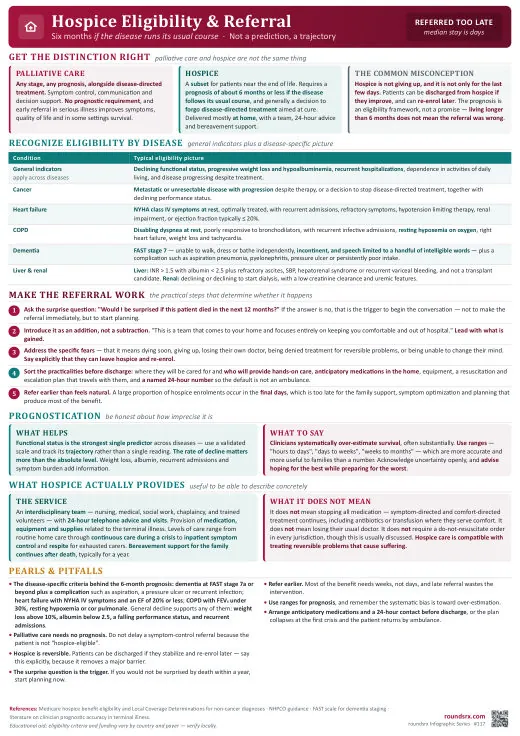
Text version
Palliative Care · One Pager
Hospice
Prognosis ≤ 6 months. Comfort-focused. Active symptom management + family support. Can be revoked if patient improves. Hospice ≠ giving up.
Eligibility
Prognosis ≤ 6 months (certified by 2 physicians). Patient elects comfort care. PPS ≤ 50%. Declining functional status, nutritional decline, recurrent hospitalizations. Disease-specific criteria exist.
Comfort Medications
Pain: morphine (first-line). Dyspnea: morphine + fan at face. Nausea: ondansetron, haloperidol. Secretions: glycopyrrolate/atropine drops. Agitation: haloperidol, lorazepam.
What to Stop
Statins, metformin, vitamins, screening tests, antihypertensives (unless symptomatic). Each med removed = reduced pill burden + side effects. Focus on comfort and quality of life.
Key Drugs
Morphine2-5 mg PO/SL q2-4h PRN
Lorazepam0.5-1 mg SL q4h PRN
Ondansetron4 mg q6h PRN
Glycopyrrolate0.2 mg SL q4h PRN
Pitfalls
- Hospice = giving up (it's active symptom management + support)
- Continuing aggressive meds that add no comfort benefit
- Not offering hospice early enough (many patients referred too late)
- Not supporting caregivers (burnout is real -hospice provides respite care)
Related Topics
Code Status & Advance DirectivesFamily Meeting FrameworkGoals of Care & Symptom ManagementNon-Opioid Symptom ManagementOpioid Rotation ConversionPalliative Extubation