Primary Aldosteronism
Primary aldosteronism (PA) is autonomous aldosterone production independent of the renin-angiotensin system. It is the most common cause of secondary hypertension, affecting 5-13% of all hypertensive patients and up to 20% of resistant HTN. Two main subtypes: bilateral adrenal hyperplasia (BAH, ~60%) and aldosterone-producing adenoma (APA / Conn's syndrome, ~35%). The distinction matters because APA is surgically curable while BAH is treated medically. Classic lab triad: hypertension + hypokalemia + metabolic alkalosis, but most patients are normokalemic (hypokalemia is present in only 30-50%). PA causes cardiovascular damage disproportionate to BP -higher rates of stroke, MI, AF, and HF than essential HTN at the same BP level, because aldosterone drives myocardial and vascular fibrosis directly, not just through the blood pressure. That is why finding it matters even when the BP looks controlled.
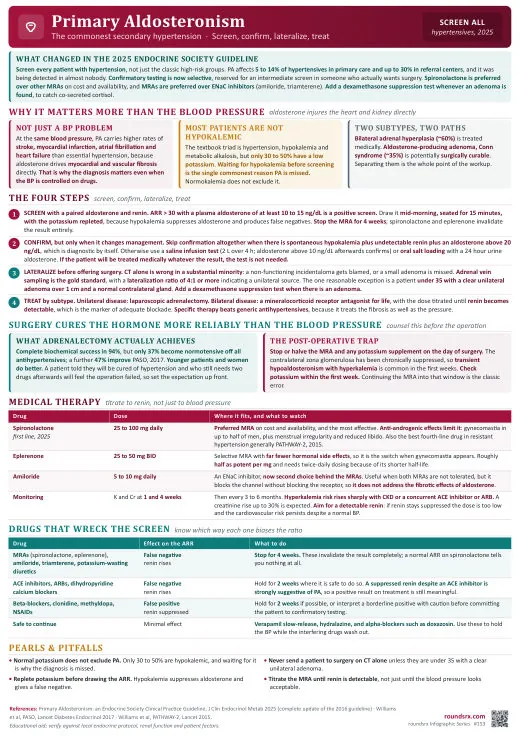
- Screen every patient with hypertension CHANGED 2025 -not only the high-risk groups below. 2016 restricted screening to resistant HTN, hypokalemia, adrenal incidentaloma, and early-onset or severe HTN. The rationale is that PA affects 5 to 14% of hypertensives in primary care and up to 30% in referral centers, and was being detected in almost nobody.
- Confirmatory testing is now selective CHANGED 2025 -reserved for an intermediate-probability screen in a patient who actually wants to pursue surgery. If the plan is medical therapy regardless, a suppression test rarely changes management.
- Spironolactone is preferred over other MRAs on cost and availability, and MRAs are preferred over ENaC inhibitors such as amiloride and triamterene NEW 2025.
- Add a dexamethasone suppression test when an adenoma is found NEW 2025, to detect co-secreted cortisol, which changes peri-operative steroid cover.
- Step 1 -Screening (ARR): Plasma aldosterone concentration (PAC) / plasma renin activity (PRA) = aldosterone-to-renin ratio. ARR > 30 with PAC ≥ 10-15 ng/dL = positive screen. Draw morning, seated, K⁺-repleted. Hold interfering medications: spironolactone × 6 weeks, eplerenone × 6 weeks, ACEi/ARB acceptable (may cause false negatives). Endocrine Society, 2016
- Who to screen: 2025: every patient with hypertension CHANGED. The highest-yield groups remain resistant HTN (≥ 3 drugs), HTN + hypokalemia (spontaneous or diuretic-induced), HTN + adrenal incidentaloma, HTN onset < 40, severe HTN (≥ 160/100), obstructive sleep apnea, atrial fibrillation out of proportion to risk factors, and a family history of early stroke or PA -so start there if you cannot screen everyone at once.
- Step 2 -Confirmatory test (suppress aldosterone), now selective: skip it entirely when there is spontaneous hypokalemia + undetectable renin + PAC > 20 ng/dL, which is diagnostic on its own, and skip it when the patient is going to be treated medically regardless. Reserve it for an intermediate screen in a surgical candidate.
- IV saline infusion test: 2L NS over 4h → measure PAC. If PAC > 10 ng/dL post-infusion = confirmed (aldosterone should suppress but doesn't).
- Oral salt loading: High-sodium diet × 3 days → 24h urine aldosterone. > 12 mcg/24h = confirmed.
- Fludrocortisone suppression test: Fludrocortisone 0.1 mg q6h × 4 days → PAC remains > 6. Most specific but rarely used (cumbersome, risk of hypokalemia).
- Step 3 -Subtype differentiation + localization:
- CT adrenals -look for unilateral adenoma (> 1 cm). BUT: CT is wrong 38% of the time (nonfunctioning incidentaloma mimics APA, or microadenoma is missed).
- Adrenal vein sampling (AVS) -gold standard to lateralize aldosterone production. Lateralization ratio ≥ 4:1 = unilateral source → surgery. Essential for ALL surgical candidates unless: age < 35 with clear > 1 cm unilateral adenoma + normal contralateral.
- Unilateral APA (Conn's): Laparoscopic adrenalectomy -biochemical cure in 94%, but only 37% become normotensive off all antihypertensives; another 47% improve PASO, 2017. Counsel the patient before surgery that the operation cures the hormone problem far more reliably than it cures the blood pressure. Pre-op: control BP and K⁺ with MRA (spironolactone or eplerenone). Post-op: monitor K⁺ (contralateral zona glomerulosa may be suppressed → transient hypoaldosteronism).
- Bilateral adrenal hyperplasia: Medical therapy with mineralocorticoid receptor antagonists (MRA):
- Spironolactone 25-100 mg daily -most effective MRA. Anti-androgenic side effects: gynecomastia (up to 50% in men), menstrual irregularity, decreased libido. PATHWAY-2, 2015
- Eplerenone 25-50 mg BID -selective MRA with far fewer anti-androgenic effects, so it is the switch when gynecomastia appears. Roughly half as potent per mg, and it must be dosed twice daily because of its shorter half-life.
- Adjunct: Sodium restriction (< 2g/day), additional antihypertensives as needed (CCB, thiazide)
- Monitoring K⁺ on MRA: Hyperkalemia risk, especially with CKD or ACEi/ARB combo. Check K⁺ + Cr at 1 week, 4 weeks, then q3-6 months.
| Setting | What to check, and when | Why |
|---|---|---|
| Starting or uptitrating an MRA | K⁺ and creatinine at 1 week and 4 weeks, then every 3 to 6 months once stable | MRAs cause hyperkalemia, and the risk multiplies with CKD or a concurrent ACE inhibitor or ARB. A creatinine rise of up to 30% is expected as the hyperfiltration comes off. |
| After adrenalectomy | K⁺ and BP within the first week; stop or halve the MRA and potassium supplements on the day of surgery | The contralateral zona glomerulosa has been chronically suppressed, so transient hypoaldosteronism with hyperkalemia is common in the first weeks. Continuing the MRA into that window is the classic post-op error. |
| Cure assessment | Renin and aldosterone at 3 months, with BP and drug count | Use the PASO definitions: biochemical cure is the rule, clinical cure is not. A persistently suppressed renin suggests residual disease. |
| On long-term medical therapy | Renin should become detectable, plus BP and K⁺ | An unsuppressed renin indicates adequate mineralocorticoid receptor blockade. If renin stays suppressed the dose is too low, and the cardiovascular risk of aldosterone excess persists even with a normal BP. |
| Drug | Dose | Route | Notes |
|---|---|---|---|
| Spironolactone (Aldactone) | 25-100 mg daily | PO | First-line MRA. Most effective for PA. Anti-androgenic SE (gynecomastia 50%, sexual dysfunction). Monitor K⁺. PATHWAY-2, 2015 |
| Eplerenone (Inspra) | 50-100 mg BID | PO | Selective MRA. Fewer hormonal SE. More expensive. May need higher doses than spironolactone. |
| Amiloride | 5-10 mg daily | PO | Alternative for K⁺-sparing if MRA intolerance. Less effective for BP lowering than spironolactone. |
| Nifedipine (Procardia) | 30-60 mg daily | PO | Add-on antihypertensive. Does not interfere with ARR screening. |
Patient: 44M with resistant HTN (BP 162/98 on 3 drugs) and recurrent hypokalemia (K⁺ 2.8 despite 80 mEq KCl daily). PAC 32 ng/dL, PRA 0.2, ARR 160. Saline infusion: PAC 22 (failed suppression). CT: 1.8 cm left adrenal adenoma.
Key findings: Confirmed primary aldosteronism, positive screen (ARR > 30) and positive confirmatory test (saline-suppressed PAC > 10). CT shows unilateral adenoma but CT is wrong 38% of the time.
Management:
- Adrenal vein sampling (AVS), mandatory before surgery (CT misidentifies lateralization in 38%)
- Start spironolactone 50 mg daily while awaiting AVS (treats HTN + replaces K⁺)
- If AVS lateralizes left → laparoscopic left adrenalectomy (cure rate 50-60% for HTN, ~100% for hypokalemia)
- Hold ACEi/ARB 4 weeks before AVS (interfere with renin/aldo ratio)
- Post-op: monitor for hyperkalemia (suppressed contralateral zona glomerulosa takes weeks to recover)
Teaching point: Never skip AVS based on CT alone. A 1.8 cm "adenoma" may be a non-functioning incidentaloma, with the real source being bilateral hyperplasia. AVS changes management in 38% of cases.
Patient: 56F with resistant HTN (4 drugs), K⁺ 3.2 on supplementation. PAC 24, PRA 0.4, ARR 60. Saline infusion: PAC 14. CT: bilateral adrenal limb thickening. AVS: no lateralization (bilateral aldosterone excess).
Key findings: Bilateral idiopathic hyperaldosteronism (IHA), accounts for ~60% of PA. Surgery not curative (bilateral process). Medical management is definitive therapy.
Management:
- Spironolactone 25-50 mg daily, titrate to BP and K⁺ (first-line MRA for PA)
- If gynecomastia/breast tenderness → switch to eplerenone 50 mg BID (selective MRA, fewer anti-androgenic effects)
- Target BP < 130/80, K⁺ 4.0-5.0
- Low-sodium diet (< 2g Na/day), amplifies MRA efficacy
- Monitor Cr and K⁺ at 1 week, 4 weeks, then q3-6 months (MRA can cause hyperkalemia especially with CKD)
Teaching point: Bilateral hyperplasia is more common than adenoma. These patients are managed medically for life. Spironolactone is preferred (more potent) but eplerenone avoids anti-androgen side effects in men.
Patient: 52M with resistant HTN (BP 154/92 on amlodipine, losartan, chlorthalidone). K⁺ consistently 3.8-4.0 (normal). Screened because of resistant HTN. PAC 18 ng/dL, PRA 0.3, ARR 60.
Key findings: Normokalemic PA, up to 50% of PA patients are normokalemic. Hypokalemia is neither sensitive nor specific for PA. Endocrine Society recommends screening all patients with resistant HTN.
Management:
- Confirm with saline infusion test or fludrocortisone suppression test
- Hold interfering medications before testing: spironolactone (6 weeks), ACEi/ARB (2 weeks), dihydropyridine CCB and alpha-blockers are allowed during testing
- If confirmed: CT adrenals → AVS if surgical candidate
- Start MRA therapy, many "resistant HTN" patients become controlled once PA is treated
- PA may explain 5-10% of all HTN and 20% of resistant HTN
Teaching point: Normal potassium does NOT rule out PA. The classic teaching "hypokalemia = think aldosteronism" misses half of cases. Screen based on resistant HTN, not potassium level.
Mr. Kim is a 48-year-old man with resistant hypertension (amlodipine 10, lisinopril 40, HCTZ 25 -BP 158/96) and persistent hypokalemia (K⁺ 3.0 despite supplementation). BMI 28. No secondary HTN features on exam. Labs: PAC 28 ng/dL, PRA 0.3 ng/mL/hr, ARR 93. Confirmatory: saline infusion PAC 18 ng/dL (failed suppression). CT adrenals: 1.4 cm left adrenal adenoma.
- K⁺ + Cr at 1 week, 4 weeks, then q3-6 months on MRA -hyperkalemia risk (especially with CKD, ACEi/ARB)
- BP -target < 130/80. Most patients need additional antihypertensives besides MRA.
- ARR is NOT useful for monitoring -it's only a screening test. Follow clinical endpoints (BP, K⁺).
- Post-adrenalectomy: Check K⁺ and aldosterone at 1 month. Expect transient hyperkalemia (suppressed contralateral adrenal). Hold MRA. Resume antihypertensives only if BP remains elevated.
- Annual cardiovascular risk assessment -PA causes disproportionate end-organ damage. Screen for AF, LVH (echo), proteinuria.