Hypercalcemia of Malignancy
| Mechanism | Frequency | Associated Cancers | Key Lab Finding |
|---|---|---|---|
| PTHrP (Humoral) | ~80% | Squamous cell carcinomas (lung, H&N), renal cell, breast, bladder | PTHrP elevated, PTH suppressed, PO₄ low |
| Osteolytic metastases | ~20% | Breast cancer, multiple myeloma | PTHrP normal, local cytokine release (RANKL, IL-6) |
| 1,25-dihydroxyvitamin D | < 1% | Lymphoma (Hodgkin and non-Hodgkin) | 1,25-vit D elevated (tumor-produced 1-alpha hydroxylase) |
| Ectopic PTH | Very rare | Ovarian, lung small cell (rare) | PTH elevated (from tumor) |
- Stones: Nephrolithiasis, nephrocalcinosis, polyuria (nephrogenic DI from Ca²⁺ → impaired ADH response)
- Bones: Bone pain, pathologic fractures, osteoporosis
- Groans: Abdominal pain, constipation, nausea, vomiting, pancreatitis (rare)
- Psychiatric moans: Confusion, lethargy, depression, psychosis, coma
- Cardiac: Shortened QT interval, bradycardia, AV block (severe)
- Renal: Polyuria → dehydration → worsening hypercalcemia (vicious cycle)
| Severity | Corrected Ca²⁺ | Approach |
|---|---|---|
| Mild | 10.5–12.0 mg/dL | Oral hydration, monitor, treat underlying malignancy |
| Moderate | 12.0–14.0 mg/dL | IV fluids ± calcitonin + bisphosphonate |
| Severe / Symptomatic | > 14.0 mg/dL or symptomatic | Aggressive IV fluids + calcitonin + bisphosphonate. May need ICU. |
| Step | Intervention | Onset | Details |
|---|---|---|---|
| Step 1: IV NS | Normal Saline 200–300 mL/hr | Immediate | Most patients are severely volume-depleted from hypercalcemia-induced nephrogenic DI (polyuria + poor PO intake). This alone drops Ca by 1–2 mg/dL. Goal: restore euvolemia and enhance renal calcium excretion. |
| Step 2: Calcitonin | Calcitonin (Miacalcin) 4 IU/kg SQ/IM q12h | 4–6 hours | Bridge therapy -works FAST but tachyphylaxis by 48h (receptors downregulate). Drops Ca by ~1–2 mg/dL. Mild side effect: flushing, nausea. Used while waiting for bisphosphonate to kick in. |
| Step 3: Bisphosphonate | Zoledronic acid (Zometa) 4 mg IV over 15 min | 2–4 DAYS | Definitive treatment. Inhibits osteoclast-mediated bone resorption. Effect lasts weeks. Check Cr first -reduce dose if CrCl < 60. Alternative: pamidronate 60–90 mg IV over 2–4h (slower infusion, may be better in renal impairment). |
| Step 4 (Refractory) | Denosumab (Xgeva) 120 mg SQ | Days | For bisphosphonate-refractory hypercalcemia. RANKL inhibitor. Works even in renal failure (not renally cleared, unlike bisphosphonates). Dose on days 1, 8, 15, 29, then monthly. |
- Lymphoma (1,25-vit D mediated): Glucocorticoids (dexamethasone 4 mg IV q6h or equivalent) are effective -they inhibit 1-alpha hydroxylase in tumor cells and decrease 1,25-vit D production.
- Multiple myeloma: Bisphosphonates are standard (both for hypercalcemia and skeletal events). Zoledronic acid or pamidronate.
- Dialysis: If refractory or anuric, hemodialysis with low-calcium dialysate can rapidly lower calcium.
- Corrected calcium = measured Ca + 0.8 × (4.0 − albumin). Or check ionized calcium (more accurate, not affected by albumin).
- PTH -should be SUPPRESSED (< 20 pg/mL) in malignancy. If PTH is elevated → think primary hyperparathyroidism (even in cancer patients -can coexist).
- PTHrP -elevated in humoral hypercalcemia of malignancy (80% of cases). Order if PTH suppressed.
- 1,25-dihydroxyvitamin D -elevated in lymphoma. Order if PTHrP is normal and PTH is suppressed.
- 25-hydroxyvitamin D -to rule out exogenous vitamin D toxicity.
- Phosphate -low in PTHrP-mediated (PTHrP causes renal phosphate wasting, same as PTH).
- BMP -Cr (renal function), K⁺, Mg²⁺.
- ECG -shortened QT interval is the classic finding. Also watch for bradycardia, AV block.
- SPEP/UPEP -if myeloma suspected.
| Drug | Dose | Onset | Duration | Key Notes |
|---|---|---|---|---|
| Normal Saline | 200–300 mL/hr | Immediate | During infusion | First-line. Volume expansion + calciuresis. Drops Ca ~1–2 mg/dL. Watch for volume overload. |
| Calcitonin (Miacalcin) | 4 IU/kg SQ/IM q12h | 4–6 hours | 48h (tachyphylaxis) | Bridge only. Drops Ca ~1–2 mg/dL. Safe but temporary. Tachyphylaxis limits use beyond 48h. |
| Zoledronic acid (Zometa) | 4 mg IV over 15 min | 2–4 days | Weeks | Definitive treatment. Check CrCl -reduce dose if < 60. Risk: osteonecrosis of jaw (rare), renal toxicity. |
| Pamidronate | 60–90 mg IV over 2–4h | 2–4 days | Weeks | Alternative to zoledronic acid. Longer infusion but may be better tolerated in renal impairment. |
| Denosumab (Xgeva) | 120 mg SQ | Days | Weeks | Bisphosphonate-refractory cases. RANKL inhibitor. Works in renal failure. Risk: hypocalcemia, ONJ. |
| Glucocorticoids | Dexa 4 mg IV q6h | Days | During treatment | Effective for lymphoma and granulomatous disease (1,25-vit D mediated). Not effective for PTHrP-mediated. |
Patient: 62M with 30-pack-year smoking history. Confusion, polyuria, constipation. Ca 15.2, PTH < 5, PTHrP 14.8 pmol/L (elevated). CT chest: 5 cm RUL mass with hilar LAD. Cr 2.1.
Key findings: Severe hypercalcemia of malignancy via PTHrP from probable squamous cell lung cancer. Suppressed PTH confirms non-parathyroid etiology. Dehydration worsening renal function.
Management:
- NS 200-300 mL/hr (aggressive rehydration, these patients are profoundly volume-depleted)
- Calcitonin 4 IU/kg SQ q12h (bridge, works within hours but tachyphylaxis by 48h)
- Zoledronic acid 4 mg IV over 15 min (definitive, onset 2-4 days, lasts 2-4 weeks)
- No furosemide unless volume overloaded (old teaching of "lasix for hypercalcemia" is outdated and harmful in dehydrated patients)
- Oncology consult for biopsy and staging of lung mass
Teaching point: Calcitonin is a bridge, not a treatment. Its effect wears off in 48h due to receptor tachyphylaxis. Zoledronic acid is the definitive agent but takes 2-4 days, hence the bridge strategy.
Patient: 71F with metastatic breast cancer. Ca 17.8, Cr 4.2 (baseline 1.0), AMS. PTH < 3. No urine output × 6h despite 2L NS bolus. ECG: short QT.
Key findings: Life-threatening hypercalcemia with oliguric AKI. Bisphosphonates relatively contraindicated at CrCl < 30. Need alternative approach.
Management:
- Continue aggressive IVF, target UOP > 200 mL/hr if achievable
- Calcitonin 4 IU/kg SQ q12h (immediate bridge)
- Denosumab 120 mg SQ (not renally cleared, safe in renal failure, preferred over zoledronic acid here)
- If refractory: emergent hemodialysis with low-calcium dialysate (can drop Ca 3-4 mg/dL per session)
- Telemetry monitoring, QT shortening, arrhythmia risk at Ca > 14
Teaching point: Denosumab is the rescue agent when bisphosphonates are contraindicated (renal failure) or have failed. Key risk: rebound hypercalcemia if stopped abruptly, always plan for ongoing dosing or transition.
Patient: 38F with known sarcoidosis. Ca 12.6, PTH 6 (suppressed), PTHrP normal, 1,25-dihydroxy vitamin D 88 pg/mL (elevated), 25-OH vitamin D 22 (normal). Bilateral hilar LAD on CXR.
Key findings: Granulomatous hypercalcemia, activated macrophages in granulomas express 1-alpha-hydroxylase, converting 25-OH vitamin D → 1,25-dihydroxy vitamin D (calcitriol) autonomously. Not PTH-driven.
Management:
- IV hydration (NS 150-200 mL/hr)
- Prednisone 20-40 mg daily (first-line, glucocorticoids inhibit 1-alpha-hydroxylase in macrophages)
- Expect calcium normalization within 3-5 days of steroids
- Avoid vitamin D supplementation and excessive sun exposure (fuel the pathway)
- Treat underlying sarcoidosis per pulmonology
Teaching point: Granulomatous hypercalcemia (sarcoidosis, TB, fungal) responds to glucocorticoids because steroids suppress macrophage 1-alpha-hydroxylase. This is the one form of hypercalcemia where steroids are first-line, not bisphosphonates.
| Parameter | Frequency | Target / Action |
|---|---|---|
| Ionized calcium or corrected Ca | q6–8h until stable | Trend toward normalization. Recheck 2–4 days after bisphosphonate. |
| BMP (Cr, K⁺, Mg²⁺, PO₄) | q12h initially | Cr for AKI/renal recovery. Watch for hypokalemia, hypomagnesemia, hypophosphatemia with fluids. |
| Fluid balance / I&Os | Strict | Maintain euvolemia. Aggressive IVF but watch for volume overload (especially if cardiac history). |
| ECG | Admission + PRN | Shortened QT, bradycardia, AV block. |
| Mental status | q shift | Improvement in confusion/lethargy as calcium normalizes. |
| Parameter | Frequency | Target / Action |
|---|---|---|
| Vitals | q4h floor, q1–2h ICU | HR, BP, RR, SpO₂, Temp -notify for significant deviations |
| Labs (BMP, CBC) | Daily AM or as indicated | Trend Cr, K⁺, WBC, Hgb -adjust treatment based on trajectory |
| Disease-specific markers | Per clinical context | See Overview and Management tabs for condition-specific targets |
| I&Os | Strict if volume-sensitive | UOP ≥ 0.5 mL/kg/hr. Net fluid balance guides diuresis or resuscitation. |
| Telemetry | Continuous if indicated | Arrhythmia detection. Discontinue when no longer indicated (reduces alarm fatigue). |
| Clinical response | Each assessment | Symptom improvement, functional status, appetite, mental status -the exam matters more than labs |
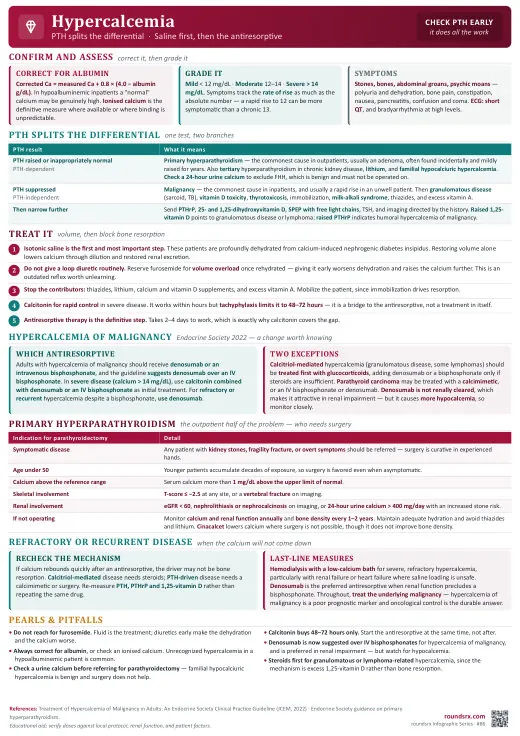
Text version
- PTHrP, humoral (~80%), in squamous cell carcinomas (lung, head and neck), renal cell, breast, bladder. PTHrP elevated, PTH suppressed, phosphate LOW, because PTHrP causes renal phosphate wasting exactly as PTH does.
- Osteolytic metastases (~20%), in breast cancer and multiple myeloma. PTHrP is normal here: calcium comes from local cytokine release (RANKL, IL-6) dissolving bone directly, which is why bone-directed therapy is the answer.
- 1,25-dihydroxyvitamin D mediated (< 1%), in lymphoma (Hodgkin and non-Hodgkin). Tumor cells make their own 1-alpha hydroxylase, so 1,25-vitamin D is elevated. This is the subtype that responds to steroids.
- Ectopic PTH (very rare), ovarian and small cell lung. PTH is elevated because the tumor itself secretes it, the one malignant mechanism that breaks the "PTH is suppressed" rule.
- Why the mechanism matters: it decides whether the definitive drug is a bisphosphonate, denosumab, or a glucocorticoid.
- Stones: nephrolithiasis, nephrocalcinosis, and polyuria from a nephrogenic DI (calcium impairs the renal response to ADH).
- Bones: bone pain, pathologic fractures, osteoporosis.
- Groans: abdominal pain, constipation, nausea, vomiting, rarely pancreatitis.
- Psychiatric moans: confusion, lethargy, depression, psychosis, coma.
- Cardiac: shortened QT interval (the classic ECG finding), bradycardia, AV block when severe.
- The vicious cycle: polyuria causes dehydration, dehydration reduces renal calcium clearance, calcium climbs further. This is why volume comes first in treatment.
- Mild, corrected Ca 10.5-12.0: oral hydration, monitor, treat the underlying malignancy.
- Moderate, 12.0-14.0: IV fluids ± calcitonin plus a bisphosphonate.
- Severe, > 14.0 or symptomatic: aggressive IV fluids plus calcitonin plus bisphosphonate; may need ICU.
- Ionized or corrected calcium q6-8h until stable, then recheck 2-4 days after the bisphosphonate, which is when it actually starts working and when you decide whether denosumab is needed.
- BMP q12h initially: creatinine for AKI and renal recovery, and watch for the hypokalemia, hypomagnesemia, and hypophosphatemia that aggressive fluids produce.
- Strict intake and output. You are deliberately running fluids hard, so volume overload is the predictable complication, especially with cardiac history.
- ECG on admission and PRN: shortened QT, bradycardia, and AV block are the arrhythmia signals, and the risk rises above a calcium of 14.
- Mental status each shift. Clearing confusion is the clinical endpoint that tells you the number is translating into benefit.
- Corrected calcium = measured Ca + 0.8 × (4.0 − albumin), or use ionized calcium, which albumin does not distort.
- Reaching for furosemide. Outdated teaching: it does not meaningfully lower calcium and it deepens the dehydration that caused the hypercalcemia. Only for true volume overload.
- Treating calcitonin as the therapy. Tachyphylaxis at 48h means the calcium rebounds unless a bisphosphonate or denosumab was started alongside it on day one.
- Giving zoledronic acid without checking renal function. Reduce the dose if CrCl < 60, and reach for denosumab instead when the kidney is failing.
- Stopping denosumab abruptly. Rebound hypercalcemia follows; always plan ongoing dosing or a deliberate transition.
- Assuming every hypercalcemia in a cancer patient is paraneoplastic. If PTH is elevated, think primary hyperparathyroidism, which can coexist with malignancy and needs an entirely different workup.
- Giving steroids for PTHrP-mediated hypercalcemia. They only work when the driver is tumor or macrophage 1,25-vitamin D production.
- Expecting a bisphosphonate to work overnight. Onset is 2-4 days, which is the entire reason the calcitonin bridge exists.
- Lymphoma (1,25-vitamin D mediated): glucocorticoids, dexamethasone 4 mg IV q6h or equivalent, because they inhibit 1-alpha hydroxylase in the tumor cells and shut off calcitriol production at the source.
- Granulomatous disease (sarcoidosis, TB, fungal): prednisone 20-40 mg daily is first-line, since activated macrophages in granulomas autonomously convert 25-OH vitamin D to calcitriol. Expect normalization within 3-5 days, and avoid vitamin D supplements and heavy sun exposure, which fuel the pathway. This is the one form of hypercalcemia where steroids beat bisphosphonates.
- Multiple myeloma: bisphosphonates are standard, treating both the hypercalcemia and the skeletal-related events. Zoledronic acid or pamidronate.
- Refractory or anuric: hemodialysis with low-calcium dialysate rapidly lowers calcium, dropping it 3-4 mg/dL per session when fluids are not an option.
- Corrected or ionized calcium first, to confirm the calcium is genuinely high and not an albumin artifact.
- PTH: should be SUPPRESSED (< 20 pg/mL) in malignancy, because high calcium feeds back on the parathyroid calcium-sensing receptor and the glands respond appropriately. An elevated PTH points to primary hyperparathyroidism instead.
- PTHrP next if PTH is suppressed, since it is the mechanism in 80% of cases.
- 1,25-dihydroxyvitamin D if PTHrP is normal and PTH is suppressed, which identifies the lymphoma and granulomatous group that needs steroids.
- 25-hydroxyvitamin D to rule out exogenous vitamin D toxicity as the cause.
- Phosphate: low in PTHrP-mediated disease, because PTHrP wastes phosphate at the kidney just as PTH does.
- BMP for creatinine, K⁺, and Mg²⁺; ECG for the shortened QT; SPEP/UPEP if myeloma is suspected.