Hypercalcemia
"Stones, bones, groans, thrones, and psychiatric overtones." Corrected Ca > 10.5 mg/dL. 90% caused by primary hyperparathyroidism or malignancy. Aggressive IVF is the first treatment for everything -then target the cause.
🔍 Overview
Severity
| Level | Corrected Ca | Symptoms |
|---|---|---|
| Mild | 10.5–12 mg/dL | Often asymptomatic. Fatigue, constipation. |
| Moderate | 12–14 mg/dL | Polyuria, polydipsia, nausea, constipation, confusion, short QT on ECG. |
| Severe (hypercalcemic crisis) | > 14 mg/dL | AMS, stupor, coma, cardiac arrhythmias (short QT → Osborn waves → cardiac arrest), AKI, pancreatitis. |
Always correct for albumin: Corrected Ca = measured Ca + 0.8 × (4.0 − albumin). Or check ionized calcium (more accurate, especially in ICU patients).
Differential -The Two Big Ones
| Cause | % of Cases | PTH | Key Features |
|---|---|---|---|
| Primary hyperparathyroidism | ~55% (most common overall, #1 outpatient cause) | ↑ or inappropriately normal | Usually mild, chronic. Single adenoma (~85%). ↑ Ca, ↓ PO₄, ↑ urine Ca. Stones, osteoporosis. |
| Malignancy | ~35% (#1 inpatient cause) | ↓ (suppressed) | Usually severe, acute onset. Mechanisms: PTHrP secretion (squamous cell, RCC, breast → humoral hypercalcemia of malignancy), osteolytic metastases (breast, myeloma), calcitriol production (lymphoma). |
| Other (~10%) | Variable | Granulomatous disease (sarcoid → ↑ calcitriol), thiazides, lithium, vitamin D intoxication, milk-alkali syndrome, immobilization, thyrotoxicosis, Addison disease. |
First lab after finding hypercalcemia: PTH. PTH high or normal → primary hyperparathyroidism. PTH low → malignancy or other cause → check PTHrP, vitamin D levels (25-OH and 1,25-OH), SPEP/UPEP.
🥛 Milk-Alkali Syndrome
Classic triad: hypercalcemia + metabolic alkalosis + AKI from excess calcium-containing alkali ingestion. Third most common cause of hypercalcemia in hospitalized patients (after malignancy and primary hyperparathyroidism), and easy to miss because patients describe their calcium carbonate as "antacids" or "Tums" rather than calcium.
Modern setup
Elderly woman taking calcium carbonate (Tums, OsCal, Caltrate) for osteoporosis or GERD, often > 5 g/day elemental calcium. Co-factors that tip her over: thiazide (reduces Ca excretion), volume depletion (NSAIDs, loop diuretics, GI loss), CKD, vitamin D supplementation. Modern incidence rose with widespread OTC calcium use; the historical 1920s "milk + bicarbonate for peptic ulcers" recipe is mostly extinct.
Mechanism (vicious cycle)
- High oral Ca and alkali load → mild hypercalcemia + alkalosis.
- Hypercalcemia causes renal vasoconstriction and nephrogenic DI → volume depletion → AKI.
- AKI prevents the kidney from excreting the alkali load → alkalosis worsens.
- Alkalosis further reduces urinary Ca excretion → hypercalcemia worsens.
- Loop continues until the calcium source is removed.
Distinguishing labs (PTH suppressed)
| Lab | Milk-alkali | vs Primary HPT | vs Malignancy |
|---|---|---|---|
| PTH | Low (suppressed by hyperCa) | High or inappropriately normal | Low (suppressed) |
| PTHrP | Normal | Normal | Often high (humoral hyperCa of malignancy) |
| Phosphate | Normal to high | Low (PTH wastes PO4) | Variable |
| HCO3- | Elevated (metabolic alkalosis) | Normal or mildly low (hyperchloremic acidosis) | Normal |
| Creatinine | Elevated (AKI is part of the triad) | Often normal | Variable |
| 25-OH / 1,25-OH vit D | Normal (unless coingested) | Variable | 1,25 elevated in lymphoma and granulomatous disease |
Treatment
- Stop the calcium and alkali source immediately. Most cases resolve in 2–7 days.
- IV NS 200–500 mL/hr to restore volume and enhance Ca excretion.
- Avoid bisphosphonates in most cases. Bone turnover is already suppressed (no osteoclast-driven hyperCa to block), and there is real risk of rebound hypocalcemia once renal Ca handling recovers. Reserve for severe or refractory hypercalcemia.
- Hold thiazides (reduce Ca excretion) and any vitamin D supplements.
- Dialysis only if severe AKI with refractory hypercalcemia.
- Counsel patient and family on safe calcium dosing (target < 1500 mg/day elemental Ca, with food, and separated from PPI).
Boards bait: Elderly woman, calcium carbonate for osteoporosis or "indigestion," now with confusion and AKI. PTH suppressed, phosphate normal-to-high, HCO3- elevated. Don't reach for bisphosphonates. Stop the Tums.
🚨 Management
Acute Hypercalcemia Treatment
| Step | Drug | Dose | Onset | Notes |
|---|---|---|---|---|
| 1. Volume | IV NS FIRST | 200–500 mL/hr (aggressive -these patients are volume-depleted from hypercalcemia-induced nephrogenic DI) | Hours | Always start here. Volume expansion enhances renal Ca excretion. Target UOP 200–300 mL/hr. Most patients need 3–6 L in first 24h. |
| 2. Calcitonin | Calcitonin (Miacalcin) | 4 IU/kg SC/IM q12h | 4–6 hours | Fastest onset. Inhibits osteoclasts + enhances renal Ca excretion. Effect is modest (↓ Ca by 1–2 mg/dL) and tachyphylaxis within 48h (receptors downregulate). Bridge to bisphosphonate. |
| 3. Bisphosphonate | Zoledronic acid (Zometa) MOST EFFECTIVE | 4 mg IV over 15 min | 2–4 days | Potent osteoclast inhibitor. Best for malignancy-associated hypercalcemia. Effect lasts 2–4 weeks. Nephrotoxic -hold if Cr > 4.5. Alternative: pamidronate 60–90 mg IV over 2–4h. |
| 4. Denosumab | Denosumab (Xgeva) | 120 mg SC | 4–10 days | RANKL inhibitor. Use if bisphosphonate-refractory or CKD (not renally cleared). Risk: severe rebound hypercalcemia when stopped. |
| Steroids | Hydrocortisone (Solu-Cortef) 200 mg IV/day | As needed | Days | Specific indications: granulomatous disease (sarcoid → steroids ↓ calcitriol production), lymphoma, vitamin D intoxication, myeloma. Ineffective for PTH-mediated or most solid tumor hypercalcemia. |
| Dialysis | Hemodialysis with low-Ca bath | Emergent | Immediate | Last resort for severe (> 18 mg/dL), symptomatic, refractory, or with AKI preventing bisphosphonate use. |
Furosemide for hypercalcemia is largely obsolete. Old teaching was "saline + Lasix." Current evidence: loop diuretics only help if the patient is volume-overlo
🧪 Workup
Workup
- PTH -the single most important test. Elevated/inappropriately normal = PTH-mediated (primary hyperparathyroidism 90%). Suppressed = PTH-independent (malignancy, granulomatous, vitamin D).
- PTHrP -if PTH suppressed. Humoral hypercalcemia of malignancy (squamous cell lung, renal, breast). Elevated in ~80% of malignancy-associated hypercalcemia.
- 25-OH vitamin D -exogenous vitamin D toxicity
- 1,25-dihydroxy vitamin D -elevated in granulomatous disease (sarcoidosis, TB, histoplasmosis, lymphoma) -macrophage 1α-hydroxylase activity. Normal PTH, suppressed PTHrP.
- SPEP/UPEP + free light chains -multiple myeloma (osteolytic lesions → calcium release). Must check in unexplained hypercalcemia, especially with bone pain + anemia + renal failure.
- Corrected calcium = measured Ca + 0.8 × (4 − albumin). Or use ionized calcium (more accurate, not affected by albumin).
- ECG -shortened QT interval. Severe: Osborn waves, bradycardia, heart block.
- Cr + BUN -hypercalcemia causes nephrogenic DI → dehydration → prerenal AKI (most patients are significantly volume-depleted)
- Phosphorus -low in hyperPTH (PTH causes phosphaturia). High in vitamin D toxicity, granulomatous disease, tumor lysis.
💊 Medications
Medications
| Drug | Dose | Route | Notes |
|---|---|---|---|
| Normal saline | 200-300 mL/hr | IV | FIRST and most important step. Most patients 3-6L depleted from hypercalcemia-induced nephrogenic DI. Restores GFR → renal calcium excretion. |
| Calcitonin | Endocrine Society, 2014 4 IU/kg IM/SQ q12h | IM/SQ | Fast onset (4-6h). Bridges to bisphosphonate effect. Modest drop (~1-2 mg/dL). Tachyphylaxis at 48h -stop after 2 days. |
| Zoledronic acid | Zoledronic Acid Hypercalcemia Trial, 2001 4 mg IV over 15 min | IV | Most potent long-term treatment. Onset 2-4 days, peak 4-7 days, lasts weeks. Avoid if CrCl < 35 (use denosumab instead). Monitor for osteonecrosis of jaw (rare). |
| Denosumab | Denosumab Hypercalcemia Trial, 2014 120 mg SQ | SQ | RANKL inhibitor. Use if renal impairment (not renally cleared) or bisphosphonate failure. Risk of severe rebound hypercalcemia if stopped. |
| Prednisone | 20-40 mg daily | PO | Granulomatous disease and lymphoma ONLY. Blocks 1α-hydroxylase in macrophages. NOT effective for PTH-mediated or PTHrP-mediated. |
| Cinacalcet | 30 mg BID | PO | Calcimimetic for primary hyperPTH (if not surgical candidate). Also parathyroid carcinoma. Lowers PTH → lowers Ca. |
| Furosemide (Lasix) | 20-40 mg IV PRN | IV | ONLY after adequate hydration. Calciuresis. Do NOT give to dehydrated patient -worsens hypercalcemia. |
📋 On Rounds
How do you distinguish hyperparathyroidism from malignancy as the cause?
PTH level. In primary hyperparathyroidism, PTH is elevated or inappropriately normal (should be suppressed by high calcium but isn't -the parathyroid adenoma is autonomously producing PTH). In malignancy, PTH is suppressed (low) because the hypercalcemia is driven by PTHrP, osteolytic metastases, or calcitriol -all of which suppress normal PTH via negative feedback.
Why does calcitonin lose effectiveness after 48 hours?
Tachyphylaxis from receptor downregulation. Calcitonin binds osteoclast calcitonin receptors, inhibiting bone resorption. With sustained exposure (> 48h), osteoclasts internalize and downregulate their calcitonin receptors -they become resistant to the drug. The clinical effect fades and calcium starts rising again. This is why calcitonin is a bridge agent -its fast onset (4–6h)
Why is furosemide no longer recommended for hypercalcemia treatment?
Old teaching: "NS + Lasix for hypercalcemia" -the idea was furosemide blocks calcium reabsorption in the Loop of Henle (calciuresis). Current evidence: furosemide is NOT recommended unless the patient is volume overloaded. Reasons: (1) Most hypercalcemia patients are severely volume depleted (hypercalcemia → nephrogenic DI → polyuria → dehydration). Giving furosemide before adequate volume repletion worsens dehydration → worsens hypercalcemia.
What is the approach to determining the etiology of hypercalcemia?
PTH is the branch point. Check PTH first. PTH elevated (or inappropriately normal): primary hyperparathyroidism (#1 cause of hypercalcemia in outpatients). Rarely: familial hypocalciuric hypercalcemia (FHH -check 24h urine calcium: FHH has low urine Ca, PHPT has high urine Ca), lithium-induced, parathyroid carcinoma. PTH suppressed (< 20): non-PTH-mediated.
What is the single most important test in the workup of hypercalcemia?
PTH. It's the diagnostic branch point. Elevated/normal PTH = PTH-mediated (90% primary hyperparathyroidism). Suppressed PTH = malignancy, granulomatous disease, or vitamin D toxicity.
Why should you NOT give furosemide as initial treatment for hypercalcemia?
Most patients are severely dehydrated from hypercalcemia-induced nephrogenic diabetes insipidus. Furosemide in a dehydrated patient worsens volume depletion and hypercalcemia. Rehydrate with NS first, then furosemide only if volume-overloaded.
A patient with sarcoidosis has hypercalcemia. Which medication treats it and why?
Prednisone -sarcoid macrophages express 1α-hydroxylase that converts 25-OH vitamin D to active 1,25-dihydroxy vitamin D. Steroids suppress this enzyme. Bisphosphonates are less effective because the mechanism is vitamin D-mediated, not bone resorption.
Why does calcitonin have tachyphylaxis at 48 hours?
Calcitonin receptors on osteoclasts become downregulated after 48h of continuous exposure. The Ca-lowering effect wanes. It's used only as a bridge while waiting for zoledronic acid to take effect (onset 2-4 days).
📣 Sample Presentation
One-Liner
"Mrs. Taylor is a 72-year-old with metastatic breast cancer presenting with confusion, constipation, and polyuria. Ca²⁺ 14.8 (corrected for albumin). PTH suppressed at 8. PTHrP pending."
Key Points to Cover on Rounds
Hypercalcemia of malignancy (PTH suppressed → not primary hyperparathyroidism). Most likely humoral hypercalcemia (PTHrP secretion from breast cancer). Treatment initiated: (1) NS at 250 mL/hr (volume expansion -first priority), (2) calcitonin 4 IU/kg IM q12h (fast onset, bridges to zoledronic acid, tachyphylaxis at 48h), (3) zoledronic acid 4 mg IV over 15 min (most effective long-term, onset 2-4 days). No furosemide unless volume overloaded. Ca trending 14.8→13.2→11.4 over 48h. Plan: oncology for disease-directed therapy, repeat Ca in 48h, denosumab if bisphosphonate fails.
Monitoring
- Ionized calcium q6-12h during active treatment (more accurate than corrected Ca in critical illness, hypoalbuminemia, acid-base disorders)
- BMP q12-24h -Cr (renal function during aggressive hydration), K⁺, Mg²⁺ (calcitonin can cause hypokalemia/hypomagnesemia)
- Urine output q1-4h during initial hydration -target ≥ 100-150 mL/hr. Hypercalcemia causes nephrogenic DI → patients are severely volume-depleted
- ECG -short QT interval, Osborn waves, bradycardia at very high levels. Monitor for QTc normalization
- Repeat Ca²⁺ at 48h after zoledronic acid -onset 2-4 days, peak effect 4-7 days. Don't re-dose before day 7.
- Phosphate -bisphosphonates can cause hypophosphatemia
- Mental status -confusion, lethargy correlate with severity ("bones, stones, groans, psychiatric overtones")
- Daily volume status -aggressive IVF can cause overload in CHF/CKD patients
⚡ Summary
Summary
One Test Splits the Whole Differential
Check PTH first, because primary hyperparathyroidism and malignancy together explain about 90% of hypercalcemia. Elevated or even inappropriately normal PTH is PTH-dependent disease: a normal PTH in the face of a high calcium is already abnormal, since a healthy gland would have shut off. Suppressed PTH means something else is driving the calcium: send PTHrP for humoral malignancy and 1,25-vitamin D for granulomatous disease or lymphoma, and review the med list (thiazides, lithium, calcium-alkali, vitamin D excess).
Outpatient #1: Primary Hyperparathyroidism
High calcium with a high or non-suppressed PTH, usually a single parathyroid adenoma. Typically mild and found on routine labs. Parathyroidectomy is the cure for symptomatic disease or guideline criteria (age under 50, calcium more than 1 above normal, osteoporosis or fracture, eGFR below 60, stones). Check a 24-hour urine calcium before referring for surgery: familial hypocalciuric hypercalcemia mimics the labs, causes no harm, and gains nothing from an operation.
Inpatient #1: Malignancy
The commonest cause of severe inpatient hypercalcemia, and the mechanism guides the workup: humoral PTHrP secretion (squamous cell cancers, renal cell, breast) in about 80%, direct osteolytic destruction (myeloma, breast metastases) in most of the rest, and tumor 1,25-vitamin D production (lymphoma), which is the one that responds to steroids. Calcium high enough to admit usually means disease advanced enough to see, so a normal PTHrP with an unremarkable exam should push toward myeloma workup and imaging.
Treatment Order, and Why That Order
(1) Normal saline 200 to 300 mL/h first and most important: hypercalcemia causes a nephrogenic diabetes insipidus plus vomiting, so every one of these patients is volume depleted, and restoring volume restores renal calcium excretion. (2) Calcitonin 4 IU/kg SC q12h works within hours but exhausts itself by 48 h (receptor tachyphylaxis), so it exists to bridge the gap. (3) Zoledronic acid 4 mg IV is the durable therapy, shutting down osteoclasts, with onset 2 to 4 days. No furosemide unless volume overloaded: it worsens the depletion that is driving the calcium. Steroids only for 1,25-D-mediated disease, where they cut the vitamin D activation.
Severe (Above 14) or Symptomatic
Run all three at once: aggressive saline, calcitonin for the first 48 h, and zoledronic acid on day one, because the bisphosphonate started today is what controls day four. ICU and telemetry for AMS or cardiac findings; the ECG clue is a short QT. Denosumab if bisphosphonate-refractory or renal failure blocks bisphosphonate use, and dialysis for the refractory patient with AKI who cannot receive the saline volume.
Symptoms: Stones, Bones, Groans, Moans
Renal stones, bone pain and fractures, abdominal pain with constipation and pancreatitis, and neuropsychiatric changes from depression to coma. Polyuria with thirst is the underrated one: calcium impairs the collecting duct's response to ADH (nephrogenic DI), which is exactly why these patients arrive dehydrated and why fluids come first. Severity tracks the speed of the rise more than the number: a slow drift to 12 may be silent while a rapid rise to the same level is not.
📄 One Pager
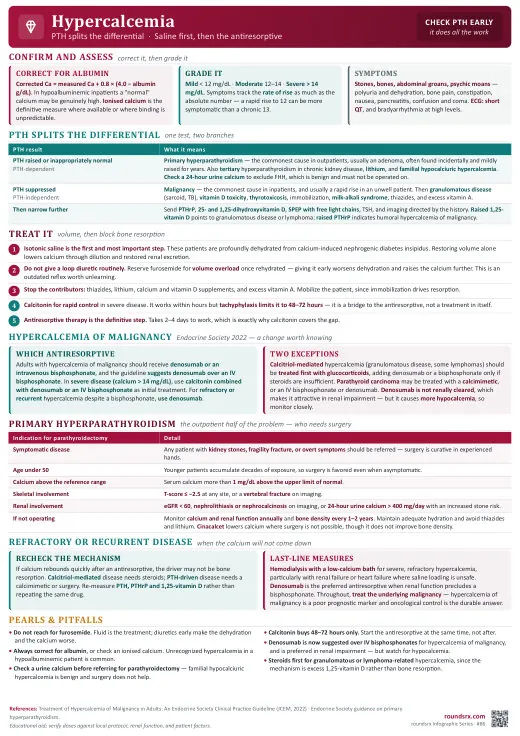
Text version
Endocrine / Oncology · One Pager
Hypercalcemia
PTH is the branch point. Outpatient #1: primary hyperparathyroidism. Inpatient #1: malignancy. NS hydration first → calcitonin → zoledronic acid. No furosemide unless overloaded.
Etiology -PTH Branch
PTH elevated: primary hyperparathyroidism (parathyroid adenoma). PTH suppressed: malignancy (PTHrP → squamous, RCC, breast), granulomatous disease (sarcoid, TB → 1,25-D), vitamin D toxicity, lytic bone mets.
Treatment
(1) NS 200-300 mL/hr (most important -rehydrate first). (2) Calcitonin 4 IU/kg IM q12h (fast onset, bridges to bisphosphonate, tachyphylaxis at 48h). (3) Zoledronic acid 4 mg IV over 15 min (most effective, onset 2-4 days).
Symptoms -Stones, Bones, Groans, Moans
Stones (renal), Bones (pain, fractures), Groans (constipation, abd pain, pancreatitis), Moans (depression, AMS), Overtones (polyuria, dehydration, short QT).
Key Drugs
NS200-300 mL/hr
Calcitonin4 IU/kg IM q12h
Zoledronic acid4 mg IV over 15 min
Denosumab120 mg SQ (if bisphosphonate fails)
Pitfalls
- Furosemide for hypercalcemia (only if volume overloaded -most patients are dehydrated)
- Not checking PTH first (the diagnostic branch point)
- Delayed hydration
- Missing malignancy as cause in hospitalized patients
Related Topics
Adrenal CrisisCushing's SyndromeDiabetes InsipidusHyperosmolar Hyperglycemic State (HHS)Hyperthyroidism / Graves' DiseaseHypocalcemia