Hyperkalemia
| K⁺ Level | ECG Finding | Urgency |
|---|---|---|
| 5.5–6.0 | Peaked T waves (tall, narrow, symmetric -earliest sign) | Urgent -start treatment |
| 6.0–6.5 | Prolonged PR interval, flattened P waves | Emergent |
| 6.5–7.0 | Widened QRS (> 120 ms) | Critical -calcium NOW |
| 7.0–8.0 | Sine wave pattern (QRS merges with T wave) | Pre-arrest. Calcium + emergent dialysis. |
| > 8.0 | VF, asystole, PEA | Cardiac arrest. Treat during resuscitation. |
- Renal failure (AKI, CKD G4–G5) -most common, impaired K⁺ excretion
- Medications -ACEi/ARBs, spironolactone, trimethoprim, NSAIDs, heparin, succinylcholine
- Cellular shift -acidosis, rhabdomyolysis, tumor lysis, DKA, massive transfusion
- Adrenal insufficiency -cortisol + aldosterone deficiency → impaired renal K⁺ excretion
- Pseudohyperkalemia -hemolyzed sample (most common lab artifact), high WBC/plt count, tourniquet too tight
- Hemolysis during phlebotomy -the most common cause. Traumatic draw, small-gauge needle, vigorous shaking of the tube, or pneumatic tube transport causes RBC lysis and K⁺ release. The lab usually flags the specimen as hemolyzed (hemolysis index elevated).
- Prolonged tourniquet time -fist clenching with a tight tourniquet causes local ischemia and K⁺ leakage from forearm muscles. Can raise K⁺ by 0.5–1.5 mEq/L.
- Thrombocytosis (plt > 500K) -during clot formation in a serum (red-top) tube, platelets degranulate and release intracellular K⁺. The higher the platelet count, the greater the artifact. A plasma (green-top/heparin) sample bypasses clotting and gives the true K⁺.
- Leukocytosis (WBC > 70–100K) -seen in leukemia/lymphoma. Fragile WBCs lyse in vitro, releasing K⁺. Again, a plasma sample is more accurate.
- In vitro hemolysis from specimen handling -delayed processing, refrigeration of whole blood, or prolonged storage allows ongoing K⁺ leak from cells.
- Familial pseudohyperkalemia -rare inherited RBC membrane defect causing K⁺ leak at room temperature but not at 37°C.
| Feature | Pseudohyperkalemia | True Hyperkalemia |
|---|---|---|
| ECG changes | Normal -no peaked T's, no QRS widening | Peaked T waves, PR prolongation, wide QRS, sine wave |
| Hemolysis index | Elevated (lab flags specimen as hemolyzed) | Normal (non-hemolyzed sample) |
| Serum vs. plasma K⁺ | Serum K⁺ significantly higher than plasma K⁺ (difference > 0.3–0.4 mEq/L) | Serum and plasma K⁺ are concordant |
| Clinical context | No risk factors (normal renal function, no culprit drugs, no acidosis) | AKI/CKD, K⁺-sparing drugs, acidosis, rhabdomyolysis, etc. |
| Symptoms | Patient is asymptomatic, feels well | May have weakness, palpitations, paresthesias |
| Repeat sample | Normal K⁺ on a free-flowing, non-hemolyzed redraw | Persistently elevated on repeat |
| Plt/WBC count | Often markedly elevated (thrombocytosis or leukocytosis) | Usually normal or irrelevant |
| Step | Drug (Brand) | Dose | Onset | Duration | Mechanism |
|---|---|---|---|---|---|
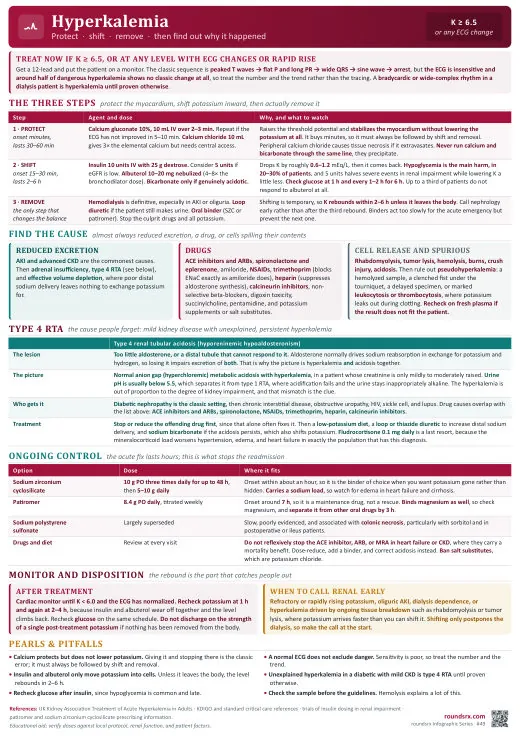
| 1. STABILIZE | Calcium gluconate FIRST IF ECG CHANGES | 1–2 g (10–20 mL of 10%) IV over 2–3 min | 1–3 min | 30–60 min | Stabilizes cardiac membrane. Does NOT lower K⁺. Repeat in 5 min if ECG unchanged. Use calcium chloride (1g) via central line for more rapid effect. |
| 2a. SHIFT | Insulin + Glucose 1ST LINE SHIFT | Regular insulin 10 units IV + D50 25g (1 amp) IV | 15–30 min | 4–6 hrs | Insulin drives K⁺ into cells via Na⁺/K⁺-ATPase. Must give dextrose or the patient becomes hypoglycemic (10–75% incidence) AHA Hyperkalemia Guidelines, 2023. Check glucose at 1h and 2h. Give D10 drip if glucose < 250 before insulin. |
| 2b. SHIFT | Sodium bicarbonate | 50–100 mEq (1–2 amps) IV over 5 min | 15–30 min | 2 hrs | Drives K⁺ into cells via H⁺/K⁺ exchange. Most effective if acidotic (pH < 7.2). Minimal effect if pH normal. Avoid in volume overload (sodium load). |
| 2c. SHIFT | Albuterol (nebulized) | 10–20 mg nebulized (4–8× standard asthma dose) | 15–30 min | 2–4 hrs | β₂-mediated K⁺ shift into cells. Drops K⁺ by 0.5–1.0 mEq/L. Watch for tachycardia. Often forgotten -add it to insulin/glucose. |
| 3a. REMOVE | Furosemide (Lasix) IF RENAL FUNCTION OK | 40–80 mg IV | 30–60 min | 6 hrs | Enhances renal K⁺ excretion. Only works if kidneys functional. Give with NS if volume depleted. |
| 3b. REMOVE | Patiromer (Veltassa) CHRONIC | 8.4 g PO daily | 4–7 hrs | Ongoing | K⁺ binder. NOT for acute emergencies (too slow). Best for chronic hyperK management to allow continuation of ACEi/ARB/MRA. OPAL-HK, 2015 |
| 3c. REMOVE | Sodium zirconium cyclosilicate (Lokelma) CHRONIC/SUBACUTE | 10 g PO TID × 48h (acute) → 5–10 g daily | 1–2 hrs | Ongoing | Faster than patiromer. Can be used in acute setting (onset 1–2h). Well-tolerated. HARMONIZE, 2014 |
| 3d. REMOVE | Hemodialysis REFRACTORY / SEVERE | Emergent HD | Immediate | Definitive | Most effective K⁺ removal. Drops K⁺ by 1–2 mEq/L per session. Indicated: refractory to medical therapy, anuric patient, K⁺ > 6.5 with ECG changes + CKD/ESKD. |
Patient: 68F with CKD Stage IV on lisinopril (Zestril) + spironolactone (Aldactone), K⁺ 7.1, ECG shows peaked T waves and widened QRS.
Immediate (seconds to minutes -stabilize the heart):
- Calcium gluconate 1g IV over 2–3 min → repeat ECG. Does NOT lower K⁺ -stabilizes cardiac membrane. Effect lasts 30–60 min. Repeat if ECG still abnormal.
Shift K⁺ intracellularly (minutes to hours):
- Regular insulin 10 units IV + D50 1 amp (25g glucose) -onset 15–30 min, lowers K⁺ by 0.5–1.0. Check glucose q1h × 4h (hypoglycemia risk peaks at 2–4h, give D10 infusion if needed).
- Albuterol (ProAir) 10–20mg nebulized -onset 15–30 min, lowers K⁺ by 0.5–1.0. Additive with insulin.
- Sodium bicarbonate 50 mEq IV -only if concurrent metabolic acidosis. Limited K⁺-lowering effect alone.
Remove K⁺ from body (hours):
- Furosemide (Lasix) 40–80mg IV -if any residual kidney function.
- Patiromer (Veltassa) 8.4g PO or sodium zirconium (Lokelma) 10g PO -newer K⁺ binders. Onset hours. Better tolerated than kayexalate.
- Hemodialysis -definitive treatment for severe/refractory hyperkalemia or anuric patients.
Fix the cause: Hold lisinopril + spironolactone. Recheck K⁺ in 2h.
- Hold offending medications: ACEi/ARB, spironolactone, trimethoprim, NSAIDs, K⁺-sparing diuretics
- Stop all IV potassium (check infusions, TPN, LR has 4 mEq/L K⁺)
- Low-K⁺ diet if chronic
- Treat underlying
- ECG -first test
- Repeat K⁺ -rule out hemolysis
- BMP
- Med review -ACEi, ARB, spironolactone, TMP-SMX
- CK -rhabdomyolysis
- LDH, UA, PO₄ -TLS
| Drug | Dose | Route | Notes |
|---|---|---|---|
| Ca gluconate | 1g IV/5min | IV | Stabilize. Does NOT lower K⁺. |
| Insulin | 10U+D50 | IV | Best shifter. Check glucose 1h. |
| Albuterol | 10-20mg neb | Neb | Additive with insulin |
| Patiromer (Veltassa) | 8.4g daily | PO | GI elimination (preferred). Onset 4–7h. |
| SZC (Lokelma) | 10g PO × 3 doses | PO | GI elimination. Faster onset (~1h). Preferred in acute setting. |
| Kayexalate (SPS) | 15-30g | PO | GI elimination (outdated -prefer patiromer or Lokelma. Risk of intestinal necrosis.) |
Key findings: K⁺ 7.1, ECG: peaked T waves, widened QRS. Cr 4.2 (baseline 3.5), pH 7.32. No hemolysis on repeat sample.
Management:
- Calcium gluconate 1g IV over 5 min (membrane stabilization, onset 1-3 min), QRS narrows immediately
- Insulin 10U IV + D50 (shift K⁺ intracellularly, onset 15-30 min)
- Albuterol 10 mg continuous neb (additive shift, lowers K⁺ 0.5-1.0 mEq/L)
- Hold lisinopril + spironolactone; nephrology consult for RAAS inhibitor safety reassessment
Teaching point: The combination of ACEi + MRA in CKD is the most common cause of dangerous hyperkalemia. Always recheck K⁺ and Cr within 1 week of starting or uptitrating RAAS inhibitors.
Patient: 45 y/o F with CML (WBC 180K), routine labs show K⁺ 6.8. Asymptomatic, normal ECG, no prior renal disease.
Key findings: Cr 0.9 (normal), bicarb 24, glucose 105. Sample noted as "slightly hemolyzed." Repeat K⁺ from free-flowing venipuncture without tourniquet: 4.4.
Management:
- Recognize pseudohyperkalemia, hemolyzed sample is the #1 cause of spurious K⁺ elevation
- Extreme leukocytosis (CML) causes in-vitro K⁺ release from fragile WBCs during clotting
- Send plasma K⁺ (heparinized tube, no clotting) for accurate result in leukocytosis
- Do NOT treat unless confirmed on repeat and/or ECG changes present
Teaching point: Always recheck before treating. Hemolyzed samples, prolonged tourniquet use, fist clenching, and extreme leukocytosis/thrombocytosis all cause pseudohyperkalemia. Treating a false K⁺ risks iatrogenic hypokalemia.
Patient: 58 y/o M with newly diagnosed Burkitt lymphoma, K⁺ 7.8 with sine-wave pattern on ECG 12h after starting chemotherapy.
Key findings: K⁺ 7.8, phosphate 8.2, uric acid 14.5, Ca²⁺ 6.8, LDH 4,200, Cr 3.6. Classic tumor lysis syndrome (TLS).
Management:
- Calcium gluconate 1g IV x2 (sine wave = near-arrest, may need repeat dose)
- Emergent dialysis, K⁺ 7.8 with sine wave is refractory-level hyperkalemia
- Rasburicase 0.2 mg/kg IV for uric acid (avoid allopurinol in established TLS)
- Aggressive IVF for renal protection; avoid calcium-containing solutions (risk of calcium-phosphate precipitation)
Teaching point: TLS causes hyperkalemia, hyperphosphatemia, hyperuricemia, and hypocalcemia. Sine-wave pattern on ECG is a pre-arrest rhythm, this patient needs emergent dialysis, not just medical management.
- ECG after each intervention
- K⁺ at 1h and 2h
- Glucose at 1h post-insulin
- Continuous telemetry if >6.5
- UOP
- Insulin without D50 (hypoglycemia)
- Not checking ECG
- Not holding offending meds (ACEi, spironolactone, TMP-SMX)
- Treating hemolyzed sample