Hypernatremia
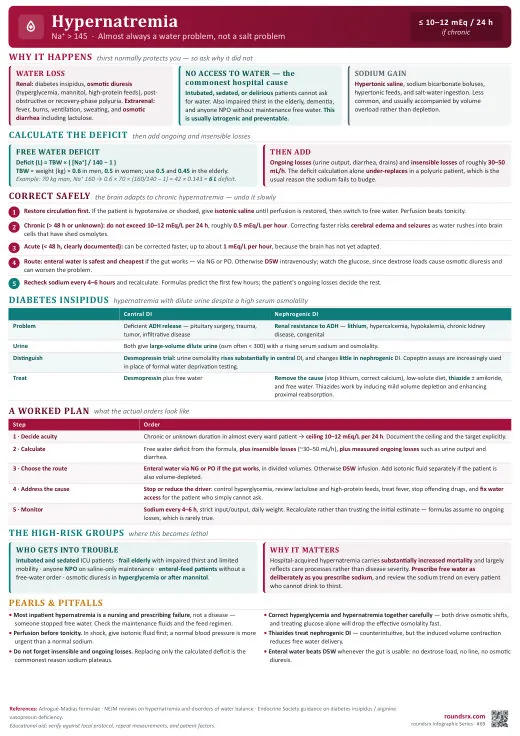
- Na > 145 mEq/L -almost always from free water deficit (not sodium excess)
- Serum osmolality is always elevated (> 295 mOsm/kg)
| Category | Examples |
|---|---|
| Inadequate water intake | Altered mental status, intubated patients without free water, elderly with impaired thirst, NPO without adequate IVF |
| Diabetes insipidus | Central DI: post-neurosurgery, pituitary injury, brain death. Nephrogenic DI: lithium, hypercalcemia, hypokalemia |
| Osmotic diuresis | Hyperglycemia (DKA/HHS), mannitol, urea (high-protein TPN) |
| GI losses | Diarrhea (especially osmotic diarrhea -lactulose), vomiting, NG suction |
| Renal losses | Loop diuretics, post-obstructive diuresis |
| Na Level | Symptoms | Urgency |
|---|---|---|
| 146-150 | Thirst, oliguria, concentrated urine. May be asymptomatic | Monitor, start free water |
| 150-160 | Lethargy, irritability, weakness, nausea | Urgent correction with D5W or free water |
| 160-170 | Confusion, disorientation, hyperreflexia, muscle twitching | Urgent. ICU monitoring recommended |
| >170 | Seizures, coma, intracranial hemorrhage (brain shrinkage tears bridging veins) | Emergency. ICU mandatory. Mortality 40-60% |
TBW = weight (kg) × 0.5 (women) or 0.6 (men)
Example: 70 kg man, Na 160 → TBW = 42 L → FWD = 42 × (160/140 − 1) = 42 × 0.143 = 6 L deficit
Quick bedside estimate: roughly 3 L per 10 mEq/L the Na sits above 140 in an average-sized (~70 kg) adult -the formula scales linearly, so a larger patient (TBW ~55-60 L) runs closer to 4 L per 10, and a smaller or elderly patient (lower TBW fraction) runs closer to 2 L per 10. Use this to sanity-check the calculated deficit, not to replace it.
| Fluid | Na Content | Free Water per Liter | When to Use |
|---|---|---|---|
| D5W | 0 mEq/L | 1000 mL | Best for pure free water deficit. Glucose metabolized, leaves pure water. First-line for most hypernatremia |
| 0.45% NS (half-normal) | 77 mEq/L | ~500 mL | Provides free water + some sodium. Good when patient is also volume depleted |
| 0.9% NS (normal saline) | 154 mEq/L | ~0 mL | Only for initial volume resuscitation in hypotensive patients. Does NOT correct hypernatremia efficiently |
| Free water (PO/NG) | 0 mEq/L | 1000 mL | Most physiologic route if patient has NG or can drink. Preferred when possible |
| Test | Purpose |
|---|---|
| BMP | Na level, Cr (dehydration), glucose (osmotic diuresis) |
| Serum osmolality | Always elevated in true hypernatremia (> 295) |
| Urine osmolality | High (> 600): appropriate ADH response -not getting enough water. Low (< 300): DI -kidneys not concentrating urine |
| Urine Na | Helps differentiate renal vs extrarenal losses |
| Glucose | Rule out osmotic diuresis from hyperglycemia |
| Urine specific gravity | Low in DI, high in appropriate response |
- Urine osm < 300 → suspect DI
- Give DDAVP → if urine concentrates (osm > 600) = Central DI (responds to exogenous ADH)
- If no response to DDAVP = Nephrogenic DI (kidneys resistant to ADH)
| Drug | Dose | Indication |
|---|---|---|
| D5W | 250–500 mL/hr IV (adjust to correction rate) | Primary free water replacement -no sodium |
| 0.45% NS (half-normal saline) | Variable rate IV | Alternative to D5W -provides some sodium + free water |
| Desmopressin (DDAVP) | 1–2 mcg IV or SQ | Central DI -replaces deficient ADH |
| Free water flushes | 200–500 mL via NG q4–6h | Enteral free water if NG access available -most physiologic |
| Parameter | Frequency | Target / Action |
|---|---|---|
| Serum Na | q4–6h during correction | Decrease ≤10 mEq/24h for chronic. Faster OK if acute (< 48h). |
| I&Os | Strict | Track free water replacement and ongoing losses |
| Urine output | Hourly | Polyuria in DI (can be > 3–20 L/day) |
| Daily weights | Daily | Fluid balance tracking |
| Serum osmolality | q12–24h | Should normalize with Na correction |
Patient: 68M intubated for respiratory failure (pneumonia). Day 5 in ICU. BMP: Na 158 (was 140 on admission), Cr 1.0, BUN 28. Urine osm 750 (appropriately concentrated). On NS at 75 mL/hr for maintenance. No free water flushes ordered.
Assessment: Hospital-acquired hypernatremia from inadequate free water. Urine osm >600 = ADH is working (NOT DI). The patient is getting NS (154 mEq/L Na) as maintenance and cannot drink. Classic preventable ICU complication.
Free water deficit: TBW = 70 kg x 0.6 = 42 L. FWD = 42 x (158/140 - 1) = 42 x 0.129 = 5.4 L. Plus ~1.5 L/day ongoing insensible losses.
Management: Changed maintenance to D5W at 200 mL/hr. Added free water flushes 250 mL via NG q4h. Target correction: <=10 mEq/24h. Na rechecked q4h. Na 152 at 12h, 148 at 24h (on target). Continued D5W + free water until Na normalized.
Patient: 45F post-op day 1 from transsphenoidal pituitary adenoma resection. Nursing reports UOP 600 mL/hr x 3 hours. BMP: Na 151 (was 138 pre-op). Urine osm 85 (dilute). Urine specific gravity 1.001.
Assessment: Central DI from pituitary stalk manipulation/damage. Acute onset. Classic triad: polyuria (>300 mL/hr), dilute urine (osm <300), rising Na.
Workup: Gave DDAVP 1 mcg IV. Urine osm rose to 680 within 2h = central DI confirmed (kidneys respond to exogenous ADH).
Management: DDAVP 1 mcg IV q12h. D5W at 250 mL/hr to replace ongoing free water losses. Match IV rate to UOP. Na corrected to 143 by 24h. Post-surgical central DI may be transient (resolves in days-weeks) or permanent. Follow Na and UOP closely.
Patient: 88F from nursing home, found lethargic. Na 172, Cr 2.8 (baseline 1.0), BUN 65, glucose 110. Urine osm 620. Mucous membranes dry, skin tenting, tachycardia.
Assessment: Severe chronic hypernatremia from dehydration (inadequate oral intake). Urine osm >600 = appropriate ADH response, kidneys are concentrating maximally. Prerenal AKI from volume depletion. Duration unknown but likely >48h (chronic).
Free water deficit: TBW = 50 kg x 0.5 = 25 L. FWD = 25 x (172/140 - 1) = 25 x 0.229 = 5.7 L. Plus significant volume depletion.
Management: First: NS bolus for hemodynamic stabilization (this patient is also volume depleted, not just free water depleted). Then: D5W at 150 mL/hr + free water via NG 200 mL q6h. Target: Na decrease <=10 mEq/24h. Too-rapid correction risks cerebral edema (idiogenic osmoles). Na trended: 172 -> 164 at 24h -> 156 at 48h -> 148 at 72h. AKI resolved with volume repletion.