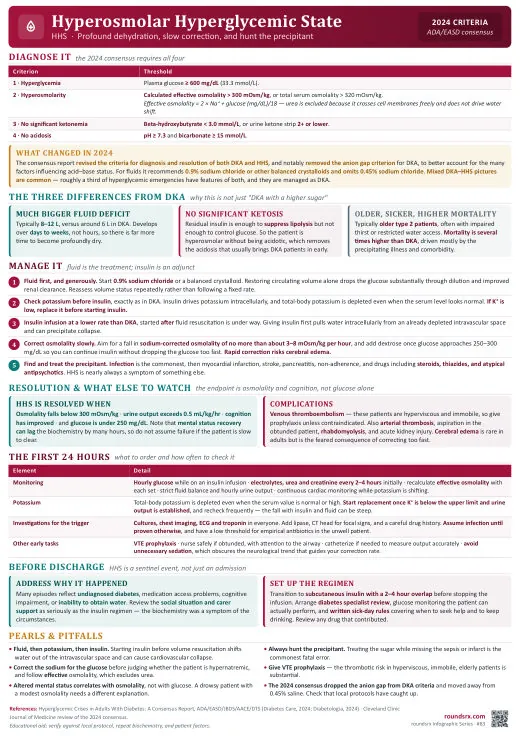
Hyperosmolar Hyperglycemic State (HHS)
HHS is a diabetic emergency characterized by severe hyperglycemia (> 600 mg/dL), hyperosmolality (> 320 mOsm/kg), and profound dehydration (average 8-10L deficit) without significant ketoacidosis (pH > 7.30, bicarb > 18, minimal ketonemia). [ADA Consensus, Kitabchi 2009 Occurs almost exclusively in Type 2 diabetes, typically in elderly patients with limited water access (nursing home, dementia, post-CVA). Mortality is 5-20% -much higher than DKA -because patients are older with more comorbidities and the degree of dehydration is more severe. Triggers: infection (#1, especially UTI/pneumonia), medication non-compliance, new diabetes diagnosis, MI, stroke, medications (steroids, thiazides). Key difference from DKA: HHS patients have enough insulin to prevent lipolysis/ketogenesis, but not enough for glucose uptake. Treatment priority: fluids first, insulin second.
- Fingerstick glucose -often > 600 mg/dL (can exceed 1000). Some glucometers read "HIGH" above 500 → send serum glucose.
- BMP -Na⁺ (correct for hyperglycemia: add 1.6 mEq per 100 mg/dL glucose above 100), K⁺ (total body depleted even if serum normal/elevated), Cr (pre-renal AKI from dehydration), bicarb (should be > 18 in pure HHS)
- Serum osmolality (measured) -> 320 mOsm/kg diagnostic. Calculate: 2×Na + glucose/18 + BUN/2.8. Effective osmolality (excludes BUN): 2×Na + glucose/18 > 320.
- Lactate -hypoperfusion from dehydration
- ECG -rule out MI as trigger. Check for hyperkalemia/hypokalemia changes.
- Lipase -pancreatitis can trigger HHS
- Step 1 -AGGRESSIVE IV FLUIDS (priority #1):
- NS 1-1.5 L/hr × first 1-2 hours (15-20 mL/kg/hr). These patients are 8-10L depleted.
- After initial bolus: NS 250-500 mL/hr if corrected Na low or normal. 0.45% NS if corrected Na elevated.
- When glucose < 300 → add D5 0.45% NS (not D5W -need to continue volume repletion).
- Step 2 -POTASSIUM REPLETION: Check K⁺ before insulin. If K⁺ < 3.5 → replete BEFORE insulin (10-20 mmol/hr until > 3.5). If 3.5-5.0 → add 20-40 mEq K⁺ per liter of IVF. If > 5.3 → hold K⁺, recheck in 2h.
- Step 3 -INSULIN (lower priority than fluids): Regular insulin 0.1 U/kg/hr IV drip (no bolus in HHS). Start AFTER 1-2L fluids and confirmed K⁺ > 3.5. Target glucose decline: 50-70 mg/dL per hour. Reduce rate to 0.02-0.05 U/kg/hr when glucose < 300. ADA Hyperglycemic Crises Protocol, Kitabchi 2009
- Step 4 -TREAT THE TRIGGER: Antibiotics for infection. Hold offending medications. Manage MI/stroke if present.
- Step 5 -DVT PROPHYLAXIS: Enoxaparin 40 mg SQ daily. HHS is a hypercoagulable state (hemoconcentration + immobility).
| Drug | Dose | Route | Notes |
|---|---|---|---|
| NS (0.9% NaCl) | 1-1.5 L/hr × 1-2h → 250-500 mL/hr | IV | First-line. Priority #1. Average deficit 8-10L. Switch to 0.45% if corrected Na high. |
| Regular insulin | 0.1 U/kg/hr (no bolus) | IV drip | Start AFTER fluids + K⁺ > 3.5. Target BG drop 50-70/hr. Reduce when < 300. |
| KCl | 20-40 mEq per liter IVF | IV | Total body K⁺ depleted. Replete before insulin. K⁺ < 3.5 → hold insulin until repleted. |
| D5 + 0.45% NS | 150-250 mL/hr | IV | When glucose < 300. Continue volume repletion while preventing hypoglycemia. |
| Enoxaparin | 40 mg SQ daily | SQ | DVT prophylaxis -HHS is hypercoagulable. |
| Glargine | 0.2-0.3 U/kg SQ | SQ | Give 2-4h BEFORE stopping insulin drip for transition. Do NOT stop drip without basal overlap. |
Patient: 82F, T2DM on metformin + glipizide, dementia, HTN. Brought from SNF with 4 days of progressive lethargy, decreased PO intake, and new urinary incontinence.
Key findings: T 100.8°F, HR 108, BP 88/52. Glucose 1,040, Na 152 (corrected 167), K 4.6, Cr 3.2 (baseline 1.0), serum osm 398, pH 7.32, bicarb 22, BHB 0.6. UA: pyuria + bacteria.
Management:
- NS 1.5 L/hr x 2 hours, then 500 mL/hr; switch to 0.45% NS when corrected Na begins to normalize
- Insulin 0.1 U/kg/hr IV (NO bolus) started after first liter of fluids and K confirmed > 3.5
- Ceftriaxone 1g IV for UTI (trigger treatment)
- DVT prophylaxis with enoxaparin (HHS is a hypercoagulable state)
- Target glucose drop 50-70 mg/dL/hr; target osm correction ≤ 3 mOsm/kg/hr
Teaching point: Fluids alone drop glucose 75-100 mg/dL/hr. The corrected sodium reveals the true degree of dehydration. Always identify and treat the trigger.
Patient: 55M, T2DM on insulin (non-adherent x 2 weeks), obesity, CKD stage 3. Presents with confusion, vomiting, and polyuria.
Key findings: HR 118, BP 96/60. Glucose 890, Na 131 (corrected 144), K 5.8, Cr 4.1 (baseline 1.8), pH 7.18, bicarb 10, AG 28, BHB 5.2, serum osm 342.
Management:
- HHS/DKA overlap, meets criteria for both (glucose > 600, osm > 320, AND AG acidosis + elevated ketones)
- Aggressive NS resuscitation 1 L/hr; K 5.8 so safe to start insulin immediately
- Insulin drip 0.1 U/kg/hr (treat ketoacidosis like DKA; follow BHB to resolution)
- When glucose reaches 300: switch to D5 0.45% NS + reduce insulin to 0.02-0.05 U/kg/hr
- Monitor K q2h, will drop rapidly with insulin and fluids
Teaching point: Up to 30% of hyperglycemic emergencies have overlap features. Treat the ketoacidosis like DKA (close the anion gap) while managing hyperosmolarity like HHS (gradual osm correction). The K of 5.8 is falsely reassuring, total body K is depleted. ADA Consensus, Kitabchi 2009
Patient: 70F, T2DM on sulfonylurea, found confused at home for 2+ days. Started on aggressive IV fluids and insulin at outside hospital before transfer.
Key findings: Glucose dropped from 1,100 to 450 in 4 hours. Osm corrected from 410 to 340 (17.5 mOsm/hr). Patient now obtunded with new fixed dilated left pupil.
Management:
- Stat CT head, cerebral edema confirmed
- Mannitol 1 g/kg IV bolus or hypertonic saline 3% 250 mL
- Elevate head of bed to 30 degrees
- STOP hypotonic fluids; switch to NS to prevent further osmolality drop
- Neurosurgery consult for possible EVD placement
Teaching point: Cerebral edema from overly aggressive correction is the most feared HHS complication. The brain generates idiogenic osmoles to adapt to chronic hyperosmolality. Target osm decline ≤ 3 mOsm/kg/hr and glucose decline 50-70 mg/dL/hr. This patient's osm dropped at nearly 6x the safe rate.
Mrs. Williams is an 78-year-old woman with T2DM, dementia, and HTN, brought from nursing home with 3 days of altered mental status, decreased PO intake, and new incontinence. VS: T 100.4°F, HR 112, BP 92/58, RR 20. Exam: dry mucous membranes, tenting, somnolent but arousable. Labs: glucose 923, Na 149 (corrected 163), K 4.8, Cr 2.8 (baseline 1.1), pH 7.34, bicarb 20, BHB 0.8, serum osm 384. UA: pyuria. CXR: clear.
- Fingerstick glucose q1h -target decline 50-70 mg/dL per hour. Faster correction risks cerebral edema.
- BMP q2-4h -K⁺ (shifts dramatically with insulin), Na⁺ (corrected Na should rise as glucose falls -if not, you're giving too much free water), Cr (improving = adequate hydration)
- Serum osmolality q2-4h -target decline ≤ 3 mOsm/kg/hr. If dropping faster → slow IVF rate.
- Urine output q1h -target ≥ 0.5 mL/kg/hr (sign of adequate resuscitation). Foley catheter in ICU.
- Mental status -should improve as osmolality normalizes. If AMS worsens despite improving labs → CT head (stroke may have been the trigger).
- Fluid balance (I&Os) -track meticulously. Goal: replace deficit over 24-48h.
- Resolution criteria: glucose < 300, osmolality < 315, patient alert/eating → transition to SQ insulin. ADA/AACE Consensus, 2009