Hypertensive Emergency
Urgency: Severely elevated BP without end-organ damage. Can be managed with oral agents and close outpatient follow-up. NOT an emergency. Outpatient target: SBP <130 for high-risk patients SPRINT, 2015. First-line: thiazide-type diuretic ALLHAT, 2002.
- Neurologic: Hypertensive encephalopathy (AMS, headache, vision changes), hemorrhagic stroke, ischemic stroke
- Cardiac: Aortic dissection, ACS, acute pulmonary edema
- Renal: AKI, hematuria, proteinuria (hypertensive nephrosclerosis)
- Ophthalmologic: Papilledema, retinal hemorrhages (fundoscopy)
- Hematologic: Microangiopathic hemolytic anemia (MAHA), TTP-like picture
- OB: Eclampsia, HELLP syndrome
| Syndrome | Target | First-Line Drug |
|---|---|---|
| Hypertensive encephalopathy | MAP reduction 20–25% in 1h | Nicardipine or labetalol IV |
| Aortic dissection (Type A/B) | SBP < 120, HR < 60 ASAP | Esmolol + nitroprusside or nicardipine |
| Acute pulmonary edema | Rapid reduction | Nicardipine + nitroglycerin IV + diuresis |
| ACS with hypertension | SBP < 140 | Nitroglycerin IV + beta-blocker |
| Ischemic stroke | Only treat if BP > 220/120 (no tPA) or > 185/110 (if tPA candidate) AHA/ASA, 2019 | Labetalol or nicardipine IV -go slow |
| Hemorrhagic stroke | SBP < 140 ATACH-2, 2016 INTERACT2, 2013 | Nicardipine or labetalol IV |
| Eclampsia | SBP < 160, DBP < 110 | Labetalol IV or hydralazine IV + MgSO₄ MAGPIE, 2002 |
| Pheochromocytoma crisis | MAP reduction 20–25% | Phentolamine IV -α-blockade first, then add beta-blocker |
- Patient: 52M presents with BP 228/134, headache, blurred vision, chest pain. Cr 2.4 (baseline 1.0). Troponin 0.08. UA: 2+ protein, RBC casts.
- This is a hypertensive EMERGENCY (not urgency) -end-organ damage present: AKI, proteinuria with active sediment (renal), troponin elevation (cardiac), visual changes (retinal/CNS).
- Step 1 -Choose IV agent based on end-organ damage:
- Renal damage → Nicardipine (Cardene) 5mg/hr IV, titrate by 2.5mg/hr q5-15min (max 15mg/hr). Smooth, titratable, no renal dosing needed.
- Aortic dissection → Esmolol (Brevibloc) drip first (target HR <60), THEN add nicardipine. Must reduce HR before afterload reduction.
- Acute pulmonary edema → Nitroglycerin (Nitrostat) drip + furosemide (Lasix).
- Eclampsia → Magnesium sulfate + hydralazine (Apresoline) or labetalol (Trandate).
- Stroke → see specific stroke BP targets (different for ischemic vs hemorrhagic, tPA vs no tPA).
- Step 2 -BP target:
- Reduce MAP by no more than 25% in the first hour. Then toward 160/100 over next 2-6 hours.
- Do NOT normalize BP rapidly → risk of watershed infarction (brain, kidneys).
- Exception: Aortic dissection → SBP <120 within 20 minutes.
- Step 3 -Transition to oral:
- Once stable on IV × 12-24h → start oral antihypertensive (amlodipine 5-10mg, lisinopril, etc.).
- Overlap IV + PO for 2-4 hours before weaning drip.
- Hypertensive URGENCY (BP >180/120 WITHOUT end-organ damage): Do NOT use IV meds. Restart/uptitrate oral meds. Discharge with close follow-up. The BP did not get this high overnight and does not need to come down overnight.
- Patient: 58M with sudden tearing chest pain radiating to back. BP 210/120. CT angiography: Stanford Type B dissection.
- Step 1 -IV esmolol drip FIRST: Target HR <60 BEFORE lowering BP. Beta-blocker first to reduce aortic shear stress. Do NOT lower BP without HR control first, dropping BP alone causes reflex tachycardia → increased aortic shear → propagation of dissection.
- Step 2 -Add vasodilator AFTER HR controlled: Nicardipine or nitroprusside for BP target <120 systolic within 20 minutes. Never nitroprusside alone, must have beta-blocker on board first.
- Step 3 -Pain control: IV morphine. Pain drives catecholamine release → higher BP. Adequate analgesia is part of BP management.
- Type A (ascending) → emergent surgery. Type B (descending) → medical management unless complicated (malperfusion, rupture, refractory pain).
- Key Lesson: In dissection, HR control comes BEFORE BP control. Esmolol first, then vasodilator. Target SBP <120 and HR <60. Never nitroprusside alone.
- Patient: 72F with flash pulmonary edema, BP 230/130, SpO2 82%, severe respiratory distress.
- Step 1 -Position + BiPAP immediately: Sit upright. BiPAP reduces preload + afterload + improves oxygenation. Start before anything else.
- Step 2 -IV nitroglycerin drip: Start 5 mcg/min, titrate rapidly up to 200 mcg/min if needed. Potent vasodilator that reduces both preload AND afterload. Nitroglycerin is MORE important than diuresis in the first 30 minutes.
- Step 3 -IV furosemide 80-120mg: Important but secondary to nitroglycerin. The acute crisis is afterload-driven, not volume-driven (though volume contributes).
- Do NOT give labetalol, negative inotropy worsens acute decompensated heart failure. Avoid beta-blockers in this setting.
- BP target: Reduce by 25% in the first hour. Reassess with repeat CXR, SpO2 trending, work of breathing.
- Key Lesson: Flash pulmonary edema = BiPAP + nitroglycerin drip. Nitroglycerin is the hero, not lasix. Avoid beta-blockers in acute decompensated HF.
| Drug | Dose | Onset | Best For | Avoid In |
|---|---|---|---|---|
| Nicardipine (Cardene) | 5–15 mg/hr IV drip | 5–10 min | Most hypertensive emergencies. Excellent titratable agent. | Advanced aortic stenosis |
| Labetalol (Trandate) | 20–80 mg IV bolus q10min, or 0.5–2 mg/min drip | 5 min | Aortic dissection, stroke, eclampsia | Asthma, severe bradycardia, acute HF |
| Esmolol (Brevibloc) | 500 mcg/kg bolus, then 50–200 mcg/kg/min | 1–2 min | Aortic dissection (HR control) | Bronchospasm, bradycardia |
| Sodium Nitroprusside | 0.3–10 mcg/kg/min | Seconds | Hypertensive emergency when other agents fail | Renal failure (cyanide toxicity), elevated ICP, pregnancy |
| Nitroglycerin (Nitrostat) | 5–200 mcg/min IV | 1–2 min | Pulmonary edema, ACS | Aortic dissection (reflex tachycardia), PDE5 inhibitor use |
| Hydralazine (Apresoline) | 10–20 mg IV q4–6h | 10–20 min | Eclampsia (if labetalol not available) | Aortic dissection, aortic aneurysm (reflex tachycardia worsens shear stress), CAD (unpredictable response, reflex tachycardia), elevated ICP |
| Test | Looking For | End-Organ Damage |
|---|---|---|
| BMP + Cr | Cr above baseline | Renal: AKI from malignant nephrosclerosis |
| UA + microscopy | Proteinuria, hematuria, RBC casts | Renal: Active sediment = hypertensive nephropathy |
| Troponin | Elevated, rise-fall | Cardiac: Demand ischemia or ACS from afterload |
| ECG | LVH, ST/T changes, new arrhythmia | Cardiac: Acute ischemia, atrial strain |
| CXR | Pulmonary edema, wide mediastinum | Cardiac: Flash pulmonary edema. Wide mediastinum → CTA for dissection |
| Fundoscopy | Flame hemorrhages, papilledema | Retinal/CNS: Grade III-IV = malignant HTN |
| CT head | Hemorrhage, PRES, ischemia | CNS: Order if headache, AMS, focal deficits, seizures, visual changes |
| Peripheral smear | Schistocytes, low platelets | Hematologic: MAHA from shear stress. Check LDH ↑, haptoglobin ↓ |
| BNP | Elevated | Cardiac: Flash pulmonary edema from afterload crisis |
| Urine drug screen | Cocaine, amphetamines | Etiology: Avoid beta-blockers with cocaine (unopposed alpha) |
| Pregnancy test | Positive β-hCG | Etiology: Pre-eclampsia/eclampsia → magnesium + delivery |
Patient: 54M, non-adherent to amlodipine and lisinopril, presents with headache, blurred vision, and nausea. No chest pain or focal neurologic deficits.
Key findings: BP 238/142, HR 92. Fundoscopy: flame hemorrhages + papilledema. Cr 3.4 (baseline 1.2), proteinuria 3+, hematuria. CT head negative. TTE: LVH, EF 55%.
Management:
- IV nicardipine drip starting at 5 mg/hr, titrate q5-15 min (max 15 mg/hr)
- Target: reduce MAP by 25% in first hour, then to 160/100 over next 2-6h
- Arterial line for continuous BP monitoring
- Trending Cr q12h, expect improvement with controlled BP reduction
- Transition to oral amlodipine 10 mg + lisinopril 20 mg when stable on drip x 24h
Teaching point: Hypertensive nephrosclerosis with acute end-organ damage (AKI + papilledema) defines hypertensive emergency. Nicardipine is first-line for most hypertensive emergencies: smooth, titratable, no CNS depression. Renal function often improves with controlled BP reduction.
Patient: 72F, HTN and AF (not on anticoagulation), presents with acute right-sided weakness and aphasia. Symptom onset 2 hours ago. NIHSS 14.
Key findings: BP 204/118, HR 88 irregular. CT head: no hemorrhage. CTA: left MCA occlusion. tPA candidate (within window, no contraindications).
Management:
- BP must be < 185/110 BEFORE tPA administration
- IV labetalol 10-20 mg bolus; repeat if needed. Alternatively, nicardipine drip
- Once tPA given: maintain BP < 180/105 for 24 hours
- If NOT a tPA candidate: only treat BP if > 220/120 (permissive hypertension protects the penumbra)
- Thrombectomy evaluation given large vessel occlusion
Teaching point: BP management in stroke differs from other hypertensive emergencies. Aggressive BP lowering in ischemic stroke expands the infarct by reducing perfusion to the penumbra. The only reason to lower BP acutely is to safely give tPA. AHA/ASA Stroke Guidelines, 2019
Patient: 42F, no prior medical history, presents with episodic severe headaches, palpitations, and diaphoresis. In the ED, BP spikes to 260/150 with HR 132 during a paroxysm.
Key findings: Between episodes: BP 145/90. 24h urine metanephrines: 4x upper normal. CT abdomen: 4.2 cm right adrenal mass. Plasma-free metanephrines markedly elevated.
Management:
- Phentolamine 5 mg IV bolus for acute crisis (alpha-blocker)
- Start phenoxybenzamine 10 mg BID, titrate up over 10-14 days pre-operatively
- Add beta-blocker (propranolol) ONLY AFTER adequate alpha blockade (typically 3-5 days later)
- NEVER give beta-blocker first, causes unopposed alpha stimulation and hypertensive crisis
- High-sodium diet + liberal fluids to restore intravascular volume before surgery
Teaching point: Pheochromocytoma hypertensive crisis requires alpha-blockade FIRST. Beta-blockers before alpha-blockade removes the beta-2 vasodilatory counterbalance, leaving unopposed alpha vasoconstriction. This is one of the most testable concepts in medicine.
| Parameter | Frequency | Target / Action |
|---|---|---|
| Arterial line BP | Continuous (art line mandatory in ICU) | Reduce MAP no more than 25% in the first hour. Cuff pressures are insufficient for IV drip titration -art line is standard of care. |
| MAP during titration | q5–15 min while adjusting IV drip | First hour: ≤ 25% MAP reduction. Next 2–6h: target ~160/100. Next 24–48h: gradual normalization. Too fast → watershed stroke. |
| Neuro checks | q1–2h during active titration | GCS, pupil reactivity, focal deficits, level of consciousness. New deficit during BP lowering → stop titration, allow BP to rise, urgent imaging (stroke?). |
| Urine output | q1h (Foley) | UOP ≥ 0.5 mL/kg/hr. Declining UOP during BP reduction = renal hypoperfusion -may need to allow higher BP target. |
| Creatinine | q12–24h | Trend from baseline. Rising Cr suggests renal end-organ injury or overly aggressive BP lowering. Adjust target accordingly. |
| Troponin | On admission, repeat at 6h if elevated or ongoing chest pain | Hypertensive emergency can cause demand ischemia (type 2 MI). Elevated troponin changes management -cardiology consult. |
| Fundoscopic exam | On admission, repeat if worsening | Papilledema, flame hemorrhages, cotton-wool spots, AV nicking. Presence confirms end-organ damage and classifies as true emergency vs urgency. |
| Transition to oral agents | After 12–24h stable on IV drip | Start long-acting oral antihypertensives (amlodipine, lisinopril, etc.) with IV drip overlap. Wean drip gradually as oral agents take effect (24–48h). Do not abruptly stop IV. |
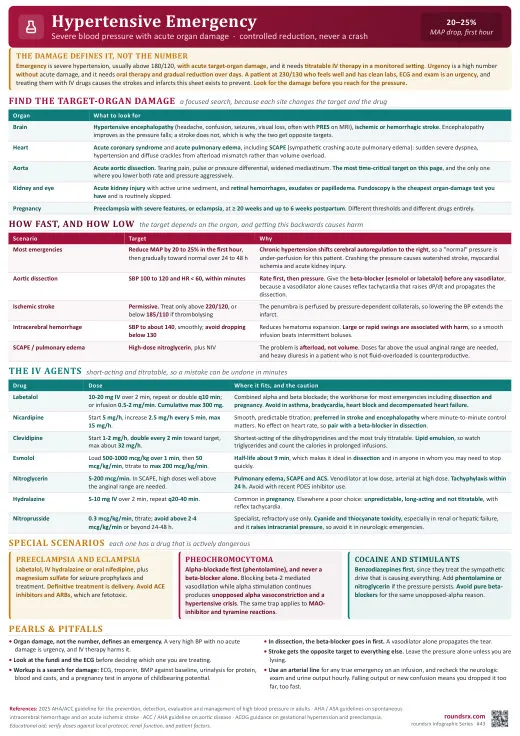
Text version
- Chest/back pain + very high BP → CTA chest/abdomen NOW
- Target SBP < 120, HR < 60 ASAP
- Esmolol + nicardipine or nitroprusside
- Never nitrates alone (reflex tachycardia)
- Reduce MAP ≤ 25% in first hour
- Then to 160/100 over 2–6h
- Exception: Dissection (aggressive) and ischemic stroke (conservative)
- Ischemic stroke: only treat if BP > 220/120
- α-block FIRST with phentolamine
- THEN add beta-blocker
- Beta-block first → unopposed α → crisis
- Chronic HT shifts autoregulation rightward
- Rapid drop → cerebral ischemia
- Watershed infarcts, blindness, renal infarction