Hypertrophic Cardiomyopathy
- ↓ Preload -dehydration, Valsalva, standing, diuretics (smaller LV cavity → septum and MV closer together)
- ↓ Afterload -vasodilators, exercise-induced vasodilation
- ↑ Contractility -exercise, inotropes, digoxin, catecholamines
- ↑ Preload -IV fluids, leg elevation, squatting
- ↑ Afterload -phenylephrine (alpha agonist)
- ↓ Contractility / HR -beta-blockers, verapamil
- Murmur: harsh crescendo-decrescendo systolic murmur at LLSB. Louder with Valsalva and standing (decreased preload). Softer with squatting (increased preload). This is the opposite of most murmurs.
- Symptoms: exertional dyspnea, syncope (especially exertional -red flag), chest pain, palpitations
- ECG: LVH, deep septal Q waves (V1–V3, "dagger" Q waves), T-wave inversions
- Echo (diagnostic): septal wall thickness ≥ 15 mm, SAM of mitral valve, LVOT gradient, MR
| Drug | Role | Notes |
|---|---|---|
| Beta-blocker (non-vasodilating) 1ST LINE | ↓ HR, ↓ contractility, ↑ diastolic filling time | Metoprolol or propranolol preferred. Titrate to resting HR 60–65. Do NOT use carvedilol (vasodilating properties worsen obstruction). |
| Verapamil (Calan) 2ND LINE | ↓ HR, ↓ contractility, improves diastolic relaxation | If BB intolerant. Avoid in severe resting obstruction (gradient > 100 mmHg) -vasodilatory effect may worsen hemodynamics. |
| Disopyramide ADD-ON | Negative inotrope (Class Ia antiarrhythmic) | Added to BB for refractory symptoms. Must combine with BB (disopyramide alone → reflex tachycardia from anticholinergic effects). |
| Mavacamten (Camzyos) BREAKTHROUGH | Cardiac myosin inhibitor. Directly reduces contractility by decreasing myosin-actin cross-bridge formation. | EXPLORER-HCM, 2020: reduced LVOT gradient from 74 → 12 mmHg. Improved symptoms and exercise capacity. First targeted therapy for HCM. Requires REMS program (risk of excessive EF reduction). |
- Septal myectomy (Morrow procedure) -surgical resection of hypertrophied septum. Gold standard for refractory obstructive HCM. Success rate > 95%. Mortality < 1% at experienced centers.
- Alcohol septal ablation -ethanol injection into septal perforator artery → controlled MI of hypertrophied septum. Alternative for high surgical risk. Higher rates of heart block (10–20%) and need for permanent pacemaker.
- ICD indicated (secondary prevention): prior cardiac arrest, sustained VT
- ICD considered (primary prevention) if ≥ 1 major risk factor:
| Risk Factor | Details |
|---|---|
| Family history of SCD | 1st degree relative with SCD from HCM (especially < 50 yo) |
| Massive LVH | Max wall thickness ≥ 30 mm |
| Unexplained syncope | Recent (< 6 months), especially exertional |
| NSVT | Non-sustained VT on Holter (≥ 3 beats at ≥ 120 bpm) |
| Abnormal BP response to exercise | Failure of SBP to rise ≥ 20 mmHg with exercise (especially age < 40) |
| Extensive LGE on MRI | ≥ 15% LGE → significant fibrosis → arrhythmia substrate |
| LV apical aneurysm | Independent risk for VT |
- Echo -wall thickness, LVOT gradient, SAM
- 48h Holter -NSVT for SCD
- Exercise stress -hypotension
- Cardiac MRI -fibrosis, apical HCM
- Genetic testing
- Family echo -first-degree relatives
Patient: 48M with exertional dyspnea and near-syncope when climbing stairs. Systolic murmur that increases with Valsalva. Echo: septal thickness 24 mm, LVOT gradient 72 mmHg at rest, SAM of MV with moderate MR. EF 70%.
Key findings: Obstructive HCM (resting gradient > 30 mmHg) with NYHA II-III symptoms. SAM causes dynamic LVOT obstruction + MR. Gradient worsens with decreased preload (Valsalva, dehydration, standing).
Management:
- Metoprolol succinate 50 mg → titrate to 200 mg daily (first-line, slows HR, increases filling time, reduces gradient)
- If beta-blocker inadequate: add disopyramide 100 mg QID (negative inotrope, reduces LVOT gradient)
- Mavacamten 5 mg daily if refractory to above EXPLORER-HCM, 2020
- AVOID: vasodilators (ACEi, nitrates), diuretics (reduce preload → worsen obstruction), digoxin (positive inotrope)
- If refractory to all medical therapy: septal myectomy (surgical, gold standard) or alcohol septal ablation
Teaching point: In HCM, everything that reduces preload or increases contractility worsens obstruction. The hemodynamic goal is the opposite of HFrEF, increase preload, decrease contractility, slow HR.
Patient: 22M diagnosed with HCM on screening echo after his brother died suddenly during basketball at age 19. Septal thickness 30 mm, no resting LVOT obstruction, EF 65%. Asymptomatic. Holter: 3-beat run of NSVT.
Key findings: Multiple SCD risk factors: family history of SCD, massive LVH (≥ 30 mm), NSVT on Holter. HCM is the #1 cause of SCD in young athletes.
Management:
- ICD implantation recommended, ≥ 1 major risk factor for SCD in HCM warrants primary prevention ICD
- SCD risk factors: family hx SCD, syncope, NSVT, max wall thickness ≥ 30 mm, abnormal BP response to exercise
- No competitive sports (AHA/ACC Class III recommendation for HCM with any risk factor)
- Cardiac MRI with LGE, extent of fibrosis is an emerging risk predictor
- Screen all first-degree relatives with echo + ECG (genetic counseling, consider genetic testing)
Teaching point: The decision to place an ICD in HCM requires only ONE major risk factor. This is different from HFrEF (where EF ≤ 35% is the threshold). A 22-year-old with massive LVH + family SCD + NSVT has a very high SCD risk.
Patient: 56F with known HCM, presents with palpitations and dyspnea. HR 148 irregularly irregular, BP 88/60. Echo: LVOT gradient now 95 mmHg (was 35 at baseline). New moderate MR.
Key findings: Afib with rapid ventricular response in HCM, hemodynamic emergency. Loss of atrial kick + fast HR → decreased filling time → dramatically increased LVOT gradient → hypotension.
Management:
- IV phenylephrine for hypotension (pure alpha agonist, increases afterload without increasing contractility, reduces gradient)
- IV metoprolol for rate control (do NOT use diltiazem or verapamil acutely if hypotensive)
- If hemodynamically unstable: emergent synchronized cardioversion
- Long-term anticoagulation, ALL HCM patients with Afib need anticoagulation regardless of CHA₂DS₂-VASc score
- Consider amiodarone or catheter ablation for rhythm control (Afib recurrence is poorly tolerated in HCM)
Teaching point: Afib in HCM is a medical emergency. Unlike the general population, ALL HCM patients with Afib require anticoagulation, the stroke risk is markedly elevated regardless of CHA₂DS₂-VASc score.
| Drug | Dose | Role | Watch for |
|---|---|---|---|
| Metoprolol / bisoprolol 1ST LINE | Titrate to symptoms and heart rate | First line for symptomatic obstruction. Slows the heart, so diastole is longer and filling is better, and reduces contractility so the gradient falls. | Bradycardia, fatigue, bronchospasm. Titrate to symptoms, not to a target gradient. |
| Verapamil | 120 to 480 mg daily | Alternative when beta-blockers are not tolerated. Improves diastolic relaxation. | Dangerous in severe obstruction with hypotension or a very high gradient, where its vasodilatory effect can precipitate collapse. Avoid in decompensated patients. |
| Disopyramide | Titrated, usually with a beta-blocker | Added for refractory obstruction before considering septal reduction. | Potent negative inotrope, which is the point. QT prolongation and marked anticholinergic effects (dry mouth, urinary retention). Pair with an AV nodal blocker as it can accelerate AV conduction in AF. |
| Mavacamten (Camzyos) CARDIAC MYOSIN INHIBITOR | Start 5 mg daily, titrate among 2.5, 5, 10 and 15 mg by echo | Reduces excessive actin-myosin cross-bridging, lowering the gradient and improving symptoms in obstructive HCM EXPLORER-HCM, 2020. | Dispensed only through a REMS program because it can reduce LVEF and precipitate heart failure. Echo-guided titration is mandatory; hold the drug if LVEF falls below 50%. Numerous CYP interactions. |
| Anticoagulation | DOAC or warfarin | Any atrial fibrillation in HCM warrants anticoagulation, irrespective of the CHA2DS2-VASc score. | HCM confers a stroke risk that the usual score underestimates, so the score is not used to decide here. |
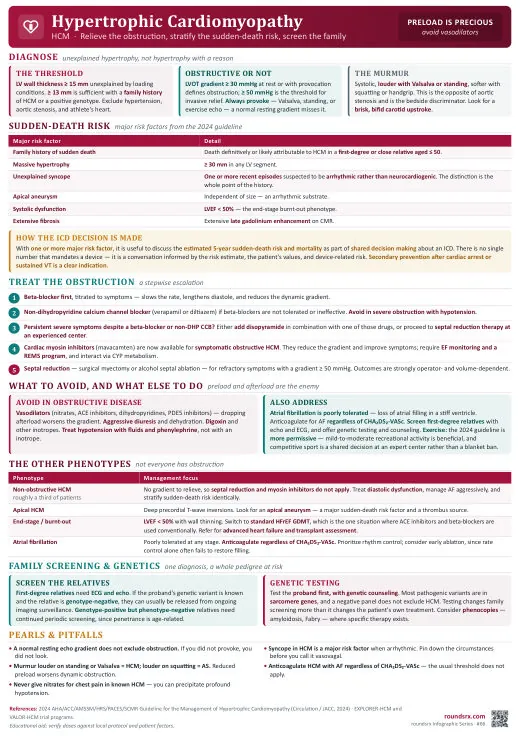
Text version
- LV wall thickness ≥ 15mm (any segment) not explained by loading conditions
- Autosomal dominant (screen first-degree relatives)
- LVOT obstruction: gradient ≥ 30 mmHg at rest or provocation
- SAM of mitral valve on echo
- Beta-blocker first-line (reduce HR → improve filling time → reduce obstruction)
- Verapamil second-line (if BB-intolerant)
- Disopyramide for refractory obstruction
- Mavacamten (cardiac myosin inhibitor) EXPLORER-HCM, 2020
- Septal myectomy or alcohol septal ablation if refractory to meds
- FH sudden cardiac death < 50 years
- Unexplained syncope
- Non-sustained VT on Holter
- Max wall thickness ≥ 30mm
- Exercise hypotension
- ICD implantation based on risk score (≥ 1 major risk factor → discuss ICD)
- Vasodilators (ACEi, nitrates) → worsen obstruction
- Diuretics → reduce preload → worsen obstruction
- Digoxin → increases contractility → worsen obstruction
- Dehydration → worse obstruction
- No competitive sports