Hyperviscosity Syndrome
| Cause | Details |
|---|---|
| Waldenström macroglobulinemia | #1 cause. IgM paraprotein -large pentamer is most viscous. Symptoms at IgM > 3 g/dL. |
| Multiple myeloma | Less common (IgA > IgG -IgA polymerizes). ~2–5% of MM cases. |
| Leukostasis | WBC > 100K (AML) or > 200–300K (CLL/ALL). White cell plugging in microvasculature. |
| Polycythemia vera | Hct > 60–65%. RBC sludging. |
- Mucosal bleeding -epistaxis, gingival bleeding (paraprotein interferes with platelet function and clotting factors)
- Visual changes -blurred vision, "sausage-link" retinal veins on fundoscopy, retinal hemorrhages
- Neurologic symptoms -headache, confusion, dizziness, stroke, coma
| Category | Specific Findings | Mechanism |
|---|---|---|
| Mucosal Bleeding | Epistaxis (most common), gingival bleeding, GI bleeding, menorrhagia, purpura | Paraprotein coats platelets (impaired aggregation) and interferes with fibrin polymerization and clotting factors |
| Visual Changes | Blurred vision, diplopia, visual loss. Fundoscopy: "sausage-link" retinal veins (alternating dilated/constricted segments), Roth spots, retinal hemorrhages (flame-shaped), papilledema, cotton-wool spots | Hyperviscous blood distends retinal veins and causes stasis → retinal ischemia and hemorrhage |
| Neurologic Symptoms | Headache, dizziness, vertigo, confusion, somnolence, obtundation, hearing loss, ataxia, stroke, coma | Cerebral hypoperfusion from sludging in cerebral microvasculature; can progress to frank infarction |
| Test | Expected Finding | Significance |
|---|---|---|
| Serum viscosity | Normal: 1.4–1.8 cP. Symptomatic: > 4 cP. Emergency: > 5–6 cP | Definitive measurement. Must be ordered specifically (not part of routine labs). |
| SPEP / Immunofixation | M-spike on electrophoresis; immunofixation identifies isotype (IgM, IgA, IgG) | Identifies the paraprotein. Large M-spike correlates with viscosity. |
| UPEP (24-hr urine) | Bence Jones protein (free light chains) | Supports myeloma diagnosis; assesses renal light-chain burden. |
| Quantitative immunoglobulins | Markedly elevated IgM (> 3 g/dL) in Waldenström; elevated IgA or IgG in myeloma | IgM > 3 g/dL almost always causes symptoms. Other Ig levels may be suppressed. |
| Fundoscopic exam | "Sausage-link" retinal veins, Roth spots, flame hemorrhages, papilledema | Pathognomonic findings. Should be performed on ALL suspected cases. Findings resolve after plasmapheresis. |
| CBC with peripheral smear | Rouleaux formation (RBCs stacked like coins), anemia, possible leukocytosis | Rouleaux is classic. Anemia may be dilutional or from marrow infiltration. |
| Coagulation studies | Prolonged PT/PTT, prolonged thrombin time | Paraprotein interferes with clotting factors and fibrin polymerization. |
| BMP, LDH, uric acid | Elevated LDH, elevated uric acid, possible renal insufficiency | Assess for tumor lysis risk and end-organ damage. |
Vision changes (blurred vision, "sausage-link" veins, Roth spots) · Immunoglobulin (IgM most common -pentamer) · Sludging of blood (hypoperfusion, microvasculature) · Coagulopathy / bleeding (epistaxis, mucosal, platelet dysfunction) · Obtundation / neuro symptoms (headache, confusion, coma) · Underlying cause (Waldenström #1, myeloma, leukostasis) · Serum viscosity > 4 cP (emergency > 5–6 cP)
Patient: 68M with known Waldenström macroglobulinemia presents with recurrent epistaxis and blurred vision over the past 3 days. On exam, bilateral retinal hemorrhages and "sausage-link" retinal veins on fundoscopy.
Labs: Serum viscosity 8.2 cP (markedly elevated). IgM 5.8 g/dL. CBC shows rouleaux formation. Hgb 9.2.
Action:
- Emergent plasmapheresis -viscosity 8.2 is critically elevated. Do NOT wait for heme/onc consult to initiate.
- Aggressive IV NS -hydration to reduce viscosity while awaiting pheresis.
- Do NOT transfuse pRBCs -will worsen sludging at this viscosity level.
- Serial fundoscopic exams after pheresis to confirm resolution of retinal findings.
- After viscosity controlled, discuss initiation of rituximab-based chemotherapy with heme/onc.
Patient: 72F with IgA multiple myeloma on lenalidomide presents with progressive confusion and severe headache over 24 hours. Family reports increasing somnolence.
Labs: Serum viscosity 5.1 cP. IgA 6.2 g/dL (polymerized). BMP shows Cr 2.1 (baseline 1.0). Peripheral smear shows rouleaux.
Action:
- Plasmapheresis -symptomatic hyperviscosity with neurologic findings. IgA less commonly causes hyperviscosity than IgM, but this patient's IgA is polymerizing.
- Neuro checks q1h -monitor for progression to obtundation or coma.
- CT head -rule out intracranial hemorrhage or stroke as alternative/concurrent diagnosis.
- Discuss chemotherapy adjustment with heme/onc -current regimen not controlling disease.
- Monitor renal function -Cr elevation may be from hyperviscosity-related renal hypoperfusion or light-chain nephropathy.
Patient: 55M presents with left leg DVT and is incidentally found to have IgM 4.5 g/dL on workup. Reports fatigue and "haziness" in vision for weeks. Fundoscopy shows early sausage-link changes. Serum viscosity 4.8 cP.
Action:
- New diagnosis of Waldenström macroglobulinemia with symptomatic hyperviscosity. Bone marrow biopsy for confirmation.
- Plasmapheresis -symptomatic with visual changes and viscosity 4.8 cP.
- Anticoagulation for DVT -heparin drip (monitor closely given bleeding risk from paraprotein).
- Avoid pRBC transfusion before viscosity is reduced -even if Hgb is low, transfusion can precipitate stroke/MI.
- Rituximab-based therapy (e.g., bendamustine-rituximab or ibrutinib) for definitive treatment. Note: rituximab can cause transient "IgM flare" (paradoxical IgM rise) -pheresis may need to be repeated.
- Plasmapheresis (plasma exchange) -first-line for symptomatic hyperviscosity. Removes paraprotein directly. 1–2 sessions typically provide rapid relief.
- Leukostasis: Leukapheresis + hydroxyurea + start definitive chemotherapy. IV fluids for dilution.
- Polycythemia: Phlebotomy to target Hct < 45%.
- IV fluids -aggressive hydration to reduce viscosity
- Avoid diuretics -worsens hemoconcentration
- Avoid pRBC transfusion -until viscosity is reduced (except for life-threatening anemia)
- Serum viscosity -normal 1.4–1.8 cP. Symptoms typically at > 4 cP. Emergency at > 5–6 cP.
- SPEP + immunofixation -identify paraprotein
- CBC with diff -WBC count (leukostasis), Hct (polycythemia)
- Quantitative immunoglobulins
- Fundoscopic exam -"sausage-link" veins, papilledema, retinal hemorrhages
- BMP, LDH, uric acid
- Coagulation studies -may be abnormal (paraprotein interference)
| Intervention | Details | Notes |
|---|---|---|
| Plasmapheresis | 1–1.5 plasma volumes per session | First-line. 1–2 sessions for symptom relief. Bridge to chemotherapy. |
| IV NS | Aggressive hydration | Dilute viscous blood. Avoid dehydration. |
| Hydroxyurea (Hydrea) | 50–100 mg/kg/day | Leukostasis -cytoreduction while awaiting chemo |
| Phlebotomy | Target Hct < 45% | Polycythemia vera |
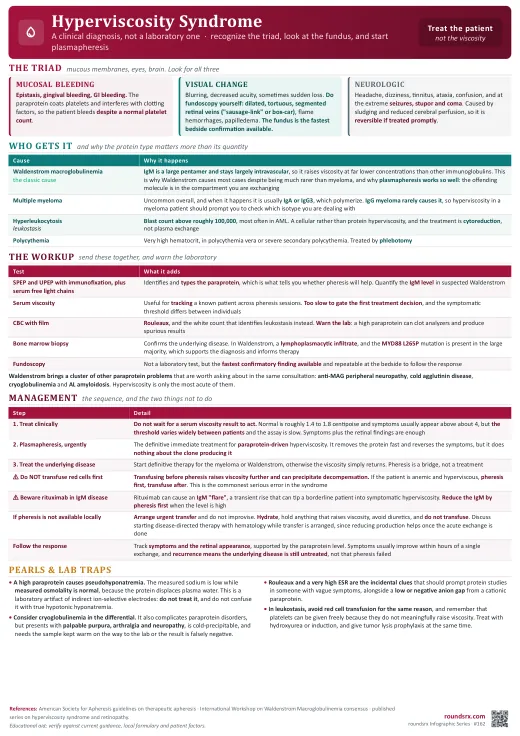
Text version
- Mucosal bleeding: epistaxis (most common), gingival bleeding, GI bleeding, menorrhagia, purpura. The paraprotein coats platelets (impaired aggregation) and interferes with fibrin polymerization and clotting factors, so PT/PTT and thrombin time can be prolonged with no primary coagulopathy.
- Visual changes: blurred vision, diplopia, visual loss. Fundoscopy shows "sausage-link" retinal veins (alternating dilated and constricted segments), Roth spots, flame-shaped retinal hemorrhages, papilledema, cotton-wool spots. Hyperviscous blood distends the retinal veins and causes stasis, leading to retinal ischemia and hemorrhage.
- Neurologic symptoms: headache, dizziness, vertigo, confusion, somnolence, obtundation, hearing loss, ataxia, stroke, coma. Cerebral microvascular sludging causes hypoperfusion that can progress to frank infarction, which is why this is time-sensitive.
- Do the fundoscopic exam on every suspected case. The findings are pathognomonic, they are available at the bedside before the viscosity result comes back, and they resolve after plasmapheresis so they also serve as your response marker.
- Waldenström macroglobulinemia, the #1 cause. IgM paraprotein; the large pentamer is the most viscous immunoglobulin. Symptoms appear at IgM > 3 g/dL.
- Multiple myeloma, less common, about 2–5% of MM cases. IgA > IgG because IgA polymerizes; IgG rarely does this because it stays a small monomer.
- Leukostasis: WBC > 100K in AML, or > 200–300K in CLL/ALL. This is not true viscosity, it is mechanical plugging of the microvasculature by large sticky blast cells (AML blasts are stickier than ALL), and that is why the treatment differs.
- Polycythemia vera: Hct > 60–65% with RBC sludging.
- Why IgM dominates: IgM circulates as a pentamer (~900 kDa) versus IgG at ~150 kDa and IgA at ~160 kDa as a monomer. The relationship between immunoglobulin concentration and viscosity is exponential, not linear, so small increases at high levels cause disproportionate rises in viscosity.
- Serum viscosity: normal 1.4–1.8 cP, symptoms > 4 cP, emergency > 5–6 cP. The definitive measurement, and it must be ordered specifically.
- SPEP with immunofixation: M-spike plus isotype (IgM, IgA, IgG). A large M-spike correlates with viscosity.
- Quantitative immunoglobulins: IgM > 3 g/dL almost always causes symptoms in Waldenström; other Ig levels may be suppressed.
- UPEP (24-hr urine): Bence Jones protein, supports myeloma and gauges renal light-chain burden.
- CBC with peripheral smear: rouleaux formation (RBCs stacked like coins) is classic. Anemia may be dilutional or from marrow infiltration.
- Coagulation studies: prolonged PT/PTT and thrombin time from paraprotein interference, not from factor deficiency.
- BMP, LDH, uric acid: assess tumor lysis risk and end-organ damage.
- Serial fundoscopy after pheresis to confirm the retinal findings are resolving, which is your objective evidence the viscosity actually came down.
- Transfusing pRBCs before plasmapheresis. This is the classic killer. Adding RBCs raises the cellular fraction without removing any paraprotein, causing a dramatic further rise in whole-blood viscosity, which worsens sludging and can precipitate stroke or MI. Hold transfusion until viscosity is reduced, even if the Hgb looks low.
- Giving diuretics for the "volume overloaded" appearance. They worsen hemoconcentration and drive viscosity up.
- Not ordering serum viscosity, then concluding the labs are unremarkable. It is not on any routine panel.
- Treating leukostasis with plasmapheresis. Leukostasis is cell plugging, not plasma viscosity; it needs leukapheresis, hydroxyurea, and emergent chemotherapy. Both syndromes look alike (CNS, pulmonary, bleeding) but the therapy differs.
- Forgetting the rituximab "IgM flare." Rituximab can cause a paradoxical transient rise in IgM in Waldenström, so pheresis may need to be repeated.
- Assuming a normal PT/PTT excludes bleeding risk, or assuming an abnormal one means DIC. The paraprotein itself interferes with platelet function and fibrin polymerization.
- Serum viscosity > 5–6 cP: emergency range, initiate plasmapheresis without waiting.
- Any neurologic finding (confusion, somnolence, focal deficit): pheresis plus neuro checks q1h to catch progression to obtundation or coma, and CT head to rule out intracranial hemorrhage or stroke as an alternative or concurrent diagnosis.
- Sausage-link retinal veins or new visual loss: retinal ischemia is already happening, treat as emergent.
- Rising creatinine: may reflect hyperviscosity-related renal hypoperfusion or light-chain nephropathy; both change urgency and both need heme/onc input.
- New paraprotein without a known diagnosis: bone marrow biopsy for confirmation once the patient is stabilized, not before pheresis.
- Concurrent thrombosis: anticoagulate but monitor closely, because the same paraprotein that causes clotting risk also causes a bleeding diathesis.
- Vision changes (blurred vision, sausage-link veins, Roth spots)
- Immunoglobulin (IgM most common, the pentamer)
- Sludging of blood (hypoperfusion in the microvasculature)
- Coagulopathy and bleeding (epistaxis, mucosal, platelet dysfunction)
- Obtundation and neuro symptoms (headache, confusion, coma)
- Underlying cause (Waldenström #1, myeloma, leukostasis)
- Serum viscosity > 4 cP (emergency > 5–6 cP)