Hypocalcemia
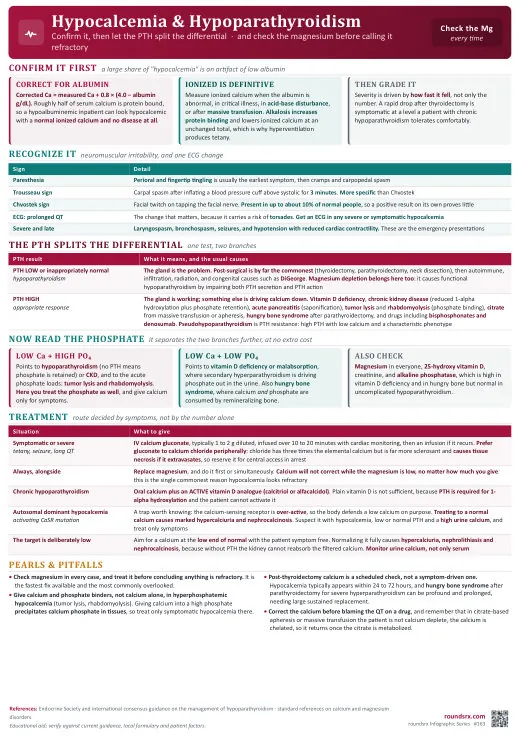
Hypocalcemia = ionized Ca < 4.4 mg/dL or corrected total Ca < 8.5 mg/dL. Correct total calcium for albumin: corrected Ca = total Ca + 0.8 × (4 − albumin). Always check ionized calcium in critically ill patients (more accurate with hypoalbuminemia, acid-base disturbances). Most common causes: (1) Post-surgical hypoparathyroidism (after thyroidectomy/parathyroidectomy -most common inpatient cause), (2) Vitamin D deficiency (most common overall), (3) CKD (decreased 1,25-OH vitamin D production), (4) Hypomagnesemia (impairs PTH secretion AND causes PTH resistance -MUST correct Mg first), (5) Acute pancreatitis (calcium saponification), (6) Massive transfusion (citrate chelates calcium). Symptoms correlate with rate of decline more than absolute level.
- Ionized calcium -most accurate, especially in ICU (not affected by albumin or pH). < 4.4 mg/dL = hypocalcemia.
- Corrected total calcium -if ionized not available. Corrected = total + 0.8 × (4 − albumin).
- Albumin -for correction. Low albumin → falsely low total Ca (but ionized is normal).
- PTH (intact) -the diagnostic branch point. Low PTH = hypoparathyroidism (post-surgical, autoimmune, infiltrative). High PTH = secondary hyperparathyroidism (vitamin D deficiency, CKD, PTH resistance).
- Magnesium -MUST check. Mg < 1.5 → impairs PTH secretion AND causes end-organ PTH resistance. Hypocalcemia will NOT correct until Mg is repleted.
- 25-OH vitamin D -< 20 ng/mL = deficiency. Most common cause of hypocalcemia worldwide.
- 1,25-dihydroxy vitamin D -low in CKD (can't hydroxylate 25-OH to active form). Also low in hypoparathyroidism (PTH stimulates 1-alpha-hydroxylase).
- Phosphate -high PO₄ + low Ca = hypoparathyroidism or CKD. Low PO₄ + low Ca = vitamin D deficiency.
- ECG -prolonged QTc (risk of torsades de pointes). Also: ST changes mimicking ischemia.
- BMP, Cr -CKD assessment
- EMERGENT (symptomatic or iCa < 3.2):
- Calcium gluconate 10% 1-2 g (10-20 mL) IV over 10-20 min -first-line, and safe through a peripheral IV. Repeat until symptoms resolve.
- Calcium chloride 10% 1 g IV over 5-10 min through a central line only -it carries 3× the elemental calcium (272 mg/g vs 93), but extravasation causes tissue necrosis.
- Follow the bolus with an infusion -5-10 g calcium gluconate in 500 mL D5W over 12-24h. A bolus alone wears off within hours and the tetany returns.
- Continuous ECG monitoring -the prolonged QT is what precedes the arrhythmia, so it is the parameter that tells you the correction is working.
- Do NOT run calcium in the same line as bicarbonate or phosphate -they precipitate. Flush between, or use a separate line.
- Correct MAGNESIUM FIRST: Hypocalcemia will NOT respond to calcium supplementation if Mg is depleted. MgSO₄ 2-4g IV over 20-60 min.
- Chronic management:
- Vitamin D deficiency: Ergocalciferol 50,000 IU PO weekly × 8-12 wk → maintenance 1000-2000 IU daily
- Hypoparathyroidism: Calcitriol 0.25-2 mcg PO BID + calcium carbonate 1-3g TID with meals. Target: low-normal Ca (8-8.5) to avoid hypercalciuria.
- CKD: Calcitriol (active vitamin D) + phosphate binders. Correct 25-OH vitamin D if deficient. Manage per CKD-MBD guidelines.
| Drug | Dose | Route | Notes |
|---|---|---|---|
| Calcium gluconate 10% | 1-2g (10-20 mL) IV over 10-20 min | IV | First-line IV. Can use peripheral IV. 93 mg elemental Ca per gram. Repeat PRN. Follow with drip. |
| Calcium chloride 10% | 1g (10 mL) IV over 5-10 min | IV (central) | 3× more elemental Ca than gluconate (272 mg/g). Central line ONLY -tissue necrosis risk. For arrest/severe tetany. |
| Ca gluconate drip | 5-10g in 500 mL D5W over 12-24h | IV | Continuous infusion for sustained correction. Do NOT mix with bicarb (precipitates). |
| MgSO₄ | 2-4g IV over 20-60 min | IV | Correct Mg BEFORE Ca. Hypomagnesemia causes PTH resistance → Ca won't correct. |
| Calcitriol | 0.25-2 mcg PO BID | PO | Active vitamin D. For hypoparathyroidism + CKD. Fast onset (1-2 days). Monitor Ca closely (narrow window). |
| Ergocalciferol (D2) | 50,000 IU weekly × 8-12 wk | PO | Vitamin D deficiency repletion. Then maintenance 1000-2000 IU daily. |
| Calcium carbonate | 500-1500 mg elemental TID with meals | PO | Chronic replacement. Requires gastric acid for absorption (take with food, not with PPI). |
Patient: 48F, POD1 from total thyroidectomy for papillary thyroid carcinoma. Perioral tingling, hand cramping. HR 94, BP 130/78. Positive Trousseau and Chvostek signs. iCa 3.4 mg/dL, Mg 1.9, PO₄ 5.4, PTH < 5. QTc 520 ms.
Key findings: Post-surgical hypoparathyroidism, most common cause of acute hypocalcemia in hospital. Low PTH + low Ca + high PO₄ = classic pattern. QTc prolongation → arrhythmia risk.
Management:
- Calcium gluconate 2g IV over 20 min → start continuous drip (6g in 500 mL D5W at 50 mL/hr)
- Calcitriol 0.5 mcg PO BID (active vitamin D, bypasses PTH-dependent 1-alpha-hydroxylation)
- Oral calcium carbonate 1-2g TID with meals (long-term replacement)
- Check iCa q4-6h until stable on drip. Target iCa > 4.0 mg/dL
- Telemetry for QTc monitoring, torsades risk if QTc > 500 ms
Teaching point: Use calcitriol (not ergocalciferol) in hypoparathyroidism, without PTH, the kidney cannot 1-alpha-hydroxylate 25-OH vitamin D to its active form. Calcitriol is already active and works within hours.
Patient: 34F with CKD stage 5 (not yet on dialysis). Generalized tonic-clonic seizure in ED. iCa 2.8 mg/dL, Mg 1.2, PO₄ 8.4, PTH 380 (elevated). Cr 7.8. QTc 560 ms.
Key findings: Severe hypocalcemia from CKD: elevated PO₄ (can't excrete), elevated PTH (secondary hyperparathyroidism but can't make active vitamin D), and hypomagnesemia (impairs PTH action). Seizure = emergent.
Management:
- Calcium gluconate 4g IV over 20 min (2 amps in code-like urgency for seizure)
- Magnesium sulfate 2g IV over 1h, MUST correct Mg first or Ca will not stay up
- Continuous calcium drip after bolus, iCa q2h until > 4.0
- Sevelamer 800 mg TID with meals (phosphate binder, high PO₄ complexes with Ca, worsening hypocalcemia)
- Calcitriol 0.25-0.5 mcg daily. Expedite dialysis initiation (nephrologist)
Teaching point: In CKD hypocalcemia, lowering phosphate is as important as giving calcium. High PO₄ × Ca product > 55 → metastatic calcification (soft tissue calcium deposits). Always correct Mg concurrently, it's futile to give calcium without adequate Mg.
Patient: 72F from nursing home, minimal sun exposure, poor nutrition. Progressive fatigue, muscle cramps, diffuse bone pain. Ca 7.8, albumin 3.8 (corrected Ca 8.0), PO₄ 2.0 (low), PTH 185 (elevated), 25-OH vitamin D 6 ng/mL (severely deficient). ALP 240 (elevated).
Key findings: Vitamin D deficiency → low Ca AND low PO₄ (both malabsorbed). PTH appropriately elevated (secondary hyperparathyroidism). Elevated ALP = increased bone turnover (osteomalacia). This is the classic pattern: low Ca, low PO₄, high PTH, high ALP.
Management:
- Ergocalciferol (D2) 50,000 IU PO weekly × 8-12 weeks, then 1000-2000 IU daily maintenance
- Oral calcium carbonate 1-1.5g daily (gut absorption impaired without vitamin D, will improve as D repletes)
- Recheck 25-OH vitamin D at 8-12 weeks, target > 30 ng/mL
- Monitor Ca, PO₄, PTH, PTH should normalize as vitamin D repletes
- DEXA scan once vitamin D replete (osteomalacia artificially lowers T-score)
Teaching point: The phosphate level is the key differentiator: low PO₄ = vitamin D deficiency (both Ca and PO₄ malabsorbed, PTH causes phosphaturia). High PO₄ = hypoparathyroidism or CKD (PTH normally wastes phosphate, without PTH, PO₄ rises).
Mrs. Liu is a 55-year-old woman, post-op day 1 from total thyroidectomy for papillary thyroid carcinoma. Nurse calls for perioral tingling and hand cramping. VS: HR 92, BP 128/78. Exam: positive Trousseau sign, positive Chvostek sign. Labs: iCa 3.6 mg/dL (low), Mg 1.8, PO₄ 5.2 (high), PTH < 5 (low). ECG: QTc 510 ms.
- Ionized calcium q4-6h during IV replacement (q2h if critically symptomatic)
- ECG -QTc monitoring. QTc should shorten as Ca normalizes. Torsades risk if QTc > 500 ms.
- Mg level -recheck after repletion. Must remain > 1.5 for Ca correction to work.
- Post-thyroidectomy: ionized Ca q6h × 24-48h. Albumin-corrected Ca unreliable post-surgery (fluid shifts). ATA Thyroidectomy Guidelines, 2020
- Phosphate -trending helps differentiate causes. Falling PO₄ + rising Ca on treatment = responding to vitamin D/PTH replacement.
- Chvostek and Trousseau signs -clinical bedside assessment. Chvostek: tap facial nerve → ipsilateral facial twitch. Trousseau: BP cuff inflated above systolic × 3 min → carpal spasm (more specific).
- 24h urine calcium -for chronic hypoparathyroidism. Target: avoid hypercalciuria (> 300 mg/24h) → nephrolithiasis risk.
- Cr -calcium + vitamin D therapy can worsen renal function. Monitor in CKD patients.