Inpatient Hypoglycemia
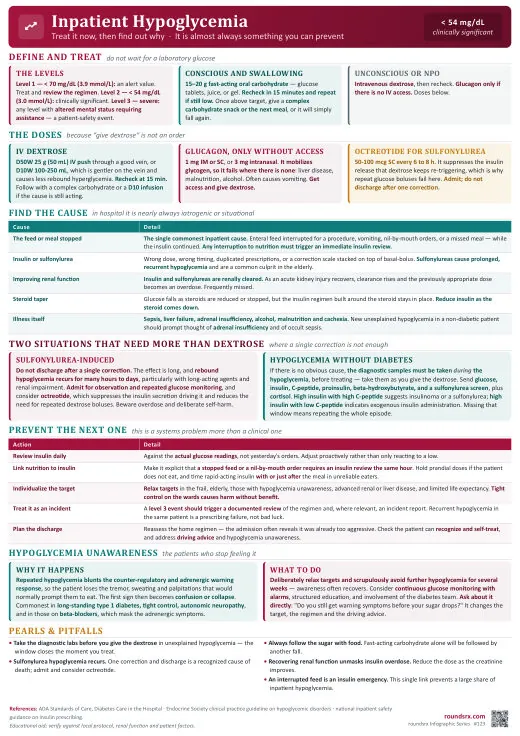
Inpatient hypoglycemia (glucose < 70 mg/dL) affects up to 10-30% of hospitalized diabetic patients and is independently associated with increased mortality, longer LOS, and ICU transfer. NICE-SUGAR, NEJM 2009 Classified as: Level 1 (54-70 mg/dL, alert), Level 2 (< 54, clinically significant), Level 3 (severe, requiring assistance from another person). Most common causes: (1) insulin-food mismatch (holding meals while continuing insulin), (2) renal insufficiency (reduced insulin clearance), (3) reduced PO intake (NPO, nausea, surgery), (4) medication errors. Key principle: every hypoglycemic event is preventable and deserves root cause analysis. The attending will ask "why did this happen and what did you change?"
- Confirm with venous glucose -point-of-care glucometers are less accurate at low ranges. Whipple's triad: symptoms + low glucose + symptom resolution with glucose correction.
- Review insulin/secretagogue doses -#1 cause. Check timing of last insulin dose vs last meal. Basal insulin too high? Sliding scale overlapping with scheduled dose?
- BMP -Cr (AKI/CKD reduces insulin clearance → prolonged insulin effect), hepatic function (reduced gluconeogenesis)
- Medication reconciliation -sulfonylureas (long-acting, especially in CKD), insulin dose errors, fluoroquinolones (rare), pentamidine, beta-blockers (mask symptoms)
- NPO status -was patient made NPO for procedure while basal insulin continued?
- Nutrition assessment -decreased PO intake, skipped meals, vomiting, new tube feed interruption
- If non-diabetic unexplained hypoglycemia: insulin level + C-peptide + proinsulin + sulfonylurea screen (draw DURING hypoglycemia). High insulin + high C-peptide = endogenous hyperinsulinism (insulinoma). High insulin + low C-peptide = exogenous insulin. High C-peptide + positive SU screen = sulfonylurea use.
- Cortisol -if adrenal insufficiency suspected (especially if recurrent hypoglycemia with hypotension)
- Reduce basal insulin by 20-40% if the episode occurred overnight or fasting ADA Standards of Care, 2026
- Hold or reduce prandial insulin if patient is eating less than usual or NPO
- Discontinue sulfonylurea in CKD/AKI (long half-life → recurrent hypoglycemia for 24-72h)
- Adjust sliding scale -reduce correction factor if consistently hypoglycemic
- Ensure meal delivery before prandial insulin -coordinate with nursing
- Hold prandial insulin if patient is NPO -only continue basal (and reduce by 20-50%)
| Drug | Dose | Route | Notes |
|---|---|---|---|
| D50W (Dextrose 50%) | 25g (50 mL) IV push | IV | First-line for severe/unable to eat. Repeat q15min PRN. Causes phlebitis -use large bore IV. |
| D10W drip | 50-100 mL/hr | IV | For recurrent hypoglycemia (especially sulfonylurea-induced). Prevents repeated D50 pushes. |
| Glucagon | 1 mg IM/SQ | IM/SQ | If no IV access. Mobilizes hepatic glycogen. Ineffective if glycogen-depleted (alcoholics, liver failure). Causes nausea. |
| Octreotide (Sandostatin) | 50 mcg SQ q6h | SQ | For sulfonylurea-induced hypoglycemia refractory to D10. Suppresses insulin release from pancreatic beta cells. McLaughlin, 2000 |
| Oral glucose (juice/tabs) | 15-20g fast-acting carbs | PO | First-line if alert + able to swallow. Follow with complex carbs. Recheck at 15 min. |
Mr. Garcia is a 68-year-old man with T2DM on glargine 40 units + glipizide 10 mg BID, admitted for pneumonia, found to have fingerstick glucose of 38 at 3 AM. Diaphoretic, confused. Last meal was dinner at 5 PM (ate 50% of tray). Cr 2.4 (baseline 1.2). Received full sliding scale correction of 6 units at 9 PM for glucose of 220.
- Fingerstick glucose q15 min until glucose > 100 and stable
- Then q1h × 4h to ensure no recurrence (especially with long-acting insulin or sulfonylureas)
- Resume regular glucose monitoring (AC/HS or q6h) once stable
- Review all insulin orders after ANY hypoglycemic event -this is the intern's most important action
- Notify attending of any Level 2 (< 54) or Level 3 (severe) hypoglycemia
- Hypoglycemia event report -many hospitals require formal incident reporting
- Pre-prandial glucose + post-meal check if adjusting regimen -verify effectiveness of changes
- A1c -helps guide discharge insulin regimen (A1c < 7% on insulin = possibly over-basal'd)