Hyponatremia
| Serum Osm | Category | Causes |
|---|---|---|
| < 275 (low) | Hypotonic (true hyponatremia) | Most cases. Proceed to Step 2. Includes post-TURP (transurethral resection of the prostate) absorption of glycine or sorbitol irrigant, which is genuinely hypo-osmolar and therefore swells the brain, unlike the mannitol row below. |
| 275–295 (normal) | Isotonic (pseudohyponatremia) | Hyperlipidemia, hyperproteinemia (multiple myeloma). Lab artifact -true Na is normal. Check lipid panel + protein. |
| > 295 (high) | Hypertonic (translocational) | Hyperglycemia (#1 -correct Na for glucose: add 1.6 mEq/L Na for every 100 mg/dL glucose above 100), mannitol, IV contrast. The water is pulled out of cells, so the patient is hypertonic despite the low sodium: do NOT give hypertonic saline. |
- Where you will actually meet it: mannitol given for raised intracranial pressure or cerebral edema (severe TBI, large hemispheric stroke, tumor with mass effect), for acute angle-closure glaucoma to drop the intraocular pressure, and mannitol used as the irrigant during monopolar TURP or hysteroscopy. The neuro-ICU patient on repeated dosing is the classic setup, because the risk is cumulative.
- Mechanism: mannitol is an effective osmole, meaning it stays outside cells. It raises plasma osmolality, which pulls intracellular water out into the extracellular space, and that water dilutes the serum sodium. The sodium falls while the patient is hypertonic, which is the opposite of ordinary hyponatremia.
- How to recognize it: the measured osmolality exceeds the calculated osmolality (2 × Na + glucose/18 + BUN/2.8), producing an osmolal gap, because mannitol is a solute the calculation does not include. A low sodium plus a high measured osmolality plus an osmolal gap in someone who received mannitol is the entire diagnosis.
- Do not give hypertonic saline: the brain cells are already shrunken by the hypertonicity, so adding more tonicity worsens the problem you are trying to treat. The treatment is to stop the mannitol and let the kidney clear it, and dialysis if it has accumulated and the patient is symptomatic.
- Accumulation is the setup, and renal impairment is the risk factor: mannitol is freely filtered and not reabsorbed, so clearance depends entirely on GFR. In AKI or CKD it builds up in the circulation and keeps pulling water out of cells. Follow the osmolal gap rather than the serum osmolality alone before each repeat dose, since a rising gap means drug is accumulating even when the calculated numbers look acceptable.
- The second phase flips to hypernatremia: once mannitol reaches the tubule it drives an osmotic diuresis that loses proportionally more water than sodium. The same drug therefore causes hyponatremia early and hypernatremia later, so a patient on repeated dosing needs the sodium followed in both directions rather than checked once.
- Watch the potassium too: water leaving cells carries potassium with it, so the identical shift that lowers the sodium can raise the potassium, and it does so fastest in the patients with the worst renal clearance.
- Why the irrigant is electrolyte-free in the first place: monopolar transurethral resection of the prostate (TURP) returns current through the patient's body to a grounding pad, so a conductive fluid such as saline would disperse the current and stop the loop cutting. That forces an electrolyte-free irrigant: glycine 1.5%, sorbitol, or mannitol. The hyponatremia is a direct consequence of the electrosurgical design, not of the surgery itself.
- How it gets in: resection opens prostatic venous sinuses, and irrigation pressure exceeding venous pressure drives fluid straight into the circulation at roughly 20 mL/min, which is several liters across a long resection. About 1 L absorbed in an hour drops the sodium 5 to 8 mEq/L.
- The triad is hyponatremia, hypo-osmolality, and hypervolemia. Glycine 1.5% runs about 200 mOsm/L and contains no sodium. The hypo-osmolality is what swells the brain (headache, confusion, seizures, and in severe cases herniation), while the hypervolemia is what floods the lungs.
- The vital signs run backwards from what you expect: intraoperative trouble usually means tachycardia and hypotension, but irrigant absorption gives hypertension with bradycardia because the problem is volume overload. In an awake patient under spinal anesthesia, restlessness, nausea, confusion, and visual disturbance arrive first and give you a warning. Under general anesthesia that warning is erased, and the presentation may be an unexplained blood pressure rise, ECG changes, or a seizure. That early-warning value is a large part of why spinal anesthesia is favored for TURP.
- Glycine carries two toxicities beyond the sodium: it is metabolized to ammonia, so hyperammonemic encephalopathy can persist after the sodium is fixed and explains the patient who stays confused despite a corrected number; and it is an inhibitory neurotransmitter in the retina, so it causes transient blurred vision or frank blindness. Transient blindness after a TURP is the glycine, not a stroke, and it resolves as the glycine clears, which saves the patient an emergent stroke workup.
- Management: tell the surgeon to stop and terminate the resection, secure the airway, and send an immediate sodium and osmolality. Give 3% hypertonic saline for seizures or severe neurologic symptoms, and add a loop diuretic when there is pulmonary edema, since this patient is volume overloaded rather than dry. Use dialysis or CRRT for profound hyponatremia with volume overload, where hypertonic saline alone would worsen the fluid load.
- Anticipate spontaneous overcorrection: as glycine is metabolized and the absorbed water is excreted, the sodium climbs on its own. Layer hypertonic saline on top of that and you can overshoot into osmotic demyelination. Recheck the sodium every 1 to 2 h and stop the hypertonic saline the moment symptoms resolve. This hyponatremia developed over minutes to hours, so the brain has not adapted and the demyelination risk is lower than in chronic hyponatremia, but respect the 24-hour ceiling anyway because you can rarely be certain the baseline was normal.
- Prevention, and why this is now uncommon: bipolar resection keeps the current flowing between two electrodes millimeters apart on the resectoscope tip, so it never crosses the patient and normal saline can be used as the irrigant, which has made classic TURP syndrome rare. Also limit resection time, keep the irrigation bag height low to reduce driving pressure, and check a sodium during long resections rather than waiting for symptoms.
| Irrigant | Resulting picture | Extra toxicity beyond the sodium |
|---|---|---|
| Glycine 1.5% (~200 mOsm/L, most common in monopolar TURP) | Hypotonic hyponatremia with true hypo-osmolality, so cerebral edema is the danger | Metabolized to ammonia (encephalopathy outlasting the sodium correction) and transient visual disturbance or blindness from retinal inhibition |
| Sorbitol 3% | Hypotonic hyponatremia, same cerebral edema risk | Metabolized to fructose and glucose, so hyperglycemia and lactic acidosis, which matters most in diabetics |
| Mannitol 5% (~275 mOsm/L, near iso-osmolar) | Dilutional hyponatremia without hypo-osmolality, so volume overload dominates rather than cerebral edema | Intravascular expansion and pulmonary edema, then an osmotic diuresis as it is excreted |
| Normal saline (possible only with bipolar resection) | No hyponatremia, which is the entire reason bipolar equipment displaced monopolar | Large absorbed volumes can still cause hyperchloremic metabolic acidosis and fluid overload |
| Volume Status | Urine Na | Causes | Treatment |
|---|---|---|---|
| Hypovolemic (dry mucous membranes, orthostasis, tachycardia, skin tenting) | < 20: extrarenal losses (GI: vomiting, diarrhea; 3rd spacing: burns, pancreatitis) > 20: renal losses (diuretics, adrenal insufficiency, cerebral salt wasting) | GI losses, diuretics, adrenal crisis, burns | Volume resuscitation with NS. Na will correct as volume is restored. Watch for overcorrection -once ADH stimulus (hypovolemia) is removed, kidneys dump free water rapidly. |
| Euvolemic (no edema, no orthostasis -hardest to assess) | > 40 (inappropriately concentrated urine) | SIADH (#1), hypothyroidism, adrenal insufficiency, psychogenic polydipsia (Uosm < 100), beer potomania, tea-and-toast | Fluid restriction (SIADH). Treat underlying cause. See SIADH topic for details. |
| Hypervolemic (edema, JVD, ascites, anasarca) | < 20: CHF, cirrhosis, nephrotic syndrome (effective hypovolemia → ADH release → water retention) > 20: CKD/ESKD (kidneys can't excrete water) | HF, cirrhosis, nephrotic, CKD | Fluid restriction + treat underlying disease. Diuretics for HF/cirrhosis. Dialysis if ESKD. |
| Hypervolemic, acute and iatrogenic post-TURP or operative hysteroscopy | > 20 (the sudden volume expansion drives a natriuresis, which lowers the sodium further) | Absorbed hypotonic irrigant: glycine 1.5% or sorbitol during monopolar resection. Suspect it on hypertension with bradycardia, the reverse of the usual intraoperative crash, plus confusion or visual disturbance in an awake patient | Stop the resection first. This is the one hypervolemic hyponatremia where you still give 3% hypertonic saline for seizures or severe symptoms, adding a loop diuretic for pulmonary edema. Full section |
- Serum osmolality (first -classifies the hyponatremia)
- Urine osmolality (Uosm < 100 = appropriate dilution → water overload/polydipsia. Uosm > 100 = kidneys inappropriately concentrating → ADH-mediated)
- Urine sodium (renal vs extrarenal losses in hypovolemic; confirms SIADH if > 40 in euvolemic)
- Serum glucose (correct for hyperglycemia: add 1.6 per 100 above 100)
- TSH, AM cortisol (rule out hypothyroidism and adrenal insufficiency before diagnosing SIADH)
- Osmolal gap (measured minus calculated osmolality) whenever the patient received mannitol or absorbed irrigant -an unmeasured osmole means you are dealing with a translocational or iatrogenic hyponatremia, not a volume problem, and the treatment changes completely
| Scenario | Max Correction Rate | Treatment |
|---|---|---|
| Chronic (> 48h or unknown duration) | ≤ 8 mEq/L in 24h (some guidelines use ≤ 10). High-risk for ODS: ≤ 6 mEq/L in 24h. | Fluid restriction (SIADH), NS (hypovolemic), treat underlying cause. Check Na q4–6h. |
| Acute (< 48h, known onset) | Can correct faster -brain hasn't adapted. Still aim for ≤ 10–12 mEq/L in 24h. | More aggressive treatment acceptable. Still monitor closely. |
| Symptomatic (seizures, coma, severe AMS) | Immediate goal: raise Na by 4–6 mEq/L in first 6h to stop symptoms. Then ≤ 8 total in 24h. | 3% hypertonic saline 100–150 mL IV bolus over 10–20 min. SALSA, 2021 May repeat × 2. ICU. Check Na q2h. |
- Occurs 2–6 days after overcorrection -not immediately
- Central pontine myelinolysis → "locked-in syndrome" (quadriplegia, inability to speak/swallow, preserved consciousness)
- Risk factors for ODS: chronic hyponatremia (> 48h), alcoholism, malnutrition, hypokalemia (correct K⁺ simultaneously -K⁺ correction counts toward Na correction!), liver disease, Na < 105
- If overcorrecting (Na rising too fast): (1) D5W infusion (free water to re-lower Na), (2) DDAVP 2 mcg IV q8h (clamp urine output → stop Na from rising further), (3) target: bring Na back within safe correction range
Patient: 68F with SCLC, found lethargic, Na⁺ 118 mEq/L.
Step 1 -Is this real? Serum osm: 248 (< 280 = true hypoosmolar hyponatremia). Not pseudohyponatremia.
Step 2 -Assess volume status:
- Exam: Mucous membranes moist, no edema, no JVD, skin turgor normal → euvolemic
- Urine Na: 45 mEq/L (> 40 = kidneys wasting Na → SIADH)
- Urine osm: 520 (> 100 = kidneys concentrating inappropriately → SIADH)
- TSH: normal. AM cortisol: normal (rules out hypothyroid and adrenal insufficiency)
Diagnosis: SIADH from SCLC (paraneoplastic ADH secretion)
Step 3 -Treatment:
- Symptomatic (lethargic) → 3% hypertonic saline 100 mL IV bolus over 10 min. Recheck Na in 2h.
- Na went 118 → 121 (+3 in 2h) -good. Symptoms improving.
- Target: correct ≤ 8 mEq/L in first 24h (risk of osmotic demyelination if faster)
- Fluid restriction 1L/day for maintenance
- If refractory SIADH: tolvaptan (Samsca) 15mg PO daily (check Na q6h -potent)
Patient: 48M heavy beer drinker (12+ beers/day), found confused. Na⁺ 108 mEq/L. No edema. Uosm 58 (maximally dilute).
Diagnosis: Beer potomania, massive free water intake with minimal solute intake → kidneys cannot excrete the water load despite maximally dilute urine.
Treatment:
- STOP free water intake. Normal saline is usually sufficient (not hypertonic) because once solute intake resumes, kidneys correct rapidly.
- Monitor Na q2h closely.
- If correcting > 8 mEq/day → give DDAVP 2 mcg IV q8h + D5W to slow correction.
⚠️ DANGER: These patients auto-correct too fast once admitted and beer is stopped. The kidneys suddenly have enough solute to excrete free water → Na shoots up.
Key lesson: Beer potomania corrects itself dangerously fast when you admit the patient and stop beer. DDAVP rescue may be needed to SLOW correction.
Patient: 72F started on sertraline 3 weeks ago, presents with nausea and confusion. Na⁺ 122 mEq/L. Euvolemic.
Labs: Uosm 580 (inappropriately concentrated). Urine Na 65. TSH and cortisol normal.
Diagnosis: Classic SIADH from SSRI.
Treatment:
- Fluid restriction 1–1.2 L/day (first-line for SIADH).
- If not improving → salt tabs 1–2 g TID + loop diuretic (furosemide 20 mg, forces dilute urine).
- Consider stopping sertraline or switching to a less SIADH-prone antidepressant.
- Avoid hypertonic saline unless symptomatic (seizures, severe AMS).
Key lesson: Always check the med list for SIADH causes. SSRIs are the #1 medication cause. Fluid restriction is first-line, not hypertonic saline.
| Test | Rationale | Key Values / Interpretation |
|---|---|---|
| Serum osmolality | First step -classifies the hyponatremia. | < 275 = hypotonic (true hyponatremia -proceed to step 2). 275-295 = isotonic (pseudohyponatremia -check lipids, protein). > 295 = hypertonic (hyperglycemia -correct Na: add 1.6 mEq/L per 100 mg/dL glucose above 100). |
| Urine osmolality | Distinguishes ADH-mediated from water overload. | < 100 mOsm/kg = kidneys appropriately diluting (polydipsia, beer potomania, tea-and-toast). > 100 = ADH-mediated (inappropriate concentration → SIADH, hypovolemia, hypervolemia). |
| Urine sodium | Differentiates renal from extrarenal sodium losses in hypovolemic states; confirms SIADH in euvolemic. | UNa < 20 = extrarenal losses (GI, third-spacing) or effective hypovolemia (CHF, cirrhosis). UNa > 40 in euvolemic state = SIADH. UNa > 20 in hypovolemic = renal losses (diuretics, adrenal insufficiency). |
| Volume status (clinical) | Essential physical exam -guides entire differential and treatment. | Hypovolemic (orthostasis, dry mucous membranes, tachycardia) → NS. Euvolemic → SIADH workup. Hypervolemic (edema, JVD, ascites) → CHF/cirrhosis/nephrotic. |
| TSH | Hypothyroidism is a reversible cause -must exclude before diagnosing SIADH. | Severe hypothyroidism → decreased free water clearance → hyponatremia. Treat thyroid disease first. |
| AM cortisol | Adrenal insufficiency mimics SIADH (euvolemic, high UNa). Must exclude before SIADH diagnosis. | AM cortisol < 3 = adrenal insufficiency likely. 3-15 = indeterminate → ACTH stimulation test. > 15 = AI unlikely. |
| Serum glucose | Correct Na for hyperglycemia (translocational hyponatremia). | Corrected Na = measured Na + 1.6 × [(glucose - 100) / 100]. If corrected Na is normal → not true hyponatremia. |
| Drug | Dose | Route | Indication | Key Notes |
|---|---|---|---|---|
| 3% Hypertonic saline | 100-150 mL IV bolus over 10-20 min. May repeat × 2 (max 3 boluses). | IV | Severe symptomatic hyponatremia (seizures, coma, severe AMS) | ICU setting. Goal: raise Na by 4-6 mEq/L in first 6h to stop symptoms. Check Na q2h. Rapid intermittent bolus is as effective and safer than continuous infusion SALSA, 2021. |
| Fluid restriction | 1-1.5 L/day (all PO and IV fluids combined) | - | SIADH (first-line), hypervolemic hyponatremia (HF, cirrhosis) | Effective if urine osmolality is not extremely high. Poor compliance limits effectiveness. Calculate free water clearance to predict response. |
| NaCl tablets (salt tabs) | 1-3 g PO TID | PO | Chronic SIADH (with or without loop diuretic) | Often combined with furosemide 20 mg daily -the diuretic promotes free water excretion while salt tabs replenish sodium. Effective outpatient strategy. |
| Furosemide | 20-40 mg PO daily | PO | Combined with salt tabs for chronic SIADH | Impairs urinary concentration → promotes electrolyte-free water excretion. Only effective when combined with adequate sodium intake (salt tabs). |
| Tolvaptan (Samsca) | 15 mg PO daily (may increase to 30-60 mg) | PO | Refractory SIADH or hypervolemic hyponatremia not responding to fluid restriction | V2 receptor antagonist ("vaptan") -blocks ADH at collecting duct → aquaresis (free water loss). Must initiate inpatient. Check Na q6h for first 24h. Hepatotoxicity risk -do not use > 30 days. Do NOT use in hypovolemic hyponatremia. |
| Demeclocycline | 300-600 mg PO BID | PO | Alternative for chronic SIADH (if tolvaptan not available/tolerated) | Tetracycline that induces nephrogenic DI. Slow onset (3-5 days). Nephrotoxic -avoid in liver disease. Largely replaced by tolvaptan. |
| DDAVP (desmopressin) | 2 mcg IV q8h | IV | ODS rescue -given when Na is overcorrecting too rapidly | Clamps urine output → stops further Na correction. Combine with D5W (3-6 mL/kg/hr) to actively re-lower Na. Target: bring correction rate back to ≤ 8 mEq/L in 24h. |
| D5W (5% dextrose) | 3-6 mL/kg/hr | IV | ODS rescue -free water to re-lower sodium if overcorrecting | Used with DDAVP. The dextrose is metabolized, leaving free water. Start immediately if Na rising > 8-10 mEq/L in 24h. |
Patient: 72 y/o F on sertraline x3 weeks, presents with confusion. Na⁺ 112 (was 128 two weeks ago).
Key findings: Serum osm 238, urine osm 480, UNa 52, euvolemic. TSH and cortisol normal. SIADH from sertraline.
Management:
- Stop sertraline, removing the SIADH stimulus may cause rapid free water excretion
- Fluid restriction < 1L/day + salt tabs 1g TID
- Na rose 10 mEq in 18h (overcorrection), start ODS rescue: D5W + DDAVP 2 mcg IV q8h
- Re-lower Na back to safe correction rate (≤ 8 mEq/24h); recheck Na q2h
Teaching point: When the SIADH stimulus is removed, ADH drops and free water is excreted rapidly, causing overcorrection. ODS is devastating and irreversible. High-risk patients need proactive DDAVP clamping.
Patient: 55 y/o M with SCLC, found seizing at home. Na⁺ 104, obtunded.
Key findings: Serum osm 218, urine osm 640, UNa 68, GCS 8. Euvolemic. Ectopic ADH from SCLC.
Management:
- 3% NaCl 100-150 mL bolus over 10 min, repeat x1 if still seizing
- Target 4-6 mEq/L acute rise to stop seizures, then ≤ 8 mEq/24h total
- Check Na q2h during correction; DDAVP 2 mcg IV q8h proactively to prevent overcorrection
- ICU admission, oncology for underlying SCLC treatment
Teaching point: Seizures from hyponatremia require emergent 3% NaCl, the one scenario where rapid correction is indicated. Target only enough rise to stop symptoms, then strictly limit total correction.
Patient: 48 y/o M, chronic alcohol use, Na⁺ 118. Drinks 12+ beers daily, minimal food intake.
Key findings: Serum osm 248, urine osm 52 (maximally dilute, ADH suppressed), UNa 8. Malnourished.
Management:
- Urine osm 52 = ADH appropriately suppressed, this is NOT SIADH
- Low solute intake → low obligate urine output → cannot excrete enough free water
- Treatment: normal diet (increase solute) + fluid restriction
- HIGH overcorrection risk when diet resumes, use prophylactic DDAVP
Teaching point: Urine osm < 100 rules out SIADH. Beer potomania corrects rapidly when normal diet resumes, proactive DDAVP is essential to prevent ODS. SALT-1/2, 2006 showed tolvaptan is effective for SIADH but is NOT appropriate for low-solute states.
| Parameter | Frequency | Target / Action |
|---|---|---|
| Serum sodium | q2h if on hypertonic saline; q4-6h during active correction; q6-8h once stable | Max correction ≤ 8 mEq/L in any 24h period (≤ 6 in high-risk: alcoholism, malnutrition, hypokalemia, liver disease, Na < 105). If overcorrecting → DDAVP + D5W rescue immediately. |
| Serum osmolality | At baseline, then q12-24h during correction | Should rise proportionally with Na. Guides assessment of correction adequacy. |
| Urine output | q1-2h during active treatment | Sudden brisk water diuresis (> 200 mL/hr of dilute urine) = danger sign for overcorrection. This happens when ADH stimulus is removed (e.g., volume resuscitation in hypovolemic hyponatremia). Start DDAVP preemptively if UOP surges. |
| Neurological status | q2-4h during active correction | Improving: resolution of confusion, seizures, lethargy = adequate correction. New dysarthria, dysphagia, quadriparesis 2-6 days after correction = ODS -MRI brain, neurology consult. |
| Potassium | With each Na check | K⁺ correction counts toward Na correction (K⁺ enters cells, Na⁺ comes out). If repleting K⁺ aggressively, account for this in your correction rate calculation. |
| I&Os | Strict q1h during active treatment | Track all free water intake (IV and PO). Ensure fluid restriction is enforced if indicated. Document urine osmolality if available (Uosm < 200 on tolvaptan = expected). |
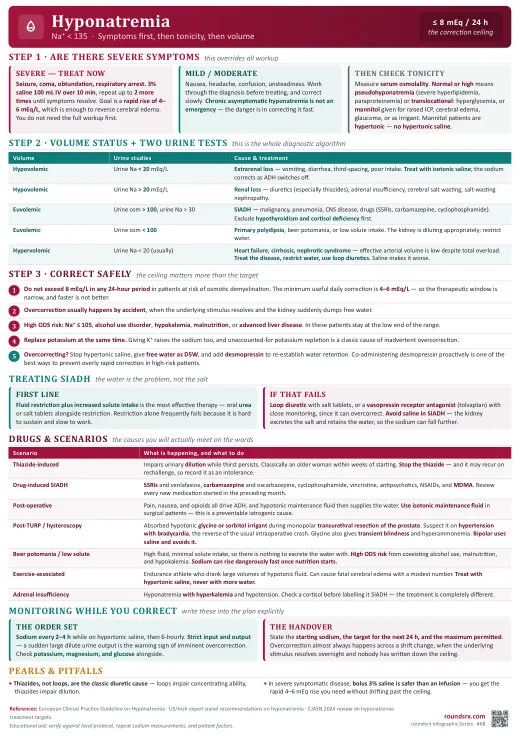
Text version
- Overcorrection → ODS (irreversible pontine demyelination)
- Not checking TSH and cortisol (must exclude before diagnosing SIADH)
- Free water restriction while on tolvaptan (dangerous combo)
- IV NS for hypovolemic hyponatremia in SIADH (worsens it)