Hypoparathyroidism
| Cause | Details |
|---|---|
| Post-surgical (#1) | After thyroidectomy or parathyroidectomy -parathyroid glands damaged/removed |
| Autoimmune | Autoimmune polyendocrine syndrome type 1 (APS-1) |
| Hypomagnesemia | Mg < 1.0 → impaired PTH secretion AND PTH resistance. Fix Mg first! |
| Infiltrative | Hemochromatosis, Wilson disease, metastatic cancer |
| DiGeorge syndrome | 22q11 deletion -absent parathyroids + thymic aplasia |
| Cause | Mechanism | Key Feature |
|---|---|---|
| Post-surgical (most common) | Parathyroid glands damaged or removed during thyroidectomy/parathyroidectomy | Hypocalcemia within 24–72h post-op; may be transient or permanent |
| Autoimmune | Autoimmune destruction of parathyroid glands (APS-1: AIRE gene mutation) | Associated with mucocutaneous candidiasis, adrenal insufficiency |
| DiGeorge syndrome | 22q11.2 deletion → absent/hypoplastic parathyroids | Congenital: cardiac defects, thymic aplasia, characteristic facies |
| Hypomagnesemia (functional) | Mg < 1.0 → impaired PTH secretion AND end-organ PTH resistance | PTH is low despite low calcium; calcium won't correct until Mg repleted |
| Infiltrative (hemochromatosis, Wilson) | Iron/copper deposition in parathyroid glands destroys tissue | Look for liver disease, skin changes; check ferritin, ceruloplasmin |
Chvostek sign (facial twitch on tapping) · Hyperreflexia · Vitals (prolonged QT interval) · Obtundation/seizures · Spasm (Trousseau sign -carpopedal spasm) · Tetany · Excitability (neuromuscular irritability) · Kidney stones (chronic hypercalciuria → nephrocalcinosis)
- Calcium gluconate 1–2g IV over 10–20 min (preferred over CaCl for peripheral IV -less tissue necrosis)
- Follow with continuous infusion: 0.5–1.5 mg/kg/hr of elemental calcium
- Correct magnesium if low -MgSO₄ 2g IV
- Continuous telemetry -monitor QTc
- Calcium Carbonate (Tums) 1–3g elemental calcium daily in divided doses
- Calcitriol (Rocaltrol) 0.25–2 mcg daily -active vitamin D (PTH normally activates vitamin D; without PTH, must give active form)
- Natpara (recombinant PTH) -for refractory cases not controlled with calcium/calcitriol
| Setting | Treatment | Details |
|---|---|---|
| Acute | IV Calcium Gluconate | 1–2g IV over 10 min; preferred for peripheral IV (less tissue necrosis) |
| Continuous calcium drip | 0.5–1.5 mg/kg/hr elemental calcium; titrate to ionized Ca q4–6h | |
| Cardiac monitoring | Continuous telemetry -prolonged QTc → torsades risk; correct Mg simultaneously | |
| Chronic | Calcitriol (Rocaltrol) | 0.25–2 mcg daily -active vitamin D (bypasses PTH-dependent activation) |
| Calcium Carbonate (Tums) | 1–3g elemental calcium daily in divided doses with food | |
| Thiazide diuretics | Reduce urinary calcium excretion → prevent nephrocalcinosis/kidney stones | |
| Natpara (recombinant PTH) | PTH replacement for refractory cases; reduces calcium/calcitriol requirements |
- Serum calcium -low (correct for albumin: add 0.8 per 1g albumin below 4)
- Ionized calcium -most accurate
- PTH -low or inappropriately normal (confirms hypoparathyroidism)
- Phosphate -elevated (PTH normally promotes PO₄ excretion)
- Magnesium -check in ALL hypocalcemia. Low Mg → functional hypoPTH
- 25-OH vitamin D -rule out deficiency (common confounder)
- ECG -prolonged QTc
| Drug | Dose | Purpose |
|---|---|---|
| Calcium Gluconate | 1–2g IV over 10–20 min | Acute symptomatic hypocalcemia -peripheral IV safe |
| Calcium Chloride | 1g IV | 3× more elemental Ca than gluconate -central line only (tissue necrosis risk) |
| Calcitriol (Rocaltrol) | 0.25–2 mcg daily | Active vitamin D -replaces PTH-dependent activation |
| Calcium Carbonate (Tums) | 500–1500 mg elemental Ca TID | Chronic oral replacement. Take with food (needs acid for absorption). |
| Magnesium Sulfate | 2–4g IV | Correct hypomagnesemia FIRST -calcium won't correct otherwise |
Patient: 54F, post-op day 1 from total thyroidectomy for papillary thyroid carcinoma. Reports perioral tingling and fingertip numbness.
Exam: Chvostek sign positive (facial twitch on tapping). Trousseau sign positive. HR 88, BP 118/72.
Labs: Total Ca 6.8 mg/dL (low), ionized Ca 0.82 mmol/L (low), PO₄ 5.2 (high), PTH < 5 pg/mL (low), Mg 2.0 (normal).
ECG: Prolonged QTc at 510 ms.
Management:
- Calcium gluconate 2g IV over 10 min → symptoms improve within minutes
- Start continuous calcium drip at 1 mg/kg/hr elemental calcium
- Continuous telemetry for QTc monitoring
- Begin Calcitriol (Rocaltrol) 0.5 mcg BID + oral calcium carbonate 1g TID
- Check ionized Ca q4–6h; taper IV calcium as oral takes effect
- Counsel patient: may need lifelong calcium + calcitriol if parathyroids do not recover
Key lesson: Post-thyroidectomy hypocalcemia is the #1 cause of hypoparathyroidism. Always monitor calcium in the first 24–72h post-op. Symptomatic patients need IV calcium urgently.
Patient: 8-month-old male with known 22q11.2 deletion (DiGeorge syndrome), history of tetralogy of Fallot repair. Presents with generalized tonic-clonic seizure lasting 2 minutes.
Labs: Ionized Ca 0.7 mmol/L (critically low), total Ca 5.9 mg/dL, PO₄ 7.1 (high), PTH < 3 pg/mL, Mg 1.8 (normal).
Management:
- IV calcium gluconate 100 mg/kg (max 2g) slow push over 10 min with cardiac monitoring
- Seizure resolves with calcium correction
- Start Calcitriol (Rocaltrol) 0.25 mcg daily + oral calcium supplements
- Immunology consult (thymic aplasia → T-cell deficiency)
- Lifelong calcium and calcitriol replacement -absent parathyroids will not recover
Key lesson: DiGeorge syndrome = absent parathyroids + thymic aplasia. Seizures in DiGeorge should trigger immediate calcium check. These patients need lifelong replacement -no chance of parathyroid recovery.
Patient: 62F with chronic hypoparathyroidism (post-thyroidectomy 8 years ago), on calcitriol 1 mcg BID + calcium carbonate 1.5g TID. Presents with flank pain. CT shows bilateral nephrocalcinosis.
Labs: Total Ca 9.2 (normal on replacement), 24h urine Ca 420 mg (elevated, normal < 300), creatinine 1.4 (baseline 0.9), PO₄ 4.8.
Problem: Without PTH, kidneys cannot reabsorb calcium → chronic hypercalciuria → nephrocalcinosis → renal damage despite normal serum calcium.
Management:
- Add hydrochlorothiazide 25 mg daily -thiazide diuretics enhance renal calcium reabsorption, reducing urinary calcium
- Reduce calcitriol dose to 0.5 mcg BID (lower target serum Ca to low-normal 8.0–8.5)
- Consider Natpara (recombinant PTH) -PTH replacement restores physiologic calcium handling, reduces urinary calcium
- Low-sodium diet (Na increases urinary Ca excretion)
- Nephrology consult for CKD management
- Monitor 24h urine calcium q3–6 months, renal US annually
Key lesson: Chronic hypoparathyroidism management is a balancing act. Aim for low-normal serum Ca to minimize urinary calcium losses. Thiazides and PTH replacement (Natpara) are key tools for preventing nephrocalcinosis.
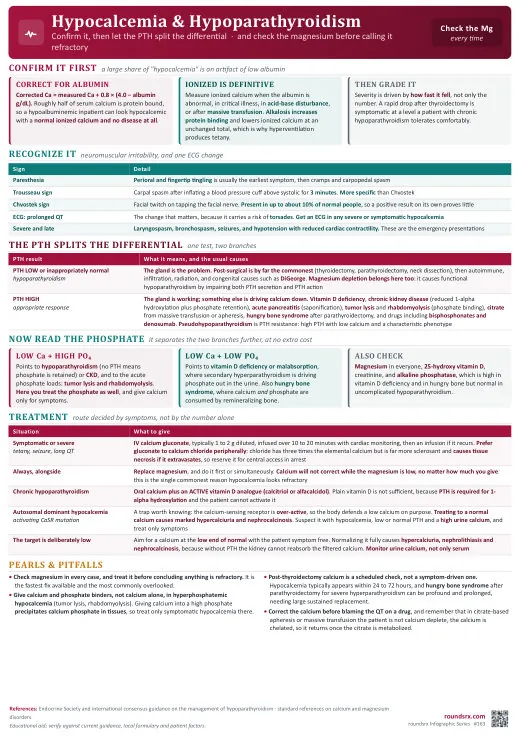
Text version
- The triad: ↓ Ca, ↓ PTH, ↑ PO₄. PTH normally drives renal phosphate excretion, so losing PTH raises phosphate at the same time it drops calcium. A low calcium with a high PTH is a different disease entirely.
- Serum calcium, corrected for albumin: add 0.8 per 1 g of albumin below 4, because roughly half of measured calcium is albumin-bound and hypoalbuminemia fakes hypocalcemia.
- Ionized calcium is the most accurate measure and is what you titrate acute therapy against.
- PTH low or inappropriately normal confirms hypoparathyroidism: any normal value in the face of hypocalcemia is inappropriate, since a healthy gland should be maximally stimulated.
- Magnesium in ALL hypocalcemia. Mg < 1.0 impairs both PTH secretion and end-organ PTH action, producing functional hypoparathyroidism that will not respond to calcium alone.
- 25-OH vitamin D to exclude simple deficiency, which is a common confounder of a low calcium.
- ECG for prolonged QTc, the finding that converts a lab abnormality into a torsades risk.
- Post-surgical (#1), after thyroidectomy or parathyroidectomy: glands damaged or removed. Hypocalcemia appears within 24-72 h post-op, which is exactly why calcium is monitored through that window. May be transient or permanent.
- Hypomagnesemia (functional), Mg < 1.0: PTH is low despite low calcium because secretion is impaired and receptors are resistant. Reversible once Mg is repleted, so it is the one cause you can cure at the bedside.
- Autoimmune, autoimmune polyendocrine syndrome type 1 (APS-1, AIRE gene mutation): look for mucocutaneous candidiasis and adrenal insufficiency alongside it.
- Infiltrative (hemochromatosis, Wilson disease, metastatic cancer): iron or copper deposition destroys gland tissue. Check ferritin and ceruloplasmin, and look for liver disease and skin changes.
- DiGeorge syndrome, 22q11.2 deletion: absent or hypoplastic parathyroids plus thymic aplasia, with cardiac defects and characteristic facies. Congenital, so there is no chance of recovery.
- Ionized calcium q4-6h during IV therapy, to titrate the drip and know when oral therapy has taken over.
- Continuous telemetry while symptomatic: the QTc is the marker that tracks torsades risk, not the total calcium number alone.
- Target serum calcium at the LOW end of normal (8.0-8.5) in chronic disease. Aiming for mid-normal drives urinary calcium losses, because without PTH the kidney cannot reabsorb what you give.
- 24-hour urine calcium q3-6 months (normal < 300 mg): this catches hypercalciuria before it becomes nephrocalcinosis and CKD.
- Renal ultrasound annually to detect nephrocalcinosis, plus creatinine trend, since renal damage can progress while serum calcium looks perfect.
- Recheck calcium in the 24-72 h window after thyroidectomy, the period in which post-surgical hypoparathyroidism declares itself.
- Giving calcium without checking magnesium. Mg < 1.0 blocks both PTH secretion and PTH action, so repletion is futile until Mg is fixed. This is the classic miss.
- Prescribing plain vitamin D (ergocalciferol or cholecalciferol) instead of calcitriol. Activation requires PTH-driven renal 1-alpha hydroxylation, which these patients cannot do, so only the active form works.
- Assuming a normal serum calcium means the patient is safe. Without PTH the kidney wastes calcium, so chronic hypercalciuria damages kidneys despite a perfectly normal serum level.
- Running calcium chloride through a peripheral IV. Extravasation causes tissue necrosis; use gluconate peripherally and reserve CaCl₂ for central access.
- Over-replacing with calcitriol. Higher serum calcium means higher filtered load and more urinary calcium; back the dose down and add a thiazide when 24-hour urine calcium is high.
- Missing hypocalcemia as the cause of a new seizure in a patient with DiGeorge or a recent neck operation, where a stat ionized calcium is the fastest diagnostic move.
- Seizure, tetany, or prolonged QTc: IV calcium plus telemetry now, since these are the manifestations that kill rather than merely uncomfort.
- Not controlled on calcium plus calcitriol: consider Natpara (recombinant PTH), which replaces the missing hormone rather than working around it.
- Nephrocalcinosis on imaging, rising creatinine, or 24-hour urine calcium above 300 mg: add a thiazide, reduce calcitriol toward a low-normal serum calcium, restrict dietary sodium (sodium drives urinary calcium excretion), and involve nephrology.
- DiGeorge syndrome: immunology consult for thymic aplasia and the associated T-cell deficiency, alongside lifelong calcium and calcitriol.
- Suspected APS-1: screen for the associated adrenal insufficiency, because an unrecognized adrenal crisis is the more immediately lethal problem.
- Chvostek sign, facial twitch on tapping the facial nerve.
- Hyperreflexia, from neuromuscular hyperexcitability as calcium falls.
- Vitals, meaning the prolonged QT interval on the monitor.
- Obtundation and seizures, the severe end of the CNS spectrum.
- Spasm, the Trousseau sign of carpopedal spasm with cuff inflation.
- Tetany.
- Excitability, generalized neuromuscular irritability.
- Kidney stones, from chronic hypercalciuria progressing to nephrocalcinosis.