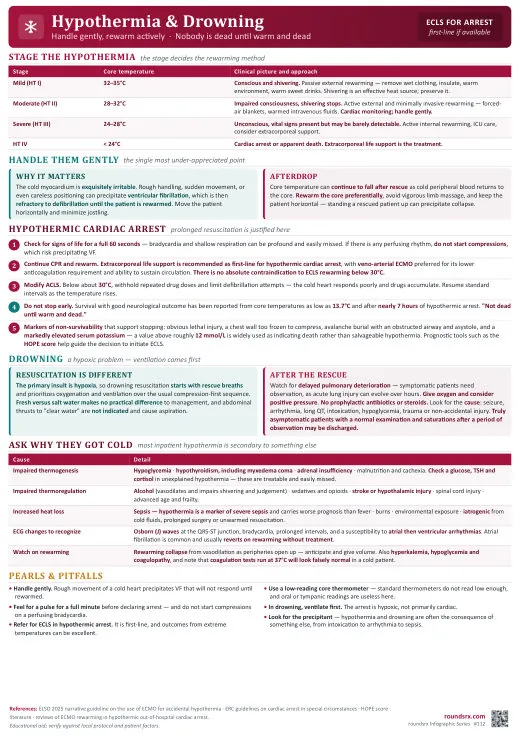
Hypothermia & Drowning
| Severity | Temp Range | Key Features | Treatment |
|---|---|---|---|
| Mild | 32–35°C | Shivering, tachycardia, vasoconstriction, altered judgment | Passive external rewarming (blankets, warm room). Remove wet clothing. |
| Moderate | 28–32°C | Shivering stops, confusion→stupor, bradycardia, Osborn (J) waves on ECG, atrial fibrillation | Active external rewarming (Bair Hugger, warm packs to axillae/groin). Warm IV fluids 40–42°C. |
| Severe | < 28°C | Coma, areflexia, VF risk, fixed dilated pupils, appears dead | Active core rewarming (warm humidified O₂, peritoneal/pleural lavage, ECMO). Withhold meds until ≥ 30°C. |
| Profound | < 24°C | Asystole, no vital signs. May still be salvageable with rewarming. | ECMO/cardiopulmonary bypass (gold standard). Prolonged CPR. Do NOT declare death. |
| Method | Indication | Rate of Rewarming |
|---|---|---|
| Passive external (blankets, warm room, remove wet clothes) | Mild hypothermia (32–35°C). Patient can generate heat via shivering. | 0.5–2°C/hr |
| Active external (Bair Hugger, warm packs to axillae/groin) | Moderate hypothermia (28–32°C). Shivering lost, patient cannot self-rewarm. | 1–2°C/hr |
| Warm IV fluids (NS/LR at 40–42°C) | Moderate–severe. Adjunct to other rewarming methods. | Modest contribution (~0.5°C/hr alone) |
| Warm humidified O₂ (42–46°C via ETT or NRB) | Moderate–severe. Active core rewarming adjunct. | 1–1.5°C/hr |
| Peritoneal/pleural lavage (42°C warm saline) | Severe (< 28°C) when ECMO unavailable. More effective than bladder lavage. | 2–4°C/hr |
| ECMO / cardiopulmonary bypass | Severe hypothermic cardiac arrest. Gold standard. | 5–10°C/hr |
- ECMO/CPB -gold standard rewarming for VF arrest in hypothermia. Rewarms at 5–10°C/hr.
- Continue CPR -may need prolonged resuscitation
- Defibrillation: May attempt up to 3 shocks if temp < 30°C. If unsuccessful, defer further shocks until core temp ≥ 30°C.
- Medications: Withhold vasopressors and antiarrhythmics until core temp ≥ 30°C (drugs don't work and accumulate in cold circulation)
- Rescue breathing is the priority -drowning is a hypoxic event. Begin ventilation as soon as possible, even in the water if safe.
- Cervical spine precautions -maintain inline stabilization if diving injury, trauma, or mechanism suggests c-spine injury. However, routine c-spine immobilization in all drowning victims is NOT supported.
- Warm IV fluids -most drowning victims are hypothermic. Start warm NS/LR (40–42°C). Treat concomitant hypothermia aggressively per rewarming protocols above.
- Pulmonary edema -watch for delayed pulmonary edema 24–48 hours post-submersion. Aspirated water disrupts surfactant and damages alveolar epithelium. CXR may be initially normal but deteriorate.
- Freshwater vs saltwater -freshwater is hypotonic (washes out surfactant, absorbed into circulation). Saltwater is hypertonic (pulls fluid into alveoli). Clinical management is the same for both.
- Prognostication:
- Submersion time -strongest predictor. > 25 min submersion in warm water = very poor prognosis.
- Water temperature -cold water (< 6°C) is neuroprotective. Full neurologic recovery reported after > 60 min submersion in ice water (especially children).
- Age -children have better outcomes than adults due to higher surface-area-to-body-mass ratio → faster cooling → more neuroprotection.
- CPR duration and initial rhythm -faster ROSC = better outcome. VF is better than asystole.
- Core temperature -rectal or esophageal probe (NOT oral/tympanic -inaccurate in hypothermia)
- ECG -Osborn (J) waves, prolonged intervals, atrial fibrillation, VF
- ABG -pH interpretation complex (use temperature-corrected values)
- BMP -hyperkalemia (cell lysis), hypoglycemia
- CBC, coags (hypothermia causes coagulopathy)
- Lactate
- TSH, cortisol -rule out myxedema/adrenal crisis as cause
| Intervention | Details | Notes |
|---|---|---|
| Warm IV NS/LR (40–42°C) | 250–500 mL boluses | Use fluid warmer. Contributes modestly to rewarming. |
| Warm humidified O₂ | 42–46°C via ETT or NRB | Active core rewarming adjunct |
| Warm bladder lavage | 42°C NS via 3-way Foley | Moderate core rewarming |
| Warm peritoneal lavage | 42°C NS via peritoneal catheter | More effective than bladder lavage |
| ECMO | Venoarterial (VA-ECMO) | Gold standard for severe hypothermic cardiac arrest. Rewarms 5–10°C/hr. |
Patient: 78M found on his kitchen floor by a neighbor. Last seen well 18 hours ago. Confused, minimally responsive. Temp: 30.1°C (rectal). HR 38 (bradycardia). BP 88/54. RR 8.
ECG: Sinus bradycardia with Osborn (J) waves at the J-point. QTc prolonged. No VF.
Labs: K⁺ 5.8, glucose 48 (hypoglycemic), lactate 3.2, TSH pending, cortisol pending.
Management:
- Remove all wet/cold clothing. Dry skin. Wrap in warm blankets.
- Active external rewarming: Bair Hugger forced-air warming blanket. Warm packs to axillae and groin (high-flow areas). Target: rewarm the trunk first.
- Warm IV fluids: NS at 40–42°C via fluid warmer, 250–500 mL bolus. Correct hypoglycemia with D50W.
- Do NOT treat bradycardia or AF with medications, the arrhythmia is from hypothermia and will resolve with rewarming.
- Check TSH and cortisol, hypothyroidism and adrenal insufficiency are precipitating causes of hypothermia in the elderly.
- K⁺ 5.8: Monitor closely. Expected to improve with rewarming. K⁺ >12 = non-survivable (massive cell lysis); K⁺ 5.8 is compatible with survival.
- Serial core temps q1h (esophageal or rectal probe) and continuous telemetry during rewarming.
Teaching point: In elderly patients found down, always measure core temperature. Oral/tympanic temps are unreliable, use rectal or esophageal probe. Check TSH and cortisol; hypothyroidism is a classic precipitant of hypothermia in the elderly.
Patient: 32M found unresponsive in a snowbank by ski patrol. No pulse, no respirations. Estimated outdoor exposure 2+ hours. Initial core temp: 24°C.
In the field: CPR initiated immediately. AED delivered 1 shock, rhythm remained VF. Patient transported to ED with ongoing CPR.
In the ED:
- Confirm core temperature with esophageal probe: 24°C, profound hypothermia
- Continue CPR, do not stop. Hypothermia is neuroprotective; viable patients have been resuscitated after >6 hours of CPR.
- Attempt defibrillation × 3 total (have already done 1 in field). If unsuccessful at <30°C, defer further shocks until core temp ≥30°C.
- Withhold epinephrine and amiodarone until core temp ≥30°C, drugs accumulate and are ineffective in cold circulation.
- ACTIVATE ECMO TEAM STAT, VA-ECMO is the gold standard for hypothermic cardiac arrest. Can rewarm at 5–10°C/hr.
- K⁺: 7.2, compatible with survival. Proceed with rewarming.
- ECMO initiated. Core temp rises over 90 minutes to 32°C → spontaneous ROSC, VF terminates. Patient extubated day 3. Full neurologic recovery.
Teaching point: K⁺ >12 mEq/L = non-survivable (massive cell lysis). This patient's K⁺ 7.2 meant the cells were still viable, aggressive ECMO rewarming was warranted. "No one is dead until warm and dead."
Patient: 7F falls through ice on a frozen pond. Submerged approximately 45 minutes before rescue. Core temp on EMS arrival: 22°C. No pulse. Pupils fixed and dilated. Cyanotic.
EMS: CPR initiated. Bystanders attempted rescue within 5 minutes of submersion.
ED Management:
- Core temp 22°C, do NOT declare death. "No one is dead until warm and dead."
- Fixed dilated pupils, absent reflexes: all expected findings at this temperature. Do not use these as markers of irreversibility in hypothermia.
- ECMO activation, VA-ECMO for hypothermic cardiac arrest. Children have better outcomes than adults (faster cooling via diving reflex + higher surface-area-to-mass ratio).
- Warm via ECMO, core temp rises to 36°C over 2 hours. ROSC at core temp 30°C (sinus bradycardia → normal sinus rhythm with rewarming).
- Post-resuscitation care: Targeted temperature management at 33–36°C × 24h. ICU monitoring. Neurologic exam serially.
- Day 5: Extubated. Neurologically intact. Discharged day 10.
Teaching point: The mammalian diving reflex + rapid hypothermic cooling in ice water provides profound neuroprotection in children. The protective combination: apnea + bradycardia + peripheral vasoconstriction + near-freezing temperatures drops oxygen consumption to near zero. Full neurologic survival after prolonged submersion is well-documented in pediatric cold-water drowning, never stop early.