Hypothyroidism
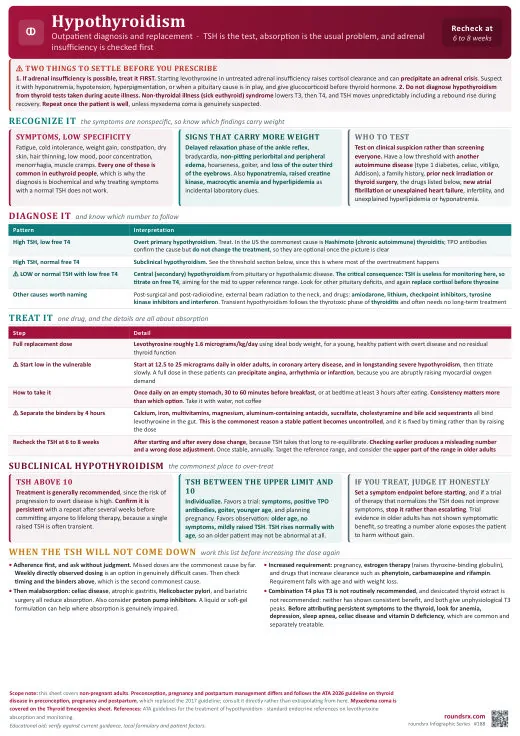
Hypothyroidism = insufficient thyroid hormone production. Primary (> 95%): thyroid gland failure -TSH high, FT4 low. Central (< 5%): pituitary or hypothalamic disease -TSH low/normal, FT4 low. Hashimoto's thyroiditis (chronic autoimmune) is the #1 cause in iodine-sufficient countries. Other causes: post-RAI, post-thyroidectomy, post-radiation, medications (amiodarone, lithium, checkpoint inhibitors), iodine deficiency (worldwide), infiltrative (sarcoidosis, hemochromatosis). Prevalence: 5-10% (overt + subclinical). Subclinical hypothyroidism: TSH elevated (4.5-10), FT4 normal. Treatment controversial -treat if: TSH > 10, symptoms, pregnancy/planning pregnancy, positive TPO antibodies with TSH > 7. Symptoms: fatigue, cold intolerance, weight gain, constipation, dry skin, hair loss, menorrhagia, depression, myalgias, delayed DTRs.
- TSH -most sensitive test. Elevated in primary hypothyroidism. Normal/low in central hypothyroidism (misleading -always check FT4 if clinical suspicion).
- Biotin interference -high-dose biotin (hair/skin/nail supplements, 5 mg or more) makes TSH falsely low and FT4 falsely high on biotin-streptavidin immunoassays. In a patient on levothyroxine this looks like overreplacement and prompts an unneeded dose cut, so ask about supplements and repeat after holding biotin at least 48 h before changing the dose (see biotin and thyroid tests).
- Free T4 -low confirms hypothyroidism. TSH high + FT4 low = primary overt hypothyroidism. TSH high + FT4 normal = subclinical.
- TPO antibodies (anti-thyroid peroxidase) -positive in Hashimoto's (~95%). Useful for: (1) confirming etiology, (2) predicting progression from subclinical → overt, (3) informs treatment decisions in subclinical hypothyroidism.
- Anti-thyroglobulin antibodies -positive in ~60% of Hashimoto's. Less specific than TPO.
- Lipid panel -hypothyroidism causes hyperlipidemia (elevated LDL). May normalize with treatment. Don't start statins until euthyroid.
- CBC -normocytic or macrocytic anemia is common
- BMP -hyponatremia (impaired free water excretion), elevated Cr (decreased renal perfusion)
- CK -elevated from hypothyroid myopathy (can be markedly elevated, mimicking rhabdomyolysis)
- If central hypothyroidism suspected: check FT4 (not just TSH), pituitary MRI, assess other pituitary axes (ACTH/cortisol, FSH/LH, GH, prolactin). Must rule out adrenal insufficiency before starting T4 (same principle as myxedema coma).
- Levothyroxine (T4): Standard replacement. Full dose: 1.6 mcg/kg/day. Start lower in elderly or cardiac patients: 12.5-25 mcg daily → increase by 12.5-25 mcg q6-8 weeks.
- How to take: On empty stomach, 30-60 min before breakfast (or at bedtime, ≥ 3h after last meal). Separate from calcium, iron, PPIs, soy, coffee by ≥ 4 hours (all impair absorption).
- Dose adjustments:
- Check TSH at 6-8 weeks (TSH has a long half-life -don't recheck sooner).
- Target TSH 0.5-2.5 mIU/L for most adults. Elderly (> 70): target 3-6 (higher TSH is protective, over-replacement → AF + osteoporosis).
- Pregnancy: target TSH < 2.5 in 1st trimester. Levothyroxine dose typically increases 25-50% during pregnancy. ATA, 2017
⚠ Pregnancy guidance on this page predates the current guideline. The pregnancy and postpartum recommendations below, including the trimester-specific TSH targets, are drawn from the 2017 ATA guideline. That guideline has been replaced by the ATA 2026 Guidelines for Thyroid Disease in Preconception, Pregnancy, and Postpartum, which moves toward a more conservative and individualized approach, including verifying mild abnormalities before treating and pulling back from treating subclinical disease where benefit is not established. Check the 2026 guideline directly before applying these targets to a pregnant patient. Non-pregnancy management on this page is unaffected.
| Drug | Dose | Route | Notes |
|---|---|---|---|
| Levothyroxine (T4) | 1.6 mcg/kg/day (full dose); start 25-50 mcg in elderly | PO | Standard of care. Empty stomach, 30-60 min before breakfast. Separate from Ca, Fe, PPI by 4h. Half-life 7 days → steady state in 6 wk. ATA, 2014 |
| Liothyronine (T3) | 5-25 mcg daily (divided BID-TID) | PO | NOT routine. Short half-life → TID dosing. Consider only if persistent symptoms on adequate T4 with normal TSH. Variable absorption. |
| IV levothyroxine | 50-100% of oral dose | IV | For patients who cannot take PO (ICU, post-surgical). 100% bioavailable vs ~70% PO. For myxedema coma: loading dose 200-400 mcg. |
Patient: 38F with fatigue, weight gain (12 lb/6 months), constipation, cold intolerance, and menorrhagia. TSH 62 mIU/L, FT4 0.3 ng/dL. TPO Ab 580 IU/mL. No goiter.
Key findings: Overt primary hypothyroidism (elevated TSH + low FT4). Hashimoto thyroiditis confirmed by strongly positive TPO antibodies. Symptomatic.
Management:
- Levothyroxine 1.6 mcg/kg/day (full replacement dose in young, healthy patient), ~88 mcg daily
- Take on empty stomach, 30-60 min before breakfast. Avoid calcium, iron, PPI within 4 hours
- Recheck TSH in 6-8 weeks (steady state requires 5-6 half-lives; T4 t½ = 7 days)
- Goal TSH 0.5-2.5 mIU/L (lower half of normal range for symptomatic patients)
- Screen for associated autoimmune conditions: celiac (10% co-occurrence), B12 deficiency, adrenal insufficiency
Teaching point: In young, healthy patients, start full replacement dose immediately. In elderly or cardiac patients, start low (25-50 mcg) and titrate slowly, rapid correction can precipitate angina or arrhythmia.
Patient: 32F with known Hashimoto's on levothyroxine 75 mcg daily. Newly pregnant (6 weeks). Pre-pregnancy TSH 1.8. Current TSH 4.2, FT4 0.8 ng/dL.
Key findings: TSH above pregnancy target (< 2.5 in first trimester per ATA 2017). Fetal thyroid doesn't function until week 12, fetus depends entirely on maternal T4 for neurodevelopment.
Management:
- Increase levothyroxine by ~25-30%: add 2 extra tablets per week (75 mcg × 9/week instead of 7) ATA, 2017
- Target TSH < 2.5 mIU/L in first trimester, < 3.0 in second/third trimester
- Recheck TSH every 4 weeks through mid-pregnancy, then once at 30 weeks
- Maternal hypothyroidism → lower fetal IQ and neurodevelopmental delay
- Postpartum: return to pre-pregnancy dose, recheck TSH at 6 weeks postpartum
Teaching point: Pregnancy increases T4 demand by 25-50% due to increased TBG, plasma volume expansion, and placental deiodinase. The "2 extra tablets per week" rule is a practical way to increase dose ~30% immediately.
Patient: 72F brought by EMS. Found unresponsive at home. Temp 33.2°C, HR 42, BP 82/50, RR 8. Known hypothyroidism, ran out of levothyroxine 3 months ago. Na 118, glucose 48.
Key findings: Myxedema coma: hypothermia + bradycardia + AMS + hypotension in the setting of severe hypothyroidism. Precipitated by medication non-compliance. Mortality 30-60%.
Management:
- IV levothyroxine 200-400 mcg loading dose → 1.6 mcg/kg/day IV (gut absorption unreliable in critical illness)
- Stress-dose hydrocortisone 100 mg IV q8h (must rule out concurrent adrenal insufficiency before giving T4, T4 increases cortisol clearance)
- Passive rewarming only (active warming → vasodilation → cardiovascular collapse)
- D50 for hypoglycemia, hypertonic saline only if Na < 120 with seizures
- ICU admission, intubate if GCS ≤ 8, avoid sedatives (prolonged metabolism)
Teaching point: Always give stress-dose steroids BEFORE or WITH IV levothyroxine in myxedema coma. If undiagnosed adrenal insufficiency coexists (Schmidt syndrome), T4 alone can precipitate adrenal crisis.
Mrs. Johnson is a 45-year-old woman with 6 months of fatigue, 10 lb weight gain, constipation, cold intolerance, and hair thinning. PMH: nothing. No medications. Exam: dry skin, periorbital puffiness, bradycardia (HR 56), delayed DTR relaxation. No goiter. Labs: TSH 48 mIU/L (elevated), Free T4 0.4 ng/dL (low), TPO Ab 420 IU/mL (strongly positive).
- TSH at 6-8 weeks after any dose change -do NOT recheck sooner (TSH equilibration takes 4-6 weeks). Adjust by 12.5-25 mcg increments.
- Annual TSH once stable on appropriate dose
- Pregnancy: TSH monthly through first trimester, then q4-6 weeks. Increase dose 25-50% as early as 4-6 weeks gestation. ATA, 2017
- Central hypothyroidism: Monitor Free T4 (NOT TSH -TSH is unreliable when the pituitary is the problem). Target FT4 in upper half of reference range.
- Elderly (> 70): Target TSH 3-6. Do NOT over-replace -subclinical hyperthyroidism from excess T4 → AF, osteoporosis, fractures.
- Drug interactions: Reassess dose when starting/stopping calcium, iron, PPIs, estrogen (increases TBG → need more T4), phenytoin/carbamazepine (increase T4 metabolism).
- Lipid panel -recheck 3-6 months after achieving euthyroidism (hyperlipidemia often normalizes).