Infective Endocarditis
| Major Criteria | Details |
|---|---|
| 1. Positive blood cultures | Typical organisms from 2 separate cultures: Viridans strep, S. bovis, HACEK, S. aureus, or Enterococcus (without primary focus). OR persistently positive cultures (≥ 2 drawn > 12h apart, or 3/3 or majority of ≥ 4 cultures positive). |
| 2. Endocardial involvement | Echo: vegetation, abscess, new prosthetic dehiscence. OR new valvular regurgitation (murmur change). |
| Minor Criteria |
|---|
| Predisposition: IV drug use, prosthetic valve, prior IE, structural heart disease |
| Fever ≥ 38°C |
| Vascular phenomena: septic emboli, mycotic aneurysm, Janeway lesions, conjunctival hemorrhage |
| Immunologic phenomena: Osler nodes, Roth spots, glomerulonephritis, positive RF |
| Microbiologic: positive cultures not meeting major criteria, or serologic evidence |
| Organism | % of IE | Key Association |
|---|---|---|
| S. aureus | ~30–40% | Most common overall (especially IVDU and healthcare-associated). Acute, destructive. High embolic risk. |
| Viridans streptococci | ~20–25% | Subacute. Dental procedures. Native valve. More indolent course. |
| Enterococcus | ~10% | GI/GU source. Elderly patients. Requires synergistic therapy (ampicillin + gentamicin or ampicillin + ceftriaxone). |
| Coagulase-negative staph | ~10% | Prosthetic valve IE (especially early < 1 year). S. epidermidis. |
| HACEK organisms | ~3% | Gram-negative, slow-growing. May need prolonged incubation. Treat with ceftriaxone. |
| Culture-negative | ~5–10% | Prior antibiotics (most common reason), Coxiella burnetii (Q fever), Bartonella, Brucella, fungi. |
| Setting | Empiric Regimen | Notes |
|---|---|---|
| Native valve, acute | Vancomycin (Vancocin) 15–20 mg/kg IV q8–12h + cefepime (Maxipime) 2g IV q8h | Covers MRSA + gram-negatives. Narrow based on cultures. Duration: 4–6 weeks. |
| Native valve, subacute | Vancomycin (Vancocin) + ceftriaxone (Rocephin) 2g IV q24h | Covers strep + staph. Add gentamicin if Enterococcus suspected. Enterococcal Endocarditis Trial, 2013 |
| Prosthetic valve | Vancomycin (Vancocin) + gentamicin + rifampin (Rifadin) 300 mg PO q8h | Rifampin for biofilm penetration. Triple therapy × 6 weeks minimum. Gentamicin × 2 weeks only. |
| IVDU (right-sided) | Vancomycin (Vancocin) (covers MRSA -most common in IVDU IE) | Narrow to nafcillin/oxacillin if MSSA. Right-sided (tricuspid) has better prognosis than left-sided. POET, 2019 |
- Heart failure from severe valvular regurgitation -most common surgical indication
- Uncontrolled infection -persistent bacteremia > 5–7 days despite appropriate antibiotics, perivalvular abscess, fistula
- Large vegetation (> 10 mm) with embolic events despite antibiotics
- Fungal endocarditis -almost always requires surgery
- Prosthetic valve endocarditis with dehiscence, abscess, or persistent bacteremia
- S. aureus prosthetic valve IE -consider early surgery regardless
Patient: 58M with poorly controlled diabetes, presents with 3 weeks of fevers, malaise, and new-onset left arm weakness. Recent dental extraction 4 weeks ago without antibiotic prophylaxis.
Key findings: Temp 38.9°C, HR 105, new aortic regurgitation murmur, Janeway lesions on palms, splinter hemorrhages. Blood cultures 4/4 positive for Streptococcus gallolyticus. TEE: 1.4 cm vegetation on aortic valve with moderate AR. MRI brain: acute embolic infarct R MCA territory.
Management:
- IV penicillin G 4 million units q4h + gentamicin 1 mg/kg q8h (synergy) x 4 weeks
- Urgent CT surgery consult: large vegetation (>10 mm) + embolic event = surgical indication EASE Trial, 2012
- Colonoscopy required: S. gallolyticus (bovis) has strong association with colorectal neoplasia (~60% have polyps or cancer)
- Serial blood cultures q48h until clearance; repeat TEE at 1 week
Teaching point: S. gallolyticus endocarditis mandates colonoscopy regardless of GI symptoms. Embolic events with vegetations >10 mm warrant early surgery.
Patient: 72F with mechanical aortic valve (replaced 8 months ago), presents with fever x 2 weeks, chills, and new heart failure symptoms. Central line placed 3 weeks ago for chemotherapy.
Key findings: Temp 38.5°C, HR 98, BP 100/55, bilateral crackles, JVD. Blood cultures 4/4 positive for methicillin-resistant Staphylococcus epidermidis. TEE: 8 mm vegetation on prosthetic AV, paravalvular abscess with new dehiscence.
Management:
- Vancomycin (trough 15-20) + rifampin 300 mg PO q8h + gentamicin 1 mg/kg IV q8h x 2 weeks, then vanco + rifampin x 6 weeks total
- Emergent surgical referral: PVE + paravalvular abscess + heart failure = absolute surgical indication
- Heart failure management: diuresis, preload/afterload optimization while awaiting surgery
- Rifampin added ONLY after blood cultures negative (induces resistance if started during active bacteremia)
Teaching point: PVE with paravalvular abscess has near-100% surgical indication. Rifampin is essential for biofilm penetration on prosthetic material but must be started after culture clearance.
Patient: 38F, no significant PMH, presents with 6 weeks of fevers, weight loss, arthralgias, and night sweats. Given azithromycin empirically 2 weeks ago at urgent care.
Key findings: Temp 38.2°C, new MR murmur, Osler nodes on fingertips. Blood cultures 4/4 negative (drawn on antibiotics). TTE: 6 mm vegetation on anterior mitral leaflet. Bartonella henselae IgG titer 1:1024. Patient has 3 cats.
Management:
- Culture-negative workup: Bartonella, Coxiella (Q fever), Brucella, HACEK serologies, Tropheryma whipplei PCR
- Bartonella IE confirmed: doxycycline 100 mg BID + gentamicin 1 mg/kg q8h x 2 weeks, then doxycycline alone x 6 weeks
- Prior antibiotic exposure is the most common cause of culture-negative IE (~50% of cases)
- Consider 16S rRNA PCR on excised valve tissue if serologies inconclusive
Teaching point: When cultures are negative, always ask about prior antibiotics. Bartonella is the most common cause of culture-negative IE in immunocompetent patients -- think cat exposure.
| Parameter | Frequency | Target / Action |
|---|---|---|
| Blood cultures | q24-48h until negative | Must document clearance. Persistent bacteremia → evaluate for abscess, source control |
| Vancomycin trough | Before 4th dose, then 1-2x/week | AUC/MIC-guided dosing preferred. Target AUC 400-600 |
| Gentamicin levels | Peak and trough with first dose | Peak 3-5 mcg/mL (synergy). Trough < 1. Monitor Cr and hearing |
| Renal function | 2-3x/week | Aminoglycosides and vancomycin are nephrotoxic. Adjust doses accordingly |
| CBC, ESR/CRP | Weekly | Trend WBC and inflammatory markers. Should decline with treatment |
| Repeat TTE/TEE | At completion of therapy | New baseline. Sooner if clinical deterioration, new murmur, or concern for abscess |
| Neuro checks | Daily | Embolic stroke in 20-40%. New focal deficit → urgent CT/MRI head |
| ECG | Daily initially | New PR prolongation → perivalvular abscess. New AV block is an emergency |
| Test | Findings | Clinical Significance |
|---|---|---|
| Blood cultures ×3 ESSENTIAL | Persistent bacteremia (same organism in multiple sets) | Draw from 3 separate sites BEFORE antibiotics. Continuous bacteremia is a major Duke criterion. Identifies organism + susceptibilities. |
| TTE → TEE | Vegetations, abscess, valve perforation, regurgitation | Start with TTE. If negative but suspicion high → TEE (sensitivity 90-100% vs TTE ~60-75%). TEE mandatory for prosthetic valves. |
| CBC | Leukocytosis, anemia (chronic disease), thrombocytopenia | Anemia of chronic disease common in subacute IE. Thrombocytopenia suggests severe sepsis or DIC. |
| BMP | Cr (baseline + immune complex GN), electrolytes | Renal function -immune complex glomerulonephritis, aminoglycoside toxicity monitoring. |
| ESR / CRP | Elevated | Markers of inflammation. Trend to monitor treatment response. |
| Rheumatoid factor | Elevated in chronic IE | Minor Duke criterion. Immune complex formation in subacute endocarditis. |
| Complement levels (C3/C4) | Low | Consumed by immune complex deposition (glomerulonephritis). |
| Urinalysis | Microscopic hematuria, RBC casts, proteinuria | Immune complex GN or renal septic emboli. Hematuria in up to 50% of IE patients. |
| Scenario | Regimen | Duration | Notes |
|---|---|---|---|
| Empiric (native valve) | Vancomycin (AUC 400-600) + Ceftriaxone (Rocephin) 2g IV q24h | Pending cultures | Covers MRSA + streptococci + HACEK. Add gentamicin if considering enterococcal coverage. |
| MSSA -native valve | Nafcillin or Oxacillin 2g IV q4h | 6 weeks | Anti-staphylococcal penicillins are preferred over vancomycin for MSSA (better outcomes). Cefazolin 2g IV q8h if penicillin allergy (non-anaphylactic). |
| MRSA -native valve | Vancomycin IV, AUC-guided dosing (target AUC 400-600) | 6 weeks | Trough-based dosing is outdated. AUC-guided dosing reduces nephrotoxicity. Alternative: daptomycin 8-10 mg/kg IV daily (NOT for left-sided endocarditis with pulmonary involvement -inactivated by surfactant). |
| Prosthetic valve (empiric) | Vancomycin + Gentamicin 1 mg/kg IV q8h + Rifampin 300 mg PO q8h | ≥6 weeks (vanco + rifampin), 2 weeks (gent) | Rifampin penetrates biofilm on prosthetic material. Do NOT start rifampin until blood cultures are negative (resistance develops rapidly). |
| Viridans streptococci (MIC ≤0.12) | Ceftriaxone 2g IV q24h | 4 weeks | Can use 2-week short course with ceftriaxone + gentamicin if uncomplicated native valve. Penicillin G 12-18 million units/day IV continuous is alternative. |
| Enterococcus | Ampicillin 2g IV q4h + Ceftriaxone 2g IV q12h | 6 weeks | Ampicillin + ceftriaxone preferred over ampicillin + gentamicin (avoids nephrotoxicity, similar efficacy). If VRE: linezolid or daptomycin. |
- Blood cultures × 3 sets from separate sites BEFORE antibiotics. 20 mL per set (10 mL aerobic + 10 mL anaerobic). Sensitivity > 90% with 3 sets
- CBC: Leukocytosis, anemia (normocytic, chronic disease), thrombocytopenia (if DIC)
- BMP: Cr (renal emboli, drug-induced nephritis), electrolytes
- ESR/CRP: Elevated in > 90%. Useful for monitoring treatment response
- Urinalysis: Microscopic hematuria (renal emboli, immune complex GN) in 25-50%
- RF (rheumatoid factor): Positive in ~50% of subacute IE
- Procalcitonin: Supports bacterial etiology if elevated
- TTE first -sensitivity ~75% for native valves. Adequate if high quality and clinical picture clear
- TEE if: TTE negative but high suspicion, prosthetic valve, poor TTE windows, suspected abscess/fistula. Sensitivity ~95%
- CT chest/abdomen/pelvis: If concern for septic emboli (splenic infarct, renal infarct, mycotic aneurysm)
- Brain MRI: If neurologic symptoms. Mycotic aneurysms, septic emboli, meningitis
- PET/CT: Consider for prosthetic valve IE or cardiac implantable device infection when echo is equivocal
| Organism | Native Valve | Prosthetic Valve | Duration |
|---|---|---|---|
| Empiric (acute) | Vancomycin + cefepime (or gentamicin) | Vancomycin + cefepime + rifampin | Until cultures return |
| MSSA | Nafcillin/oxacillin 2g IV q4h | Nafcillin + rifampin 300mg PO q8h + gentamicin × 2 weeks | NV: 6 weeks. PV: ≥ 6 weeks |
| MRSA | Vancomycin 15-20 mg/kg IV q8-12h (trough 15-20) OR daptomycin 8-10 mg/kg IV daily | Vancomycin + rifampin + gentamicin × 2 weeks | 6 weeks |
| Viridans Strep (MIC ≤ 0.12) | Ceftriaxone 2g IV daily OR penicillin G 12-18 MU/day | Same + gentamicin × 2 weeks | NV: 4 weeks. PV: 6 weeks |
| Enterococcus | Ampicillin 2g IV q4h + ceftriaxone 2g IV q12h (preferred for E. faecalis) | Ampicillin + ceftriaxone 6 weeks | 6 weeks |
| HACEK | Ceftriaxone 2g IV daily | Ceftriaxone 2g IV daily | NV: 4 weeks. PV: 6 weeks |
| Culture-negative | Vancomycin + cefepime. ID consult for serologies (Bartonella, Coxiella, Brucella) | Same + rifampin | 6 weeks |
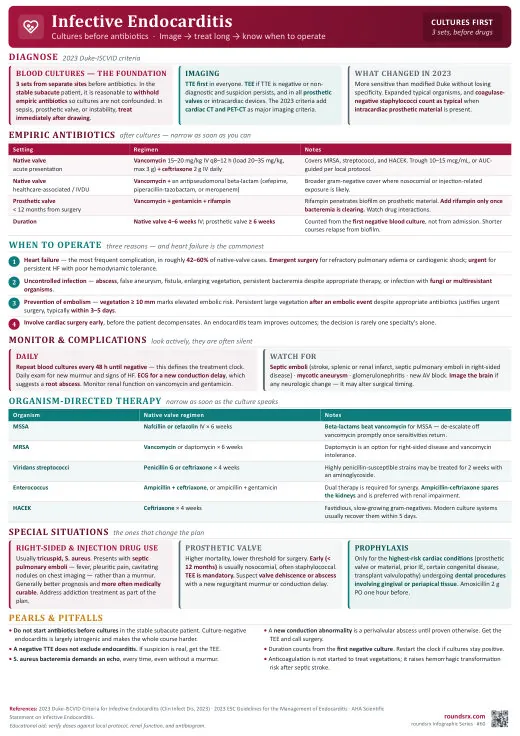
Text version
- 2 major = definite IE
- 1 major + 3 minor = definite IE
- Major: typical organism on ≥ 2 cultures; vegetation/abscess on echo
- Minor: predisposing condition, fever, vascular/immunologic phenomena, positive cultures not meeting major
- Blood cultures × 3 from different sites BEFORE antibiotics
- Empiric: vancomycin + ceftriaxone (native valve)
- Prosthetic valve: vancomycin + gentamicin + rifampin
- TTE first → TEE if negative but high suspicion
- ID consult always. Duration: 4-6 weeks IV
- Heart failure from valvular dysfunction (most common indication)
- Uncontrolled infection (persistent bacteremia > 7 days, abscess)
- Large vegetation > 10mm with embolism EASE, 2012
- Prosthetic valve IE with any of the above
- Fungal endocarditis (almost always requires surgery)
- Antibiotics before blood cultures
- Missing perivalvular abscess (need TEE)
- Not consulting surgery early enough
- Not checking for embolic complications (CT head, spleen)