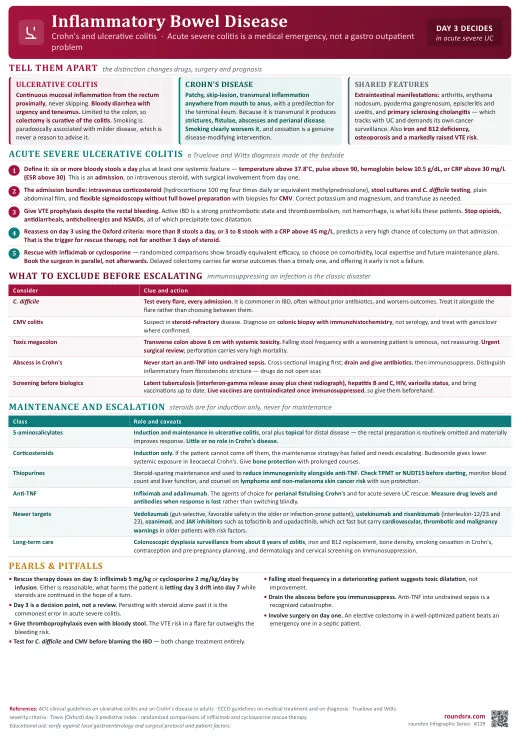
Inflammatory Bowel Disease
| Feature | Crohn Disease | Ulcerative Colitis |
|---|---|---|
| Location | Mouth to anus (terminal ileum most common) | Colon only -rectum always involved, extends proximally |
| Depth | Transmural → fistulas, strictures, abscesses | Mucosa/submucosa only |
| Pattern | Skip lesions, cobblestoning | Continuous, no skip lesions |
| Histology | Non-caseating granulomas | Crypt abscesses, pseudopolyps |
| Bloody diarrhea | Less common | Hallmark symptom |
| Smoking | Worsens disease | Protective (but don't recommend!) |
| Surgery | Not curative -disease recurs | Total colectomy is curative |
| Parameter | Mild | Moderate | Severe |
|---|---|---|---|
| Bloody stools/day | < 4 | 4–6 | > 6 |
| Heart rate | Normal | ≤ 90 | > 90 |
| Temperature | Normal | ≤ 37.8°C | > 37.8°C |
| Hemoglobin | Normal | ≥ 10.5 g/dL | < 10.5 g/dL |
| ESR | ≤ 20 | 20–30 | > 30 |
The CDAI is a composite score (0–600+) incorporating stool frequency, abdominal pain severity, general well-being, extraintestinal features, anti-diarrheal use, abdominal mass, hematocrit, and body weight. CDAI < 150 = remission; 150–220 = mild; 220–450 = moderate; > 450 = severe. Primarily used in clinical trials. At the bedside, use clinical judgment: stool frequency, CRP, nutritional status, and presence of complications (fistula, abscess) guide management decisions.
| Severity | UC Treatment | Crohn Treatment |
|---|---|---|
| Mild | Mesalamine (Asacol/Lialda) PO/PR | Mesalamine (limited evidence) or budesonide |
| Moderate | Oral steroids → thiopurines or biologics | Budesonide (Entocort) → thiopurines or biologics |
| Severe | IV steroids → Infliximab (Remicade) or cyclosporine | IV steroids → anti-TNF or vedolizumab |
| Perianal/Fistulizing | N/A | Anti-TNF (infliximab preferred) + antibiotics + surgical drainage |
- Day 0: Admit. Rule out C. diff (send toxin PCR), CMV colitis (if on immunosuppression, send CMV PCR). IV methylprednisolone 60 mg daily. DVT prophylaxis (UC flares are prothrombotic). NPO if toxic megacolon suspected.
- Day 1–3: Monitor stool frequency, CRP, abdominal exam. Flexible sigmoidoscopy (NOT full colonoscopy, perforation risk) to assess severity and rule out CMV.
- Day 3 assessment: Responding → transition to oral prednisone 40 mg, plan steroid taper + biologic initiation. NOT responding → infliximab 5 mg/kg (preferred) or IV cyclosporine 2 mg/kg/day. Surgical consultation for colectomy if refractory.
- Day 5–7: If rescue therapy failing → subtotal colectomy with end ileostomy is life-saving. Do not delay.
| Drug | Mechanism | Approved For | Key Pearls |
|---|---|---|---|
| Infliximab (Remicade) | Anti-TNF-alpha (chimeric mAb) | UC + Crohn | Preferred for fistulizing Crohn + acute severe UC. IV infusion. ACT 1/ACT 2, 2005 |
| Adalimumab (Humira) | Anti-TNF-alpha (fully human mAb) | UC + Crohn | SC injection, convenient for outpatient. Less immunogenic than infliximab. CLASSIC I, 2006 |
| Vedolizumab (Entyvio) | Anti-α4β7 integrin (gut-selective) | UC + Crohn | Lower systemic infection risk, does NOT increase TB/opportunistic infection risk. Slower onset (8–14 weeks). Preferred if infection concerns. GEMINI 1, 2013 |
| Ustekinumab (Stelara) | Anti-IL-12/23 (p40 subunit) | Crohn (UC emerging) | IV induction → SC maintenance. Good safety profile. Consider after anti-TNF failure. UNITI-1/UNITI-2, 2016 |
| Tofacitinib (Xeljanz) | JAK inhibitor (small molecule) | UC only | Oral, no infusions. Rapid onset. Risk: VTE, herpes zoster. Avoid in patients with VTE risk factors. OCTAVE, 2017 |
- MSK: Peripheral arthritis (follows disease activity), sacroiliitis/ankylosing spondylitis (independent)
- Skin: Erythema nodosum (follows activity), pyoderma gangrenosum (independent)
- Eyes: Uveitis, episcleritis
- Hepatobiliary: Primary sclerosing cholangitis (strong UC association)
- Colonoscopy with biopsies -gold standard for diagnosis
- CT enterography/MR enterography -small bowel involvement (Crohn)
- Stool studies -C. diff, cultures, O&P (rule out infectious mimics)
- CRP, ESR -inflammation markers
- Fecal calprotectin -non-invasive marker of intestinal inflammation
- CBC (anemia), albumin, iron studies
- pANCA (UC ~70%) vs ASCA (Crohn ~60%)
| Drug | Dose | Class | Key Notes |
|---|---|---|---|
| Mesalamine (Asacol) | 2.4–4.8 g/day PO | 5-ASA | UC first-line mild disease. Minimal role in Crohn. |
| Budesonide (Entocort) | 9 mg daily × 8 wk taper | Steroid | Ileal/right colon Crohn. Less systemic effects than prednisone. |
| Azathioprine (Imuran) | 2–2.5 mg/kg/day | Thiopurine | Steroid-sparing. Check TPMT before starting. Risk: lymphoma, pancreatitis. |
| Infliximab (Remicade) | 5 mg/kg IV wk 0,2,6 then q8wk | Anti-TNF | Moderate-severe IBD. Screen for TB/Hep B before starting. |
| Vedolizumab (Entyvio) | 300 mg IV q8wk | Anti-integrin | Gut-selective. Lower infection risk than anti-TNF. |
| Ustekinumab (Stelara) | Induction IV → 90 mg SC q8wk | Anti-IL12/23 | Moderate-severe Crohn. Growing UC evidence. |
Patient: 34F with known UC (pancolitis, on mesalamine) presents with 3 days of worsening bloody diarrhea (10-12/day), cramping, fever 38.9°C, HR 112.
Labs: WBC 14.2, Hgb 9.8, CRP 62, albumin 2.4, K 3.1. C. diff PCR negative.
Assessment: Meets Truelove-Witts severe criteria. KUB: no toxic megacolon.
Management:
- Admit. IV methylprednisolone 60 mg/day. DVT prophylaxis. Correct K.
- Flexible sigmoidoscopy day 1-2 for severity + CMV biopsy.
- Day 3: 8+ stools/day, CRP 55 → Travis criteria met for steroid failure.
- Rescue therapy: infliximab 5 mg/kg. Surgical consultation placed.
- Responded by day 5. Oral prednisone taper + infliximab maintenance initiated.
Teaching Point: Day-3 reassessment with Travis criteria is critical. Delayed rescue therapy increases colectomy and mortality risk.
Patient: 26M with ileal Crohn (on azathioprine), 2 weeks of perianal pain, swelling, purulent drainage. 4-5 loose stools/day, 8 lb weight loss.
Exam: External fistula at 5 o'clock with purulent discharge. Fluctuant area = undrained abscess.
Imaging: MRI pelvis: complex perianal fistula + intersphincteric abscess (2.3 cm).
Management:
- Step 1: EUA with abscess I&D + seton placement.
- Step 2: Cipro 500 BID + metronidazole 500 TID (bridge to biologic).
- Step 3: Infliximab initiated (preferred for fistulizing Crohn). ACCENT II, 2004
- Azathioprine continued (combination reduces immunogenicity). Seton removed at 3 months.
Teaching Point: Always drain abscess BEFORE biologics. Combined medical-surgical approach is standard for fistulizing Crohn.
Patient: 58F with UC on IV steroids for 4 days. Overnight: abdominal distention, absent bowel sounds, fever 39.4°C, HR 128, BP 92/58, AMS.
Labs: WBC 22K, lactate 3.8, K 2.9, Hgb 7.4.
Imaging: KUB: transverse colon 8.5 cm. No free air.
Assessment: Toxic megacolon, dilation > 6 cm + systemic toxicity.
Management:
- NPO, NG tube, aggressive IVF, correct K. IV pip-tazo. Continue IV steroids.
- Avoid: opioids, anticholinergics, loperamide, colonoscopy.
- Emergent surgical consult. Serial abdominal exams + KUB q12h.
- No improvement 24h → subtotal colectomy with end ileostomy.
Teaching Point: Mortality 20-30% with perforation. Do NOT delay surgery. Intern role: serial exams, trend WBC/lactate, escalate immediately.