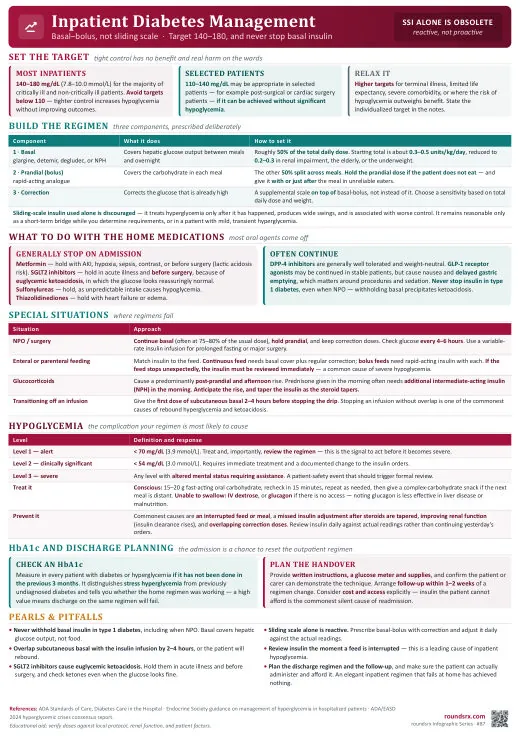
Inpatient Diabetes Management
Inpatient hyperglycemia is extremely common and associated with increased mortality, infections, and length of stay. The landmark NICE-SUGAR, 2009 trial showed that targeting 140-180 mg/dL in ICU patients reduces mortality compared to tight glucose control (81-108). For non-ICU patients, the ADA 2026 recommends 100-180 mg/dL. Initiate or intensify insulin for persistent BG ≥180 mg/dL confirmed on two occasions.
• Perioperative: A1c goal <8% within 3 months of elective surgery. Target BG 100–180 mg/dL perioperatively. Do NOT postpone surgery based on A1c alone
• CGM in hospital: Hospital-owned CGM devices show feasibility for detecting nocturnal/asymptomatic hypoglycemia (no devices FDA-approved for inpatient use yet)
• Discharge planning: Initiate CGM prior to discharge to facilitate follow-up. Prescribe glucagon at discharge for patients with severe hypoglycemia or impaired awareness
• Cancer treatment hyperglycemia (NEW): Metformin first-line for PI3K/mTOR inhibitor-induced hyperglycemia. Insulin reserved for severe/crisis-level. Close monitoring for immune checkpoint inhibitor patients
- ICU patients: 140-180 mg/dL (NICE-SUGAR, 2009)
- Non-ICU patients: 100-180 mg/dL (pre-meal <140, random <180)
- Avoid hypoglycemia: <70 mg/dL is harmful. <54 = clinically significant. <40 = severe.
1. Holding basal insulin in an NPO patient, especially T1DM. Basal covers hepatic glucose output (gluconeogenesis), not meals. Holding causes DKA within hours in T1DM, severe hyperglycemia in T2DM. Reduce by 20-50%, never hold.
2. Sliding scale alone for persistent glucoses >180. Reactive (treats highs after they happen) instead of proactive. RABBIT 2, 2007 proved basal-bolus is superior. Convert within 24 h.
3. Continuing SGLT2i on admission for acute illness. Causes euglycemic DKA, glucose may be normal while patient is in DKA. Always hold and check anion gap + beta-hydroxybutyrate if any clinical concern.
4. Not anticipating steroid or tube-feed hyperglycemia. Both are predictable from a known stressor; add the right insulin upfront (NPH for AM prednisone, basal for dex, scheduled coverage for tube feeds) instead of chasing with correction.
5. Discharging on full inpatient insulin doses. Home activity and normal PO intake increase insulin sensitivity. Reduce inpatient TDD by 30-50% at discharge to avoid outpatient hypoglycemia.
The first decision on every diabetic admit. Most non-insulin agents get held during acute illness; insulin gets adjusted, never stopped entirely.
| Class | Drug | Action | Why |
|---|---|---|---|
| Biguanide | Metformin | HOLD if eGFR <30, sepsis, hypoxia, IV contrast within 48 h, AKI, decompensated HF, or hospitalized for serious illness. Restart 48 h post-contrast if Cr stable. | Lactic acidosis risk in tissue hypoxia or impaired clearance. Most inpatients have at least one trigger. |
| SGLT2 inhibitor | Empagliflozin (Jardiance), Dapagliflozin (Farxiga), Canagliflozin (Invokana), Ertugliflozin (Steglatro) | HOLD on admission for any acute illness. Pre-op: hold 3 days (4 days for ertugliflozin) before elective surgery. | Euglycemic DKA risk when fasting, ill, or peri-op. Glucose may be normal while the patient is in DKA. FDA label updated 2024. |
| GLP-1 RA | Semaglutide (Ozempic, Wegovy), Dulaglutide (Trulicity), Liraglutide (Victoza), Tirzepatide (Mounjaro) | HOLD for surgery / procedural sedation: daily formulations on day of surgery; weekly formulations 1 week before. Continue otherwise unless severe nausea or pancreatitis. | Aspiration risk from delayed gastric emptying (residual food despite NPO >8 h). Multi-society 2023 / ADA 2025-2026 guidance. |
| Sulfonylurea | Glipizide, Glyburide, Glimepiride | HOLD while inpatient, especially if NPO or variable PO intake. | Long half-life with prolonged hypoglycemia (worst with glyburide + renal impairment). Unpredictable when meals are missed or delayed. |
| Meglitinide | Repaglinide, Nateglinide | HOLD if NPO or unreliable meal timing. | Mealtime secretagogue, only safe when patient eats predictably. |
| TZD | Pioglitazone | HOLD if HF exacerbation, edema, or active bladder cancer workup. | Fluid retention worsens HF. Slow onset (weeks) so no inpatient utility either way. |
| DPP-4 inhibitor | Sitagliptin (Januvia), Linagliptin (Tradjenta), Saxagliptin (Onglyza) | CONTINUE at home dose (renal dose-adjust sitagliptin and saxagliptin). Hold saxagliptin in HF (HF hospitalization signal). | Weight-neutral, very low hypoglycemia risk, modest A1c effect. Useful adjunct to basal insulin. |
| Basal insulin | Glargine, Detemir, Degludec, NPH | CONTINUE at 60-80% of home dose (illness reduces PO intake; full dose risks hypoglycemia). NEVER hold completely in T1DM. | Basal covers hepatic glucose output regardless of PO. Holding basal in T1DM causes DKA within hours. |
| Mealtime insulin | Lispro, Aspart, Glulisine, Regular | HOLD if NPO. RESUME at 50% of home dose with first meal, then titrate. | No food, no need for nutritional insulin. Continue correction-only sliding scale while NPO. |
| Premixed insulin (70/30) | Humalog Mix 75/25, NovoLog Mix 70/30, Humulin 70/30 | CONVERT to basal-bolus inpatient. | Inpatient carb intake is unpredictable; premixed locks the ratio and risks both hypo and hyperglycemia. Resume premixed at discharge if patient prefers. |
| Patient Type | TDD Calculation |
|---|---|
| Already on insulin at home | Use 80% of home TDD (reduce for illness-related decreased intake) |
| Insulin-naive, Type 2 | 0.4-0.5 units/kg/day (start conservatively). Elderly / CKD eGFR < 30 / thin → 0.3 units/kg/day. |
| Type 1 | 0.4-0.6 units/kg/day. NEVER hold basal completely. |
| On steroids | ↑ TDD by 20-40% (prednisone causes afternoon/evening hyperglycemia). Increase nutritional insulin at lunch/dinner more than basal. |
- 50% as basal: Glargine (Lantus) or Detemir (Levemir) once daily (usually at bedtime or in the morning). Covers fasting glucose / hepatic glucose output.
- 50% as bolus (nutritional): Divided into 3 equal doses before each meal, Lispro (Humalog) or Aspart (NovoLog) before meals. Skip if NPO or not eating.
- Correction factor: 1700 / TDD = how many mg/dL 1 unit of insulin will drop glucose. Add correction to mealtime dose. Example: TDD 32 → 1700/32 ≈ 53 mg/dL per unit.
Three pre-built ladders by insulin sensitivity. Add correction to the mealtime dose; do NOT use as monotherapy. Pick the ladder by patient phenotype, not by glucose level.
| Glucose (mg/dL) | Low-Dose | Medium-Dose | High-Dose |
|---|---|---|---|
| <150 | 0 U | 0 U | 0 U |
| 150-199 | 1 U | 2 U | 4 U |
| 200-249 | 2 U | 4 U | 8 U |
| 250-299 | 3 U | 6 U | 10 U |
| 300-349 | 4 U | 8 U | 12 U |
| 350-399 | 5 U | 10 U | 14 U |
| >400 | 6 U + call MD | 12 U + call MD | 16 U + call MD |
Pick low-dose: insulin-naive, <60 kg, eGFR <30, age >75, cirrhosis. Medium-dose: typical T2DM with home TDD 30-60 U. High-dose: home TDD >60 U, on steroids, BMI >35, or known insulin resistance. Why three ladders: a fixed sliding scale that gives 4 U for glucose 200 will overshoot a thin elderly woman and undershoot an obese man on prednisone. Match the dose to the patient's expected response.
- Fasting glucose high? → increase basal by 10-20%
- Pre-lunch / dinner / bedtime high? → increase prior meal's nutritional dose by 10-20%
- Hypoglycemia (< 70)? → reduce the responsible component by 20%. If nocturnal → reduce basal.
- NPO? → continue basal (reduce by 20-50% if concerned), hold nutritional, use correction-only sliding scale
- Tube feeds? → basal + correction q6h, OR 70/30 insulin BID for continuous feeds
- Continuous insulin infusion for critically ill patients (DKA, postoperative, unstable PO intake, persistent BG > 180 despite SubQ).
- Regular insulin drip: start 0.5-1 unit/hr, titrate to target 140-180 mg/dL.
- Check BG q1h until stable, then q2h.
- Transitioning to SubQ -the overlap rule: calculate 24-hr drip total (last 6-8 h average × 24), give 80% of that as daily basal. Give the SubQ basal dose 2-4 hours BEFORE stopping the drip -basal needs time to reach steady-state.
- Glargine overlap = 4 hours (slower onset)
- Detemir overlap = 2 hours
- Why the overlap matters: if you stop the drip before SubQ basal reaches therapeutic level, there's a 2-4 h gap with no effective insulin → rebound hyperglycemia in T2DM, DKA in T1DM.
The insulin choice depends on the steroid pharmacokinetics. Match the insulin profile to the glycemic-peak pattern, the wrong choice leaves the patient hyperglycemic when the steroid peaks and hypoglycemic when it wears off.
| Steroid | Glycemic Pattern | Best Insulin Strategy | Why |
|---|---|---|---|
| Prednisone (once-daily AM) | Afternoon / evening peak (4-8 h after dose), fasting near-normal | NPH 0.1-0.2 U/kg with AM prednisone. Add lispro/aspart correction at lunch and dinner. | NPH peaks at 4-12 h, matches steroid peak. Glargine is the WRONG choice here, flat 24 h profile causes overnight hypoglycemia while under-covering the afternoon peak. |
| Dexamethasone (long-acting, t½ 36-72 h) | Sustained 24 h hyperglycemia, including fasting | Basal insulin (glargine or degludec) 0.2-0.3 U/kg. Add mealtime lispro/aspart if eating. | Dex effect lasts >24 h so the hyperglycemia is basal-pattern, not just postprandial. NPH would leave a 12 h gap. |
| IV methylprednisolone (e.g., 60 mg q6h) | Continuous, dose-dependent hyperglycemia throughout the day | Basal-bolus + low-threshold for IV insulin drip if glucose >250 sustained. Start basal at 0.3-0.4 U/kg. | Q6h dosing creates near-continuous steroid effect; need scheduled coverage rather than peak-matched. |
| Pulse methylprednisolone (1 g IV daily) | Severe hyperglycemia within hours, often glucose >400 | IV insulin drip from start. Transition to high-dose basal-bolus once stable. | SubQ insulin can't keep up with the pharmacologic spike; risk of HHS/DKA without aggressive control. |
- Taper insulin proportionally with the steroid taper. Halve the steroid → halve the steroid-coverage insulin (NPH, or the basal added for dex). Failing to taper is the #1 cause of post-steroid hypoglycemia.
- Pre-existing diabetes + new steroids: increase home TDD by 20-40% on day 1, then titrate.
- Steroid-induced hyperglycemia in non-diabetics: common, usually resolves with steroid discontinuation. Check A1c on admission to identify undiagnosed pre-existing DM.
The insulin strategy depends on the feeding pattern, not the patient. Match the insulin profile to the carbohydrate delivery profile.
| Feed Type | Insulin Strategy | Why |
|---|---|---|
| Continuous TF (24 h) | Option A: basal (glargine 0.2-0.3 U/kg) + regular insulin q6h correction. Option B: NPH BID (0.2-0.3 U/kg/day, divided q12h) + correction. Option C: 70/30 BID for stable feed rates. | Continuous carbohydrate delivery means continuous insulin need. NPH or 70/30 BID matches the steady-state carb load. |
| Bolus TF (4-6 boluses/day) | Basal (50% TDD) + rapid-acting (lispro/aspart) before each bolus feed, just like meals. Calculate bolus dose by carb-to-insulin ratio (or as fixed per-bolus amount, e.g., 4-6 U). | Behaves like normal eating; treat each bolus as a meal. |
| Cyclic TF (e.g., 12 h overnight) | NPH at start of feeds (0.3-0.5 U/kg of feed-period requirement), correction q4-6h during feeds. NO basal during feed-off period. | Hyperglycemia is confined to the feeding window; using long-acting basal causes hypoglycemia during the feed-off hours. |
- T1DM on tube feeds still needs basal insulin even if NPH is used for the feeding window. NPH alone leaves a 12 h gap, T1DM patients ketose. Add small-dose glargine (typically 30-50% of usual basal).
- Transitioning from continuous to bolus feeds (or to oral): recalculate TDD on the new pattern; dropping from continuous to bolus typically reduces TDD by 20-30%.
- Start with regular insulin IN the TPN bag at 0.05-0.1 U per gram of dextrose (i.e., 1 U per 10-20 g dextrose). Use the lower end for insulin-naive, higher end for known DM.
- Adjust daily based on glucose readings; recalculate when dextrose concentration changes.
- Supplement with correction-scale regular insulin SQ q6h for persistent hyperglycemia.
- Roll 80% of the prior 24 h correction insulin into the next TPN bag, anticipates rather than chases.
- If TPN is held abruptly (line issue, infection workup), the insulin in the bag stops with it, but any SubQ basal already given is still active, hang D10W until the basal effect wears off (8-24 h depending on agent).
Decision: keep the pump on (patient self-manages) or convert to basal-bolus (team manages). The pump is a self-titration device; in critical illness or altered mental status it becomes a hazard.
- KEEP pump on if: patient is alert, oriented, hemodynamically stable, eating, and willing/able to self-manage. Most short ward admits.
- SWITCH to basal-bolus if: ICU, altered mental status, DKA, surgery >2 h, MRI (pump and CGM are MRI-incompatible), NPO with planned procedures, or patient unable to self-manage.
- Conversion to basal-bolus: total daily basal rate from pump (e.g., 0.8 U/h × 24 = 19 U) → give as glargine at the same total dose. Pump bolus ratios → use as mealtime insulin and correction.
- Document settings BEFORE disconnection: all basal rates by time-of-day, ICR (insulin-to-carb ratio), correction factor, and target glucose. Restart pump at discharge using the same settings.
- MRI: pump and CGM sensors must be removed before scan. Bridge with SubQ glargine + correction during the MRI window; resume pump immediately after.
- Glucose <70 mg/dL: If able to eat, 15 g oral glucose (juice box, glucose tabs). If NPO or unable, D50 25 mL (12.5 g) IV push.
- Recheck glucose in 15 minutes. Repeat if still <70.
- If recurrent hypoglycemia: reduce insulin dose by 20%, investigate cause (missed meals, renal clearance, adrenal insufficiency).
The peri-op window is the highest-risk period for both hypo- and hyperglycemia. Goals: glucose 100-180 mg/dL intra-op and PACU, avoid DKA / euglycemic DKA, prevent aspiration from GLP-1-induced gastroparesis, prevent surgical-site infection from severe hyperglycemia.
- Goal A1c <8% within 3 months of elective surgery, when feasible.
- Do NOT postpone surgery based on A1c alone, individualize. A1c 8-10 is generally acceptable; >10 warrants discussion with surgical team and endocrine consult if time permits.
- BG target 100-180 mg/dL perioperatively. A single elevated finger-stick is not a reason to cancel; sustained >250 with ketones is.
| Medication | When to Hold | Why |
|---|---|---|
| SGLT2 inhibitor | Hold 3 days before elective surgery (4 days for ertugliflozin) | Euglycemic DKA risk during fasting / surgical stress. FDA label updated 2024. |
| GLP-1 RA, daily | Hold day of surgery (semaglutide PO, liraglutide, exenatide BID) | Delayed gastric emptying with aspiration risk despite NPO >8 h. |
| GLP-1 RA, weekly | Hold 1 week before surgery (semaglutide SC, dulaglutide, tirzepatide, exenatide ER) | Long half-life; gastroparesis effect persists for days. ASA 2023 / ADA 2025-2026. |
| Metformin | Hold morning of surgery; resume 48 h post-op if Cr stable | Lactic acidosis risk with contrast, AKI, or hypoperfusion. |
| Sulfonylurea / meglitinide | Hold morning of surgery | Hypoglycemia risk while NPO. |
| Basal insulin (glargine, detemir, degludec) | Give 60-80% of usual dose evening before or morning of surgery | Maintains hepatic glucose suppression. Holding entirely → DKA in T1DM, severe hyperglycemia in T2DM. |
| NPH | Give 50% of usual morning dose | Has a peak; full dose risks intra-op hypoglycemia under anesthesia. |
| Mealtime insulin | Hold morning of surgery (NPO) | No food, no need. |
| Insulin pump | Continue at basal rate only (suspend boluses) if surgery <2 h. For longer surgery → switch to IV insulin drip. | Pump maintains basal coverage, but bolus risks hypoglycemia under anesthesia. Long surgery exceeds reservoir / battery safety margin. |
- Intra-op glucose check q1h; q1-2h in PACU until stable.
- IV insulin drip for: surgery >2 h, T1DM (any case), glucose >180 despite SubQ, cardiac surgery, transplant, neurosurgery (per institutional protocol).
- Resume SubQ insulin once eating: restart basal at 80% of home dose, mealtime insulin at 50% of home (titrate up over 1-2 days).
- Resume non-insulin agents: metformin 48 h post-op if Cr stable; SGLT2i once eating regularly and not at AKI risk; GLP-1 once tolerating diet (consider lower starting dose if held >1 week, GI tolerance is reset).
The discharge regimen is set by the admission A1c (reflects 3-month average pre-admission glycemia) and the inpatient response. Don't discharge on more insulin than the patient can safely manage at home, and reduce inpatient TDD by 30-50% at discharge because home activity and normal PO intake increase insulin sensitivity.
| Admission A1c | Recommended Discharge Regimen | Follow-up |
|---|---|---|
| <7% | Resume home regimen (oral agents). If well-controlled on metformin alone, do not add insulin at discharge. | PCP within 2-4 weeks. No urgent endocrine. |
| 7-9% | Resume home oral agents + add basal insulin (glargine 0.1-0.2 U/kg, ~10 U at bedtime) if inpatient glucoses still >180 on orals. Continue metformin if eGFR >30. | PCP within 1-2 weeks for titration. Diabetes educator referral. |
| >9% | Basal-bolus insulin at discharge. Calculate as 50-70% of inpatient TDD (lower because home insulin sensitivity is higher). Add metformin if not contraindicated. | Endocrinology referral. PCP within 1 week. Diabetes educator MANDATORY. |
| T1DM (any A1c) | Resume home basal-bolus or pump. Verify insulin supply, glucagon kit, and CGM (if applicable) are in hand at discharge. | Endocrinology within 2 weeks. |
| Steroid hyperglycemia (no prior DM) | If steroids continuing >2 weeks: discharge on basal insulin OR oral agent based on severity. If steroids tapering quickly: short-term insulin with daily glucose checks. | PCP within 1 week. Reassess once steroids stopped, hyperglycemia often resolves. |
| Stress hyperglycemia (no DM, no steroids) | Often resolves with illness. Discharge with home glucometer + check fasting BG x 1 week. A1c at PCP visit (not as inpatient, acute illness skews A1c minimally but A1c ≥6.5 inpatient still flags new DM). | PCP within 2-4 weeks. Screen for new-onset DM at follow-up. |
• CGM script at discharge for any patient on insulin, especially T1DM, hypoglycemia unawareness, or recent severe hypoglycemia. Improves outpatient adherence and time-in-range, and bridges the gap until first endocrine visit.
• Glucagon prescription for any patient with severe hypoglycemia or impaired awareness during admission. Nasal glucagon (Baqsimi) preferred for caregiver use, no reconstitution needed.
• Diabetes self-management education (DSME) referral for newly insulin-requiring patients: injection technique, glucose monitoring, hypoglycemia recognition, sick-day rules.
• Sick-day rules reviewed before discharge: never stop basal, check glucose q4h when ill, hydration, when to call (BG >300 x 2, ketones, vomiting, can't keep fluids down).
- A1c, if not checked in past 3 months. Reflects 3-month average. Guides discharge planning.
- Home insulin regimen, detailed medication reconciliation. What type, how much, when?
- Type 1 vs Type 2, critical distinction. Type 1 patients MUST have basal insulin at all times (DKA risk). Check C-peptide if unclear.
- Point-of-care glucose (POC), AC (before meals) and HS (bedtime) = 4x/day for eating patients. Q6h if NPO.
- Renal function, CKD increases hypoglycemia risk (reduced insulin clearance). Reduce TDD by 25-50% if eGFR <30.
- Nutritional status, is the patient eating? NPO? On TPN? On tube feeds? This drives your insulin strategy.
- Review all 4 POC glucose values from the past 24h
- Identify patterns: fasting highs = increase basal. Pre-dinner highs = increase lunch bolus. Overnight lows = reduce basal.
- Adjust insulin doses by 10-20% increments daily
| Drug | Type | Onset / Peak / Duration | Notes |
|---|---|---|---|
| Glargine (Lantus) | Basal (long-acting) | 2-4h / peakless / 20-24h | Once daily. Provides baseline insulin coverage. Do NOT hold when NPO (reduce by 20-50%). |
| Detemir (Levemir) | Basal (long-acting) | 1-2h / 6-8h / 18-24h | May need BID dosing. Slight peak compared to glargine. |
| Degludec (Tresiba) | Basal (ultra-long-acting) | 1h / peakless / >42h | Once daily, very flat profile. Lowest nocturnal hypoglycemia rate of all basal options. Forgiving for missed/late doses (give within 8 h of usual time). Good choice for shift workers and elderly with variable schedules. |
| Glargine U-300 (Toujeo) | Basal (concentrated, long-acting) | 6h / peakless / 24-36h | 3x more concentrated than glargine U-100. Smaller injection volume, slower absorption, lower hypoglycemia. Not interchangeable unit-for-unit with U-100 glargine on uptitration. |
| NPH | Intermediate-acting | 1-3h / 4-12h / 12-18h | Key for steroid-induced hyperglycemia (prednisone). Give with morning prednisone, peak matches steroid glycemic peak. Also useful for cyclic tube feeds. |
| 70/30 (NPH 70 / Regular 30) | Premixed (intermediate + short) | 30 min / 2-12h / 18-24h | BID dosing matches continuous tube feeds well. Inflexible for variable PO intake, convert to basal-bolus when oral. Common formulations: Humulin 70/30, Novolin 70/30, Humalog Mix 75/25. |
| U-500 Regular | Concentrated short-acting | 30 min / 4-8h / 12-24h | 5x more concentrated than U-100 regular. For severe insulin resistance (TDD >200 U/day). Acts more like NPH due to depot volume. Dosing errors are catastrophic, write orders as both units AND mL, and use a dedicated U-500 syringe. |
| Lispro (Humalog) | Rapid-acting (bolus) | 15 min / 1-2h / 3-5h | Give 0-15 min before meals. Hold if NPO. Correction scale uses this. |
| Aspart (NovoLog) | Rapid-acting (bolus) | 15 min / 1-2h / 3-5h | Equivalent to lispro. Interchangeable. |
| Regular insulin | Short-acting | 30-60 min / 2-4h / 6-8h | Used in IV insulin drips (ICU) and added to TPN bags. Give 30 min before meals if used SQ. |
| D50 (Dextrose 50%) | Hypoglycemia rescue | 25 mL (12.5g) IV push | For glucose <70 when patient cannot eat. Recheck in 15 min. |
Patient: 70M with T2DM (A1c 9.8), admitted for cellulitis. Home meds: metformin + glipizide. Weight 85 kg. Glucose 280-380 on sliding scale alone × 24h.
Key findings: Sliding scale alone is failing. Patient needs basal-bolus insulin. Home orals (metformin, glipizide) are held inpatient, metformin risk with IV contrast/AKI, glipizide unpredictable when eating is variable.
Management:
- Calculate TDD: 0.4 U/kg × 85 kg = 34 U/day (conservative for insulin-naive)
- Basal (50%): glargine 17 U at bedtime
- Bolus (50% ÷ 3): lispro 5-6 U before each meal (hold if NPO)
- Correction factor: 1700/34 = 50 → 1 unit drops glucose ~50 mg/dL. Add correction to mealtime dose
- Adjust daily: increase basal by 2-4 U if fasting glucose > 180; increase bolus by 1-2 U if pre-meal values high
Teaching point: The "50/50 split" is the foundation: 50% basal (covers liver glucose output) + 50% bolus (covers meals). Never hold basal in T1DM. Reduce basal by 20-50% in NPO patients but never to zero, the liver never stops making glucose.
Patient: 65F with no diabetes history, admitted for COPD exacerbation. Started prednisone 40 mg daily. Day 2: glucose pattern, fasting 118, pre-lunch 162, pre-dinner 298, bedtime 264.
Key findings: Classic steroid hyperglycemia pattern: morning glucose near-normal, peaks in afternoon/evening (prednisone peaks at 4-6h → hyperglycemia at 6-12h). Fasting glucose is relatively spared because steroid effect wears off overnight.
Management:
- NPH insulin with AM prednisone dose: start 0.15 U/kg = ~10 U (NPH peaks at 6-8h, matching steroid peak)
- Correction lispro with lunch and dinner only (where the peaks are)
- Do NOT add glargine (flat profile → overnight hypoglycemia while missing afternoon peaks)
- Titrate NPH by 2-4 U daily based on pre-dinner and bedtime glucose
- When prednisone tapered: reduce NPH proportionally, halve insulin when steroid dose is halved
Teaching point: NPH is the ideal match for once-daily prednisone because its pharmacokinetic profile parallels the hyperglycemic pattern. Glargine is the WRONG choice, its flat 24h profile causes overnight hypoglycemia while under-covering the afternoon peak. Always co-taper insulin with steroids.
Patient: 25M with T1DM, admitted in DKA (now resolved). Insulin drip at 2.5 U/hr × last 8h. Eating well. BHB 0.3, bicarb 19. Team ready to transition to SubQ.
Key findings: T1DM = zero endogenous insulin. The drip-to-SubQ transition is the highest-risk moment, any gap in insulin coverage → DKA recurrence within hours. The "2-hour overlap" is mandatory.
Management:
- Calculate: 2.5 U/hr × 24h = 60 U/day → give 80% = 48 U as daily basal
- Give glargine 48 U SubQ NOW, continue drip for 2 more hours (overlap period for SubQ absorption)
- After 2h overlap: stop drip. Start mealtime lispro 8 U before each meal + correction scale
- Check glucose before each meal + bedtime + 3 AM for first 24h (catch overnight hypo or hyperglycemia)
- If patient was on home insulin: use their home regimen if A1c was reasonable (< 8); use drip-calculated dose if home regimen was clearly inadequate
Teaching point: The 2-hour overlap saves lives. Glargine takes ~4h to reach steady state, giving it 2h before stopping the drip ensures no insulin gap. In T1DM, even a 2-hour gap without insulin can trigger ketogenesis. Write the overlap as an explicit nursing order.
Mr. Garcia is a 58-year-old man with T2DM (A1c 8.7) admitted for community-acquired pneumonia. He is on prednisone 40 mg daily for severe COPD exacerbation. Home regimen: metformin 1000 mg BID + glipizide 10 mg BID. Weight 90 kg. Admission glucose 280. We transitioned to basal-bolus: TDD 0.4 x 90 = 36 units. Glargine 18 units QHS, lispro 6 units AC meals, correction scale. For steroid-induced hyperglycemia: added NPH 10 units (0.1 u/kg) with morning prednisone. Yesterday's glucoses: AM 145, pre-lunch 168, pre-dinner 242, HS 198. The pre-dinner spike confirms steroid effect, increasing NPH to 14 units. Metformin and glipizide held inpatient.
- POC glucose AC + HS (before meals and bedtime) = 4 checks/day for eating patients
- POC glucose q6h for NPO patients
- Q1h glucose for patients on IV insulin drip (ICU)
- Hypoglycemia alerts: <70 requires intervention. <54 = clinically significant. <40 = severe, consider dose reduction and workup.
- Daily insulin adjustment: review all 4 values, identify patterns, adjust by 10-20% per day.
- BMP daily, monitor K+ (insulin shifts K+ intracellularly), renal function (affects insulin clearance).
- A1c on admission, guides discharge insulin planning (A1c >9 likely needs insulin at discharge, A1c <8 may resume oral agents).