Interstitial Lung Disease
| HRCT Pattern | Key Features | Most Likely Diagnosis | Prognosis |
|---|---|---|---|
| UIP (Usual Interstitial Pneumonia) | Basal, peripheral, subpleural honeycombing + traction bronchiectasis + reticulation. Heterogeneous (areas of normal lung adjacent to fibrosis). | IPF (if no identifiable cause) | Worst. Median survival 3–5 years. |
| NSIP (Non-Specific Interstitial Pneumonia) | Ground-glass opacities, basal-predominant, relatively uniform. Subpleural sparing. Less honeycombing. | CTD-ILD (RA, scleroderma), drug-induced, idiopathic NSIP | Better than UIP. Often responds to immunosuppression. |
| Organizing Pneumonia (OP) | Peripheral, patchy consolidations that may be migratory. "Reverse halo" (atoll sign). | COP (cryptogenic), drug-induced, post-infection, CTD | Good. Usually responds dramatically to steroids. |
| Upper-lobe predominant | Fibrosis/nodules in upper lobes | Sarcoidosis, hypersensitivity pneumonitis (chronic), silicosis, coal workers | Variable |
- Most common IIP. Male > female. Typically age > 60. Smoking is a risk factor.
- Clinical: progressive exertional dyspnea, dry cough, bibasilar Velcro-like crackles on auscultation, clubbing (~50%)
- PFTs: restrictive pattern (↓ FVC, ↓ TLC) + ↓↓ DLCO
- Diagnosis: UIP pattern on HRCT in appropriate clinical context → may not need biopsy. If HRCT indeterminate → surgical lung biopsy via VATS for confirmation.
| Drug | Dose | Evidence | Notes |
|---|---|---|---|
| Pirfenidone (Esbriet) ANTIFIBROTIC | 267 mg TID → titrate to 801 mg TID | ASCEND, 2014: reduced FVC decline by ~50% at 1 year. | Slows progression, does not cure. GI side effects (nausea), photosensitivity. Take with food. |
| Nintedanib (Ofev) ANTIFIBROTIC | 150 mg BID | INPULSIS, 2014: reduced FVC decline by ~50%. Also approved for SSc-ILD and progressive fibrosing ILD. | Tyrosine kinase inhibitor. Diarrhea is the main side effect (~60%). Hepatotoxicity -monitor LFTs. |
- FVC decline ≥ 10% in 6 months
- DLCO < 40% predicted
- Desaturation < 88% on 6-minute walk test
- Hospitalization for respiratory decline or pneumothorax
- Refer early -transplant evaluation takes months
| Drug | Dose | Evidence | Notes |
|---|---|---|---|
| Pirfenidone (Esbriet) ANTIFIBROTIC | 267 mg TID → titrate to 801 mg TID | ASCEND, 2014: reduced FVC decline by ~50% at 1 year. | Slows progression, does not cure. GI side effects (nausea), photosensitivity. Take with food. |
| Nintedanib (Ofev) ANTIFIBROTIC | 150 mg BID | INPULSIS, 2014: reduced FVC decline by ~50%. Also approved for SSc-ILD and progressive fibrosing ILD. | Tyrosine kinase inhibitor. Diarrhea is the main side effect (~60%). Hepatotoxicity -monitor LFTs. |
- FVC decline ≥ 10% in 6 months
- DLCO < 40% predicted
- Desaturation < 88% on 6-minute walk test
- Hospitalization for respiratory decline or pneumothorax
- Refer early -transplant evaluation takes months
Patient: 72M with progressive dyspnea × 2 years and dry cough. Bibasilar velcro crackles. PFTs: FVC 58%, DLCO 42% (restrictive + impaired gas exchange). HRCT: basal-predominant honeycombing, traction bronchiectasis, minimal GGO. UIP pattern.
Key findings: Definite UIP pattern on HRCT = IPF diagnosis without biopsy needed (if clinical context fits). IPF is the most common and most lethal ILD, median survival 3-5 years from diagnosis.
Management:
- Antifibrotic therapy: pirfenidone or nintedanib (slows FVC decline by ~50%) ASCEND/INPULSIS, 2014
- Pulmonary rehabilitation (improves exercise capacity and QOL even as disease progresses)
- Supplemental O₂ for resting SpO₂ < 88% or exertional desaturation
- Lung transplant evaluation if age < 70, no major comorbidities, refer EARLY (waitlist mortality is high)
- NO steroids or immunosuppression (PANTHER-IPF showed HARM from prednisone + azathioprine + NAC in IPF)
Teaching point: Steroids are HARMFUL in IPF, this is the one ILD where immunosuppression makes things worse. Antifibrotics (pirfenidone, nintedanib) slow progression but do not reverse fibrosis. Early transplant referral is critical.
Patient: 55F bird breeder with progressive dyspnea × 1 year. HRCT: diffuse GGO with mosaic attenuation, air trapping on expiratory images, centrilobular nodules. No honeycombing. PFTs: FVC 68%, DLCO 52%. BAL: lymphocytosis 48%.
Key findings: Chronic hypersensitivity pneumonitis from avian antigen exposure. HRCT pattern: GGO + mosaic attenuation + air trapping is classic. BAL lymphocytosis (> 30%) supports the diagnosis. Unlike IPF, HP is potentially reversible with antigen avoidance.
Management:
- Antigen avoidance is the MOST important intervention, remove birds, professional home cleaning
- Prednisone 0.5 mg/kg daily × 4-8 weeks for symptomatic disease, then slow taper
- If fibrotic HP refractory to steroids: mycophenolate or azathioprine as steroid-sparing agents
- If fibrotic HP progressing despite antigen avoidance + immunosuppression: consider antifibrotic (nintedanib approved for progressive fibrosing ILD)
- Serial PFTs q3-6 months to monitor for progression vs stabilization
Teaching point: HP is the treatable mimic of IPF. The key differentiators: HP has GGO + mosaic attenuation (not honeycombing), BAL lymphocytosis, and an identifiable exposure. Antigen removal can halt or reverse disease if caught before fibrosis.
Patient: 68M with known IPF on nintedanib. Admitted with acute worsening dyspnea × 5 days. SpO₂ 78% on 6L NC. CT: new bilateral GGO superimposed on known UIP pattern. No PE on CTA. Sputum cultures negative.
Key findings: Acute exacerbation of IPF: rapid respiratory deterioration + new bilateral GGO on CT + no identifiable cause (ruled out infection, PE, HF). Mortality > 50% per episode.
Management:
- High-dose methylprednisolone 1g IV daily × 3 days → prednisone 1 mg/kg taper (limited evidence but standard practice)
- Broad-spectrum antibiotics until infection excluded (empiric coverage while cultures pending)
- High-flow nasal cannula or NIV for respiratory support, intubation carries very poor prognosis in IPF
- Discuss goals of care early, in-hospital mortality for intubated IPF patients exceeds 80%
- Continue antifibrotic therapy if able to take PO
Teaching point: Acute exacerbation of IPF is often fatal. The most important conversation is goals of care, mechanical ventilation in IPF rarely leads to meaningful recovery. Palliative care should be involved early if the patient does not respond to steroids within 48-72h.
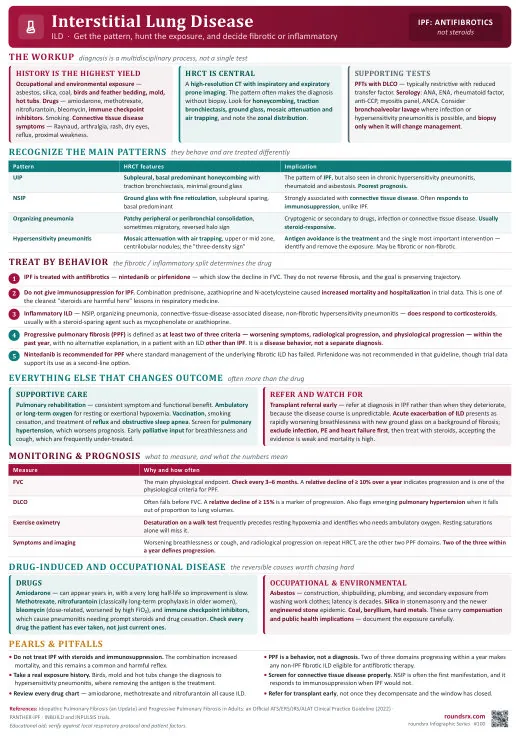
Text version
- Steroids for IPF (harmful -worsens outcomes [PANTHER-IPF])
- Not screening for CTD (ANA, RF, CCP, myositis panel) in new ILD
- Late transplant referral (IPF median survival 3-5 years)
- Forgetting pulmonary rehab (dramatically improves QOL)