Intra-Abdominal Infections
Intra-abdominal infections (IAI) range from uncomplicated appendicitis to life-threatening peritonitis and hepatic abscess. Source control (surgery, drainage, or percutaneous intervention) is the cornerstone, antibiotics alone are insufficient for complicated IAI. Empiric coverage must include gram-negatives AND anaerobes. SBP in cirrhotics is a distinct entity requiring paracentesis and rapid antibiotics.
🔍 Overview
Classification
| Type | Definition | Examples |
|---|---|---|
| Uncomplicated IAI | Infection confined to a single organ, no peritoneal contamination | Uncomplicated appendicitis, uncomplicated cholecystitis, uncomplicated diverticulitis |
| Complicated IAI (cIAI) | Infection extends beyond the organ into the peritoneal space, abscess, peritonitis, or perforation | Perforated appendicitis, perforated diverticulitis, peritonitis, intra-abdominal abscess, anastomotic leak |
| Primary peritonitis (SBP) | Peritoneal infection without visceral perforation. Spontaneous. Almost exclusively in cirrhotics with ascites. | Spontaneous bacterial peritonitis in cirrhosis. Usually monomicrobial (E. coli, Klebsiella, Strep pneumo). |
| Secondary peritonitis | Peritoneal contamination from GI tract perforation or disruption | Perforated ulcer, ruptured appendix, diverticular perforation, anastomotic leak, traumatic bowel injury |
| Tertiary peritonitis | Persistent/recurrent peritonitis after initially adequate source control | Often nosocomial organisms (Enterococcus, Candida, resistant GNRs). High mortality. ICU population. |
Common Intra-Abdominal Infections
| Condition | Presentation | Key Management |
|---|---|---|
| SBP | Cirrhotic + ascites + fever, abdominal pain, AMS, worsening encephalopathy. May be subtle. | Diagnostic paracentesis: PMN ≥250/mm³ = SBP. Start ceftriaxone 2g IV daily. Albumin 1.5 g/kg day 1, 1 g/kg day 3 (if Cr >1, BUN >30, or bilirubin >4). No source control needed. |
| Acute cholangitis | Charcot triad: fever + jaundice + RUQ pain. Reynolds pentad adds AMS + hypotension (severe). Biliary obstruction. | Emergency biliary drainage (ERCP or PTC) within 24h for severe cholangitis. Antibiotics: pip-tazo or ceftriaxone + metronidazole. Blood cultures. Fluid resuscitation. |
| Intra-abdominal abscess | Persistent fever despite antibiotics, localized pain, elevated WBC/CRP. Often post-surgical. | Percutaneous drainage (CT or US-guided) is first-line. Surgery if not drainable percutaneously, multiloculated, or associated with fistula. Antibiotics alone insufficient for large (>3 cm) abscesses. |
| Perforated viscus | Acute abdomen: sudden severe pain, rigidity, rebound, guarding. Free air on imaging. | Emergent surgery. Broad-spectrum antibiotics immediately. NPO, IV fluids, NG tube. Mortality increases with each hour of delay. |
| Diverticulitis (complicated) | LLQ pain, fever, perforation/abscess/fistula/stricture. | Small abscess (<3 cm): antibiotics alone. Large abscess: percutaneous drainage + antibiotics. Perforation with diffuse peritonitis: emergent surgery (Hartmann procedure). |
| Secondary peritonitis | Diffuse abdominal pain and tenderness, fever, sepsis following perforation or leak. | Source control is paramount (surgery to repair perforation, drain contamination). Broad-spectrum antibiotics. Polymicrobial: GNR + anaerobes + sometimes enterococcus. |
Microbiology
- Community-acquired cIAI: E. coli (most common), Klebsiella, Strep spp., Bacteroides fragilis (key anaerobe). Usually susceptible to standard empiric regimens.
- Healthcare-associated/post-surgical: Resistant GNRs (ESBL, Pseudomonas, Acinetobacter), Enterococcus (including VRE), Candida. Broader empiric coverage needed.
- SBP: Monomicrobial, E. coli (#1), Klebsiella, Strep pneumoniae. If polymicrobial on culture, suspect secondary peritonitis (perforation).
- Biliary: E. coli, Klebsiella, Enterococcus, Bacteroides. Cholangitis may have Enterococcus more frequently than other cIAI.
Polymicrobial culture from ascites = red flag. SBP is monomicrobial. If multiple organisms grow from peritoneal fluid, suspect secondary peritonitis (bowel perforation) and get urgent CT imaging, the patient may need surgery, not just antibiotics.
🧪 Workup
Diagnostic Approach
| Test | When | Key Points |
|---|---|---|
| CT abdomen/pelvis with IV contrast | First-line imaging for most cIAI | Gold standard for IAI. Detects abscess, free air, perforation, bowel wall thickening, mesenteric stranding. Sensitivity >95% for abscess. Guides percutaneous drainage. |
| Diagnostic paracentesis | ALL cirrhotics admitted with ascites | PMN ≥250/mm³ = SBP (start antibiotics immediately). Send: cell count + differential, culture (inoculate blood culture bottles at bedside for best yield), albumin, total protein, glucose, LDH, gram stain. |
| RUQ ultrasound | Cholecystitis, cholangitis, biliary obstruction | First-line for biliary pathology. Gallstones, GB wall thickening (>3 mm), pericholecystic fluid, sonographic Murphy sign, CBD dilation (>6 mm). |
| Blood cultures (×2 sets) | All suspected cIAI, SBP, cholangitis | Positive in 30–50% of SBP, higher in cholangitis. Essential for targeted therapy. |
| CBC, CMP, lipase, lactate | All suspected IAI | Leukocytosis (or leukopenia in severe sepsis). Elevated lactate = tissue hypoperfusion, surgical urgency. LFTs for biliary etiology. Lipase if pancreatitis in differential. |
| Upright chest X-ray / KUB | Suspected perforation (rapid screening) | Free air under diaphragm = perforation until proven otherwise. Sensitivity ~80% for pneumoperitoneum. CT is more sensitive if clinical suspicion persists with negative X-ray. |
| MRCP / ERCP | Biliary obstruction, cholangitis | MRCP: non-invasive biliary imaging. ERCP: therapeutic (stone extraction, stent placement) + diagnostic. Emergent ERCP for severe cholangitis. |
SBP Diagnostic Criteria
| Finding | Interpretation |
|---|---|
| Ascitic PMN ≥250/mm³ | = SBP. Start empiric antibiotics immediately. Do not wait for culture. |
| Positive ascitic culture + PMN <250 | = Bacterascites. May resolve spontaneously. Repeat paracentesis in 48h, if PMN rises to ≥250, treat as SBP. |
| PMN ≥250 + negative culture | = Culture-negative neutrocytic ascites (CNNA). Still SBP, treat the same. Cultures are negative in ~40% of SBP. |
| Ascitic fluid total protein >1 g/dL, glucose <50, LDH > serum | Suggests secondary peritonitis (perforation). Get urgent CT. Surgical evaluation. |
| Polymicrobial ascitic fluid culture | Secondary peritonitis until proven otherwise. CT + surgical consult. |
🚨 Management
Principles of Management
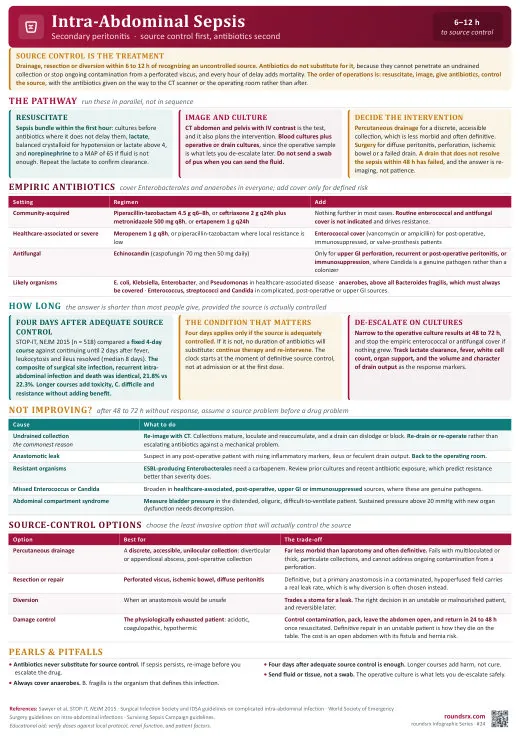
Source control + antibiotics. Antibiotics alone are insufficient for complicated IAI with abscess, perforation, or necrosis. Identify and address the source: surgery (repair perforation, resection), percutaneous drainage (abscess), or endoscopic intervention (ERCP for cholangitis).
Empiric Antibiotic Therapy
| Scenario | Empiric Regimen | Notes |
|---|---|---|
| Community-acquired, mild-moderate cIAI | Ceftriaxone 2g IV daily + Metronidazole 500 mg IV q8h or Ertapenem 1g IV daily | Covers GNRs + anaerobes. Ertapenem is single-agent option. No Pseudomonas or Enterococcus coverage needed for mild community-acquired. SIS/IDSA, 2010 |
| Community-acquired, severe cIAI (sepsis, peritonitis) | Piperacillin-tazobactam 4.5g IV q6h or Meropenem 1g IV q8h | Broader coverage for sicker patients. Pip-tazo covers GNRs + anaerobes + Enterococcus. Meropenem for ESBL risk or penicillin allergy (severe). |
| Healthcare-associated / post-surgical | Meropenem 1g IV q8h or Pip-tazo + Vancomycin ± Fluconazole/Echinocandin | Broader coverage for resistant organisms (ESBL, Pseudomonas, VRE, Candida). Add vancomycin if MRSA/VRE risk. Add antifungal if Candida risk (prior surgery, TPN, broad-spectrum antibiotics). De-escalate aggressively by culture. |
| SBP (primary peritonitis) | Ceftriaxone 2g IV daily or Cefotaxime 2g IV q8h | Covers E. coli, Klebsiella, Strep pneumo. Do NOT add anaerobic coverage (SBP is monomicrobial, rarely anaerobic). Add albumin (1.5 g/kg day 1, 1 g/kg day 3), reduces mortality Sort, 1999 |
| Cholangitis | Pip-tazo 4.5g IV q6h or Ceftriaxone + Metronidazole | Covers biliary pathogens (E. coli, Klebsiella, Enterococcus, Bacteroides). Priority: biliary drainage (ERCP) within 24h for severe cholangitis. Add vancomycin if healthcare-associated or concern for resistant Enterococcus. |
Source Control by Condition
| Condition | Source Control | Timing |
|---|---|---|
| Perforated viscus | Emergent surgery (repair, resection, washout) | ASAP, minutes to hours. Mortality increases with delay. |
| Acute cholangitis | ERCP with stone extraction/stent ± sphincterotomy | Within 24h (urgent). Emergent if severe sepsis/shock. |
| Acute cholecystitis | Cholecystectomy (lap chole) or percutaneous cholecystostomy if too sick for surgery | Within 72h preferred (early cholecystectomy). Perc chole if unstable/high surgical risk. |
| Intra-abdominal abscess | Percutaneous CT-guided drainage (first-line). Surgery if not amenable. | Within 24–48h of identification. Small (<3 cm) may resolve with antibiotics alone. |
| SBP | None, antibiotics only (no perforation) | Antibiotics immediately upon diagnosis (PMN ≥250) |
| Complicated diverticulitis with abscess | Small abscess (<3 cm): antibiotics. Larger: perc drain. Diffuse peritonitis: surgery. | Abscess drain within 24–48h. Surgery emergent if free perforation. |
Duration of Therapy
- Adequate source control achieved: 4 days (96 hours) of antibiotics is sufficient for most cIAI STOP-IT, 2015
- Inadequate source control: Continue antibiotics until source control achieved + clinical improvement. No fixed duration.
- SBP: 5 days of ceftriaxone (or until PMN <250 on repeat paracentesis at 48h)
- Cholangitis: 4–7 days after successful biliary drainage
- Bacteremia: If concurrent bacteremia, treat per BSI guidelines (typically 7–14 days from first negative culture)
STOP-IT trial: In cIAI with adequate source control, 4 days of antibiotics had similar outcomes to traditional longer courses (median 8 days). Shorter is better when the source is controlled, reduces resistance, C. diff risk, and cost.
💊 Medications
Key Antibiotics for Intra-Abdominal Infections
| Drug (Brand) | Spectrum | Dosing | Key Considerations |
|---|---|---|---|
| Piperacillin-Tazobactam (Zosyn) | GNRs + anaerobes + Enterococcus + Pseudomonas | 4.5g IV q6h (or 3.375g q6h extended infusion) | Workhorse for cIAI. Broad-spectrum single agent. Extended infusion (over 4h) improves PK. Does NOT cover ESBL-producers or MRSA. |
| Meropenem (Merrem) | Broadest: GNRs (incl ESBL) + anaerobes + Pseudomonas | 1g IV q8h (2g q8h for CNS infections) | Reserve for healthcare-associated or ESBL risk. Does NOT cover MRSA or VRE. Seizure risk (lower than imipenem). Excellent penetration. |
| Ceftriaxone (Rocephin) | GNRs (not Pseudomonas) | 2g IV q24h | Community-acquired cIAI backbone. Must pair with metronidazole for anaerobic coverage. SBP monotherapy. Once-daily dosing. |
| Metronidazole (Flagyl) | Anaerobes (Bacteroides fragilis) | 500 mg IV/PO q8h | Anaerobic coverage when using non-anaerobic-active GNR agents (ceftriaxone, fluoroquinolones). Excellent oral bioavailability. Disulfiram reaction with alcohol. Metallic taste. |
| Ertapenem (Invanz) | GNRs (incl ESBL) + anaerobes. NOT Pseudomonas. | 1g IV q24h | Once-daily carbapenem for community-acquired cIAI. DOES cover ESBL. Does NOT cover Pseudomonas, Acinetobacter, or Enterococcus. Good for step-down OPAT. |
| Ciprofloxacin (Cipro) | GNRs (incl Pseudomonas) | 400 mg IV q12h or 500 mg PO BID | Alternative for penicillin/cephalosporin allergy. Pair with metronidazole. Rising resistance limits empiric use. Check local antibiogram. FDA black box warnings (tendon, neuropathy). |
📋 On Rounds
What is the diagnostic threshold for SBP and what should you do immediately?
Ascitic fluid PMN ≥250/mm³ = SBP. Start ceftriaxone 2g IV daily immediately, do not wait for cultures (40% will be culture-negative). Add IV albumin (1.5 g/kg day 1, 1 g/kg day 3) if Cr >1, BUN >30, or bilirubin >4, reduces hepatorenal syndrome and mortality (Sort trial). Treat for 5 days. No source control needed.
Why is source control more important than antibiotics in complicated IAI?
Antibiotics cannot sterilize undrained collections or dead tissue. Abscesses have low blood flow and low antibiotic penetration. Necrotic tissue and pus are incubators for ongoing bacterial growth. Without source control, antibiotics will fail, the patient will remain septic despite broadest-spectrum coverage. Source control (drain abscess, repair perforation, remove necrotic tissue) is the definitive treatment; antibiotics are adjunctive.
How does the STOP-IT trial change antibiotic duration for IAI?
The STOP-IT trial (2015) showed that 4 days (96 hours) of antibiotics after adequate source control is equivalent to traditional longer courses (median 8 days) for complicated IAI. No difference in surgical site infection, recurrent IAI, or death. Shorter courses reduce antibiotic exposure, C. diff risk, resistance emergence, and cost. Key requirement: adequate source control must be achieved first.
What does polymicrobial growth from ascitic fluid tell you?
Polymicrobial ascitic fluid culture suggests secondary peritonitis (bowel perforation or surgical leak), not SBP. SBP is almost always monomicrobial. Additional clues: ascitic protein >1 g/dL, glucose <50 mg/dL, LDH > serum upper limit. This is a surgical emergency, get urgent CT abdomen and surgical consultation. The patient needs source control, not just antibiotics.
What is Charcot's triad and Reynolds' pentad?
Charcot triad (cholangitis): (1) fever/chills, (2) jaundice, (3) RUQ pain. Present in ~50–70% of cholangitis. Reynolds pentad adds: (4) altered mental status, (5) hypotension/shock. Reynolds pentad indicates severe/suppurative cholangitis with sepsis, requires emergent biliary drainage (ERCP). Do not wait for imaging to start antibiotics if Reynolds pentad is present.
📣 Sample Presentation
One-Liner
"Mr. Thompson is a 58-year-old man with decompensated cirrhosis (Child-Pugh C) admitted with fever, diffuse abdominal pain, and worsening hepatic encephalopathy. Diagnostic paracentesis showed PMN 820/mm³, consistent with spontaneous bacterial peritonitis."
Key Points to Cover on Rounds
SBP diagnosed by ascitic PMN 820, started ceftriaxone 2g IV daily. Ascitic fluid culture sent in blood culture bottles at bedside. Blood cultures ×2 drawn. IV albumin 1.5 g/kg given (Cr 1.4, BUN 38) per Sort trial protocol, day 3 albumin 1 g/kg planned. BMP monitoring for hepatorenal syndrome. Lactulose continued for encephalopathy. Repeat paracentesis planned at 48h to confirm ≥25% PMN decrease. Will complete 5-day course. SBP prophylaxis (ciprofloxacin or TMP-SMX) to be started after treatment for secondary prevention.
⚡ Summary
Summary
Source Control Plus Antibiotics
Antibiotics alone are insufficient in complicated intra-abdominal infection. Identify and address the source: surgery for perforation or ischemic bowel, percutaneous drainage for an abscess, ERCP for biliary obstruction. Failure to achieve source control is the commonest reason a patient does not improve on apparently correct antibiotics.
Separate Uncomplicated From Complicated
Uncomplicated infection is confined to a single organ with no peritoneal spread and can often be treated with antibiotics alone. Complicated infection extends beyond the organ into the peritoneum, with abscess or perforation, and needs a drainage or surgical plan from the outset.
The Flora Is Predictable
Enteric gram-negatives (E. coli, Klebsiella), anaerobes (Bacteroides fragilis) and enterococci. Coverage must include anaerobes for any infection below the diaphragm involving the bowel. Add Candida and resistant organisms in healthcare-associated, post-operative and immunocompromised cases, and in upper GI perforation.
Community Versus Healthcare-Associated Drives the Regimen
Community-acquired: ceftriaxone plus metronidazole, or ertapenem. Healthcare-associated or severe: piperacillin-tazobactam, or a carbapenem, with the addition of MRSA and antifungal cover where the risk profile warrants it. Narrow as soon as the cultures and the source are known.
A Polymicrobial Ascitic Culture Is a Red Flag
SBP is monomicrobial. If multiple organisms grow from peritoneal fluid, suspect secondary peritonitis from a perforated viscus, get urgent CT imaging, and recognize that the patient may need an operation rather than more antibiotics. Treating a perforation as SBP is fatal.
Short Courses Are Enough After Source Control
About 4 days of antibiotics after adequate source control (STOP-IT showed a fixed short course was equivalent to treating until physiologic normalization). Longer courses select resistance and cause C. difficile without improving outcomes. Extend only when source control is inadequate or incomplete.
Do Not Drain What Should Be Operated On, or Vice Versa
A well-defined, accessible abscess is drained percutaneously. Diffuse peritonitis, ischemic or perforated bowel, and failed percutaneous drainage go to the operating room. Diverticular abscess above about 4 cm drains; a smaller one often resolves on antibiotics alone.
Reassess at 48 to 72 Hours
Failure to improve means the source has not been controlled, the abscess is undrained or has recurred, or the organism is not covered. Re-image rather than simply broadening the antibiotic, which is the reflex that delays the reoperation these patients actually need.
📄 One Pager
Text version
Intra-Abdominal Infections, Quick Reference Card
Print this page (Ctrl/Cmd + P) for a condensed reference card.
INTRA-ABDOMINAL INFECTIONS, AT A GLANCE
🔑 Principle: Source control + antibiotics. Antibiotics alone fail without drainage/surgery.
💊 Mild CA-cIAI: Ceftriaxone + metronidazole, or ertapenem. Severe: pip-tazo or meropenem.
🔬 SBP: PMN ≥250 = treat. Ceftriaxone 2g daily × 5d + albumin. Polymicrobial = secondary peritonitis.
🟡 Cholangitis: Charcot triad → ERCP within 24h. Reynolds pentad = emergent drainage.
⏱️ Duration: STOP-IT: 4 days after adequate source control. Shorter is better.
⚠️ Escalate: HA/post-surgical: meropenem ± vancomycin ± antifungal. De-escalate by culture.
💊 Mild CA-cIAI: Ceftriaxone + metronidazole, or ertapenem. Severe: pip-tazo or meropenem.
🔬 SBP: PMN ≥250 = treat. Ceftriaxone 2g daily × 5d + albumin. Polymicrobial = secondary peritonitis.
🟡 Cholangitis: Charcot triad → ERCP within 24h. Reynolds pentad = emergent drainage.
⏱️ Duration: STOP-IT: 4 days after adequate source control. Shorter is better.
⚠️ Escalate: HA/post-surgical: meropenem ± vancomycin ± antifungal. De-escalate by culture.
Related Topics
Cellulitis & Skin InfectionsCLABSI & Line InfectionsDiabetic Foot InfectionFungal InfectionsHantavirus (HPS & HFRS)Herpes Simplex (HSV)