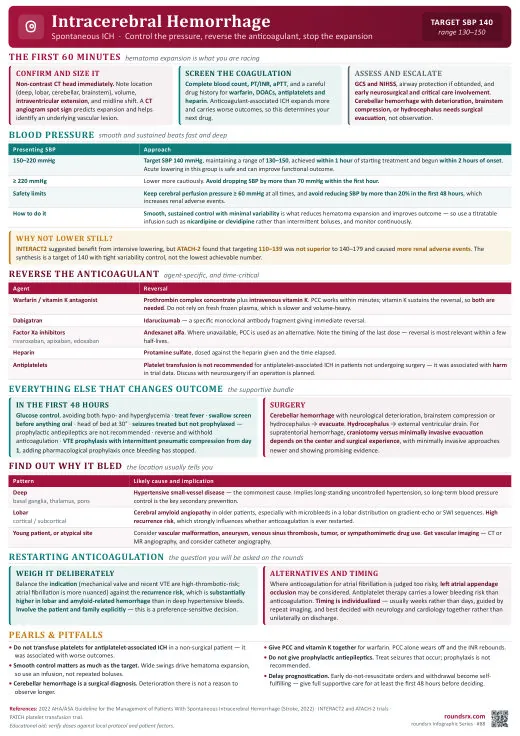
Intracerebral Hemorrhage
| Location | Most Likely Cause |
|---|---|
| Basal ganglia / putamen | Hypertension (#1 cause, #1 location) |
| Thalamus | Hypertension |
| Pons | Hypertension |
| Cerebellum | Hypertension (surgical emergency if > 3 cm) |
| Lobar (cortical) | Cerebral amyloid angiopathy (elderly), AVM (young), tumor |
| Component | Criteria | Points |
|---|---|---|
| GCS 3–4 | Comatose | 2 |
| GCS 5–12 | Obtunded / moderate impairment | 1 |
| GCS 13–15 | Alert / mild impairment | 0 |
| ICH volume ≥ 30 mL | Use ABC/2 formula on CT | 1 |
| ICH volume < 30 mL | 0 | |
| IVH present | Intraventricular extension of hemorrhage | 1 |
| Infratentorial origin | Cerebellum or brainstem | 1 |
| Age ≥ 80 | 1 |
On CT, measure: A = largest diameter of hemorrhage (cm), B = diameter perpendicular to A on same slice (cm), C = number of CT slices with hemorrhage × slice thickness (cm). Volume ≈ (A × B × C) / 2 mL.
- BP control: Target SBP < 140 within 1 hour (INTERACT2, 2013). Use Nicardipine (Cardene) or Clevidipine (Cleviprex) drip.
- Reverse anticoagulation STAT:
- Warfarin → 4-factor PCC (KCentra) + Vitamin K 10 mg IV
- Dabigatran → Idarucizumab (Praxbind) 5g IV
- Rivaroxaban/Apixaban → Andexanet Alfa (Andexxa) or 4F-PCC
- Neurosurgery consult -all ICH. Cerebellar ICH > 3 cm or with hydrocephalus → surgical evacuation
- ICP management: HOB 30°, osmotic therapy (mannitol or hypertonic saline), EVD if hydrocephalus
- Seizure prophylaxis: NOT routine -treat only clinical seizures. Continuous EEG if altered.
- Tranexamic acid (TXA): Consider within 3 hours of injury, especially in mild-to-moderate TBI. CRASH-3, 2019 showed reduced head-injury related death when given early.
| Trial | Target | Key Finding |
|---|---|---|
| INTERACT2, 2013 | SBP < 140 mmHg within 1h | Improved functional outcomes (mRS). Safe. Current standard of care. |
| ATACH-2, 2016 | SBP 110–139 vs 140–179 | No additional benefit from more aggressive lowering. Increased renal AKI. |
| Anticoagulant | Reversal Agent | Dose | Key Notes |
|---|---|---|---|
| Warfarin | 4-factor PCC (KCentra) + Vitamin K | PCC 25–50 units/kg IV + Vit K 10 mg IV | PCC reverses in minutes. Vit K sustains reversal (takes 6–24h). Do NOT use FFP alone (slow, volume overload). |
| Dabigatran (Pradaxa) | Idarucizumab (Praxbind) | 5 g IV (two 2.5g vials) | Monoclonal antibody fragment. Immediate, complete reversal. RE-VERSE AD, 2017 |
| Rivaroxaban / Apixaban (Xa inhibitors) | Andexanet alfa (Andexxa) | Low dose: 400mg bolus + 4mg/min x 2h; High dose: 800mg bolus + 8mg/min x 2h | Recombinant Xa decoy. ANNEXA-4, 2019. If unavailable, use 4F-PCC 50 units/kg. |
| Heparin (UFH) | Protamine sulfate | 1 mg per 100 units heparin (last 2–3h of infusion) | Max 50 mg. Only partially reverses LMWH (~60%). |
- Cerebellar ICH > 3 cm or with brainstem compression → Surgical evacuation (life-saving, often good outcomes)
- Obstructive hydrocephalus → EVD (external ventricular drain) placement, regardless of ICH location
- Supratentorial ICH with deterioration: Consider surgery for lobar hemorrhages within 1 cm of cortical surface. STICH II, 2013 showed no broad benefit for early surgery, but consider in deteriorating patients.
- Minimally invasive surgery: MISTIE III, 2019, catheter-based clot evacuation showed trend toward benefit if residual clot < 15 mL.
- Head of bed 30°, promotes venous drainage, reduces ICP
- Osmotic therapy: Mannitol 0.5–1 g/kg IV bolus OR hypertonic saline (23.4% 30 mL via central line, or 3% NaCl 250 mL bolus peripherally)
- EVD, both diagnostic (measure ICP) and therapeutic (drain CSF). Target ICP < 20 mmHg, CPP > 60 mmHg
- Avoid: hyperthermia (active cooling to normothermia), hyperglycemia (target glucose 140–180), hyponatremia
- Herniation protocol: If acute pupil dilation or posturing → hyperventilate briefly (target pCO2 30–35), give osmotic bolus, emergent CT and neurosurgery
- Non-contrast CT head -STAT. Shows hyperdense (white) acute blood. First-line.
- CTA head -spot sign (contrast extravasation = active bleeding, predicts expansion)
- CBC, PT/INR, PTT, fibrinogen -coagulation status
- BMP, glucose
- Type and screen
- MRI -can evaluate underlying cause (tumor, AVM, cavernoma) once stable
- CTA/MRA -evaluate for vascular malformation if non-hypertensive location
| Drug | Dose | Purpose |
|---|---|---|
| Nicardipine (Cardene) | 5–15 mg/h IV drip | BP control -titratable, no ICP effects |
| Clevidipine (Cleviprex) | 1–21 mg/h IV drip | Ultra-short acting alternative |
| 4-factor PCC (KCentra) | 25–50 units/kg IV | Warfarin reversal. Faster than FFP. |
| Idarucizumab (Praxbind) | 5 g IV | Dabigatran reversal. Immediate effect. |
| Mannitol (Osmitrol) | 0.5–1 g/kg IV bolus | ICP reduction -osmotic diuresis |
| Hypertonic Saline (23.4%) | 30 mL IV via central line | ICP crisis -can use via peripheral at lower concentration (3%) |
Patient: 62-year-old male with HTN (non-adherent to meds), presents with sudden severe headache, left hemiparesis, and slurred speech. BP 218/112 on arrival. GCS 12.
CT Head: 25 mL right basal ganglia hemorrhage, no IVH, no hydrocephalus.
Management:
- Start nicardipine drip 5 mg/h, titrate to SBP < 140 within 1 hour (INTERACT2 target)
- Place arterial line for continuous BP monitoring
- Confirm no anticoagulant use → no reversal needed
- Neurosurgery consult, supratentorial, non-surgical candidate at this size
- Neuro checks q1h, repeat CT at 6 hours
- ICH Score = 1 (GCS 12 = +1) → 13% predicted 30-day mortality
Teaching point: Hypertensive basal ganglia hemorrhage is the classic ICH. Rapid BP control to SBP < 140 is the cornerstone of management. Do NOT overshoot below 110 (ATACH-2).
Patient: 78-year-old female on warfarin (INR 3.8) for atrial fibrillation. Found by family with confusion and right-sided weakness. BP 176/94. GCS 10.
CT Head: 40 mL left frontoparietal lobar hemorrhage with intraventricular extension.
Management:
- 4-factor PCC (KCentra) 25–50 units/kg IV STAT, do NOT wait for pharmacy to mix FFP
- Vitamin K 10 mg IV, sustains reversal after PCC wears off
- Nicardipine drip → target SBP < 140
- ICH Score = 4 (GCS 10 = +1, volume ≥ 30 = +1, IVH = +1, age ≥ 80 = +1) → 97% predicted mortality
- Repeat INR 30 min after PCC, goal < 1.5
- Goals of care discussion with family, but do NOT withdraw care based solely on ICH score
Teaching point: Warfarin-associated ICH has the worst outcomes. Time to INR reversal directly impacts hematoma expansion. PCC reverses in minutes vs hours for FFP. Always give vitamin K concurrently for sustained reversal.
Patient: 55-year-old male with HTN, presents with sudden occipital headache, vomiting, severe ataxia, unable to stand. BP 198/108. GCS 13 initially, drops to 9 over 30 minutes.
CT Head: 3.5 cm cerebellar hemorrhage with compression of 4th ventricle and early obstructive hydrocephalus.
Management:
- EMERGENT neurosurgery consult, this is a surgical emergency
- Suboccipital craniectomy and clot evacuation, life-saving for cerebellar ICH > 3 cm with mass effect
- EVD placement for obstructive hydrocephalus (caution: draining supratentorial CSF alone can worsen upward herniation)
- Nicardipine drip → SBP < 140
- HOB 30°, osmotic therapy as bridge to OR
- These patients can have excellent functional recovery with timely surgery, unlike supratentorial ICH
Teaching point: Cerebellar ICH is the one ICH where surgery is clearly beneficial. The posterior fossa is a confined space, a 3 cm hemorrhage can cause brainstem compression, obstructive hydrocephalus, and tonsillar herniation within hours. Rapid clinical deterioration (as in this case) demands emergent intervention.