Irritable Bowel Syndrome (IBS)
IBS is a disorder of gut-brain interaction (the Rome Foundation's term for what used to be called functional GI disorders): recurrent abdominal pain or discomfort tied to defecation or to a change in stool frequency or form, with no structural disease to account for it. The mechanisms are real and measurable even though routine tests are normal: visceral hypersensitivity (a normal volume of gas or stool is perceived as pain), altered motility and secretion, central amplification of pain signals, low-grade mucosal immune activation, increased intestinal permeability, altered bile acid handling and microbiome shifts. This is why "your tests are normal" must never be delivered as "nothing is wrong": patients who hear the second version leave, doctor-shop, and get re-scoped.
- Prevalence is roughly 4 to 11% of adults depending on the criteria used. The Rome Foundation global survey found 4.1% by Rome IV versus 10.1% by Rome III in the same respondents, which shows how much the definition itself decides who has IBS. It is more common in women and typically begins in young adulthood.
- Post-infectious IBS is common and under-recognized: about 10% of people develop IBS in the year after infectious enteritis, a fourfold risk compared with the uninfected Klem, 2017. Protozoal infections such as Giardia carry the highest risk. A history of "I was fine until that trip" fits IBS rather than arguing against it.
- Psychological comorbidity is part of the disease, not an incidental finding: anxiety, depression, somatic symptom disorders, fibromyalgia, chronic pelvic pain and functional dyspepsia frequently coexist, and distress amplifies visceral pain through the same brain-gut pathways. Treating the mood disorder and offering brain-gut behavioral therapy is treating IBS.
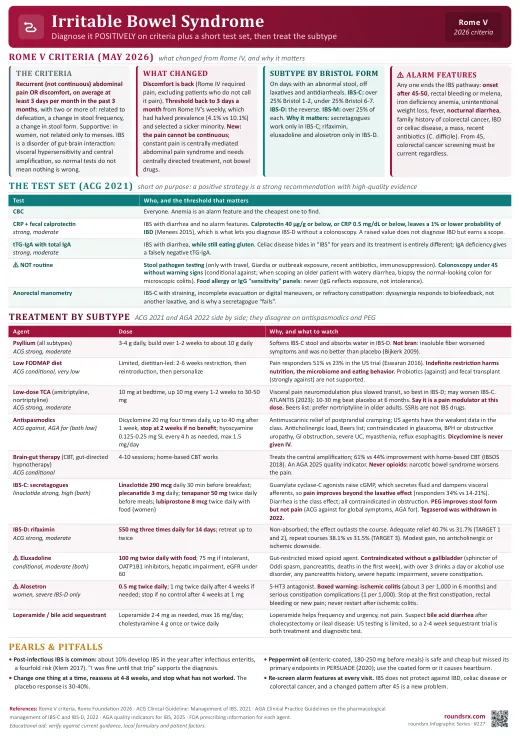
CHANGED Pain OR discomfort. Rome IV required abdominal pain; Rome V re-includes abdominal discomfort, because many patients, men in particular and some cultures generally, report an unpleasant sensation they do not call pain and were being excluded.
CHANGED Frequency threshold lowered to at least 3 days per month over the past 3 months, back to the Rome III level, instead of Rome IV's at least 1 day per week. Rome IV's stricter threshold roughly halved prevalence estimates and selected a more severe minority; Rome V identifies more patients earlier, including a milder group.
NEW The pain cannot be continuous. Constant, defecation-independent pain is the signature of centrally mediated abdominal pain syndrome, which needs centrally acting treatment rather than bowel-directed drugs. Patients excluded by this rule were the sickest group in a UK IBS registry (higher severity scores, more psychological comorbidity, more than double the healthcare cost), so they should be re-phenotyped and treated, not told they do not have IBS.
NEW Supportive criterion: in women, pain or discomfort should not be related only to menses, which points toward endometriosis or another gynecologic cause instead.
UNCHANGED The link to defecation and to a change in stool frequency or form, and subtyping by stool form.
- Rome V criteria: recurrent (not continuous) abdominal pain or discomfort, on average at least 3 days per month in the past 3 months, associated with two or more of: (1) related to defecation, (2) a change in stool frequency, (3) a change in stool form.
- Why criteria matter at all: they let you make the diagnosis positively at the first visit. The ACG rates a positive diagnostic strategy over a strategy of exclusion as a strong recommendation with high-quality evidence for cost-effectiveness, because exclusion workups delay treatment, cost money, and teach the patient that their diagnosis is whatever was left over.
Subtype by the stool form on days with at least one abnormal stool, not by what happens most days, and off laxatives and antidiarrheals. Subtyping is not academic: the secretagogues work only for IBS-C, and rifaximin, eluxadoline and alosetron only for IBS-D.
| Subtype | Definition | Why it changes management |
|---|---|---|
| IBS-C | More than 25% of abnormal stools are Bristol 1 or 2 (hard, lumpy) and fewer than 25% are Bristol 6 or 7 | Soluble fiber, then a secretagogue (linaclotide, plecanatide, tenapanor, lubiprostone); check for pelvic floor dyssynergia if refractory |
| IBS-D | More than 25% are Bristol 6 or 7 (mushy, watery) and fewer than 25% are Bristol 1 or 2 | Celiac serology and calprotectin first; rifaximin, a TCA, loperamide for urgency, eluxadoline or alosetron for severe disease |
| IBS-M (mixed) | More than 25% are Bristol 1 or 2 and more than 25% are Bristol 6 or 7 | Treat the current dominant pattern and the pain; avoid drugs that lock the bowel in one direction |
| IBS-U (unclassified) | Meets IBS criteria but stool form does not fit the three above | Re-take the history: laxative or antidiarrheal use often hides the true pattern |
- Onset after age 45 to 50, especially a short history or a progressive course, because new-onset symptoms in this group carry a real colorectal cancer and microscopic colitis yield that young patients do not.
- Rectal bleeding or melena not explained by visible hemorrhoids; iron deficiency anemia.
- Unintentional weight loss; fever; nocturnal diarrhea that wakes the patient (IBS does not usually wake people, inflammation and secretory diarrhea do).
- Family history of colorectal cancer, inflammatory bowel disease or celiac disease.
- Palpable abdominal mass or lymphadenopathy; recent antibiotics (think C. difficile, not IBS).
| Test | Who | Why, and the threshold that matters |
|---|---|---|
| CBC | Everyone | Anemia is an alarm feature in its own right and the cheapest one to find. |
| CRP and fecal calprotectin (fecal lactoferrin is the alternative) STRONG, MODERATE | Suspected IBS with diarrhea (IBS-D or IBS-M) and no alarm features | Separates IBS-D from IBD without a colonoscopy. At calprotectin 40 µg/g or below, or CRP 0.5 mg/dL or below, the probability of IBD is 1% or less Menees, 2015. An elevated value does not diagnose IBD (NSAIDs, infection and polyps also raise calprotectin) but it earns a colonoscopy. Link: IBD workup. |
| Celiac serology: tTG-IgA with a total IgA STRONG, MODERATE | IBS with diarrhea symptoms | Celiac disease is more common in people with IBS-type symptoms than in the general population, its treatment is entirely different, and years of "IBS" is a classic celiac history. Order total IgA at the same time (IgA deficiency gives a falsely negative tTG-IgA) and test while the patient is still eating gluten. Link: Celiac Disease: Diagnosis. |
| Stool testing for enteric pathogens NOT ROUTINE | Only with a specific exposure | The ACG recommends against routine stool pathogen testing (conditional, low): yield is negligible in chronic symptoms. Test when the story points to it: travel, well water or daycare exposure (Giardia), recent antibiotics (C. difficile), immunosuppression, or an outbreak. |
| Colonoscopy NOT ROUTINE UNDER 45 | Alarm features, elevated calprotectin, family history, or age 45 and over with screening not current | The ACG recommends against routine colonoscopy for IBS symptoms under age 45 without warning signs (conditional, low): the yield of IBD, microscopic colitis or cancer is very low and the burden and cost are real. From 45, colorectal cancer screening is due anyway and a recent negative colonoscopy covers the IBS question too. When scoping an older patient with watery diarrhea, take random biopsies: microscopic colitis looks normal to the eye. |
| Food allergy or "sensitivity" panels DO NOT ORDER | Nobody, unless there are reproducible, rapid allergic symptoms to a specific food | IgG food antibodies reflect exposure, not intolerance. These panels generate long restrictive diets with no demonstrated benefit and real nutritional and psychological cost (ACG consensus recommendation against). |
| Anorectal manometry and balloon expulsion | IBS-C with straining, incomplete evacuation, digital maneuvers, or constipation refractory to standard therapy | Dyssynergic defecation responds to biofeedback, not to another laxative, and it is the usual reason a secretagogue "fails" (ACG consensus recommendation). |
| TSH, metabolic panel, imaging | Only when the history points there | Routine thyroid testing, abdominal ultrasound or CT has no role in a patient who meets criteria without alarm features; each normal test reinforces the message that something is being missed. |
- Inflammatory bowel disease (calprotectin), celiac disease (serology), colorectal cancer (alarm features, age).
- Microscopic colitis: chronic watery diarrhea, often in women over 50, frequently on NSAIDs, PPIs or SSRIs; diagnosed only by biopsy of a normal-looking colon.
- Bile acid diarrhea: after cholecystectomy, with ileal Crohn disease or resection, or idiopathic; urgent watery stools, often nocturnal. Testing in the US is limited and incompletely validated, so the ACG considers an empiric trial of a bile acid sequestrant a reasonable course when it is suspected.
- Carbohydrate malabsorption (lactose, fructose), pancreatic exocrine insufficiency (steatorrhea, weight loss, alcohol or pancreatitis history), and medication effects: metformin, PPIs, SSRIs and magnesium loosen stool; opioids, iron, calcium and anticholinergics constipate.
- Endometriosis and other pelvic pathology when pain tracks the menstrual cycle (the Rome V supportive criterion), and centrally mediated abdominal pain syndrome when the pain is constant and unrelated to bowel function.
- Soluble fiber (psyllium), not insoluble fiber (wheat bran). ACG: strong recommendation, moderate quality. Start at about 3 to 4 g daily and build over 1 to 2 weeks toward 10 g daily, because rapid escalation causes the bloating that makes patients quit. Bran is worse than useless: in the primary care trial it worsened symptoms and was no better than placebo, while psyllium produced adequate relief in 57% vs 35% at one month Bijkerk, 2009. Psyllium helps IBS-C by softening stool and IBS-D by absorbing water, which is why it is the one agent that suits every subtype.
- A limited, dietitian-led trial of the low FODMAP diet. ACG: conditional recommendation, very low quality, and the word limited is the point. Three phases: strict restriction for 2 to 6 weeks, then structured reintroduction of each FODMAP group, then a personalized long-term diet. In the first US randomized trial, adequate relief was not statistically better than standard dietary advice (52% vs 41%), but abdominal pain responders more than doubled (51% vs 23%) Eswaran, 2016, and the Australian crossover trial cut overall GI symptom scores roughly in half Halmos, 2014. Why it must stay limited: indefinite restriction risks nutritional inadequacy, reduces beneficial bifidobacteria, and can feed disordered eating; screen for restrictive eating before prescribing more restriction. Standard advice (regular meals, limit alcohol, caffeine, fatty and spicy meals and gas-producing foods) gave 41% adequate relief on its own in the same trial, which is a respectable first step when a dietitian is not available.
- Peppermint oil, enteric-coated, about 180 to 250 mg up to three times daily before meals (450 to 750 mg per day in trials). ACG: conditional, low. The mechanism is smooth-muscle relaxation through calcium channel blockade. State the evidence honestly: the largest modern trial missed its FDA and EMA primary endpoints PERSUADE, 2020, with the conventional small-intestinal-release formulation improving pain and severity only as secondary outcomes. Cheap and safe enough to try; use the enteric-coated form, because peppermint relaxes the lower esophageal sphincter and the plain oil causes heartburn.
- What the evidence does not support: probiotics for global symptoms (ACG suggests against, very low quality: strain-specific, inconsistent trials), fecal microbiota transplant (ACG strongly against), and IgG-guided elimination diets. Regular exercise and sleep are reasonable and help the brain-gut axis even if the trial base is thin.
Pick the drug by the predominant stool pattern. The guideline column shows the two US guidelines side by side, because they disagree in two places that matter at the bedside (antispasmodics and PEG), and a resident should know which society said what. ACG 2021 is the comprehensive guideline; the AGA 2022 pair covers pharmacotherapy only. Give each drug 4 to 8 weeks, change one thing at a time, and stop what has not worked.
| Agent | Dose | ACG 2021 / AGA 2022 | Why it works, and what to watch |
|---|---|---|---|
| Any subtype, pain-dominant | |||
| Tricyclic antidepressants (amitriptyline, nortriptyline, desipramine) (Elavil, Pamelor, generic) | 10 mg at bedtime, increase by 10 mg every 1 to 2 weeks as tolerated; ATLANTIS titrated 10 to 30 mg over 3 weeks. Usual IBS range 10 to 50 mg, far below antidepressant dosing | ACG: strong, moderate AGA: conditional, low | Central neuromodulation of visceral pain plus anticholinergic slowing of transit, so the best fit is IBS-D or pain-dominant disease; they can worsen IBS-C. In primary care, titrated low-dose amitriptyline beat placebo on IBS severity at 6 months ATLANTIS, 2023. Tell the patient it is a pain modulator at this dose, or they read the label and stop. Watch dry mouth, drowsiness, constipation, QT prolongation at higher doses; amitriptyline is on the Beers list for older adults, so prefer nortriptyline or desipramine there. Allow 6 to 12 weeks. |
| SSRIs (any) | Not for IBS itself | ACG: no formal recommendation (its review notes the antidepressant benefit on pain came from TCAs, not SSRIs) AGA: conditional against (low) | No reliable effect on IBS symptoms in trials. Treat comorbid anxiety or depression on its own merits, which does help the IBS indirectly; just do not prescribe an SSRI as an IBS drug. |
| Dicyclomine (Bentyl) | 20 mg four times daily; after 1 week may increase to 40 mg four times daily. Label: stop if no benefit at 2 weeks, or if side effects keep the dose under 80 mg per day. IM 10 to 20 mg four times daily for 1 to 2 days only when oral is impossible; never IV (thrombosis, thrombophlebitis) | ACG: conditional against the US-available antispasmodics (low) AGA: conditional for (low) | The one place the two societies point in opposite directions. Antimuscarinic smooth-muscle relaxation blunts the postprandial gastrocolic cramp, so it is most useful taken 30 minutes before meals for predictable cramping. The ACG said no because the supporting trials are old, small and mostly of agents not sold in the US (otilonium, pinaverium, hyoscine), so dicyclomine and hyoscyamine carry the weakest data of the whole class; the AGA judged the same low-certainty data worth a conditional yes. Watch the anticholinergic load: dry mouth, blurred vision, urinary retention, constipation, confusion; Beers list in older adults. Contraindicated in glaucoma, obstructive uropathy including BPH, GI obstruction, severe ulcerative colitis or toxic megacolon, myasthenia gravis, reflux esophagitis, and unstable cardiovascular status in acute hemorrhage. |
| Hyoscyamine (Levsin) | 0.125 to 0.25 mg sublingual or oral every 4 hours as needed, maximum 1.5 mg per day | ACG: conditional against (low) AGA: conditional for (low) | Same class, same disagreement, faster onset sublingually, so it suits unpredictable cramping better than scheduled dicyclomine. Same anticholinergic cautions and contraindications; psychosis and delirium are reported in sensitive patients, especially the elderly. |
| Brain-gut behavioral therapy (CBT, gut-directed hypnotherapy) (not a drug) | 4 to 10 sessions; home-based CBT with minimal therapist contact works | ACG: conditional, very low AGA 2025 quality indicator | Targets the central amplification directly and the effect is durable. Home-based CBT over 4 sessions produced moderate to substantial improvement in 61% vs 44% with education alone and was at least as effective as 10 clinic sessions IBSOS, 2018. Refer early for pain-dominant disease, high distress, or failure of first-line drugs; do not frame it as "it is in your head". |
| IBS-C | |||
| Linaclotide (Linzess) | 290 mcg once daily, at least 30 minutes before the first meal (the 72 and 145 mcg doses are for chronic idiopathic constipation) | ACG: strong, high AGA: strong, high | Guanylate cyclase-C agonist: raises intestinal cGMP, which drives chloride and bicarbonate secretion (softer stool, faster transit) and also dampens visceral afferent firing, so pain improves beyond the laxative effect. FDA composite responders 33.7% vs 13.9% in the 26-week trial Chey, 2012 and 33.6% vs 21.0% in the 12-week trial Rao, 2012. Watch diarrhea (about 5% stop because of it; hold and rehydrate if severe). Contraindicated under age 2 (dehydration deaths in neonatal mice, boxed warning) and in mechanical obstruction. |
| Plecanatide (Trulance) | 3 mg once daily, with or without food | ACG: strong, high (guanylate cyclase-C class) AGA: conditional, moderate | Same mechanism as linaclotide, activated in the acidic proximal small bowel. Overall responders 30.2% vs 17.8% and 21.5% vs 14.2% in the two phase 3 trials, with diarrhea in about 4% Brenner, 2018. Food-independent dosing is its practical advantage. Contraindicated under age 6 and in obstruction. |
| Tenapanor (Ibsrela) | 50 mg twice daily, immediately before breakfast and dinner | ACG: not addressed (approved September 2019, after the guideline's evidence review) AGA: conditional, moderate | NHE3 (sodium-hydrogen exchanger 3) inhibitor: blocks sodium, and so water, absorption in the gut lumen, softening stool and speeding transit, with reduced visceral hypersensitivity in animal models. Combined pain-plus-CSBM responders 36.5% vs 23.7% over 26 weeks T3MPO-2, 2021. Watch diarrhea; contraindicated under 6 and in obstruction. Its niche is the patient who failed or could not tolerate a guanylate cyclase agonist. |
| Lubiprostone (Amitiza) | 8 mcg twice daily with food (the 24 mcg dose is for chronic idiopathic and opioid-induced constipation). Label indication is women 18 and over with IBS-C | ACG: strong, moderate AGA: conditional, moderate | Type 2 chloride channel activator that increases intestinal fluid secretion. The gain is the smallest of the secretagogues: overall responders 17.9% vs 10.1% Drossman, 2009. Nausea is the main problem (take with food); dyspnea within an hour of a dose and syncope or hypotension are reported. |
| Polyethylene glycol 3350 (MiraLAX) | 17 g in 8 oz of fluid daily, titrate | ACG: conditional against for global IBS-C symptoms (low) AGA: conditional for (low) | The second disagreement, and the reason is instructive: PEG reliably improves stool frequency and consistency but does not improve abdominal pain, so it treats the constipation and not the syndrome. A cheap, reasonable first step for the bowel pattern, as long as a separate plan addresses the pain. See the bowel regimen card. |
| Tegaserod (Zelnorm, not available) WITHDRAWN 2022 | Listed by both guidelines for women under 65 with low cardiovascular risk after secretagogue failure | ACG: conditional, low AGA: conditional, moderate | A 5-HT4 agonist pulled in 2007 over cardiovascular signals, relaunched in 2019, and withdrawn from the US market again in June 2022 for business reasons, so it is not an option despite its place in both guidelines. |
| IBS-D | |||
| Rifaximin (Xifaxan) | 550 mg three times daily for 14 days; patients who respond and relapse may be retreated up to two more times with the same course | ACG: strong, moderate AGA: conditional, moderate | Minimally absorbed rifamycin that alters luminal bacteria and reduces bacterial gas production and visceral sensitivity, and the effect persists for weeks after the course ends, which no other antibiotic pattern mimics. Adequate relief 40.7% vs 31.7% in the 4 weeks after treatment, bloating 40.2% vs 30.3% TARGET 1 and 2, 2011; repeat courses still beat placebo (38.1% vs 31.5%), with the benefit on pain rather than stool consistency TARGET 3, 2016. The absolute gain is modest (about 9 points, NNT around 11) and the cost is high, but it is the only IBS-D drug with no anticholinergic, constipating or ischemic downside. Evaluate any new diarrhea after a course for C. difficile. |
| Eluxadoline (Viberzi) | 100 mg twice daily with food; 75 mg twice daily if 100 mg is not tolerated, with OATP1B1 inhibitors, mild or moderate hepatic impairment, or eGFR below 60. Schedule IV | ACG: conditional, moderate AGA: conditional, moderate | Mixed opioid receptor agent (mu and kappa agonist, delta antagonist) acting locally in the gut: slows transit and reduces visceral pain without the central effects of systemic opioids. Composite responders 25.1% vs 17.1% and 29.6% vs 16.2% at 12 weeks IBS-3001 and 3002, 2016. Contraindicated without a gallbladder (sphincter of Oddi spasm and pancreatitis, with fatal cases reported, most within the first week), in biliary obstruction or sphincter of Oddi dysfunction, with alcohol use disorder or more than 3 drinks a day, any history of pancreatitis or structural pancreatic disease, severe hepatic impairment, and severe constipation or obstruction. Stop immediately for severe constipation or new epigastric pain radiating to the back. |
| Alosetron (Lotronex) | 0.5 mg twice daily; after 4 weeks may increase to 1 mg twice daily; stop if no adequate control after 4 weeks at 1 mg twice daily. Label: women with severe IBS-D of 6 months or more who have failed conventional therapy | ACG: conditional, low AGA: conditional, moderate | 5-HT3 antagonist: slows colonic transit, reduces secretion and blunts visceral sensation. Adequate relief 41% vs 29% in women, at the price of constipation in 30% vs 3% Camilleri, 2000. Boxed warning: ischemic colitis (about 3 per 1,000 women in the first 6 months in an FDA Sentinel analysis) and serious complications of constipation (about 1 per 1,000: obstruction, ileus, toxic megacolon, perforation). Stop immediately for constipation, rectal bleeding, bloody diarrhea or new or worsening pain, and never restart after ischemic colitis. The REMS program ended in 2023; the boxed warning did not. Contraindicated with fluvoxamine (CYP1A2), in IBD, diverticulitis, prior ischemic colitis, hypercoagulable states and severe hepatic impairment; extra caution in the elderly and debilitated. |
| Loperamide (Imodium) | 2 to 4 mg as needed, for example 30 minutes before a meal or before leaving the house; maximum 16 mg per day by prescription (8 mg per day over the counter) | AGA: conditional, very low | Gut-confined mu-opioid agonist that slows transit and raises anal sphincter tone, so it helps stool frequency and urgency but not pain or bloating, which is why it is a tool for predictable triggers rather than a treatment for the syndrome. Cheap and safe at labeled doses; high-dose misuse causes QT prolongation and torsades. |
| Bile acid sequestrants (cholestyramine, colesevelam) (Questran, Welchol) | Cholestyramine 4 g once or twice daily, titrated; colesevelam 1.875 g once or twice daily. Separate from other drugs by 4 hours | ACG: does not suggest for global IBS-D symptoms (very low), but endorses an empiric trial when bile acid diarrhea is suspected | Bind the excess colonic bile acids that drive secretion. Bile acid diarrhea hides inside the IBS-D label (post-cholecystectomy, ileal disease, idiopathic) and US testing for it is limited, so a 2 to 4 week empiric trial is a diagnostic test as much as a treatment: a clear response means the diagnosis was bile acid diarrhea. Watch bloating, constipation and the 4-hour binding interaction with every other medication. |
- Reassess at 4 to 8 weeks after every change, and change one thing at a time, because IBS has a large placebo response (30 to 40% in most trials) and two simultaneous changes make the responsible one unknowable.
- Define success as adequate relief and restored function, not symptom abolition; a patient who expects a cure will judge a drug that halves their pain a failure.
- Stop what has not worked on the schedule the labels set: dicyclomine at 2 weeks, alosetron after 4 weeks at 1 mg twice daily, a secretagogue or TCA after 6 to 12 weeks at a tolerated dose. Accumulating ineffective drugs is how an IBS patient ends up on six medications with no benefit from any.
- Re-examine for alarm features at every visit, because a patient with IBS can still develop IBD, celiac disease or colorectal cancer, and a change in the pattern after 45 is a new problem until proven otherwise.
- Refer to gastroenterology for refractory symptoms after two subtype-appropriate drugs, suspected pelvic floor dyssynergia, alarm features, or when alosetron or eluxadoline is being considered.
31F with 10 months of lower abdominal cramping relieved by defecation, 3 to 4 loose stools on bad days, 2 to 3 bad days a week, worse with stress and large meals. No bleeding, weight stable, sleeps through the night, no family history. Exam normal.
Approach: She meets Rome V criteria for IBS-D with no alarm features. Order CBC, CRP, fecal calprotectin and tTG-IgA with total IgA; all return normal (calprotectin 18 µg/g). Give the diagnosis with confidence at the follow-up visit and explain the gut-brain model. Start psyllium titrated to 10 g daily, refer to a dietitian for a time-limited low FODMAP trial, and offer loperamide before predictable triggers. No colonoscopy: she is under 45 with normal calprotectin.
56M referred for "IBS" with 4 months of new loose stools, cramping, and 6 lb of unintentional weight loss. Diarrhea sometimes wakes him at 3 am. Hemoglobin 11.8, MCV 76. Last colonoscopy: never.
Approach: Three alarm features (age over 45 at onset, nocturnal diarrhea, iron deficiency anemia) plus no prior screening. This is not an IBS patient until colonoscopy with random biopsies is done, because colorectal cancer, IBD and microscopic colitis all live in this presentation. Send celiac serology and calprotectin as well, but do not let normal results reassure you out of the scope. Do not start an antidiarrheal that would mask the pattern.
38F with IBS-C: hard stools 3 times a week with straining and bloating, pain relieved by a bowel movement. Psyllium and PEG improved stool frequency but her pain and bloating are unchanged, and she asks why the laxative "did not fix it".
Approach: This is the PEG lesson in person: it treats the constipation, not the syndrome. Start linaclotide 290 mcg 30 minutes before breakfast (strong recommendation, high-quality evidence from both guidelines), warn about early diarrhea, and reassess at 8 weeks. Before escalating further, ask about incomplete evacuation and digital maneuvers: if present, anorectal manometry for dyssynergia, because biofeedback fixes what no secretagogue will.
71F with long-standing IBS-D asks for the dicyclomine that "always worked" years ago. She now takes oxybutynin for urge incontinence and has early cognitive concerns.
Approach: Dicyclomine is on the Beers list, she is already on one anticholinergic, and confusion is the adverse effect most likely to be attributed to aging rather than to the drug. Decline the anticholinergic stack. Options with no anticholinergic load: psyllium, rifaximin 550 mg three times daily for 14 days, enteric-coated peppermint oil, and loperamide before predictable triggers. If a neuromodulator is needed, nortriptyline or desipramine at 10 mg rather than amitriptyline. Also recheck for microscopic colitis: new or changed watery diarrhea in a woman over 50 earns biopsies.
44F with severe IBS-D (urgency, 5 to 6 watery stools daily, missing work) despite psyllium, a TCA and two courses of rifaximin. Cholecystectomy 6 years ago. Asks about "the new IBS-D drug" a friend takes.
Approach: The friend's drug is eluxadoline, and it is contraindicated in her: without a gallbladder, sphincter of Oddi spasm causes pancreatitis, with fatal cases reported. Her post-cholecystectomy history also raises bile acid diarrhea, so an empiric trial of cholestyramine 4 g daily to twice daily is both a treatment and a diagnostic test. If that fails and she meets the severity definition, alosetron 0.5 mg twice daily with explicit ischemic colitis and constipation counseling is the remaining prescription option, alongside referral for gut-directed hypnotherapy or CBT.
Ms. Okafor is a 34-year-old woman seen in clinic for 9 months of recurrent lower abdominal cramping, present on roughly half of days, improved by defecation and associated with looser, more frequent stools on symptomatic days. Symptoms began after a gastroenteritis on a trip abroad. No rectal bleeding, no weight loss, no nocturnal symptoms, no family history of colorectal cancer, IBD or celiac disease. Exam is unremarkable. CBC, CRP and fecal calprotectin (22 µg/g) are normal, and tTG-IgA is negative with a normal total IgA.
- Rome V criteria documented (pain or discomfort at least 3 days a month for 3 months, not continuous, tied to defecation or stool change) and subtype assigned off laxatives and antidiarrheals.
- Alarm features asked about and recorded as absent: age at onset, bleeding, weight loss, nocturnal symptoms, fever, anemia, family history, mass, recent antibiotics.
- Test set sent: CBC; CRP and fecal calprotectin if diarrhea; tTG-IgA with total IgA if diarrhea, while still eating gluten. No routine stool pathogens, no routine colonoscopy under 45, no food sensitivity panels.
- Diagnosis named and explained in gut-brain terms; expectations set (chronic, relapsing, not dangerous, treatable).
- Subtype-appropriate first-line started: psyllium for everyone; dietitian referral; PEG or a secretagogue for IBS-C; loperamide for IBS-D urgency.
- No opioids prescribed; brain-gut behavioral therapy offered, not just mentioned.
- Contraindications checked before second-line drugs: gallbladder status and alcohol for eluxadoline; constipation history and fluvoxamine for alosetron; anticholinergic burden and age for dicyclomine and amitriptyline.
- Follow-up at 4 to 8 weeks with a plan to stop what has not worked, and alarm features re-screened.